The Federal Open Market Committee (FOMC) meeting held by the Federal Reserve (Fed) on Tuesday and Wednesday this week was called one of the most "strange" meetings in the history of the institution by well-known financial commentator Nick Timiraos. Markets are almost unanimous in their expectation that the Fed will announce its first interest rate cut in nine months on Wednesday following its two-day policy meeting. According to the CME's FedWatch tool, the probability of a 25 basis point cut to a range of 4.25%–4.50% is as high as 96%, making it virtually certain. The Fed finally decided to start a cycle of interest rate cuts, with the core reason being the continued weakness in the U.S. job market and officials' growing confidence that tariff-induced inflation may be only temporary. Data from the Department of Labor shows that in the three months ending in August, job creation averaged only about 29,000 per month, the weakest three-month growth since 2010 (before the pandemic). Furthermore, the number of unemployed people now exceeds the number of job openings; initial unemployment claims have reached a nearly four-year high; and the number of long-term unemployed (unemployed for more than 26 weeks) has reached its highest point since November 2021. Preliminary revisions to employment data released last week further suggest that the foundations of the US labor market have been more fragile than previously thought since the summer began. In addition, Federal Reserve Chairman Jerome Powell laid the groundwork for this rate cut in a speech at the end of August, when he explicitly stated: "Downside risks to employment are rising." This reflects that concerns within the Fed about achieving its "full employment" mission have surpassed concerns about inflation. However, while a rate cut is a foregone conclusion, uncertainty surrounding this meeting and future monetary policy has reached an unprecedented level. These unresolved factors are the real key factors affecting financial markets and asset pricing. Mystery 1: The “dot plot” of the future interest rate path – how many times will interest rates be cut this year? Since a 25 basis point rate cut is already highly priced in by the market, traders will no longer be concerned about whether there will be a rate cut, but will instead focus on the Fed’s policy forecast for the rest of 2025. Market expectations for future guidance In their announcement on Wednesday, Fed officials will release updated economic projections, with the most closely watched component being the "dot plot" – a reflection of FOMC members' expectations for future interest rate levels. Expectations of continued rate cuts: Traders are betting that the Fed will not cut rates in a "one-off" move, but rather begin a cycle. According to the CME's FedWatch tool, the market sees a greater than 70% probability of further rate cuts in October and December. Potential divergence signals: Goldman Sachs economists expect the "dot plot" to show two rate cuts rather than three, but "divergence will be narrow." If the Fed ultimately signals a slower pace of rate cuts than the market expects, it could trigger a repricing and sell-off in risk assets. Conversely, if it signals three or more rate cuts, it would be a significant positive for doves. Goldman Sachs economists believe that the key to this meeting is whether the committee will indicate that "this will be the first in a series of rate cuts." They do not expect the statement to explicitly mention an October rate cut, but Powell may "gently" hint in that direction during the press conference. Split vote between hawks and doves The voting structure of this meeting is also full of uncertainty. Although the majority of members are expected to support a 25 basis point rate cut, there are clear divisions within the committee: Calls for a "substantial" rate cut: Newly appointed Governor Stephen Miran is likely to vote against the bill, arguing for a larger rate cut. Treasury Secretary Scott Bessent has also publicly encouraged the Fed to take a "full" rate cut. Opposition to a rate cut: Kansas City Fed President Jeffrey Schmid and St. Louis Fed President Alberto Musalem are likely to oppose a rate cut, citing concerns about inflation risks from tariffs. Such a split would highlight growing policy disagreements within the committee and make the central bank’s future actions even less predictable. Suspense 2: Powell’s “tone setting” – how to balance inflation and employment? Powell's choice of words at the press conference following the rate decision is often more important than the FOMC statement itself, as he will be responsible for articulating the committee's thinking. Is inflation "temporary" or "persistent"? Fed officials generally believe that the increase in inflation caused by the Trump administration's tariff policies is likely to be temporary. San Francisco Fed President Mary Daly said, "Tariff-related price increases will be one-off." Other officials also expect that the tariff effects will be transmitted over the next two to three quarters, and the impact on inflation will then subside. They believe that amid a weak labor market and an unstable economy, businesses have less flexibility to raise prices, so persistent inflationary pressure is low. Powell's speech will have to strike a balance between the Fed's two mandates: maximum employment and price stability. He will need to strike a "pragmatic and more dovish" tone. As strategists at B. Riley Wealth Management put it, his tone will be "pragmatic, but more dovish," suggesting the Fed needs to do more to defend its full-employment mandate. Data dependence and future policy flexibility Traders will be watching closely to see if Powell gives any soft hints about October action. If he emphasizes "data dependence" and suggests there is still a lot of room for future policy adjustments, it will leave the market in suspense, allowing asset prices to continue to fluctuate with the fluctuations of economic data. Suspense 3: Unprecedented political interference – Federal Reserve independence is challenged The uniqueness of this meeting stemmed in part from the political turmoil surrounding the Fed's core power structure. The Trump administration's continued pressure on its independence was the lingering "elephant in the room" during the meeting. New directors’ rapid rise to power Trump's chief economic advisor, Stephen Milan, was confirmed by the Senate on Monday and sworn in on Tuesday morning, securing a vote in time for this FOMC meeting. This expedited process, which typically takes months, is seen as a sign that Trump is eager to secure Milan's crucial vote in favor of a "substantial rate cut" at the September meeting. Milan has stated that he will act independently, but his swift confirmation undoubtedly reflects the impact of political pressure on the Fed's operations. Cook's dismissal controversy Trump has publicly stated his desire for a Republican majority on the Federal Reserve Board and set a precedent by attempting to fire Fed Governor Lisa Cook in late August. Although an appeals court temporarily blocked Trump's firing order, allowing Cook to vote in this session, her position remains unresolved and litigation is ongoing. These changes highlight the enormous challenges facing the Federal Reserve's political independence. This means that any policy decision it makes will be politically shadowed, and for investors who rely on macroeconomic stability, this "noise" itself is a risk. Summary: The market is waiting for signals, not decisions A 25 basis point rate cut is already a market consensus. However, the real significance of this meeting lies in how it will set the tone for monetary policy in the last four months of 2025. As BNY strategists put it, the Fed's "dual mandate objectives are 'under strain,'" and growing politicization is complicating the situation. Markets will be hanging on Powell's every word for signals on portfolio allocations.The Federal Open Market Committee (FOMC) meeting held by the Federal Reserve (Fed) on Tuesday and Wednesday this week was called one of the most "strange" meetings in the history of the institution by well-known financial commentator Nick Timiraos. Markets are almost unanimous in their expectation that the Fed will announce its first interest rate cut in nine months on Wednesday following its two-day policy meeting. According to the CME's FedWatch tool, the probability of a 25 basis point cut to a range of 4.25%–4.50% is as high as 96%, making it virtually certain. The Fed finally decided to start a cycle of interest rate cuts, with the core reason being the continued weakness in the U.S. job market and officials' growing confidence that tariff-induced inflation may be only temporary. Data from the Department of Labor shows that in the three months ending in August, job creation averaged only about 29,000 per month, the weakest three-month growth since 2010 (before the pandemic). Furthermore, the number of unemployed people now exceeds the number of job openings; initial unemployment claims have reached a nearly four-year high; and the number of long-term unemployed (unemployed for more than 26 weeks) has reached its highest point since November 2021. Preliminary revisions to employment data released last week further suggest that the foundations of the US labor market have been more fragile than previously thought since the summer began. In addition, Federal Reserve Chairman Jerome Powell laid the groundwork for this rate cut in a speech at the end of August, when he explicitly stated: "Downside risks to employment are rising." This reflects that concerns within the Fed about achieving its "full employment" mission have surpassed concerns about inflation. However, while a rate cut is a foregone conclusion, uncertainty surrounding this meeting and future monetary policy has reached an unprecedented level. These unresolved factors are the real key factors affecting financial markets and asset pricing. Mystery 1: The “dot plot” of the future interest rate path – how many times will interest rates be cut this year? Since a 25 basis point rate cut is already highly priced in by the market, traders will no longer be concerned about whether there will be a rate cut, but will instead focus on the Fed’s policy forecast for the rest of 2025. Market expectations for future guidance In their announcement on Wednesday, Fed officials will release updated economic projections, with the most closely watched component being the "dot plot" – a reflection of FOMC members' expectations for future interest rate levels. Expectations of continued rate cuts: Traders are betting that the Fed will not cut rates in a "one-off" move, but rather begin a cycle. According to the CME's FedWatch tool, the market sees a greater than 70% probability of further rate cuts in October and December. Potential divergence signals: Goldman Sachs economists expect the "dot plot" to show two rate cuts rather than three, but "divergence will be narrow." If the Fed ultimately signals a slower pace of rate cuts than the market expects, it could trigger a repricing and sell-off in risk assets. Conversely, if it signals three or more rate cuts, it would be a significant positive for doves. Goldman Sachs economists believe that the key to this meeting is whether the committee will indicate that "this will be the first in a series of rate cuts." They do not expect the statement to explicitly mention an October rate cut, but Powell may "gently" hint in that direction during the press conference. Split vote between hawks and doves The voting structure of this meeting is also full of uncertainty. Although the majority of members are expected to support a 25 basis point rate cut, there are clear divisions within the committee: Calls for a "substantial" rate cut: Newly appointed Governor Stephen Miran is likely to vote against the bill, arguing for a larger rate cut. Treasury Secretary Scott Bessent has also publicly encouraged the Fed to take a "full" rate cut. Opposition to a rate cut: Kansas City Fed President Jeffrey Schmid and St. Louis Fed President Alberto Musalem are likely to oppose a rate cut, citing concerns about inflation risks from tariffs. Such a split would highlight growing policy disagreements within the committee and make the central bank’s future actions even less predictable. Suspense 2: Powell’s “tone setting” – how to balance inflation and employment? Powell's choice of words at the press conference following the rate decision is often more important than the FOMC statement itself, as he will be responsible for articulating the committee's thinking. Is inflation "temporary" or "persistent"? Fed officials generally believe that the increase in inflation caused by the Trump administration's tariff policies is likely to be temporary. San Francisco Fed President Mary Daly said, "Tariff-related price increases will be one-off." Other officials also expect that the tariff effects will be transmitted over the next two to three quarters, and the impact on inflation will then subside. They believe that amid a weak labor market and an unstable economy, businesses have less flexibility to raise prices, so persistent inflationary pressure is low. Powell's speech will have to strike a balance between the Fed's two mandates: maximum employment and price stability. He will need to strike a "pragmatic and more dovish" tone. As strategists at B. Riley Wealth Management put it, his tone will be "pragmatic, but more dovish," suggesting the Fed needs to do more to defend its full-employment mandate. Data dependence and future policy flexibility Traders will be watching closely to see if Powell gives any soft hints about October action. If he emphasizes "data dependence" and suggests there is still a lot of room for future policy adjustments, it will leave the market in suspense, allowing asset prices to continue to fluctuate with the fluctuations of economic data. Suspense 3: Unprecedented political interference – Federal Reserve independence is challenged The uniqueness of this meeting stemmed in part from the political turmoil surrounding the Fed's core power structure. The Trump administration's continued pressure on its independence was the lingering "elephant in the room" during the meeting. New directors’ rapid rise to power Trump's chief economic advisor, Stephen Milan, was confirmed by the Senate on Monday and sworn in on Tuesday morning, securing a vote in time for this FOMC meeting. This expedited process, which typically takes months, is seen as a sign that Trump is eager to secure Milan's crucial vote in favor of a "substantial rate cut" at the September meeting. Milan has stated that he will act independently, but his swift confirmation undoubtedly reflects the impact of political pressure on the Fed's operations. Cook's dismissal controversy Trump has publicly stated his desire for a Republican majority on the Federal Reserve Board and set a precedent by attempting to fire Fed Governor Lisa Cook in late August. Although an appeals court temporarily blocked Trump's firing order, allowing Cook to vote in this session, her position remains unresolved and litigation is ongoing. These changes highlight the enormous challenges facing the Federal Reserve's political independence. This means that any policy decision it makes will be politically shadowed, and for investors who rely on macroeconomic stability, this "noise" itself is a risk. Summary: The market is waiting for signals, not decisions A 25 basis point rate cut is already a market consensus. However, the real significance of this meeting lies in how it will set the tone for monetary policy in the last four months of 2025. As BNY strategists put it, the Fed's "dual mandate objectives are 'under strain,'" and growing politicization is complicating the situation. Markets will be hanging on Powell's every word for signals on portfolio allocations.

Interest rate cuts are a foregone conclusion, but three major questions remain to be answered

2025/09/17 16:00

The Federal Open Market Committee (FOMC) meeting held by the Federal Reserve (Fed) on Tuesday and Wednesday this week was called one of the most "strange" meetings in the history of the institution by well-known financial commentator Nick Timiraos.

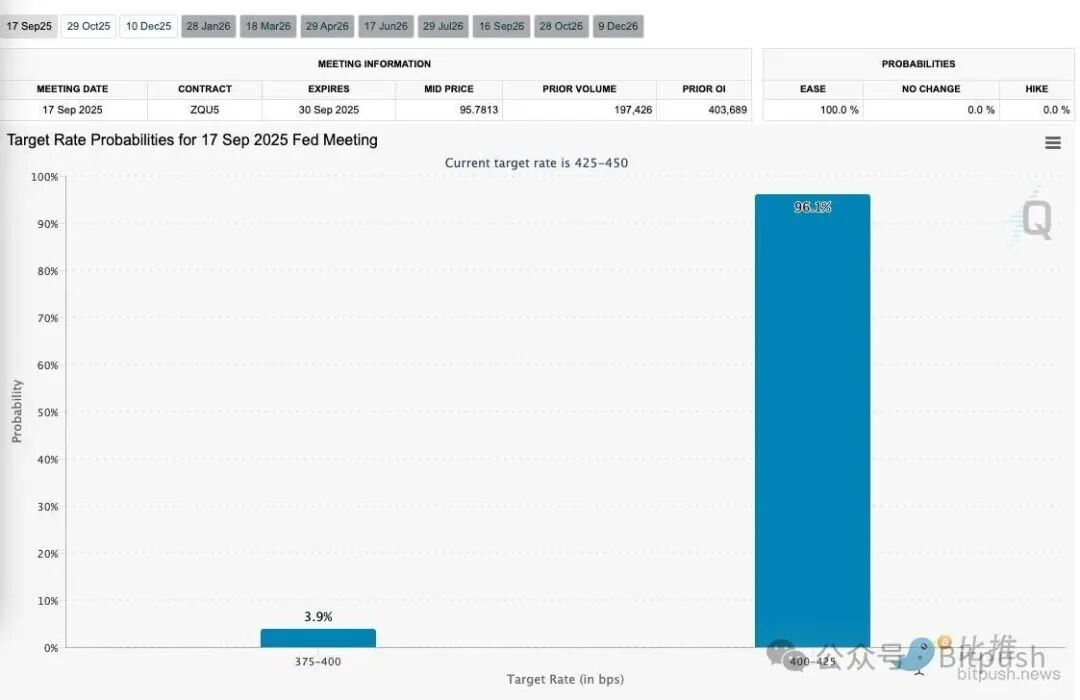
Markets are almost unanimous in their expectation that the Fed will announce its first interest rate cut in nine months on Wednesday following its two-day policy meeting. According to the CME's FedWatch tool, the probability of a 25 basis point cut to a range of 4.25%–4.50% is as high as 96%, making it virtually certain.
The Fed finally decided to start a cycle of interest rate cuts, with the core reason being the continued weakness in the U.S. job market and officials' growing confidence that tariff-induced inflation may be only temporary.

Data from the Department of Labor shows that in the three months ending in August, job creation averaged only about 29,000 per month, the weakest three-month growth since 2010 (before the pandemic). Furthermore, the number of unemployed people now exceeds the number of job openings; initial unemployment claims have reached a nearly four-year high; and the number of long-term unemployed (unemployed for more than 26 weeks) has reached its highest point since November 2021. Preliminary revisions to employment data released last week further suggest that the foundations of the US labor market have been more fragile than previously thought since the summer began.

In addition, Federal Reserve Chairman Jerome Powell laid the groundwork for this rate cut in a speech at the end of August, when he explicitly stated: "Downside risks to employment are rising." This reflects that concerns within the Fed about achieving its "full employment" mission have surpassed concerns about inflation.

However, while a rate cut is a foregone conclusion, uncertainty surrounding this meeting and future monetary policy has reached an unprecedented level. These unresolved factors are the real key factors affecting financial markets and asset pricing.

Mystery 1: The “dot plot” of the future interest rate path – how many times will interest rates be cut this year?

Since a 25 basis point rate cut is already highly priced in by the market, traders will no longer be concerned about whether there will be a rate cut, but will instead focus on the Fed’s policy forecast for the rest of 2025.

Market expectations for future guidance

In their announcement on Wednesday, Fed officials will release updated economic projections, with the most closely watched component being the "dot plot" – a reflection of FOMC members' expectations for future interest rate levels.

  • Expectations of continued rate cuts: Traders are betting that the Fed will not cut rates in a "one-off" move, but rather begin a cycle. According to the CME's FedWatch tool, the market sees a greater than 70% probability of further rate cuts in October and December.
  • Potential divergence signals: Goldman Sachs economists expect the "dot plot" to show two rate cuts rather than three, but "divergence will be narrow." If the Fed ultimately signals a slower pace of rate cuts than the market expects, it could trigger a repricing and sell-off in risk assets. Conversely, if it signals three or more rate cuts, it would be a significant positive for doves.
  • Goldman Sachs economists believe that the key to this meeting is whether the committee will indicate that "this will be the first in a series of rate cuts." They do not expect the statement to explicitly mention an October rate cut, but Powell may "gently" hint in that direction during the press conference.

Split vote between hawks and doves

The voting structure of this meeting is also full of uncertainty. Although the majority of members are expected to support a 25 basis point rate cut, there are clear divisions within the committee:

Calls for a "substantial" rate cut: Newly appointed Governor Stephen Miran is likely to vote against the bill, arguing for a larger rate cut. Treasury Secretary Scott Bessent has also publicly encouraged the Fed to take a "full" rate cut.
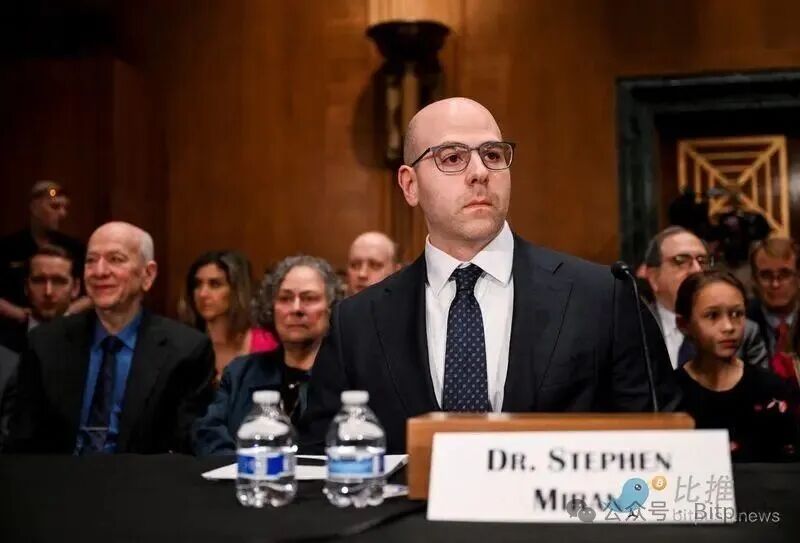
Opposition to a rate cut: Kansas City Fed President Jeffrey Schmid and St. Louis Fed President Alberto Musalem are likely to oppose a rate cut, citing concerns about inflation risks from tariffs.

Such a split would highlight growing policy disagreements within the committee and make the central bank’s future actions even less predictable.

Suspense 2: Powell’s “tone setting” – how to balance inflation and employment?

Powell's choice of words at the press conference following the rate decision is often more important than the FOMC statement itself, as he will be responsible for articulating the committee's thinking.

Is inflation "temporary" or "persistent"?

Fed officials generally believe that the increase in inflation caused by the Trump administration's tariff policies is likely to be temporary.

San Francisco Fed President Mary Daly said, "Tariff-related price increases will be one-off." Other officials also expect that the tariff effects will be transmitted over the next two to three quarters, and the impact on inflation will then subside. They believe that amid a weak labor market and an unstable economy, businesses have less flexibility to raise prices, so persistent inflationary pressure is low.

Powell's speech will have to strike a balance between the Fed's two mandates: maximum employment and price stability. He will need to strike a "pragmatic and more dovish" tone. As strategists at B. Riley Wealth Management put it, his tone will be "pragmatic, but more dovish," suggesting the Fed needs to do more to defend its full-employment mandate.

Data dependence and future policy flexibility

Traders will be watching closely to see if Powell gives any soft hints about October action. If he emphasizes "data dependence" and suggests there is still a lot of room for future policy adjustments, it will leave the market in suspense, allowing asset prices to continue to fluctuate with the fluctuations of economic data.

Suspense 3: Unprecedented political interference – Federal Reserve independence is challenged

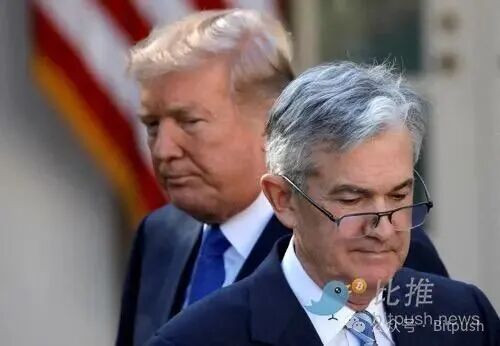
The uniqueness of this meeting stemmed in part from the political turmoil surrounding the Fed's core power structure. The Trump administration's continued pressure on its independence was the lingering "elephant in the room" during the meeting.
New directors’ rapid rise to power

Trump's chief economic advisor, Stephen Milan, was confirmed by the Senate on Monday and sworn in on Tuesday morning, securing a vote in time for this FOMC meeting. This expedited process, which typically takes months, is seen as a sign that Trump is eager to secure Milan's crucial vote in favor of a "substantial rate cut" at the September meeting. Milan has stated that he will act independently, but his swift confirmation undoubtedly reflects the impact of political pressure on the Fed's operations.

Cook's dismissal controversy

Trump has publicly stated his desire for a Republican majority on the Federal Reserve Board and set a precedent by attempting to fire Fed Governor Lisa Cook in late August. Although an appeals court temporarily blocked Trump's firing order, allowing Cook to vote in this session, her position remains unresolved and litigation is ongoing.

These changes highlight the enormous challenges facing the Federal Reserve's political independence. This means that any policy decision it makes will be politically shadowed, and for investors who rely on macroeconomic stability, this "noise" itself is a risk.

Summary: The market is waiting for signals, not decisions

A 25 basis point rate cut is already a market consensus. However, the real significance of this meeting lies in how it will set the tone for monetary policy in the last four months of 2025.

As BNY strategists put it, the Fed's "dual mandate objectives are 'under strain,'" and growing politicization is complicating the situation. Markets will be hanging on Powell's every word for signals on portfolio allocations.


Market Opportunity
B Logo
B Price(B)
$0.20274
$0.20274$0.20274
-0.45%
USD
B (B) Live Price Chart
Disclaimer: The articles reposted on this site are sourced from public platforms and are provided for informational purposes only. They do not necessarily reflect the views of MEXC. All rights remain with the original authors. If you believe any content infringes on third-party rights, please contact service@support.mexc.com for removal. MEXC makes no guarantees regarding the accuracy, completeness, or timeliness of the content and is not responsible for any actions taken based on the information provided. The content does not constitute financial, legal, or other professional advice, nor should it be considered a recommendation or endorsement by MEXC.

You May Also Like

In 2025, global cryptocurrency investors will rush to purchase Pioneer Hash smart cloud mining contracts, allowing you to earn a daily incomethatneverstops!

In 2025, global cryptocurrency investors will rush to purchase Pioneer Hash smart cloud mining contracts, allowing you to earn a daily incomethatneverstops!

The post In 2025, global cryptocurrency investors will rush to purchase Pioneer Hash smart cloud mining contracts, allowing you to earn a daily incomethatneverstops! appeared on BitcoinEthereumNews.com. In recent years, as digital assets have further entered the mainstream, Pioneer Hash has grown into a top global cloud mining service provider, serving over 6 million users in over 180 countries. The platform allows users to mine cryptocurrencies such as Bitcoin (BTC), Ethereum (ETH), Solana (SOL), Ripple (XRP), and Dogecoin (DOGE) without purchasing expensive hardware or paying for electricity. Pioneer Hash’s contracts, which transform idle assets into high-yield mining schemes, have attracted numerous cryptocurrency holders, with some advanced users reporting daily returns of up to $8,999 or more. This model is particularly suitable for both novice and professional investors, and cloud mining is rapidly becoming one of the most convenient ways for individuals to earn passive crypto income. Bitcoin mining is often associated with expensive hardware, high electricity costs, and technical know-how. But in 2025, cloud mining allows anyone to start mining, no experience required. Instead of setting up a mining rig at home, a simple contract gives remote access to an industrial-scale mining farm. These services allow beginners to earn Bitcoin securely, transparently, and efficiently, using only their phone or computer. How to join Pioneer Hash and start earning a stable daily income? 1. Visit the official website. Register an account at pioneerhash.com to quickly begin your cloud mining journey. 2. Complete registration and receive a $15 welcome bonus. Fill in your basic information and, upon successful registration, receive a $15 trial bonus from the platform. Try cloud mining at no cost. 3. Choose a contract. Choose the appropriate cloud computing power contract. No technical knowledge is required. The platform automatically schedules mining pools and computing power, and mining and generating revenue will begin within 24 hours. 4. Referral Rewards: Invite friends and earn commissions easily. Level 1 referral: Receive a 3% bonus. Level 2 referral: Receive a…
Share
BitcoinEthereumNews2025/09/22 20:51
MakinaFi suffered an attack that resulted in the loss of approximately 1299 ETH, with some funds being preemptively processed by MEV.

MakinaFi suffered an attack that resulted in the loss of approximately 1299 ETH, with some funds being preemptively processed by MEV.

PANews reported on January 20th that, according to PeckShieldAlert, the MakinaFi platform was attacked, with hackers stealing approximately 1,299 ETH, worth about
Share
PANews2026/01/20 12:32
Magic Eden co-founder sees 'speculation supercycle' ahead

Magic Eden co-founder sees 'speculation supercycle' ahead

Trading volumes in prediction markets are higher than ever, with Monday seeing a record $814.2 million worth of trades placed on Kalshi, Polymarket, and other platforms
Share
Coinstats2026/01/20 12:12



