TLDRs; Oracle ($ORCL) stock fell nearly 2% Wednesday as uncertainty over TikTok’s U.S. divestment deal pressured investor sentiment. A tentative framework would reduce ByteDance’s U.S. ownership below 20% while keeping Oracle as TikTok’s cloud provider. U.S. officials extended ByteDance’s divestment deadline to December 16, marking the fourth extension since the law was passed. The deal’s [...] The post Oracle ($ORCL): Down Nearly 2% as US-China TikTok Negotiations Drag On appeared first on CoinCentral.TLDRs; Oracle ($ORCL) stock fell nearly 2% Wednesday as uncertainty over TikTok’s U.S. divestment deal pressured investor sentiment. A tentative framework would reduce ByteDance’s U.S. ownership below 20% while keeping Oracle as TikTok’s cloud provider. U.S. officials extended ByteDance’s divestment deadline to December 16, marking the fourth extension since the law was passed. The deal’s [...] The post Oracle ($ORCL): Down Nearly 2% as US-China TikTok Negotiations Drag On appeared first on CoinCentral.

Oracle ($ORCL): Down Nearly 2% as US-China TikTok Negotiations Drag On

TLDRs;

  • Oracle ($ORCL) stock fell nearly 2% Wednesday as uncertainty over TikTok’s U.S. divestment deal pressured investor sentiment.
  • A tentative framework would reduce ByteDance’s U.S. ownership below 20% while keeping Oracle as TikTok’s cloud provider.
  • U.S. officials extended ByteDance’s divestment deadline to December 16, marking the fourth extension since the law was passed.
  • The deal’s approval hinges on political talks between President Trump and President Xi, adding fresh layers of risk.

Oracle Corporation ($ORCL) shares dipped almost 1.82% in early Wednesday trading, reflecting market unease over the ongoing TikTok divestment saga.

The decline comes a day after the stock gained momentum on optimism surrounding a tentative deal, only for fresh political hurdles to spark renewed caution among investors.

At market open, Oracle stock stood at $301.06, shedding $5.59. The slide reflects broader volatility tied not only to the U.S.–China standoff over TikTok but also to uncertainty surrounding the timeline and terms of the agreement.
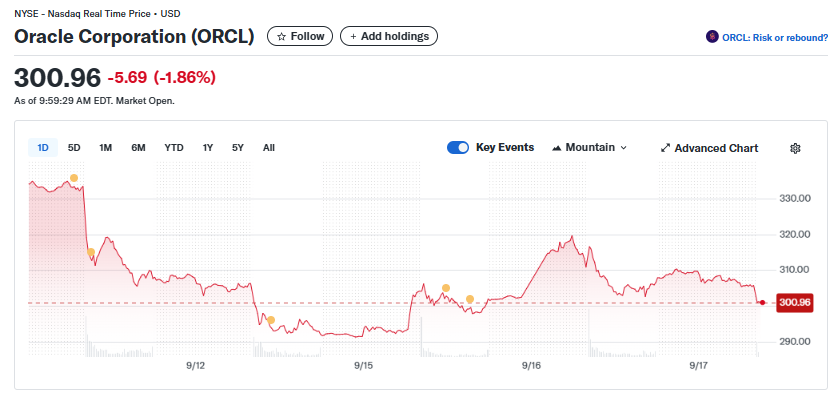
Oracle Corporation (ORCL)

Oracle’s Role in TikTok Deal

Oracle remains at the center of negotiations as a lead investor alongside Silver Lake and Andreessen Horowitz. The proposed structure would reduce ByteDance’s U.S. ownership stake to below 20%, a direct response to U.S. legislation requiring divestment or an outright ban.

Under the agreement, Oracle would continue serving as TikTok’s cloud provider, ensuring that U.S. user data is housed domestically and insulated from foreign access. While this arrangement reassures regulators, questions remain over whether ByteDance will retain any influence over TikTok’s core recommendation algorithm,  a sticking point in the deal.

Treasury officials describe the package as a “framework agreement”, signaling that negotiations are still fluid and subject to approvals by both President Donald Trump and Chinese President Xi Jinping. Talks are expected to intensify later this week, though previous extensions raise the possibility of further delays.

Political Backdrop Raises Stakes

The TikTok dispute is playing out against a backdrop of heightened U.S.–China tensions. In 2024, Congress passed a law mandating ByteDance divest TikTok or face removal from American app stores. Since then, the White House has issued multiple deadline extensions, with the latest running until December 16, 2025.

Unlike earlier cases involving Huawei and ZTE, where the U.S. imposed strict bans and sanctions, the TikTok situation highlights a different playbook: forced restructuring rather than outright exclusion. The intent, analysts say, is to maintain TikTok’s commercial viability while satisfying national security demands.

Still, the drawn-out process has fueled investor skepticism. Each new extension amplifies uncertainty, which markets often punish with volatility. For Oracle, which has pinned part of its growth narrative on cloud services, the protracted negotiations create a risk-versus-reward dynamic that investors must carefully assess.

What Comes Next for Oracle?

Market watchers believe the TikTok framework deal could close within 30 to 45 days, barring fresh political disruptions. However, with Trump and Xi both needing to weigh in, the final outcome remains uncertain.

For Oracle, the upside is clear: cementing its role as TikTok’s U.S. cloud partner could strengthen its market positioning in data services. On the flip side, prolonged delays or a collapsed deal could weigh on sentiment, particularly if TikTok faces operational constraints or an outright ban.

As of now, TikTok continues to operate in the U.S. while negotiations unfold. Investors will be watching closely for official statements in the coming weeks, with Oracle’s stock likely to remain sensitive to every twist in the saga.


The post Oracle ($ORCL): Down Nearly 2% as US-China TikTok Negotiations Drag On appeared first on CoinCentral.


Market Opportunity
Union Logo
Union Price(U)
$0.002742
$0.002742$0.002742
+13.25%
USD
Union (U) Live Price Chart
Disclaimer: The articles reposted on this site are sourced from public platforms and are provided for informational purposes only. They do not necessarily reflect the views of MEXC. All rights remain with the original authors. If you believe any content infringes on third-party rights, please contact service@support.mexc.com for removal. MEXC makes no guarantees regarding the accuracy, completeness, or timeliness of the content and is not responsible for any actions taken based on the information provided. The content does not constitute financial, legal, or other professional advice, nor should it be considered a recommendation or endorsement by MEXC.

You May Also Like

Google's AP2 protocol has been released. Does encrypted AI still have a chance?

Google's AP2 protocol has been released. Does encrypted AI still have a chance?

Following the MCP and A2A protocols, the AI Agent market has seen another blockbuster arrival: the Agent Payments Protocol (AP2), developed by Google. This will clearly further enhance AI Agents' autonomous multi-tasking capabilities, but the unfortunate reality is that it has little to do with web3AI. Let's take a closer look: What problem does AP2 solve? Simply put, the MCP protocol is like a universal hook, enabling AI agents to connect to various external tools and data sources; A2A is a team collaboration communication protocol that allows multiple AI agents to cooperate with each other to complete complex tasks; AP2 completes the last piece of the puzzle - payment capability. In other words, MCP opens up connectivity, A2A promotes collaboration efficiency, and AP2 achieves value exchange. The arrival of AP2 truly injects "soul" into the autonomous collaboration and task execution of Multi-Agents. Imagine AI Agents connecting Qunar, Meituan, and Didi to complete the booking of flights, hotels, and car rentals, but then getting stuck at the point of "self-payment." What's the point of all that multitasking? So, remember this: AP2 is an extension of MCP+A2A, solving the last mile problem of AI Agent automated execution. What are the technical highlights of AP2? The core innovation of AP2 is the Mandates mechanism, which is divided into real-time authorization mode and delegated authorization mode. Real-time authorization is easy to understand. The AI Agent finds the product and shows it to you. The operation can only be performed after the user signs. Delegated authorization requires the user to set rules in advance, such as only buying the iPhone 17 when the price drops to 5,000. The AI Agent monitors the trigger conditions and executes automatically. The implementation logic is cryptographically signed using Verifiable Credentials (VCs). Users can set complex commission conditions, including price ranges, time limits, and payment method priorities, forming a tamper-proof digital contract. Once signed, the AI Agent executes according to the conditions, with VCs ensuring auditability and security at every step. Of particular note is the "A2A x402" extension, a technical component developed by Google specifically for crypto payments, developed in collaboration with Coinbase and the Ethereum Foundation. This extension enables AI Agents to seamlessly process stablecoins, ETH, and other blockchain assets, supporting native payment scenarios within the Web3 ecosystem. What kind of imagination space can AP2 bring? After analyzing the technical principles, do you think that's it? Yes, in fact, the AP2 is boring when it is disassembled alone. Its real charm lies in connecting and opening up the "MCP+A2A+AP2" technology stack, completely opening up the complete link of AI Agent's autonomous analysis+execution+payment. From now on, AI Agents can open up many application scenarios. For example, AI Agents for stock investment and financial management can help us monitor the market 24/7 and conduct independent transactions. Enterprise procurement AI Agents can automatically replenish and renew without human intervention. AP2's complementary payment capabilities will further expand the penetration of the Agent-to-Agent economy into more scenarios. Google obviously understands that after the technical framework is established, the ecological implementation must be relied upon, so it has brought in more than 60 partners to develop it, almost covering the entire payment and business ecosystem. Interestingly, it also involves major Crypto players such as Ethereum, Coinbase, MetaMask, and Sui. Combined with the current trend of currency and stock integration, the imagination space has been doubled. Is web3 AI really dead? Not entirely. Google's AP2 looks complete, but it only achieves technical compatibility with Crypto payments. It can only be regarded as an extension of the traditional authorization framework and belongs to the category of automated execution. There is a "paradigm" difference between it and the autonomous asset management pursued by pure Crypto native solutions. The Crypto-native solutions under exploration are taking the "decentralized custody + on-chain verification" route, including AI Agent autonomous asset management, AI Agent autonomous transactions (DeFAI), AI Agent digital identity and on-chain reputation system (ERC-8004...), AI Agent on-chain governance DAO framework, AI Agent NPC and digital avatars, and many other interesting and fun directions. Ultimately, once users get used to AI Agent payments in traditional fields, their acceptance of AI Agents autonomously owning digital assets will also increase. And for those scenarios that AP2 cannot reach, such as anonymous transactions, censorship-resistant payments, and decentralized asset management, there will always be a time for crypto-native solutions to show their strength? The two are more likely to be complementary rather than competitive, but to be honest, the key technological advancements behind AI Agents currently all come from web2AI, and web3AI still needs to keep up the good work!
Share
PANews2025/09/18 07:00
Zama to Conduct Sealed-Bid Dutch Auction Using Encryption Tech

Zama to Conduct Sealed-Bid Dutch Auction Using Encryption Tech

Zama unveils innovative public token auction, using proprietary encryption. Bidding begins January 21, 2026. Key details on protocol and market impact.Read more
Share
Coinstats2026/01/20 18:13
Fed Finally Cuts Interest Rates – Crypto Boom is About to Begin

Fed Finally Cuts Interest Rates – Crypto Boom is About to Begin

The federal funds rate now stands in a range of 4.00% to 4.25%, a level that reflects a delicate balancing […] The post Fed Finally Cuts Interest Rates – Crypto Boom is About to Begin appeared first on Coindoo.
Share
Coindoo2025/09/18 02:01