Strategy co-founder Michael Saylor, Marathon Digital Holdings CEO Fred Thiel, and other leading figures in the crypto industry are set to gather on Capitol Hill today to push for legislation that could create a U.S. strategic bitcoin reserve.Strategy co-founder Michael Saylor, Marathon Digital Holdings CEO Fred Thiel, and other leading figures in the crypto industry are set to gather on Capitol Hill today to push for legislation that could create a U.S. strategic bitcoin reserve.

BITCOIN Act in Focus as Industry Executives and Lawmakers Convene in Washington

2025/09/16 21:37
3 min read

Strategy co-founder Michael Saylor, Marathon Digital Holdings CEO Fred Thiel, and other leading figures in the crypto industry are set to gather on Capitol Hill today to push for legislation that could create a U.S. strategic bitcoin reserve.  

Roundtable Scheduled with Lawmakers

The event, scheduled for Tuesday morning, will be hosted by Sen. Cynthia Lummis and Rep. Nick Begich, Republican cosponsors of the BITCOIN Act. More than a dozen industry executives are expected to attend, including Strategy co-founder Michael Saylor, Fundstrat CEO Tom Lee, Cardano founder Charles Hoskinson, Bitdeer Chief Strategy Officer Haris Basit, Riot’s Senior Vice President of Public Policy Brian Morgenstern, and Cleanspark CEO Matt Schultz.

The roundtable is being organized by The Digital Chamber and its affiliate, the Digital Power Network (DPN). Hailey Miller, DPN’s director of government relations and public policy, underscored the central objective: 

The Bill’s Foundation and Scope

The BITCOIN Act, formally titled the "Boosting Innovation, Technology, and Competitiveness through Optimized Investment Nationwide Act," was reintroduced by Sen. Lummis in March. The bill expands on an executive order signed earlier this year by President Donald Trump, which requires that bitcoin and other digital assets seized through criminal or civil proceedings be held in a permanent government fund.

The proposed legislation goes a step further, directing the Federal Reserve and Treasury to purchase one million bitcoins using budget-neutral methods. Options floated include reassessing Treasury gold certificates and using tariff revenues, ensuring that the purchases do not burden taxpayers.

Key Goals for Today’s Meeting

Industry executives are expected to press lawmakers on what has hindered the bill’s progress over the past six months and to identify objections that have stalled momentum. Supporters will also pitch bitcoin as a bipartisan priority, framing it as critical for national security and U.S. economic competitiveness.

Miller highlighted the urgency: 

Political Landscape and Next Steps

Currently, the bill has backing only from Republican lawmakers, with no Democratic support. For the legislation to advance, hearings before the House Financial Services Committee and Senate Banking Committee will be required, though no dates have yet been scheduled.

To reinforce the bipartisan case, DPN plans to circulate a briefing that presents the legislation as a “bipartisan opportunity.” Advocates hope today’s session will help build a broader coalition around the bill.

The roundtable could mark a pivotal step in determining whether momentum for the BITCOIN Act can be revived. While challenges remain, industry leaders are expected to make their strongest case yet for establishing a U.S. strategic bitcoin reserve.

Disclaimer: This article is provided for informational purposes only. It is not offered or intended to be used as legal, tax, investment, financial, or other advice

Market Opportunity
Union Logo
Union Price(U)
$0,000799
$0,000799$0,000799
-4,54%
USD
Union (U) Live Price Chart
Disclaimer: The articles reposted on this site are sourced from public platforms and are provided for informational purposes only. They do not necessarily reflect the views of MEXC. All rights remain with the original authors. If you believe any content infringes on third-party rights, please contact service@support.mexc.com for removal. MEXC makes no guarantees regarding the accuracy, completeness, or timeliness of the content and is not responsible for any actions taken based on the information provided. The content does not constitute financial, legal, or other professional advice, nor should it be considered a recommendation or endorsement by MEXC.

You May Also Like

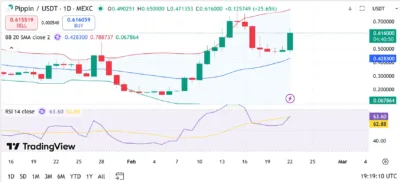
Pippin (PIPPIN) Price Prediction 2026–2030: Can PIPPIN Hit $0.70 Soon?

Pippin (PIPPIN) Price Prediction 2026–2030: Can PIPPIN Hit $0.70 Soon?

PIPPIN has surged sharply on the daily timeframe, printing a powerful bullish candle with over 25% gains. RSI is holding above 60, signaling strengthening momentum
Share
Coinstats2026/02/23 04:29
Will Cardano Reach $10 by 2030? Analysts Break Down ADA’s Growth Cycles

Will Cardano Reach $10 by 2030? Analysts Break Down ADA’s Growth Cycles

The post Will Cardano Reach $10 by 2030? Analysts Break Down ADA’s Growth Cycles appeared first on Coinpedia Fintech News Cardano (ADA) is trading at $0.9024 with a market cap of $32.91 billion. Experts say ADA has the potential to climb much higher, with some placing long-term targets as high as $10. The token continues to benefit from stronger visibility, rising liquidity, and increasing inflows from both institutional and retail markets. Can Cardano Hit $10 …
Share
CoinPedia2025/09/18 17:19
Crypto whale loses $6M to sneaky phishing scheme targeting staked Ethereum

Crypto whale loses $6M to sneaky phishing scheme targeting staked Ethereum

The post Crypto whale loses $6M to sneaky phishing scheme targeting staked Ethereum appeared on BitcoinEthereumNews.com. A crypto whale lost more than $6 million in staked Ethereum (stETH) and Aave-wrapped Bitcoin (aEthWBTC) after approving malicious signatures in a phishing scheme on Sept. 18, according to blockchain security firm Scam Sniffer. According to the firm, the attackers disguised their move as a routine wallet confirmation through “Permit” signatures, which tricked the victim into authorizing fund transfers without triggering obvious red flags. Yu Xian, founder of blockchain security company SlowMist, noted that the victim did not recognize the danger because the transaction required no gas fees. He wrote: “From the victim’s perspective, he just clicked a few times to confirm the wallet’s pop-up signature requests, didn’t spend a single penny of gas, and $6.28 million was gone.” How Permit exploits work Permit approvals were originally designed to simplify token transfers. Instead of submitting an on-chain approval and paying fees, a user can sign an off-chain message authorizing a spender. That efficiency, however, has created a new attack surface for malicious players. Once a user signs such a permit, attackers can combine two functions—Permit and TransferFrom—to drain assets directly. Because the authorization takes place off-chain, wallet dashboards show no unusual activity until the funds move. As a result, the assets are gone when the approval executes on-chain, and tokens are redirected to the attacker’s wallet. This loophole has made permit exploits increasingly attractive for malicious actors, who can siphon millions without needing complex hacks or high-cost gas wars. Phishing losses The latest theft highlights a wider trend of escalating phishing campaigns. Scam Sniffer reported that in August alone, attackers stole $12.17 million from more than 15,200 victims. That figure represented a 72% jump in losses compared with July. According to the firm, the most significant share of August’s damages came from three large accounts that accounted for nearly half…
Share
BitcoinEthereumNews2025/09/19 02:31