The total cryptocurrency market cap hit an all-time high of $4.17T on August 14. Since then, however, it has been locked in a tight consolidation range between $3.5T and $4T. Recently, it dropped sharply, falling around 9% in just 7 days between September 18 and 25, raising concerns over whether ‘Uptober’ is truly possible. That […]The total cryptocurrency market cap hit an all-time high of $4.17T on August 14. Since then, however, it has been locked in a tight consolidation range between $3.5T and $4T. Recently, it dropped sharply, falling around 9% in just 7 days between September 18 and 25, raising concerns over whether ‘Uptober’ is truly possible. That […]

DeepSeek’s Best Crypto Presales to Buy for Uptober: AI Has Spoken

2025/09/29 21:05
6 min read
For feedback or concerns regarding this content, please contact us at crypto.news@mexc.com

The total cryptocurrency market cap hit an all-time high of $4.17T on August 14. Since then, however, it has been locked in a tight consolidation range between $3.5T and $4T.

Recently, it dropped sharply, falling around 9% in just 7 days between September 18 and 25, raising concerns over whether ‘Uptober’ is truly possible.

That said, if you zoom out, Bitcoin has still gained 3.5% this month after a sharp 6.5% slump in August. Similarly, Solana and XRP are also likely to close the month in green.

Historically, Q4 has always been one of the best-performing periods for Bitcoin and cryptocurrencies.

Since 2010, October has delivered an average return of 29.23%. November tends to carry on that momentum, posting an average return of 37.64%.

As per @CryptoNobler, a crypto trader with 253K followers on X, low-cap tokens could surge by more than 200% this October.

Looking at the Altcoins/Bitcoin index, the chart has been in an uptrend since 2018, when low-cap tokens rallied 120x in just a few months.
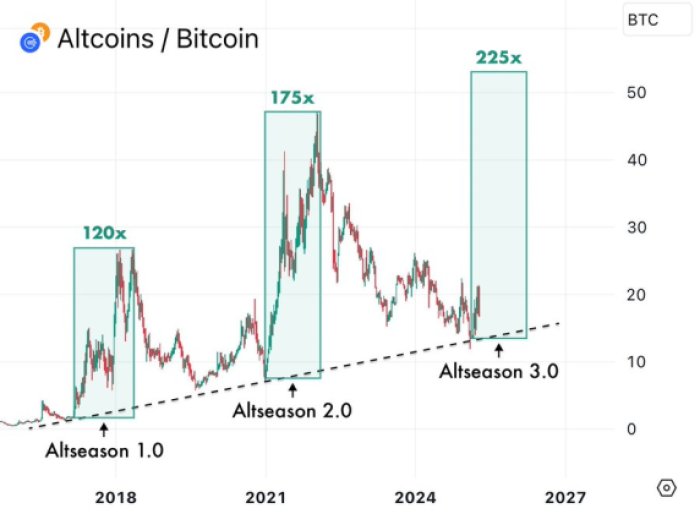
Altcoin vs. Bitcoin Index

The next pump (175x) came in 2021, once again after the index found support on the same trendline. Now, the index is hovering around that trendline again, potentially signaling the start of Altcoin Season 3.0.

Knowing that altcoin season is upon us is one thing, but taking advantage of it is a whole different ballgame.

That’s why we turned to DeepSeek to identify the most promising cryptocurrencies likely to benefit from Uptober’s rally.

After an in-depth analysis of market data, historical charts, and social chatter, DeepSeek highlighted three altcoins you shouldn’t miss.

Read on as we reveal DeepSeek’s best crypto presale picks, with a breakdown of each one in detail.

1. Bitcoin Hyper ($HYPER) – Layer-2 Bitcoin Solution with Faster Transaction Processing & Lower Fees

Bitcoin Hyper ($HYPER) aims to introduce a new layer of usability, speed, and scalability to the sluggish Bitcoin blockchain.

Imagine being Bitcoin, the world’s most popular cryptocurrency, and still not being able to participate in DeFi.

Sounds strange, right? However, that’s the way it is, but Bitcoin Hyper aims to change it.

$HYPER brings the advantages of Solana Virtual Machine (SVM) integration to the Bitcoin chain. This lets developers execute smart contracts and build dApps directly on Bitcoin without compromising security.

SVM is the same protocol that gives Solana its high throughput of around 65K transactions per second, compared to Bitcoin’s 7 TPS.

It uses parallel execution to process several transactions simultaneously, as long as those transactions aren’t related to each other.

On Bitcoin, the SVM integration will ensure transactions are aggregated and processed off-chain, then sent to the mainnet for confirmation and final settlement. This retains Bitcoin’s inherent security.

Bitcoin Hyper's layer-2 ecosystem explained, step by step.

$HYPER also introduces a decentralized canonical bridge, acting as a pathway between Layer 1 and Layer 2 Bitcoin. Here’s how it works:

  • You send your Layer 1 tokens to the bridge, which verifies and securely locks them.
  • In exchange, the bridge mints you an equivalent amount of Layer 2 tokens fully compatible with Web3 applications.
  • You can then use these L2 tokens to explore DeFi apps and engage in staking, borrowing, lending, and even NFT marketplaces.
  • Once you’re done, you simply send the L2 tokens back to the bridge, which unlocks your original L1 tokens.
The $HYPER presale has already generated significant buzz among crypto investors, raising $18.8M to date. Today, each token is priced at just $0.012995. Here’s how to buy Bitcoin Hyper.

According to our $HYPER price prediction, the token could surge to $0.32 by year’s end – a staggering 2,300% return.

Visit Bitcoin Hyper’s official website to become part of this new Layer-2 Bitcoin revolution.

2. Best Wallet Token ($BEST) – Non-Custodial Crypto Wallet That Lets You Directly Invest in the Best Presales

Best Wallet Token ($BEST) powers Best Wallet – a one-stop destination to securely manage all your crypto holdings with unmatched ease of use.

At a time when crypto adoption is at its peak, investors need a trustworthy wallet to safeguard their assets, and that’s exactly where Best Wallet comes in.

The first thing you’ll notice about the wallet is its security. It’s a non-custodial wallet, so only you have access to the private keys, ensuring no chance of foul play.

Next, you can enable two-factor authentication, including biometrics, to further secure your account. That said, security is just one part of the deal.

Best Wallet features a unique ‘Upcoming Tokens’ section where you can discover and invest in new cryptocurrency projects in presale directly within the app.

Unlike other wallets, which require you to visit presale websites and manually connect your wallet, Best Wallet lets you purchase, claim, and trade tokens seamlessly, all inside the wallet app.

Best Wallet's useful features, from multi-chain support and swaps to keyless security.

Best Wallet aims to capture 40% of the non-custodial crypto wallet market share by 2027. Naturally, this success would reflect in the price of its native token, $BEST.

Buying $BEST also unlocks exclusive perks, like:

  • Early access to presales and upcoming tokens
  • Lower gas and transaction fees within the app
  • Staking rewards, currently up to 82% p.a.

The $BEST presale has already raised $16.17M, with each token available at just $0.025715.

According to the experts behind this price prediction, a $100 investment at present could potentially grow to $2,400 by the end of 2026.

For more details, visit the official Best Wallet Token website.

3. Remittix ($RTX) – Token Powering Crypto-to-Fiat Conversions with Zero FX Fees

Remittix ($RTX) is a Payment Finance (PayFi) solution that bridges the gap between digital and traditional currencies.

The platform enables seamless conversion of cryptocurrencies into fiat with same-day transaction processing and zero forex fees.

You can send crypto to anyone in the world, and they’ll receive it as fiat currency in their local denomination, directly in their bank account – without even realizing it was a crypto transfer in the first place.
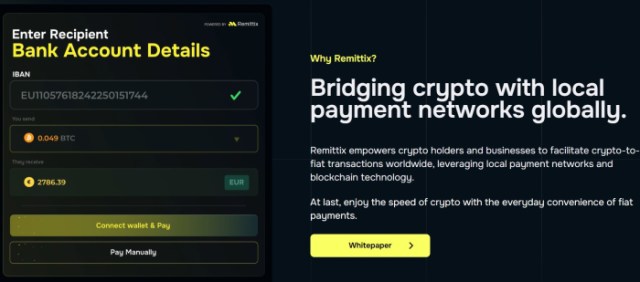
Remittix ($RTX) bridging crypto with local payment networks globally

Cross-border transactions usually involve hefty forex fees, which can add up quickly if you make regular transfers.

However, Remittix’s zero-forex-fee model ensures you don’t lose any part of your money to exorbitant platform charges.

Currently, Remittix supports 30 fiat currencies, 100 cryptocurrencies, and operates in over 40 countries, with coverage expected to expand as the platform grows.

The $RTX presale has been a huge hit, already raising $26.7M so far. Right now, you can get each $RTX token for $0.1166.

Recap: With ‘Uptober’ on the cards, we asked DeepSeek for its top altcoin picks. The result? Bitcoin Hyper ($HYPER), Best Wallet Token ($BEST), and Remittix ($RTX).

Disclaimer: Crypto is a highly risky endeavor. None of the above is financial advice, so kindly do your own research before investing.

Authored by Krishi Chowdhary, Bitcoinist – https://bitcoinist.com/deepseek-best-crypto-presales-to-buy-for-uptober

Market Opportunity
null Logo
null Price(null)
--
----
USD
null (null) Live Price Chart
Disclaimer: The articles reposted on this site are sourced from public platforms and are provided for informational purposes only. They do not necessarily reflect the views of MEXC. All rights remain with the original authors. If you believe any content infringes on third-party rights, please contact crypto.news@mexc.com for removal. MEXC makes no guarantees regarding the accuracy, completeness, or timeliness of the content and is not responsible for any actions taken based on the information provided. The content does not constitute financial, legal, or other professional advice, nor should it be considered a recommendation or endorsement by MEXC.

You May Also Like

Crucial ETH Unstaking Period: Vitalik Buterin’s Unwavering Defense for Network Security

Crucial ETH Unstaking Period: Vitalik Buterin’s Unwavering Defense for Network Security

BitcoinWorld Crucial ETH Unstaking Period: Vitalik Buterin’s Unwavering Defense for Network Security Ever wondered why withdrawing your staked Ethereum (ETH) isn’t an instant process? It’s a question that often sparks debate within the crypto community. Ethereum founder Vitalik Buterin recently stepped forward to defend the network’s approximately 45-day ETH unstaking period, asserting its crucial role in safeguarding the network’s integrity. This lengthy waiting time, while sometimes seen as an inconvenience, is a deliberate design choice with profound implications for security. Why is the ETH Unstaking Period a Vital Security Measure? Vitalik Buterin’s defense comes amidst comparisons to other networks, like Solana, which boast significantly shorter unstaking times. He drew a compelling parallel to military operations, explaining that an army cannot function effectively if its soldiers can simply abandon their posts at a moment’s notice. Similarly, a blockchain network requires a stable and committed validator set to maintain its security. The current ETH unstaking period isn’t merely an arbitrary delay. It acts as a critical buffer, providing the network with sufficient time to detect and respond to potential malicious activities. If validators could instantly exit, it would open doors for sophisticated attacks, jeopardizing the entire system. Currently, Ethereum boasts over one million active validators, collectively staking approximately 35.6 million ETH, representing about 30% of the total supply. This massive commitment underpins the network’s robust security model, and the unstaking period helps preserve this stability. Network Security: Ethereum’s Paramount Concern A shorter ETH unstaking period might seem appealing for liquidity, but it introduces significant risks. Imagine a scenario where a large number of validators, potentially colluding, could quickly withdraw their stake after committing a malicious act. Without a substantial delay, the network would have limited time to penalize them or mitigate the damage. This “exit queue” mechanism is designed to prevent sudden validator exodus, which could lead to: Reduced decentralization: A rapid drop in active validators could concentrate power among fewer participants. Increased vulnerability to attacks: A smaller, less stable validator set is easier to compromise. Network instability: Frequent and unpredictable changes in validator numbers can lead to performance issues and consensus failures. Therefore, the extended period is not a bug; it’s a feature. It’s a calculated trade-off between immediate liquidity for stakers and the foundational security of the entire Ethereum ecosystem. Ethereum vs. Solana: Different Approaches to Unstaking When discussing the ETH unstaking period, many point to networks like Solana, which offers a much quicker two-day unstaking process. While this might seem like an advantage for stakers seeking rapid access to their funds, it reflects fundamental differences in network architecture and security philosophies. Solana’s design prioritizes speed and immediate liquidity, often relying on different consensus mechanisms and validator economics to manage security risks. Ethereum, on the other hand, with its proof-of-stake evolution from proof-of-work, has adopted a more cautious approach to ensure its transition and long-term stability are uncompromised. Each network makes design choices based on its unique goals and threat models. Ethereum’s substantial value and its role as a foundational layer for countless dApps necessitate an extremely robust security posture, making the current unstaking duration a deliberate and necessary component. What Does the ETH Unstaking Period Mean for Stakers? For individuals and institutions staking ETH, understanding the ETH unstaking period is crucial for managing expectations and investment strategies. It means that while staking offers attractive rewards, it also comes with a commitment to the network’s long-term health. Here are key considerations for stakers: Liquidity Planning: Stakers should view their staked ETH as a longer-term commitment, not immediately liquid capital. Risk Management: The delay inherently reduces the ability to react quickly to market volatility with staked assets. Network Contribution: By participating, stakers contribute directly to the security and decentralization of Ethereum, reinforcing its value proposition. While the current waiting period may not be “optimal” in every sense, as Buterin acknowledged, simply shortening it without addressing the underlying security implications would be a dangerous gamble for the network’s reliability. In conclusion, Vitalik Buterin’s defense of the lengthy ETH unstaking period underscores a fundamental principle: network security cannot be compromised for the sake of convenience. It is a vital mechanism that protects Ethereum’s integrity, ensuring its stability and trustworthiness as a leading blockchain platform. This deliberate design choice, while requiring patience from stakers, ultimately fortifies the entire ecosystem against potential threats, paving the way for a more secure and reliable decentralized future. Frequently Asked Questions (FAQs) Q1: What is the main reason for Ethereum’s long unstaking period? A1: The primary reason is network security. A lengthy ETH unstaking period prevents malicious actors from quickly withdrawing their stake after an attack, giving the network time to detect and penalize them, thus maintaining stability and integrity. Q2: How long is the current ETH unstaking period? A2: The current ETH unstaking period is approximately 45 days. This duration can fluctuate based on network conditions and the number of validators in the exit queue. Q3: How does Ethereum’s unstaking period compare to other blockchains? A3: Ethereum’s unstaking period is notably longer than some other networks, such as Solana, which has a two-day period. This difference reflects varying network architectures and security priorities. Q4: Does the unstaking period affect ETH stakers? A4: Yes, it means stakers need to plan their liquidity carefully, as their staked ETH is not immediately accessible. It encourages a longer-term commitment to the network, aligning staker interests with Ethereum’s stability. Q5: Could the ETH unstaking period be shortened in the future? A5: While Vitalik Buterin acknowledged the current period might not be “optimal,” any significant shortening would likely require extensive research and network upgrades to ensure security isn’t compromised. For now, the focus remains on maintaining robust network defenses. Found this article insightful? Share it with your friends and fellow crypto enthusiasts on social media to spread awareness about the critical role of the ETH unstaking period in Ethereum’s security! To learn more about the latest Ethereum trends, explore our article on key developments shaping Ethereum’s institutional adoption. This post Crucial ETH Unstaking Period: Vitalik Buterin’s Unwavering Defense for Network Security first appeared on BitcoinWorld.
Share
Coinstats2025/09/18 15:30
White House adviser: Cryptocurrency bill is "very close" to passage

White House adviser: Cryptocurrency bill is "very close" to passage

PANews reported on June 18 that according to Jinshi, a US White House adviser said that the cryptocurrency bill is "very close" to passage, which will create demand for the
Share
PANews2025/06/18 23:52
SEC approves Grayscale’s multi-crypto fund with XRP, SOL and ADA

SEC approves Grayscale’s multi-crypto fund with XRP, SOL and ADA

GDLC's approval coincides with SEC adopting generic listing standards for crypto ETFs, which would expedite the launch process.
Share
Coinstats2025/09/18 10:26