Middle East escalation is taking a back seat in the markets as traders await Fed's decision.Middle East escalation is taking a back seat in the markets as traders await Fed's decision.

Dow Jones up 100 points as Fed takes focus away from Israel-Iran war

Stock markets are zeroing in on the Federal Reserve’s key interest rate decision, while the conflict in the Middle East takes a step out of the spotlight.

Major U.S. stock indices were higher ahead of the announcement. On Wednesday, June 18, the Dow Jones rose 132 points, or 0.31%. At the same time, the S&P 500 gained 0.40%, while the NASDAQ climbed 0.55%.
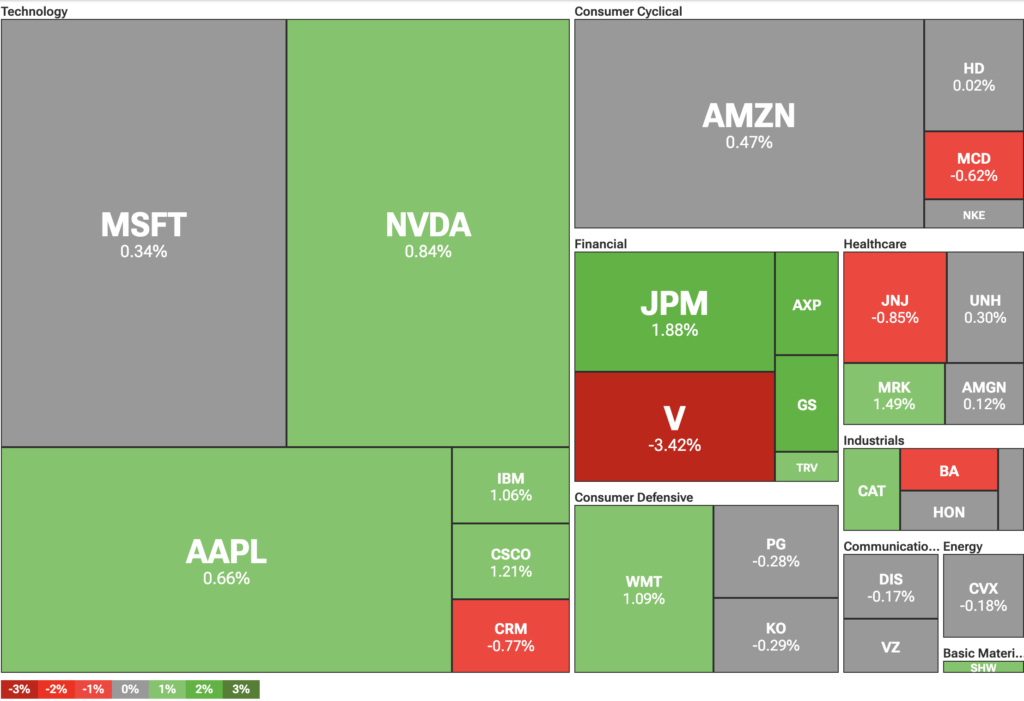
Dow Jones Industrial Average heatmap

The Fed is scheduled to announce its interest rate decision on June 18 at 2 p.m. Eastern Time. Market consensus expects the central bank to keep rates steady. The Fed remains concerned about rising inflation, particularly following the introduction of former President Donald Trump’s “Liberation Day” tariffs.

Trump also anticipates no rate cuts. Earlier, he remarked that “stupid” Fed Chair Jerome Powell probably won’t cut rates. That remark is part of the ongoing pressure by the U.S. President on the Fed.

Trump has said interest rates should be at least two percentage points lower to support the economy. However, that scenario appears unlikely, especially as rising oil prices, driven by the Israel-Iran war, add to inflation concerns.

Trump escalates rhetoric over Iran

While markets are focusing on the Fed, tensions in the Middle East threaten to escalate further. Notably, Trump confronted Iran with a threatening tone, refusing to rule out direct U.S. military involvement. He stated that “it’s very late to be talking” with Iran.

“Nobody knows what I’m going to do,” Trump told reporters when asked whether or not the U.S. would strike Iran. U.S. continues to support Israel with its strikes on Iran, which have already done significant damage to its military capabilities. However, Iran is also retaliating against Israel with missiles and drones.

While Qatar and Oman are trying to mediate a ceasefire, they are urging Israel to de-escalate. On the other hand, Israel is doing its best to get the U.S. directly involved in the war, which would likely have immediate consequences on the entire region and the global oil market.

Disclaimer: The articles reposted on this site are sourced from public platforms and are provided for informational purposes only. They do not necessarily reflect the views of MEXC. All rights remain with the original authors. If you believe any content infringes on third-party rights, please contact service@support.mexc.com for removal. MEXC makes no guarantees regarding the accuracy, completeness, or timeliness of the content and is not responsible for any actions taken based on the information provided. The content does not constitute financial, legal, or other professional advice, nor should it be considered a recommendation or endorsement by MEXC.

You May Also Like

The Channel Factories We’ve Been Waiting For

The Channel Factories We’ve Been Waiting For

The post The Channel Factories We’ve Been Waiting For appeared on BitcoinEthereumNews.com. Visions of future technology are often prescient about the broad strokes while flubbing the details. The tablets in “2001: A Space Odyssey” do indeed look like iPads, but you never see the astronauts paying for subscriptions or wasting hours on Candy Crush.  Channel factories are one vision that arose early in the history of the Lightning Network to address some challenges that Lightning has faced from the beginning. Despite having grown to become Bitcoin’s most successful layer-2 scaling solution, with instant and low-fee payments, Lightning’s scale is limited by its reliance on payment channels. Although Lightning shifts most transactions off-chain, each payment channel still requires an on-chain transaction to open and (usually) another to close. As adoption grows, pressure on the blockchain grows with it. The need for a more scalable approach to managing channels is clear. Channel factories were supposed to meet this need, but where are they? In 2025, subnetworks are emerging that revive the impetus of channel factories with some new details that vastly increase their potential. They are natively interoperable with Lightning and achieve greater scale by allowing a group of participants to open a shared multisig UTXO and create multiple bilateral channels, which reduces the number of on-chain transactions and improves capital efficiency. Achieving greater scale by reducing complexity, Ark and Spark perform the same function as traditional channel factories with new designs and additional capabilities based on shared UTXOs.  Channel Factories 101 Channel factories have been around since the inception of Lightning. A factory is a multiparty contract where multiple users (not just two, as in a Dryja-Poon channel) cooperatively lock funds in a single multisig UTXO. They can open, close and update channels off-chain without updating the blockchain for each operation. Only when participants leave or the factory dissolves is an on-chain transaction…
Share
BitcoinEthereumNews2025/09/18 00:09
‘Sinners’ Earns 16 Oscar Nominations, Shattering All-Time Record

‘Sinners’ Earns 16 Oscar Nominations, Shattering All-Time Record

The post ‘Sinners’ Earns 16 Oscar Nominations, Shattering All-Time Record appeared on BitcoinEthereumNews.com. Topline “Sinners” shattered a 75-year-old record
Share
BitcoinEthereumNews2026/01/23 02:34
‘Return To Silent Hill’ Is The Worst-Reviewed Video Game Movie In 19 Years

‘Return To Silent Hill’ Is The Worst-Reviewed Video Game Movie In 19 Years

The post ‘Return To Silent Hill’ Is The Worst-Reviewed Video Game Movie In 19 Years appeared on BitcoinEthereumNews.com. Return to Silent Hil Return to Silent Hil
Share
BitcoinEthereumNews2026/01/23 02:19

