On-chain signals show Ethereum’s exchange reserves shrinking and whales accumulating, hinting at a tightening market phase.]]>On-chain signals show Ethereum’s exchange reserves shrinking and whales accumulating, hinting at a tightening market phase.]]>

Ethereum Enters Supply Squeeze Phase, Hinting at a New Bull Cycle

  • Ethereum’s exchange reserves keep shrinking as whale-sized spot orders dominate on-chain activity.
  • Institutional accumulation hints that Ethereum may be entering another supply squeeze phase.

The latest on-chain data from analysts at XWIN Research Japan shows a pattern in Ethereum reminiscent of late 2020, when silent accumulation by large players laid the foundation for the subsequent rally.

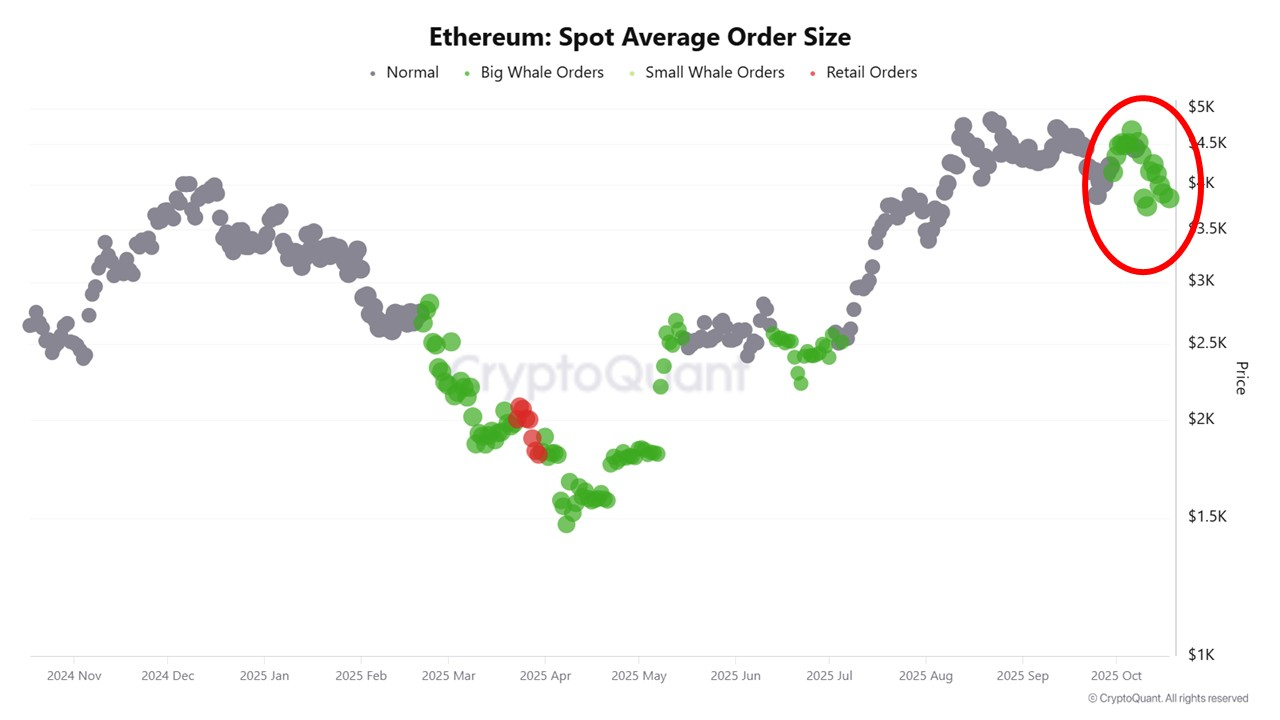
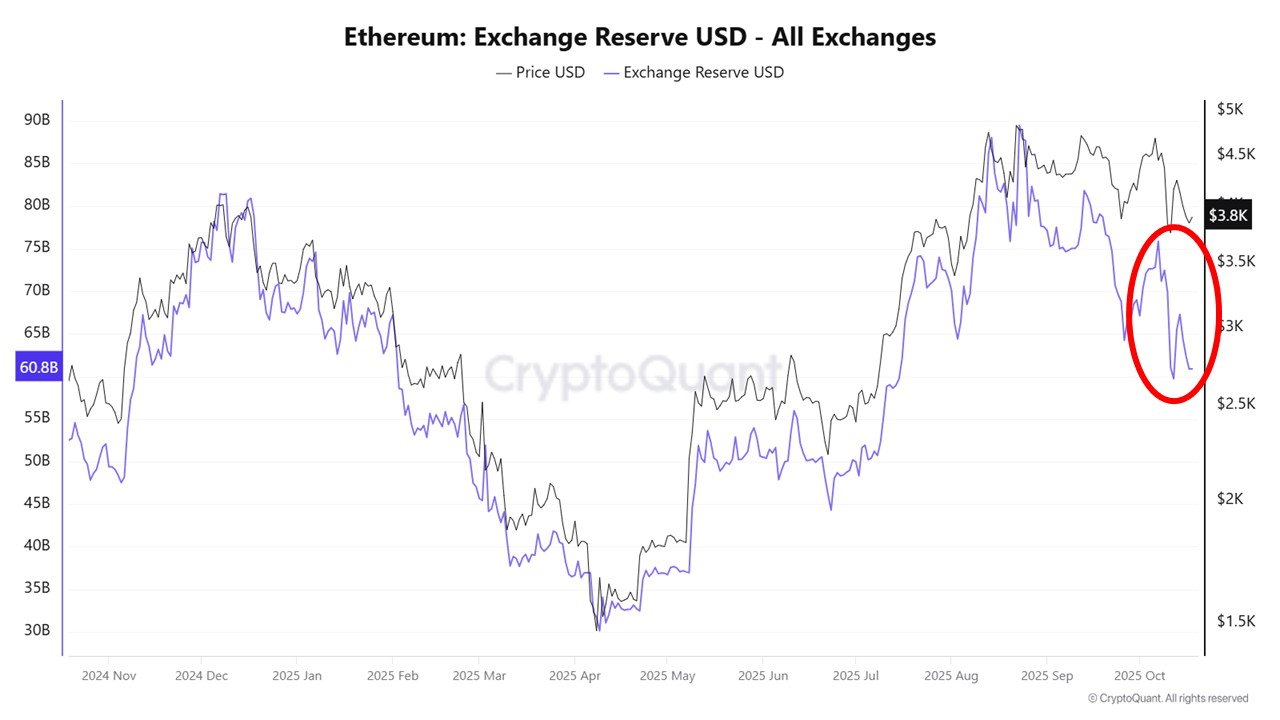
This time, the same signals are emerging: Ethereum reserves on exchanges have plummeted sharply, while the average spot order size is now dominated by large whale orders.
Source: CryptoQuant

Meanwhile, as of press time, ETH is trading at about $3,890, up 0.56% in the last 4 hours and 0.46% in 24 hours. Over the week, its gain has reached 3.74%, boosting investor enthusiasm, as investors begin to see signs of a major move ahead.

Daily spot volume is recorded at $2.33 billion, with a market cap of $470.40 billion and open interest of around $42.78 billion. While the movement appears stable on the surface, Ethereum’s underlying market structure is actually tightening.

Whales Quietly Reload as Ethereum Liquidity Dries Up

According to XWIN Research Japan, a sharp decline in ETH reserves on exchanges, coupled with an increase in large orders from whales, typically signals an accumulation phase by institutional investors and individuals with significant capital.
Source: CryptoQuant

Interestingly, the volume of dollar-denominated ETH held on exchanges is now at one of its lowest levels throughout 2025. With increasingly thin liquidity, even modest new demand could trigger a much faster price surge.

On the other hand, popular analyst Mike Investing warned bears that the market may be preparing for a surprise.

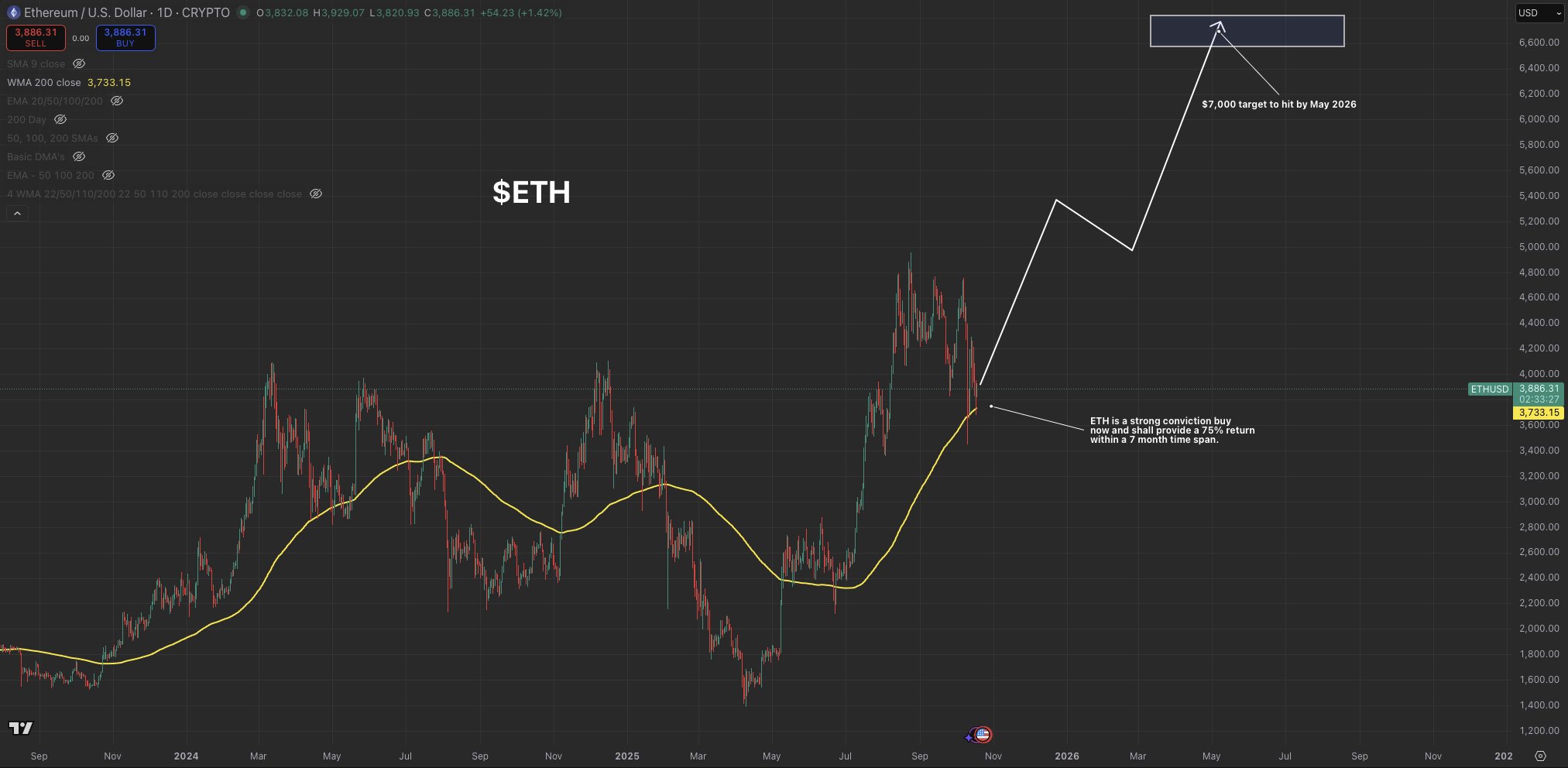
“Just a message to all ETH bears that $7,000 is incoming within the early months of 2026,” he wrote.

Mike added that Ethereum’s low of around $3,800 is likely the final pullback before a major rally begins. He stated, “This run will create generational wealth for many.”

This statement may sound optimistic, but history shows that supply squeezes like the current one often fuel the beginning of the next bull cycle.
Source: Mike Investing on X

New Push from Asia and Global Adoption

Furthermore, capital flows from Asia are also beginning to show a clear direction. Recently, the CNF reported that a group of Asian investors committed $1 billion to establish a new Ethereum Treasury.

This move is seen as a sign of long-term confidence in Ethereum’s potential, especially as various countries in the region begin to strengthen blockchain-based digital infrastructure.

Furthermore, just a few days ago, Bhutan became the first country in the world to run its national Digital ID system on the Ethereum network, replacing the previous system on Polygon. Around 800,000 Bhutanese citizens can now securely access public services through this network.

The government aims for the full migration to be completed by early 2026—a move that strengthens Ethereum’s position as the backbone of the developing world’s digital transformation.

]]>
Market Opportunity
Tron Bull Logo
Tron Bull Price(BULL)
$0.001214
$0.001214$0.001214
+9.17%
USD
Tron Bull (BULL) Live Price Chart
Disclaimer: The articles reposted on this site are sourced from public platforms and are provided for informational purposes only. They do not necessarily reflect the views of MEXC. All rights remain with the original authors. If you believe any content infringes on third-party rights, please contact service@support.mexc.com for removal. MEXC makes no guarantees regarding the accuracy, completeness, or timeliness of the content and is not responsible for any actions taken based on the information provided. The content does not constitute financial, legal, or other professional advice, nor should it be considered a recommendation or endorsement by MEXC.

You May Also Like

Trust Wallet’s Decisive Move: Full Compensation for $7M Hack Victims

Trust Wallet’s Decisive Move: Full Compensation for $7M Hack Victims

BitcoinWorld Trust Wallet’s Decisive Move: Full Compensation for $7M Hack Victims In a significant move for cryptocurrency security, Trust Wallet has committed
Share
bitcoinworld2025/12/26 17:40
Cashing In On University Patents Means Giving Up On Our Innovation Future

Cashing In On University Patents Means Giving Up On Our Innovation Future

The post Cashing In On University Patents Means Giving Up On Our Innovation Future appeared on BitcoinEthereumNews.com. “It’s a raid on American innovation that would deliver pennies to the Treasury while kneecapping the very engine of our economic and medical progress,” writes Pipes. Getty Images Washington is addicted to taxing success. Now, Commerce Secretary Howard Lutnick is floating a plan to skim half the patent earnings from inventions developed at universities with federal funding. It’s being sold as a way to shore up programs like Social Security. In reality, it’s a raid on American innovation that would deliver pennies to the Treasury while kneecapping the very engine of our economic and medical progress. Yes, taxpayer dollars support early-stage research. But the real payoff comes later—in the jobs created, cures discovered, and industries launched when universities and private industry turn those discoveries into real products. By comparison, the sums at stake in patent licensing are trivial. Universities collectively earn only about $3.6 billion annually in patent income—less than the federal government spends on Social Security in a single day. Even confiscating half would barely register against a $6 trillion federal budget. And yet the damage from such a policy would be anything but trivial. The true return on taxpayer investment isn’t in licensing checks sent to Washington, but in the downstream economic activity that federally supported research unleashes. Thanks to the bipartisan Bayh-Dole Act of 1980, universities and private industry have powerful incentives to translate early-stage discoveries into real-world products. Before Bayh-Dole, the government hoarded patents from federally funded research, and fewer than 5% were ever licensed. Once universities could own and license their own inventions, innovation exploded. The result has been one of the best returns on investment in government history. Since 1996, university research has added nearly $2 trillion to U.S. industrial output, supported 6.5 million jobs, and launched more than 19,000 startups. Those companies pay…
Share
BitcoinEthereumNews2025/09/18 03:26
Trust Wallet Hack Hits $7M: CZ Hints at Possible Insider Role

Trust Wallet Hack Hits $7M: CZ Hints at Possible Insider Role

CZ hinted at possible insider involvement in the Trust Wallet incident while assuring users that their funds would be reimbursed.
Share
CryptoPotato2025/12/26 16:48