

Financing Weekly Report | 14 public financing events; Encrypted payment company Mesh completes $82 million Series B financing, led by Paradigm

Highlights of this issue
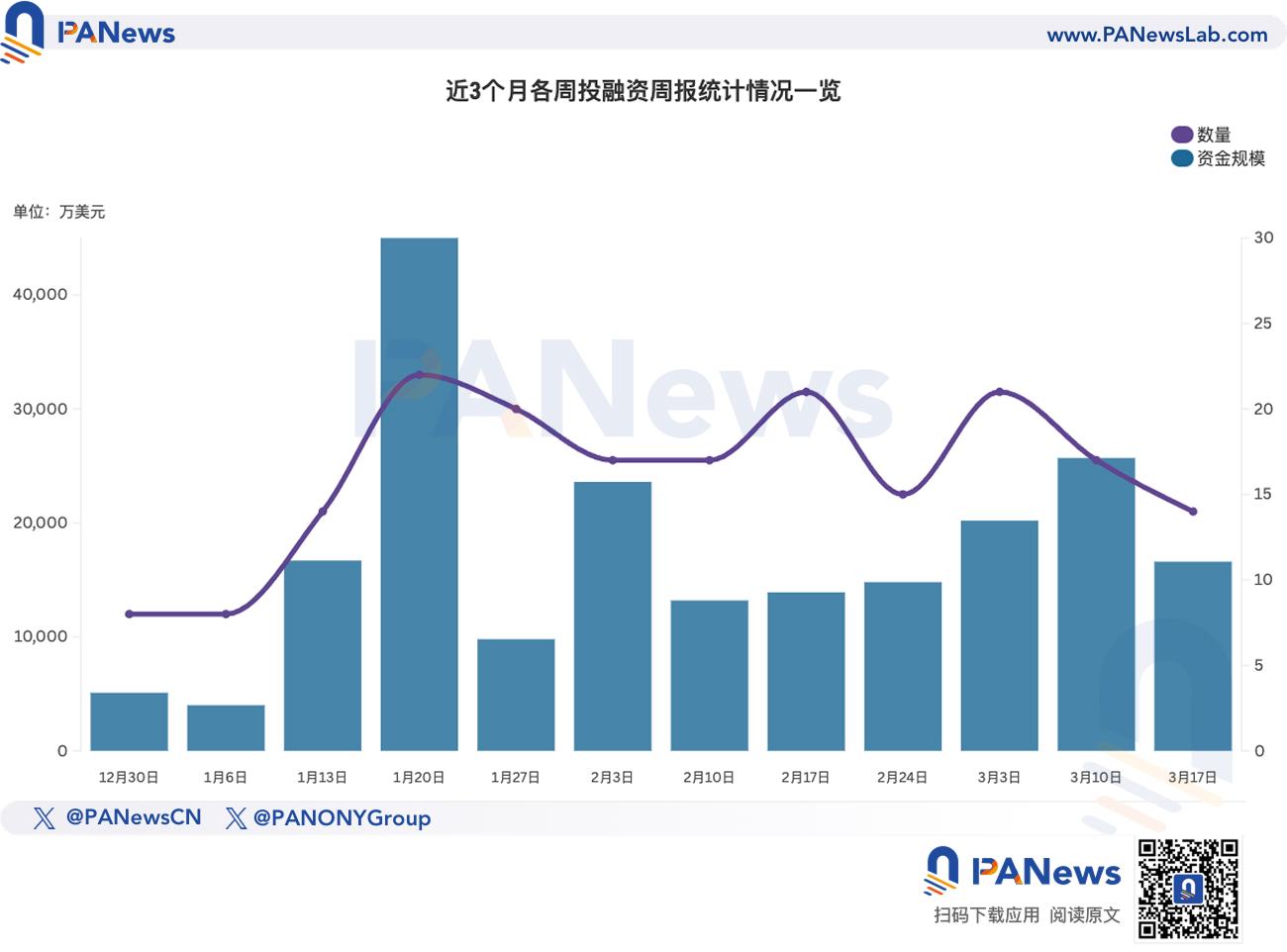
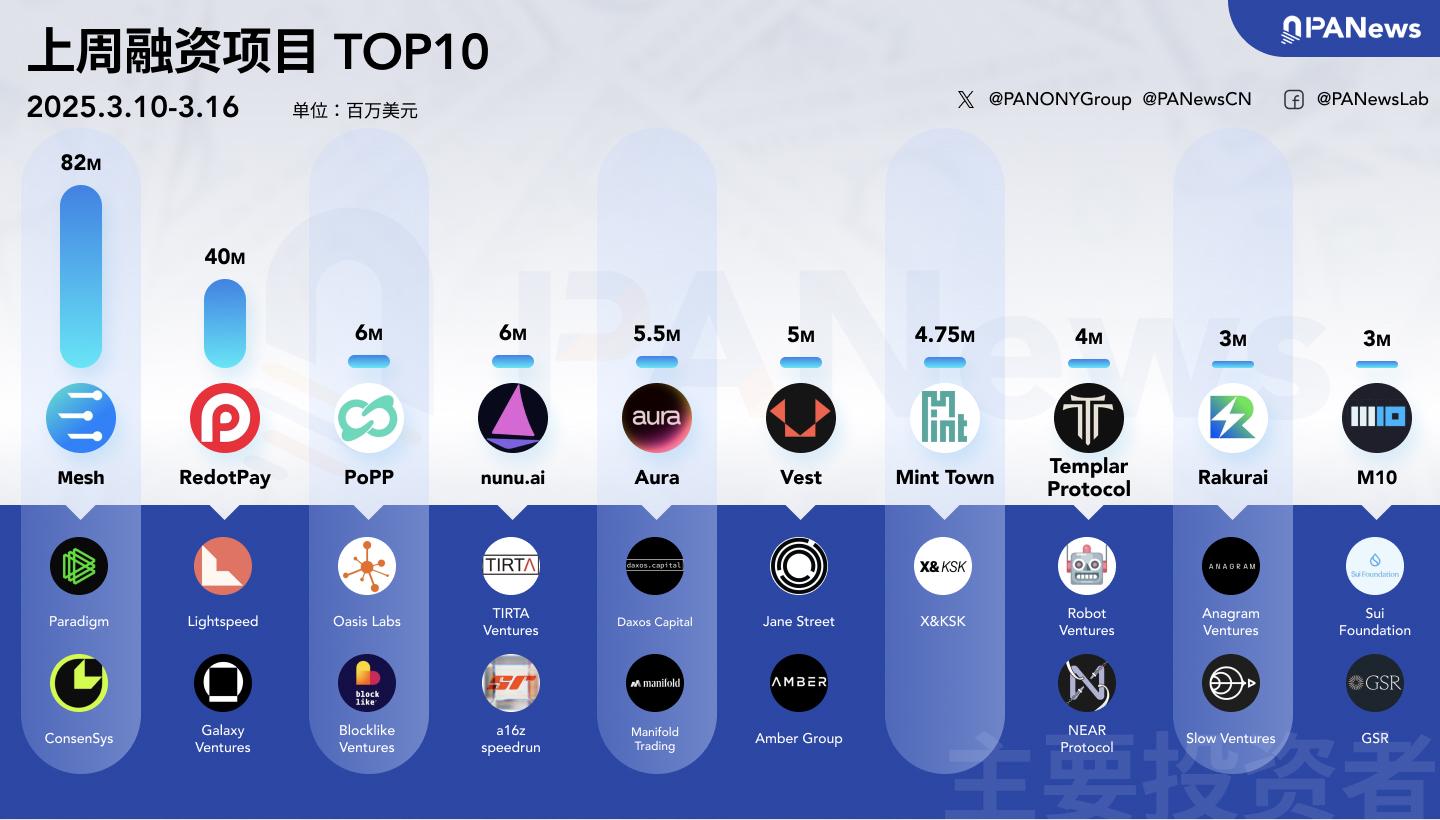
According to incomplete statistics from PANews, there were 14 blockchain investment and financing events around the world last week (March 10-16); the total funding amount exceeded US$166 million, a significant decrease compared to the previous week. An overview is as follows:
- DeFi announced four investment and financing events, among which Vest completed a $5 million financing, with Jane Street and others participating in the investment;
- The Web3 game track announced three investment and financing events, among which Japanese Web3 game development company Mint Town completed a new round of financing of approximately US$4.75 million;
- The Web3+AI field announced 4 investment and financing events, among which the AI-based decentralized user agreement platform PoPP completed a $6 million financing, with Oasis Labs and others participating in the investment;
- One investment and financing event was announced in the Infrastructure & Tools sector. Offline Protocol completed a $1.1 million Pre-Seed financing led by Portal Ventures.
- In the field of centralized finance, two investment and financing events were announced, among which RedotPay completed a US$40 million Series A financing, led by Lightspeed.
DeFi
Vest Completes $5 Million Funding and Launches Decentralized Risk Pricing Engine
Vest announced the completion of a $5 million financing to build The Universal Risk Engine. This round of financing was led by Jane Street, Selini Capital, Amber Group, QCP, Big Brain Holdings, Mozaik Capital and other institutions, and executives from financial giants such as BlackRock and Citadel participated. Vest aims to solve the current problem of fragmented and isolated risk pricing data in the financial market, and provide a verifiable neutral framework that enables financial participants to share risk models that dynamically adapt to market conditions, replacing traditional individual risk assessments. Vest's first product, Vest Exchange, is a perpetual contract exchange that uses blockchain and zero-knowledge proofs (zk proofs) technology to ensure a transparent and fair trading environment and avoid market manipulation.
Crypto lending agreement Templar Protocol completes $4 million Pre-Seed round of financing
Crypto lending protocol Templar Protocol announced the completion of a $4 million Pre-Seed round of financing, with participation from Robot Ventures, Digital Asset Capital Management, Proximity Labs, Blackdragon Capital, NEAR Protocol and several strategic angel investors. This funding will accelerate Templar's development roadmap and product launch. It is reported that Templar Protocol is a startup dedicated to developing a crypto lending platform for Bitcoin and other digital assets. Its goal is to enable users to borrow Bitcoin or other assets without relying on centralized institutions. The team plans to launch the protocol in the second quarter of 2025.
Solana Staking Protocol Rakurai Completes $3 Million Seed Round
Rakurai, a high-yield staking protocol in the Solana ecosystem, announced the completion of a $3 million seed round of financing, led by Anagram Ventures, with participation from Colosseum, Slow Ventures, Robot Ventures, Crypto.com Capital, P2P.org, Global Stake, Cyber Fund and other institutions. This round of financing will be used to accelerate the deployment of high-performance nodes and increase TPS (transactions per second) and block rewards through proprietary scheduling and pipeline optimization.
Arda, a real estate tokenization company founded by former JPMorgan executives, completes $3 million in Pre-Seed round of financing
Arda, a real estate tokenization company, received $3 million in Pre-Seed funding from Lightshift Capital. Arda will use the funds raised in this round to develop product prototypes, recruit more engineers, and establish partnerships with real estate developers and other companies in the field. According to reports, the company was founded by Oli Harris, former head of digital asset strategy at JPMorgan Chase, and aims to help digitize the entire real estate economy and use blockchain technology to store this data. Harris said that when Arda launches its product, it will make a profit by charging a fixed fee to view real estate data. The company will also charge transaction fees for updating specific property data and processing transactions.
Web3 Games
Japanese Web3 game development company Mint Town completes a new round of financing of approximately US$4.75 million
Japanese Web3 game development company Mint Town announced that it has raised a total of 700 million yen (about 4.75 million U.S. dollars) through a third-party private placement with the fund "X&KSK" established by Japanese football player Keisuke Honda as the main investor. This financing brings the company's cumulative financing to approximately 2 billion yen (about 13.56 million U.S. dollars). The funds raised will be used to strengthen the marketing of the company's "Captain Tsubasa-RIVALS-" Mini Dapps, a Web3 game based on the "Captain Tsubasa" comic, and to carry out strategic initiatives using its exclusive token "JOHN". The company plans to list the token on the exchange in the second quarter of 2025.
Web3 game developer M10 completes $3 million seed round of financing, with Sui Foundation and others participating
Web3 game developer and publisher M10 has completed a $3 million seed round of financing, with participation from Sui Foundation, GSR, Big Brain Holdings, Monoceros, Blockchain Founders Fund and Presto Labs. According to reports, M10 was founded by a group of game industry veterans who hope to go beyond the F2P model. Team members include CEO Maitham Mohamed (Forbes 30 Under 30, semi-professional FIFA player), President Lars Buttler (Trion Worlds co-founder) and Chief Creative Officer Martin Capel (Ubisoft Assassin's Creed game director).
Web3 game developer Autoverse Studios receives $1 million investment from Coinbase Ventures
Autoverse Studios, the developer of the Web3 racing game Auto Legends, has received a $1 million investment from Coinbase Ventures, having previously raised $8 million . The new funds may be used to support game development and the expansion of the Auto Legends ecosystem. According to reports, Auto Legends is a blockchain-based straight-line racing game where players can own and trade digital assets. The game contains licensed vehicles from manufacturers such as McLaren, Mitsubishi, Honda and Mazda, providing a tailored experience for car enthusiasts. The game is currently in closed beta and can be registered through the Epic Games Store for Windows and Mac. A mobile version is also in development and is scheduled to be fully released later this year.
AI
AI-based decentralized user agreement platform PoPP completes $6 million financing
PoPP, an AI-based decentralized user agreement platform, announced the completion of the last round of $6 million in financing before TGE, bringing its total financing amount to $12 million. Investors in this round include Oasis Labs, X-Labs, Becker ventures, InnoAlpha, Starbase, Blocklike Ventures, Echo3 Labs, Greenwood Global Capital, HG Ventures, IBC Group, Presto Labs, PrimeLink, and 80 KOLs from South Korea, CIS, Indonesia and the Philippines. PoPP provides users with dynamic on-chain identity tags by analyzing on-chain behavior, achieving accurate matching between users and DApps, and providing developers with efficient and privacy-focused accurate audience targeting. PoPP's latest roadmap shows that it will focus on building a Web3 user ecosystem, integrating PoPP AI-Profile, and creating a more intelligent and personalized Web3 experience for users and developers.
nunu.ai Completes $6 Million Seed Round, Led by TIRTA Ventures and a16z Speedrun
According to official news from nunu.ai, the company has completed a $6 million seed round of financing, led by TIRTA Ventures and a16z speedrun, with other investors including Factorial Funds, Y Combinator, Earthling, Hartmann Capital, FOV Ventures and New Renaissance Ventures. nunu.ai focuses on the intersection of artificial intelligence, gaming and robotics, and is committed to building the first AI agent that can test and play games, and promoting the intelligent development of the gaming industry.
Aura, an on-chain AI model validation and leasing marketplace, completes $5.5 million in seed funding
Aura, an on-chain AI model verification and leasing market, has completed a $5.5 million seed round of financing, led by Daxos Capital, Manifold Trading, and Selini Capital, with participation from Hermeneutic Investments. With the completion of this round of financing, Aura is accelerating its technology roadmap and preparing for the next stage of platform development. According to reports, Aura is a fully decentralized platform designed for AI models, with an architecture centered around the principles of discoverability, engagement, and open innovation. Aura provides on-chain AI infrastructure, supporting AI model users and creators through a decentralized AI market, a verifiable model integrity mechanism, and an incentive-aligned AI deployment ecosystem.
Decentralized creative AI platform Sogni AI completes $2 million in financing
Decentralized creative AI platform Sogni AI has completed a $2 million financing round, led by Comma3 Ventures and Republic Ventures, with participation from Contango Digital, Oyster Ventures, ARC, DEXT Force Ventures, Nosana, Formless Capital, Gecko Ventures and more Web3 investors and industry veterans. According to reports, Sogni AI was founded by former CoinMarketCap executives and has launched a decentralized GPU network Supernet to support AI-driven content creation. The network provides 176 times faster rendering speeds than traditional cloud services by distributing workloads on decentralized infrastructure.
Infrastructure & Tools
Offline Protocol Completes $1.1 Million Pre-Seed Financing, Led by Portal Ventures
According to the official announcement of Offline Protocol, the project has completed a $1.1 million Pre-Seed round of financing, led by Portal Ventures, with participation from Seed Club Ventures, and supported by angel investors such as Paul Taylor, Rushi Manche, and Rahim Noorani. Offline Protocol is committed to building a decentralized, private, and censorship-resistant offline network that allows users to directly control communications, personal finance, and information access. Currently, its core product OfflineID has covered 15,000 users in the private beta stage, with a total of 70,000 sessions and 240,000 devices.
Centralized Finance
Crypto payment company Mesh completes $82 million Series B financing, led by Paradigm
Crypto payment company Mesh announced the completion of $82 million in Series B financing to expand its global payment settlement network based on stablecoins. This round of financing was led by Paradigm, with participation from ConsenSys, QuantumLight, Yolo Investments, Evolution VC, Hike Ventures, Opportuna and AltaIR Capital. Most of the investment funds were settled through PayPal's PYUSD stablecoin. Mesh is building a blockchain payment network that enables users to pay with crypto assets such as Bitcoin (BTC), Ethereum (ETH) and Solana (SOL), while merchants can choose to settle with stablecoins such as Circle's USDC, PayPal's PYUSD or Ripple's RLUSD. Bam Azizi, co-founder and CEO of Mesh, said the funds will be used for global expansion to make crypto payments as convenient as credit card payments.
RedotPay Completes $40 Million Series A Funding, Led by Lightspeed
According to RedotPay's official announcement, it has completed a $40 million Series A financing round, led by Lightspeed, with participation from HSG, Galaxy Ventures, DST Global Partners, Accel, Vertex Ventures, etc. This round of financing will be used to accelerate the expansion of global encrypted payment solutions. RedotPay was founded in April 2023 and has developed more than 3 million users, providing seamless cryptocurrency payment and fiat currency conversion services, and is committed to providing financial services to the unbanked population.
You May Also Like

Will Cardano Reach $10 by 2030? Analysts Break Down ADA’s Growth Cycles

‘Euphoria’ Season 3 Is Now ‘Grand Theft Auto’ Meets ‘Breaking Bad’
