"It is a historical oddity that peer reviewers are not paid; the work they do is valuable and should be recognised and rewarded.""It is a historical oddity that peer reviewers are not paid; the work they do is valuable and should be recognised and rewarded."

Is the academic circle also "playing with coins"? DeSci project ResearchHub became popular after being reported by the top journal Nature

2024/12/12 14:04

Original article by Brayden Lindrea , Cointelegraph

Compiled by: Yuliya, PANews

Nature, one of the world's most influential scientific journals, recently reported on an innovative project that is changing the academic review model. The decentralized science (DeSci) protocol called ResearchHub is reshaping the traditional academic peer review system through a cryptocurrency incentive mechanism.

Innovative review incentive mechanism

Nature, a top journal with 9 million monthly visits, highlighted the innovative model of the ResearchHub platform in its December 11 article. The platform provides peer reviewers with $150 worth of cryptocurrency for independent review of new research papers. This model has achieved positive results in practice, and the article specifically mentioned the case of Pedro Paulo Gattai Gomes, a molecular biology consultant in São Paulo. He said that the income from reviewing on ResearchHub currently exceeds his income as a professor in an academic institution.

The scientist reviews an average of 15 papers per month and receives $150 worth of ResearchCoin tokens (RSC) for each review. He told the journal : "It is fair to be paid for reviewing, because it is unreasonable to not even get a thank you for purely voluntary work." Considering that the impact factor of Nature is as high as 50.5, this report undoubtedly brought important exposure opportunities for DeSci.
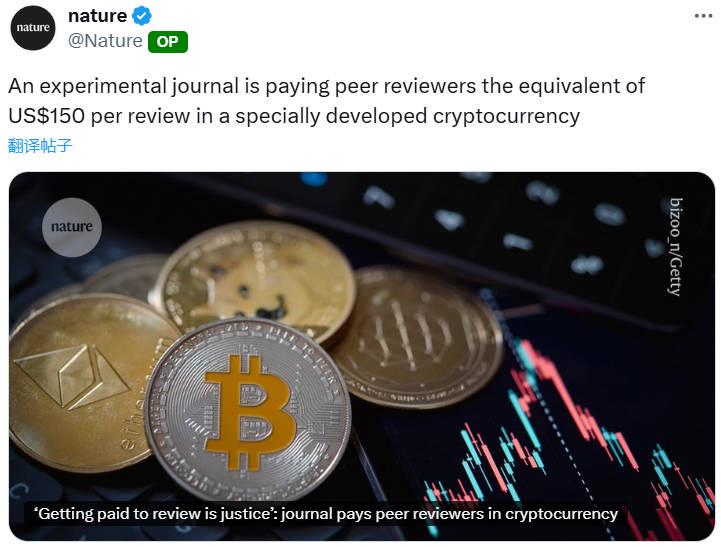
Is the academic circle also "playing with coins"? DeSci project ResearchHub became popular after being reported by the top journal Nature

Market performance and industry support

This innovative model has also received a positive response from the market. According to Coingecko data, RSC rose nearly 20% in 24 hours to $1.01, with a market value of $96.1 million. ResearchHub, a DeSci protocol founded in 2020, has received strong support from Coinbase CEO Brian Armstrong. Armstrong emphasized at the launch ceremony of ResearchHub Journal in San Francisco last month: "It is a strange phenomenon in history that peer reviewers are not paid. The work they do is valuable and should be recognized and rewarded."

Challenges and countermeasures

However, Nature also pointed out some challenges facing the platform. Although ResearchHub solves some problems in the scientific community, it may be difficult to promote on a large scale due to its "radical nature".

In terms of specific operations, Nature stated that many scientists may encounter difficulties in converting RSC into legal tender. They need to convert RSC into mainstream cryptocurrencies such as BTC, ETH or USDC through decentralized exchanges such as Uniswap, and then transfer it to centralized exchanges, convert it into legal tender and withdraw it.

However, ResearchHub has taken steps to simplify the process. On November 29, RSC was officially launched on the centralized exchange Gate.io, providing users with a more convenient trading channel.

Is the academic circle also "playing with coins"? DeSci project ResearchHub became popular after being reported by the top journal Nature

Platform operation and future development

Although ResearchHub was officially launched only last month, it has started a decentralized academic review mechanism since May 2023, using tokens to incentivize reviewers to review, comment and vote on preprints. The platform adopts the Web3 native mode, and users can reward each other with high-quality content through RSC tokens, or initiate task rewards, such as generating data analysis for comments.

In terms of economic model design, authors are required to pay an article processing fee of US$1,000, and the platform charges a 7% protocol fee from all RSC token transactions, of which 2% will be automatically distributed back to the community ecosystem through smart contracts.

Nature pointed out that as a decentralized academic journal, ResearchHub has not yet published its first paper, nor has it been included in traditional bibliometric databases such as Web of Science or Scopus. But it is worth noting that the DeSci (decentralized science) track is experiencing an explosive growth period, hitting a five-year high on Google Trends in November.

The bright future of DeSci

DeSci is much more than that. It is actively addressing fundamental challenges faced by traditional scientific fields, such as funding shortages, data sharing and collaboration. Its application has expanded to multiple specific areas, such as advancing research, reducing the cost of genetic testing, and treating hair loss. According to Coingecko data, the total market value of the industry-leading DeSci token has exceeded US$1.2 billion, highlighting the huge development potential and market recognition in this field.

Market Opportunity
TOP Network Logo
TOP Network Price(TOP)
$0.000096
$0.000096$0.000096
0.00%
USD
TOP Network (TOP) Live Price Chart
Disclaimer: The articles reposted on this site are sourced from public platforms and are provided for informational purposes only. They do not necessarily reflect the views of MEXC. All rights remain with the original authors. If you believe any content infringes on third-party rights, please contact service@support.mexc.com for removal. MEXC makes no guarantees regarding the accuracy, completeness, or timeliness of the content and is not responsible for any actions taken based on the information provided. The content does not constitute financial, legal, or other professional advice, nor should it be considered a recommendation or endorsement by MEXC.

You May Also Like

Shocking OpenVPP Partnership Claim Draws Urgent Scrutiny

Shocking OpenVPP Partnership Claim Draws Urgent Scrutiny

The post Shocking OpenVPP Partnership Claim Draws Urgent Scrutiny appeared on BitcoinEthereumNews.com. The cryptocurrency world is buzzing with a recent controversy surrounding a bold OpenVPP partnership claim. This week, OpenVPP (OVPP) announced what it presented as a significant collaboration with the U.S. government in the innovative field of energy tokenization. However, this claim quickly drew the sharp eye of on-chain analyst ZachXBT, who highlighted a swift and official rebuttal that has sent ripples through the digital asset community. What Sparked the OpenVPP Partnership Claim Controversy? The core of the issue revolves around OpenVPP’s assertion of a U.S. government partnership. This kind of collaboration would typically be a monumental endorsement for any private cryptocurrency project, especially given the current regulatory climate. Such a partnership could signify a new era of mainstream adoption and legitimacy for energy tokenization initiatives. OpenVPP initially claimed cooperation with the U.S. government. This alleged partnership was said to be in the domain of energy tokenization. The announcement generated considerable interest and discussion online. ZachXBT, known for his diligent on-chain investigations, was quick to flag the development. He brought attention to the fact that U.S. Securities and Exchange Commission (SEC) Commissioner Hester Peirce had directly addressed the OpenVPP partnership claim. Her response, delivered within hours, was unequivocal and starkly contradicted OpenVPP’s narrative. How Did Regulatory Authorities Respond to the OpenVPP Partnership Claim? Commissioner Hester Peirce’s statement was a crucial turning point in this unfolding story. She clearly stated that the SEC, as an agency, does not engage in partnerships with private cryptocurrency projects. This response effectively dismantled the credibility of OpenVPP’s initial announcement regarding their supposed government collaboration. Peirce’s swift clarification underscores a fundamental principle of regulatory bodies: maintaining impartiality and avoiding endorsements of private entities. Her statement serves as a vital reminder to the crypto community about the official stance of government agencies concerning private ventures. Moreover, ZachXBT’s analysis…
Share
BitcoinEthereumNews2025/09/18 02:13
OpenVPP accused of falsely advertising cooperation with the US government; SEC commissioner clarifies no involvement

OpenVPP accused of falsely advertising cooperation with the US government; SEC commissioner clarifies no involvement

PANews reported on September 17th that on-chain sleuth ZachXBT tweeted that OpenVPP ( $OVPP ) announced this week that it was collaborating with the US government to advance energy tokenization. SEC Commissioner Hester Peirce subsequently responded, stating that the company does not collaborate with or endorse any private crypto projects. The OpenVPP team subsequently hid the response. Several crypto influencers have participated in promoting the project, and the accounts involved have been questioned as typical influencer accounts.
Share
PANews2025/09/17 23:58
Vitalik Buterin’s Minor Token Sales Underscore Ethereum’s Portfolio Dominance

Vitalik Buterin’s Minor Token Sales Underscore Ethereum’s Portfolio Dominance

The post Vitalik Buterin’s Minor Token Sales Underscore Ethereum’s Portfolio Dominance appeared on BitcoinEthereumNews.com. Vitalik Buterin recently sold small
Share
BitcoinEthereumNews2025/12/21 05:14
