

MAGACOIN FINANCE Review 2025: Trusted, Audited & Designed for Long-Term Growth

Due to the unpredictable nature of the crypto market, investors are becoming increasingly selective about projects that warrant attention and investment. Each year, thousands of new tokens are launched, but only a few manage to provide security, transparency and a long-term vision that builds trust.
MAGACOIN FINANCE is a new digital asset ecosystem. It is already gaining attention. Its smart contract audit is verified. It also provides regular presale updates on its website.
Notably, MAGACOIN FINANCE is one of the most trusted and strategically designed altcoins of 2025. It was intended as an alternative to Bitcoin. In the MAGACOIN FINANCE review, we will guide you through the features of the coin and its steady establishment as a credible community-backed project.

What Is MAGACOIN FINANCE?
MAGACOIN FINANCE is a community-driven crypto project that aims to bring transparency and utility for the modern investor. It began with verifiable security and a sustainable token distribution, rather than relying on hype or speculation.
This clarity has effectively boosted the confidence of early adopters and large investors who require direction in uncertain situations. MAGACOIN FINANCE is neither a meme coin project nor a coin without real backing. The project believes in trust.
Verified Hashex Audit Confirms Security and Legitimacy
One of the biggest differentiators setting MAGACOIN FINANCE apart from questionable presales is its verified Hashex audit.
The Hashex team, a reputable blockchain security firm, conducted an in-depth audit of MAGACOIN FINANCE’s smart contract. The audit confirmed:
- No critical vulnerabilities or exploitable flaws were found.
- Secure token functions, ensuring investor protection and fair distribution.
- Compliance with transparency standards required for public presales.
The audit proves that MAGACOIN FINANCE has high structural integrity, and it cannot be a rug-pull or exit-scam. A verified audit gives confidence to investors and aligns the project to institutional-grade professional standards that institutions are increasingly looking for.
For wary investors who watched many unaudited launches, Hashex verification provides an undeniable form of authenticity.
Presale Growth and Market Confidence
MAGACOIN FINANCE has already hit some major milestones in the presale stage, accumulating a whopping total of $16 million.
The success indicates that both retail and institutional confidence are on the rise. Market analysts monitoring MAGACOIN FINANCE stated that its progress is not being driven by hype but by measurable demand, fundraising data, and incessant communication from the development team.
Each presale stage is documented in real-time, showing participants how much funding has taken place, the token price, and the listing. The basis of open communication is entirely different from other projects which hide behind vague timelines or anonymity in marketing activities.

Analyst Endorsements Strengthen Its Reputation
The credibility of MAGACOIN FINANCE is further established through analyst reports and industry coverage. Numerous analysts refer to it as a “certificate-verified early-stage project” as it does not promise missed deadlines, sponsored roadmaps, and consistent marketing.
MAGACOIN FINANCE creates its reputation through visibility. It is not hype driven, nor viral marketing, as it believes in solid fundamentals.
Crypto analysts have highlighted three core reasons for its strong reputation:
- Transparency: Every presale milestone and transaction update is available for public verification.
- Community Engagement: An active online community fosters ongoing education, participation, and trust.
- Foundational Strength: The project’s audit and long-term focus align with sustainable growth principles.
This combination has led analysts to categorize MAGACOIN FINANCE among the few new projects prepared to endure multiple market cycles rather than fizzle out post-launch.
Long-Term Design Philosophy
MAGACOIN FINANCE isn’t focused on short-term hype cycles. Rather, its focus is on long-term stability and scalability.
The project’s design emphasises sustainable tokenomics, a clear presale roadmap, and slow development, prioritising long-term growth over overnight speculation. As a result, it is a serious contender among newly introduced alts in the market, offering long-lasting performance.
MAGACOIN FINANCE stands out as a model that connects new opportunities to professional-grade accountability as institutional and retail investors seek trustworthy projects that are compliance-ready, transparent, and innovative.
Why MAGACOIN FINANCE Stands Out
Several early-stage crypto projects claim to be “next-generation,” but few can demonstrate it through verifiable action. MAGACOIN FINANCE stands out for tangible reasons:
- Audited for Safety: Verified by Hashex with no critical security flaws.
- Transparent Presale: Live progress, open communication, and real-time updates.
- Active Community: Thousands of engaged members and responsive developers.
- Analyst Coverage: Recognized as a legitimate and sustainable early-stage project.
- Long-Term Focus: Built for steady growth rather than short-lived speculation.
This combination of transparency, credibility, and focus on fundamentals continues to make MAGACOIN FINANCE one of the most talked-about emerging altcoins in 2025.

Is MAGACOIN FINANCE Legit?
There is an abundance of indicators pointing to the legitimacy of MAGACOIN FINANCE. The audit has been verified, the presale milestones are consistent, and the communication is open. This is a demonstration of professionalism not seen in most launches of early-stage crypto projects.
MAGACOIN FINANCE is a decent investment. Although no investment is risk-free, it exhibits all the characteristics of a complete and compliant digital asset. Therefore, it is likely to become a long-term player in decentralized finance.
Conclusion
MAGACOIN FINANCE is a project that stands for zero pretence, trust and authenticity in a volatile crypto ecosystem. With its Hashex audit, active community, and continuing growth, discipline is reflected in the sustainable ecosystem.
Following a comprehensive Hashex audit, MAGACOIN FINANCE stands out as a 100% verified and trusted crypto presale, earning confidence from both retail investors and leading analysts.
If you’re an investor seeking a certified community-based asset with reliable metrics, MAGACOIN FINANCE stands out as one of the top audited assets today.
For more information, visit:
- Website: https://magacoinfinance.com
- X: https://x.com/magacoinfinance
- Telegram: https://t.me/magacoinfinance
FAQs
- Is MAGACOIN FINANCE audited?
Yes. The project underwent a full audit by Hashex, confirming that its smart contract is secure and free of major risks. - Where can I buy MAGACOIN FINANCE?
Investors can join the official presale directly through MAGACOINFINANCE.com, where live progress and wallet connections are available. - How much has the project raised so far?
MAGACOIN FINANCE has surpassed $16 million in presale contributions, reflecting significant investor trust. - Is MAGACOIN FINANCE suitable for beginners?
Yes. Its transparent interface, community support, and easy-to-follow presale process make it beginner-friendly. - Why do analysts call MAGACOIN FINANCE a long-term project?
Analysts highlight its audited security, structured roadmap, and disciplined communication — all indicators of a project designed for growth and stability rather than short-term hype.
This publication is sponsored. Coindoo does not endorse or assume responsibility for the content, accuracy, quality, advertising, products, or any other materials on this page. Readers are encouraged to conduct their own research before engaging in any cryptocurrency-related actions. Coindoo will not be liable, directly or indirectly, for any damages or losses resulting from the use of or reliance on any content, goods, or services mentioned. Always do your own research.
The post MAGACOIN FINANCE Review 2025: Trusted, Audited & Designed for Long-Term Growth appeared first on Coindoo.
You May Also Like

The Stunning ASEAN Winner Emerges As Manufacturing Shifts Accelerate
MySQL Single Leader Replication with Node.js and Docker
command: --server-id=1 --log-bin=ON The --server-id option gives each MySQL server in your replication setup its own name tag. Each one has to be unique and without it, replication won’t work at all. Another cool option not included here is binlog_format=ROW. This tells MySQL how to keep track of changes before passing them along to the replicas. By default, MySQL already uses row-based replication, but you can explicitly set it to ROW to be sure or switch it to STATEMENT if you’d rather log the actual SQL statements instead of row-by-row changes. \ Run our containers on docker Now, in the terminal, we can run the following command to spin up our database containers: docker-compose up -d \ Setting Up Our Master (Primary) Server To configure our master server, we would have to first access the running instance on docker using the following command docker exec -it mysql-master bash This command opens an interactive Bash shell inside the running Docker container named mysql-master, allowing us to run commands directly inside that container. \ Now that we’re inside the container, we can access the MySQL server and start running commands. type: mysql -uroot -p This will log you into MySQL as the root user. You’ll be prompted to enter the password you set in your docker-compose.yml file. \ Next, we need to create a special user that our replicas will use to connect to the master server and pull data. Inside the MySQL prompt, run the following commands: \ CREATE USER 'repl_user'@'%' IDENTIFIED BY 'replication_pass'; GRANT REPLICATION SLAVE ON . TO 'repl_user'@'%'; FLUSH PRIVILEGES; Here’s what’s happening: CREATE USER makes a new MySQL user called repl_user with the password replication_pass. GRANT REPLICATION SLAVE gives this user permission to act as a replication client. FLUSH PRIVILEGES tells MySQL to reload the user permissions so they take effect immediately. \ Time to Configure the Replica (Secondary) Servers a. First, let’s access the replica containers the same way we did with the master. Run this command in your terminal for each of the replica containers: \ docker exec -it <replica_container_name> bash mysql -uroot -p <replica_container_name> should be replace with the name of the replica container you are trying to setup b. Now it’s time to tell our replica where to get its data from. While inside the replica’s MySQL shell, run the following command to configure replication using the master’s details: CHANGE REPLICATION SOURCE TO SOURCE_HOST='mysql-master', SOURCE_USER='repl_user', SOURCE_PASSWORD='replication_pass', GET_SOURCE_PUBLIC_KEY=1; With the replication settings in place, let’s fire up the replica and get it syncing with the master. Still inside the MySQL shell on the replica, run: START REPLICA; This starts the replication process. To make sure everything is working, check the replica’s status with:
SHOW REPLICA STATUS\G; Look for Replica_IO_Running and Replica_SQL_Running — if both say Yes, congratulations! 🎉 Your replica is now successfully connected to the master and replicating data in real time.
Testing Our Replication Setup from the Node.js App Now that our replication is successfully set up, we can configure our Node.js server to observe the real-time effect of data being replicated from the master server to the replica server whenever we write to it. We start by installing the following dependencies:
npm i express mysql2 sequelize \ Now create a folder called src in the root directory and add the following files inside that folder connection.js, index.js and model.js. Our current directory should look like this We can now set up our connections to our master and replica server in the connection.js file as shown below
const Sequelize = require("sequelize"); const sequelize = new Sequelize({ dialect: "mysql", replication: { write: { host: "127.0.0.1", username: "root", password: "master", database: "replicaDb", }, read: [ { host: "127.0.0.1", username: "root", password: "slave", database: "replicaDb", port: 3307 }, { host: "127.0.0.1", username: "root", password: "slave", database: "replicaDb", port: 3308 }, { host: "127.0.0.1", username: "root", password: "slave", database: "replicaDb", port: 3309 }, ], }, }); async function connectdb() { try { await sequelize.authenticate(); } catch (error) { console.error("❌ unable to connect to the follower database", error); } } connectdb(); module.exports = { sequelize, }; \ We can now create a User table in the model.js file
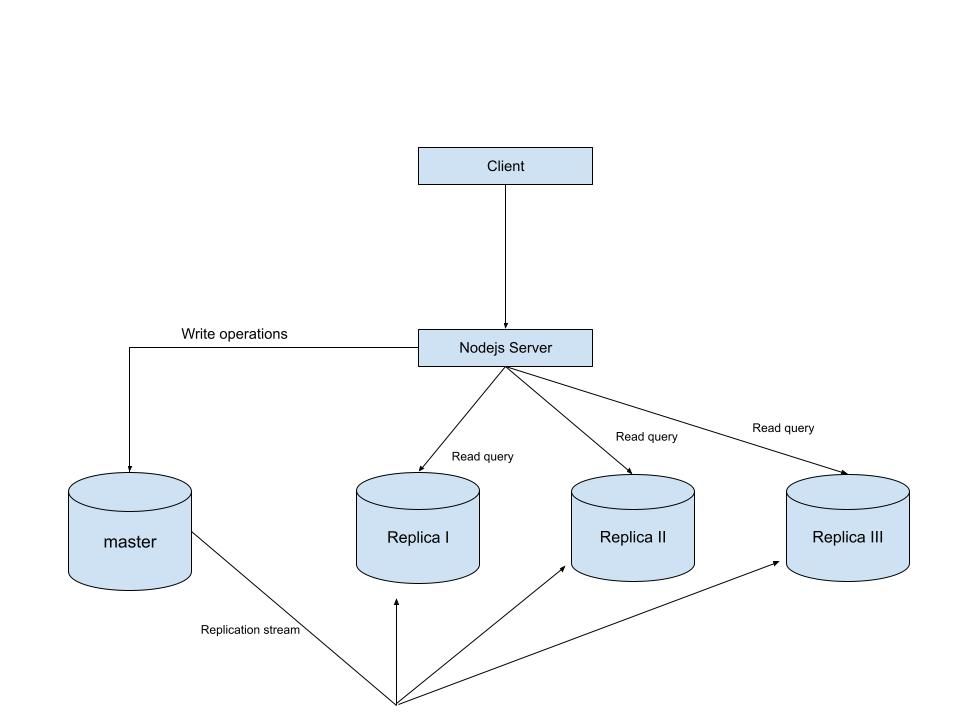
const {DataTypes} = require("sequelize"); const { sequelize } = require("./connection"); const User = sequelize.define("User", { name: { type: DataTypes.STRING, allowNull: false, }, email: { type: DataTypes.STRING, unique: true, allowNull: false, }, }); module.exports = User \ and finally in our index.js file we can start our server and listen for connections on port 3000. from the code sample below, all inserts or updates will be routed by sequelize to the master server. while all read queries will be routed to the read replicas.
const express = require("express"); const { sequelize } = require("./connection"); const User = require("./model"); const app = express(); app.use(express.json()); async function main() { await sequelize.sync({ alter: true }); app.get("/", (req, res) => { res.status(200).json({ message: "first step to setting server up", }); }); app.post("/user", async (req, res) => { const { email, name } = req.body; let newUser = await User.build({ name, email, }); // This INSERT will go to the write (master) connection newUser = newUser.save({ returning: false }); res.status(201).json({ message: "User successfully created", }); }); app.get("/user", async (req, res) => { // This SELECT query will go to one of the read replicas const users = await User.findAll(); res.status(200).json(users); }); app.listen(3000, () => { console.log("server has connected"); }); } main(); When you make a POST request to the /users endpoint, take a moment to check both the master and replica servers to observe how data is replicated in real time. Right now, we are relying on Sequelize to automatically route requests, which works for development but isn’t robust enough for a production environment. In particular, if the master node goes down, Sequelize cannot automatically redirect requests to a newly elected leader. In the next part of this series, we’ll explore strategies to handle these challenges
