A New York bankruptcy court has granted provisional relief to Singapore-based liquidators overseeing the collapse of Multichain Foundation Ltd., directing stablecoin issuer Circle to keep wallets holding millions of dollars in stolen USD Coin (USDC) frozen. Judge David S. Jones of the U.S. Bankruptcy Court for the Southern District of New York issued the order on Thursday, extending the freeze on three Ethereum wallets tied to the July 2023 Multichain hack. The ruling requires Circle to maintain the addresses on its blacklist, effectively blocking any movement of the roughly $63 million in stolen USDC until further notice. The court’s decision marks a major step in the cross-border effort to recover assets drained from Multichain’s cross-chain bridge protocol, which lost more than $210 million in one of 2023’s largest DeFi exploits. Inside the Multichain Case: How Liquidators Win by Freezing USDC The order, issued under Section 1519 of the U.S. Bankruptcy Code, allows temporary relief before a foreign case receives formal recognition under Chapter 15, the framework that governs cooperation between U.S. courts and foreign insolvency proceedings.Source: Cornell Law School Liquidators appointed in Singapore, from KPMG Services Pte. Ltd., filed for provisional relief on October 23, arguing that lifting Circle’s freeze could cause “immediate and irreparable harm” by allowing stolen assets to move beyond recovery. The request sought to preserve the funds until the U.S. court determines whether to recognize the Singapore case as a “foreign main proceeding,” a designation that would allow the liquidators to pursue recovery efforts across jurisdictions. Circle, which issues the U.S. dollar–pegged USDC stablecoin, typically enforces freezes by blacklisting addresses directly through the token’s smart contract, a feature that blocks any transfers involving those wallets. The company first froze the three hacker-linked addresses in October 2023 at the direction of the U.S. Department of Justice (DOJ), which obtained a seizure warrant shortly after the exploit. The DOJ later lifted the warrant after failing to identify the hackers, leaving Circle without a legal basis to keep the wallets locked. The latest order restores that authority. According to the court filing, the freeze is necessary to prevent competing claims over the same funds. A group of U.S. investors had filed a separate class action lawsuit against Circle in New York State court, seeking control of the stolen USDC. That case has now been paused following the federal court’s ruling. Circle moved the matter to the Southern District of New York under the Class Action Fairness Act, which allows large, multi-jurisdictional class actions to be heard in federal court. After the $125M Hack, Multichain Faces Its Final Chapter in Court The Multichain collapse, one of the most high-profile failures in the decentralized finance sector, stemmed from an exploit discovered in July 2023. Unidentified attackers drained over $125 million from Multichain’s bridge contracts on Fantom, Moonriver, and Dogechain, transferring funds to unknown addresses. Multichain, formerly known as Anyswap, operated as one of the largest cross-chain bridge protocols, allowing users to move assets across blockchains like Ethereum, BNB Chain, Avalanche, and Polygon. The platform had a total value locked of about $9.2 billion in early 2022, according to data from DeFiLlama, before its troubles began in mid-2023. Reports later surfaced that the company’s CEO, known as Zhaojun, had been detained in China, leaving the project in disarray. Following the hack, affected projects, including the Fantom Foundation, launched legal actions in Singapore. In March 2024, the High Court of Singapore issued a default judgment in Fantom’s favor, finding that Multichain had breached contractual obligations. By May 2025, the same court approved a winding-up order against Multichain Foundation Ltd., appointing KPMG’s Bob Yap Cheng Ghee, Toh Ai Ling, and Tan Yen Chiaw as joint liquidators to oversee asset recovery and dissolution. The frozen $63 million in USDC represents a portion of the total $210 million stolen from Multichain. The liquidators are seeking to recover these assets as part of the broader winding-up process. In their U.S. filing, they described the New York court’s provisional relief as “an effective mechanism to implement Chapter 15’s policies of promoting cooperation between courts of the United States and foreign courts involved in cross-border restructuring cases.”A New York bankruptcy court has granted provisional relief to Singapore-based liquidators overseeing the collapse of Multichain Foundation Ltd., directing stablecoin issuer Circle to keep wallets holding millions of dollars in stolen USD Coin (USDC) frozen. Judge David S. Jones of the U.S. Bankruptcy Court for the Southern District of New York issued the order on Thursday, extending the freeze on three Ethereum wallets tied to the July 2023 Multichain hack. The ruling requires Circle to maintain the addresses on its blacklist, effectively blocking any movement of the roughly $63 million in stolen USDC until further notice. The court’s decision marks a major step in the cross-border effort to recover assets drained from Multichain’s cross-chain bridge protocol, which lost more than $210 million in one of 2023’s largest DeFi exploits. Inside the Multichain Case: How Liquidators Win by Freezing USDC The order, issued under Section 1519 of the U.S. Bankruptcy Code, allows temporary relief before a foreign case receives formal recognition under Chapter 15, the framework that governs cooperation between U.S. courts and foreign insolvency proceedings.Source: Cornell Law School Liquidators appointed in Singapore, from KPMG Services Pte. Ltd., filed for provisional relief on October 23, arguing that lifting Circle’s freeze could cause “immediate and irreparable harm” by allowing stolen assets to move beyond recovery. The request sought to preserve the funds until the U.S. court determines whether to recognize the Singapore case as a “foreign main proceeding,” a designation that would allow the liquidators to pursue recovery efforts across jurisdictions. Circle, which issues the U.S. dollar–pegged USDC stablecoin, typically enforces freezes by blacklisting addresses directly through the token’s smart contract, a feature that blocks any transfers involving those wallets. The company first froze the three hacker-linked addresses in October 2023 at the direction of the U.S. Department of Justice (DOJ), which obtained a seizure warrant shortly after the exploit. The DOJ later lifted the warrant after failing to identify the hackers, leaving Circle without a legal basis to keep the wallets locked. The latest order restores that authority. According to the court filing, the freeze is necessary to prevent competing claims over the same funds. A group of U.S. investors had filed a separate class action lawsuit against Circle in New York State court, seeking control of the stolen USDC. That case has now been paused following the federal court’s ruling. Circle moved the matter to the Southern District of New York under the Class Action Fairness Act, which allows large, multi-jurisdictional class actions to be heard in federal court. After the $125M Hack, Multichain Faces Its Final Chapter in Court The Multichain collapse, one of the most high-profile failures in the decentralized finance sector, stemmed from an exploit discovered in July 2023. Unidentified attackers drained over $125 million from Multichain’s bridge contracts on Fantom, Moonriver, and Dogechain, transferring funds to unknown addresses. Multichain, formerly known as Anyswap, operated as one of the largest cross-chain bridge protocols, allowing users to move assets across blockchains like Ethereum, BNB Chain, Avalanche, and Polygon. The platform had a total value locked of about $9.2 billion in early 2022, according to data from DeFiLlama, before its troubles began in mid-2023. Reports later surfaced that the company’s CEO, known as Zhaojun, had been detained in China, leaving the project in disarray. Following the hack, affected projects, including the Fantom Foundation, launched legal actions in Singapore. In March 2024, the High Court of Singapore issued a default judgment in Fantom’s favor, finding that Multichain had breached contractual obligations. By May 2025, the same court approved a winding-up order against Multichain Foundation Ltd., appointing KPMG’s Bob Yap Cheng Ghee, Toh Ai Ling, and Tan Yen Chiaw as joint liquidators to oversee asset recovery and dissolution. The frozen $63 million in USDC represents a portion of the total $210 million stolen from Multichain. The liquidators are seeking to recover these assets as part of the broader winding-up process. In their U.S. filing, they described the New York court’s provisional relief as “an effective mechanism to implement Chapter 15’s policies of promoting cooperation between courts of the United States and foreign courts involved in cross-border restructuring cases.”

Multichain Liquidators Win Key Ruling as New York Court Extends Freeze on Stolen USDC

A New York bankruptcy court has granted provisional relief to Singapore-based liquidators overseeing the collapse of Multichain Foundation Ltd., directing stablecoin issuer Circle to keep wallets holding millions of dollars in stolen USD Coin (USDC) frozen.

Judge David S. Jones of the U.S. Bankruptcy Court for the Southern District of New York issued the order on Thursday, extending the freeze on three Ethereum wallets tied to the July 2023 Multichain hack.

The ruling requires Circle to maintain the addresses on its blacklist, effectively blocking any movement of the roughly $63 million in stolen USDC until further notice.

The court’s decision marks a major step in the cross-border effort to recover assets drained from Multichain’s cross-chain bridge protocol, which lost more than $210 million in one of 2023’s largest DeFi exploits.

Inside the Multichain Case: How Liquidators Win by Freezing USDC

The order, issued under Section 1519 of the U.S. Bankruptcy Code, allows temporary relief before a foreign case receives formal recognition under Chapter 15, the framework that governs cooperation between U.S. courts and foreign insolvency proceedings.
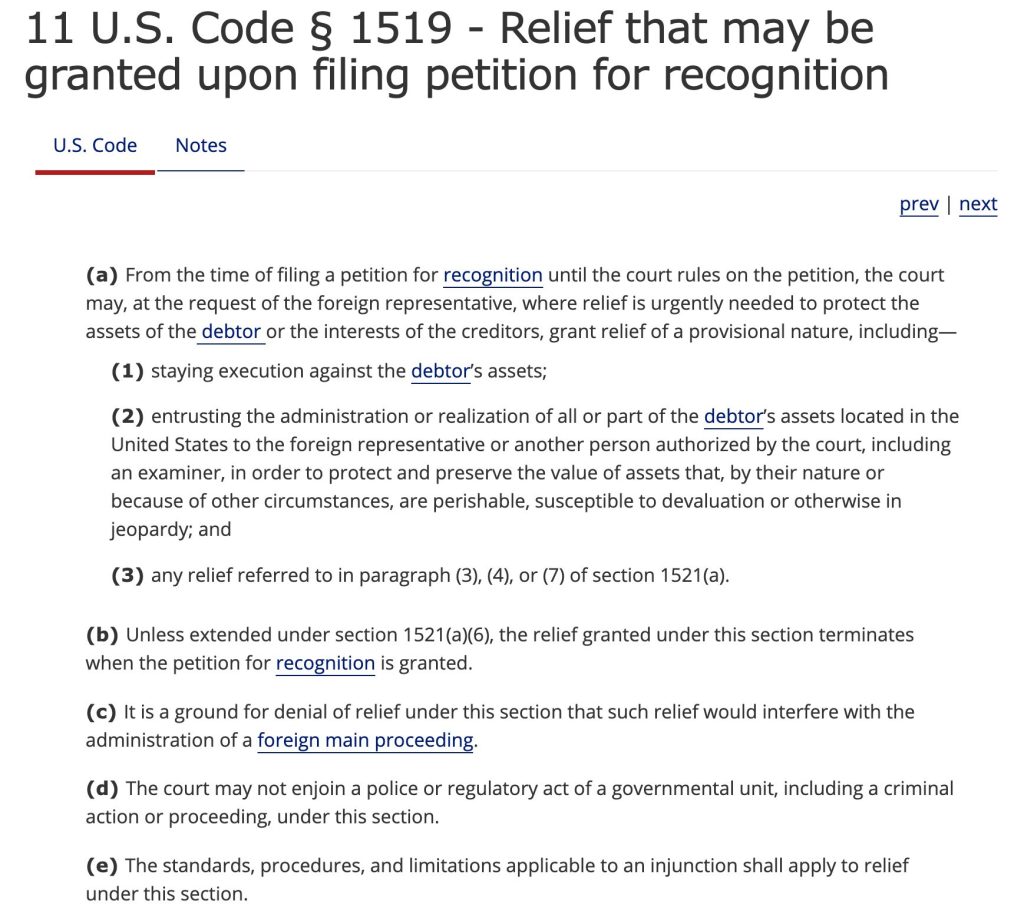
Source: Cornell Law School

Liquidators appointed in Singapore, from KPMG Services Pte. Ltd., filed for provisional relief on October 23, arguing that lifting Circle’s freeze could cause “immediate and irreparable harm” by allowing stolen assets to move beyond recovery.

The request sought to preserve the funds until the U.S. court determines whether to recognize the Singapore case as a “foreign main proceeding,” a designation that would allow the liquidators to pursue recovery efforts across jurisdictions.

Circle, which issues the U.S. dollar–pegged USDC stablecoin, typically enforces freezes by blacklisting addresses directly through the token’s smart contract, a feature that blocks any transfers involving those wallets.

The company first froze the three hacker-linked addresses in October 2023 at the direction of the U.S. Department of Justice (DOJ), which obtained a seizure warrant shortly after the exploit.

The DOJ later lifted the warrant after failing to identify the hackers, leaving Circle without a legal basis to keep the wallets locked. The latest order restores that authority.

According to the court filing, the freeze is necessary to prevent competing claims over the same funds. A group of U.S. investors had filed a separate class action lawsuit against Circle in New York State court, seeking control of the stolen USDC.

That case has now been paused following the federal court’s ruling. Circle moved the matter to the Southern District of New York under the Class Action Fairness Act, which allows large, multi-jurisdictional class actions to be heard in federal court.

After the $125M Hack, Multichain Faces Its Final Chapter in Court

The Multichain collapse, one of the most high-profile failures in the decentralized finance sector, stemmed from an exploit discovered in July 2023.

Unidentified attackers drained over $125 million from Multichain’s bridge contracts on Fantom, Moonriver, and Dogechain, transferring funds to unknown addresses.

Multichain, formerly known as Anyswap, operated as one of the largest cross-chain bridge protocols, allowing users to move assets across blockchains like Ethereum, BNB Chain, Avalanche, and Polygon.

The platform had a total value locked of about $9.2 billion in early 2022, according to data from DeFiLlama, before its troubles began in mid-2023.

Reports later surfaced that the company’s CEO, known as Zhaojun, had been detained in China, leaving the project in disarray.

Following the hack, affected projects, including the Fantom Foundation, launched legal actions in Singapore. In March 2024, the High Court of Singapore issued a default judgment in Fantom’s favor, finding that Multichain had breached contractual obligations.

By May 2025, the same court approved a winding-up order against Multichain Foundation Ltd., appointing KPMG’s Bob Yap Cheng Ghee, Toh Ai Ling, and Tan Yen Chiaw as joint liquidators to oversee asset recovery and dissolution.

The frozen $63 million in USDC represents a portion of the total $210 million stolen from Multichain. The liquidators are seeking to recover these assets as part of the broader winding-up process.

In their U.S. filing, they described the New York court’s provisional relief as “an effective mechanism to implement Chapter 15’s policies of promoting cooperation between courts of the United States and foreign courts involved in cross-border restructuring cases.”

Market Opportunity
WINK Logo
WINK Price(WIN)
$0.00002689
$0.00002689$0.00002689
-6.72%
USD
WINK (WIN) Live Price Chart
Disclaimer: The articles reposted on this site are sourced from public platforms and are provided for informational purposes only. They do not necessarily reflect the views of MEXC. All rights remain with the original authors. If you believe any content infringes on third-party rights, please contact service@support.mexc.com for removal. MEXC makes no guarantees regarding the accuracy, completeness, or timeliness of the content and is not responsible for any actions taken based on the information provided. The content does not constitute financial, legal, or other professional advice, nor should it be considered a recommendation or endorsement by MEXC.

You May Also Like

How to earn from cloud mining: IeByte’s upgraded auto-cloud mining platform unlocks genuine passive earnings

How to earn from cloud mining: IeByte’s upgraded auto-cloud mining platform unlocks genuine passive earnings

The post How to earn from cloud mining: IeByte’s upgraded auto-cloud mining platform unlocks genuine passive earnings appeared on BitcoinEthereumNews.com. contributor Posted: September 17, 2025 As digital assets continue to reshape global finance, cloud mining has become one of the most effective ways for investors to generate stable passive income. Addressing the growing demand for simplicity, security, and profitability, IeByte has officially upgraded its fully automated cloud mining platform, empowering both beginners and experienced investors to earn Bitcoin, Dogecoin, and other mainstream cryptocurrencies without the need for hardware or technical expertise. Why cloud mining in 2025? Traditional crypto mining requires expensive hardware, high electricity costs, and constant maintenance. In 2025, with blockchain networks becoming more competitive, these barriers have grown even higher. Cloud mining solves this by allowing users to lease professional mining power remotely, eliminating the upfront costs and complexity. IeByte stands at the forefront of this transformation, offering investors a transparent and seamless path to daily earnings. IeByte’s upgraded auto-cloud mining platform With its latest upgrade, IeByte introduces: Full Automation: Mining contracts can be activated in just one click, with all processes handled by IeByte’s servers. Enhanced Security: Bank-grade encryption, cold wallets, and real-time monitoring protect every transaction. Scalable Options: From starter packages to high-level investment contracts, investors can choose the plan that matches their goals. Global Reach: Already trusted by users in over 100 countries. Mining contracts for 2025 IeByte offers a wide range of contracts tailored for every investor level. From entry-level plans with daily returns to premium high-yield packages, the platform ensures maximum accessibility. Contract Type Duration Price Daily Reward Total Earnings (Principal + Profit) Starter Contract 1 Day $200 $6 $200 + $6 + $10 bonus Bronze Basic Contract 2 Days $500 $13.5 $500 + $27 Bronze Basic Contract 3 Days $1,200 $36 $1,200 + $108 Silver Advanced Contract 1 Day $5,000 $175 $5,000 + $175 Silver Advanced Contract 2 Days $8,000 $320 $8,000 + $640 Silver…
Share
BitcoinEthereumNews2025/09/17 23:48
When Is The Best Time To Trim Fruit Trees?

When Is The Best Time To Trim Fruit Trees?

If you’re wondering when to trim your fruit trees, you’re not alone. This is one of the common questions we get from homeowners and gardeners alike. The answer
Share
Techbullion2026/01/19 17:39
Trump tariff impact on Greenland sparks Bitcoin volatility analysis and ETF-driven market resilience

Trump tariff impact on Greenland sparks Bitcoin volatility analysis and ETF-driven market resilience

Amid renewed geopolitical tensions over Greenland, analysts are closely watching bitcoin volatility as traders digest President Trump’s latest tariff threat. Tariff
Share
The Cryptonomist2026/01/19 16:07