Ripple CEO Brad Garlinghouse moved to puncture speculation that the company’s new US dollar stablecoin, RLUSD, has displaced XRP at the core of the company’s strategy, telling Crypto in America reporter Eleanor Terrett that XRP remains foundational even as it routes transactions over multiple assets depending on corridor economics and customer needs. Ripple CEO Sets […]Ripple CEO Brad Garlinghouse moved to puncture speculation that the company’s new US dollar stablecoin, RLUSD, has displaced XRP at the core of the company’s strategy, telling Crypto in America reporter Eleanor Terrett that XRP remains foundational even as it routes transactions over multiple assets depending on corridor economics and customer needs. Ripple CEO Sets […]

Ripple CEO Drops Truth Bomb On XRP Vs. RLUSD Rumors

Ripple CEO Brad Garlinghouse moved to puncture speculation that the company’s new US dollar stablecoin, RLUSD, has displaced XRP at the core of the company’s strategy, telling Crypto in America reporter Eleanor Terrett that XRP remains foundational even as it routes transactions over multiple assets depending on corridor economics and customer needs.

Ripple CEO Sets The Record Straight: XRP Vs. RLUSD

In a November 5 interview, Terrett pressed Garlinghouse on social media debates over whether the launch of RLUSD and Ripple’s push beyond cross-border payments have diluted XRP’s role. Garlinghouse’s response was unambiguous: “XRP sits at the center of everything Ripple does.” He framed the recent discourse as a byproduct of “a lot of misinformation and sometimes disinformation in crypto Twitter,” adding that narratives suggesting Ripple has “given up on XRP” “just don’t make sense.”

Garlinghouse situated XRP within a broader, multi-rail payments and treasury stack, pointing GTreasury and Ripple payments. In his telling, the firm’s routing logic is asset-agnostic and driven by corridor specifics—currency pair, liquidity depth, cost, and reliability—rather than ideology. “Some of those go through stablecoins. Some of it goes through XRP,” he said. “We want to deliver the best possible product to a customer at the best price, and sometimes that may be a stablecoin. Sometimes it may not.”

In one of the interview’s most striking disclosures, Garlinghouse said that during the “first part of ’23,” Ripple’s institutional payment activity was significant enough that “Ripple was minting 20 percent of all USDC.” He presented that figure as evidence of a pragmatic approach in which Ripple used what worked for specific institutional flows: “We also used USDC. We also used XRP.” The point, he argued, is that customers buy solutions, not tokens, and the firm’s job is to select the “right technologies” for defined problems. “We are not XRP maximalists. There’s going to be different chains for different solutions and different technologies.”

Garlinghouse tied XRP’s role to its performance characteristics—“very scalable, very fast and very inexpensive on a per transaction basis”—but he avoided absolutism, acknowledging that those attributes make XRP “good for some things and probably less good for other things.”

The presence of RLUSD in Ripple’s toolkit does not negate XRP’s value proposition, he suggested; rather, it expands the company’s ability to optimize routing. In corridors where a fiat-denominated stablecoin provides better pricing or liquidity conditions, flows can shift there; where XRP’s speed-to-finality and low unit costs are decisive, XRP can carry the traffic.

Crucially, Garlinghouse framed market share as secondary to total throughput growth across Ripple’s platforms. He said the objective is to scale from “tens of billions of dollars of payment transactions to hundreds of billions… to trillions,” and that XRP’s success tracks the overall pie. “If XRP doesn’t have 100 percent of that pie, but the pie is growing very quickly, like that’s great. I’m happy. That’s a really good place to be.”

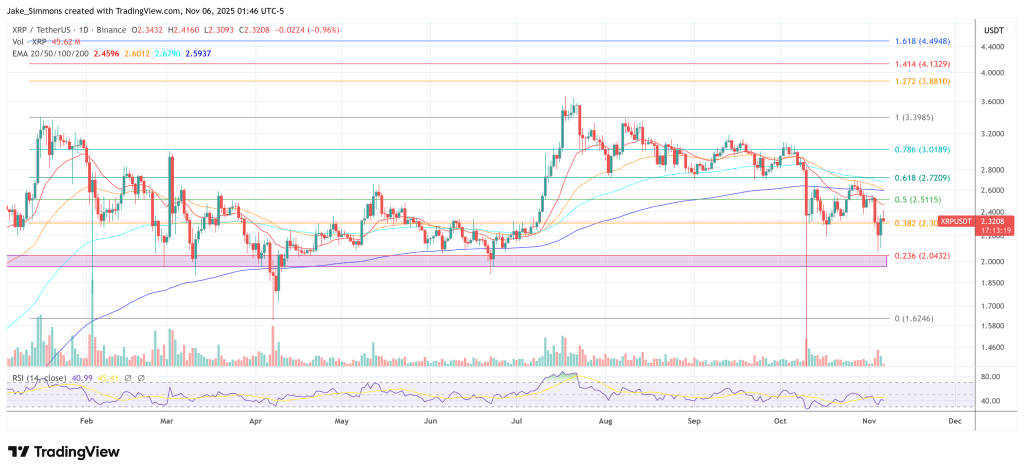
At press time, XRP traded at $2.32.
XRP price
Market Opportunity
Swarm Network Logo
Swarm Network Price(TRUTH)
$0.012555
$0.012555$0.012555
+4.45%
USD
Swarm Network (TRUTH) Live Price Chart
Disclaimer: The articles reposted on this site are sourced from public platforms and are provided for informational purposes only. They do not necessarily reflect the views of MEXC. All rights remain with the original authors. If you believe any content infringes on third-party rights, please contact service@support.mexc.com for removal. MEXC makes no guarantees regarding the accuracy, completeness, or timeliness of the content and is not responsible for any actions taken based on the information provided. The content does not constitute financial, legal, or other professional advice, nor should it be considered a recommendation or endorsement by MEXC.

You May Also Like

The Channel Factories We’ve Been Waiting For

The Channel Factories We’ve Been Waiting For

The post The Channel Factories We’ve Been Waiting For appeared on BitcoinEthereumNews.com. Visions of future technology are often prescient about the broad strokes while flubbing the details. The tablets in “2001: A Space Odyssey” do indeed look like iPads, but you never see the astronauts paying for subscriptions or wasting hours on Candy Crush.  Channel factories are one vision that arose early in the history of the Lightning Network to address some challenges that Lightning has faced from the beginning. Despite having grown to become Bitcoin’s most successful layer-2 scaling solution, with instant and low-fee payments, Lightning’s scale is limited by its reliance on payment channels. Although Lightning shifts most transactions off-chain, each payment channel still requires an on-chain transaction to open and (usually) another to close. As adoption grows, pressure on the blockchain grows with it. The need for a more scalable approach to managing channels is clear. Channel factories were supposed to meet this need, but where are they? In 2025, subnetworks are emerging that revive the impetus of channel factories with some new details that vastly increase their potential. They are natively interoperable with Lightning and achieve greater scale by allowing a group of participants to open a shared multisig UTXO and create multiple bilateral channels, which reduces the number of on-chain transactions and improves capital efficiency. Achieving greater scale by reducing complexity, Ark and Spark perform the same function as traditional channel factories with new designs and additional capabilities based on shared UTXOs.  Channel Factories 101 Channel factories have been around since the inception of Lightning. A factory is a multiparty contract where multiple users (not just two, as in a Dryja-Poon channel) cooperatively lock funds in a single multisig UTXO. They can open, close and update channels off-chain without updating the blockchain for each operation. Only when participants leave or the factory dissolves is an on-chain transaction…
Share
BitcoinEthereumNews2025/09/18 00:09
Superstate Raises Over $82 Million to Develop Onchain Capital Markets

Superstate Raises Over $82 Million to Develop Onchain Capital Markets

Superstate announced that it has raised $82.5 million in a Series B funding round. The capital will be used to develop infrastructure for issuing and trading shares
Share
Incrypted2026/01/23 00:13
Valicor Brings Financial Education to Second High School in Underserved Community

Valicor Brings Financial Education to Second High School in Underserved Community

Partnership with Ramsey Education expands from Cincinnati to Michigan, equipping students with essential money management skills. MONROE, Ohio., Jan. 22, 2026 /
Share
AI Journal2026/01/22 23:50