Cardano founder Charles Hoskinson says the network is on the cusp of a significant shift, reacting to news that an HTTP-402–based payments standard—known as “x402”—is being brought to Cardano and integrated with Masumi, an agent-to-agent protocol built atop the chain. “This is very big for Cardano,” Hoskinson wrote on X on October 27, in response […]Cardano founder Charles Hoskinson says the network is on the cusp of a significant shift, reacting to news that an HTTP-402–based payments standard—known as “x402”—is being brought to Cardano and integrated with Masumi, an agent-to-agent protocol built atop the chain. “This is very big for Cardano,” Hoskinson wrote on X on October 27, in response […]

Something ‘Very Big’ Is Coming To Cardano, Says Charles Hoskinson

Cardano founder Charles Hoskinson says the network is on the cusp of a significant shift, reacting to news that an HTTP-402–based payments standard—known as “x402”—is being brought to Cardano and integrated with Masumi, an agent-to-agent protocol built atop the chain. “This is very big for Cardano,” Hoskinson wrote on X on October 27, in response to the demo announcement.

The catalyst is a proof-of-concept published by Masumi cofounder Patrick Tobler showing a live x402 “pay-to-access” flow that ends in an on-chain action: a memecoin mint on Cardano. Tobler framed it as a milestone en route to standardizing how autonomous agents and web services exchange value via APIs without log-ins or OAuth.

Related Reading: Cardano Foundation Seeks Control Of Top-Level Domains: Here’s Why

“x402 is coming to Cardano (and Masumi)! … The first x402 Proof-Of-Concept Memecoin Mint,” he posted, adding that users can try the demo with 2 USDM for payment and a small amount of ADA for fees—and stressing that the token itself is strictly a technical showcase with “0 future plans.”

What This Means For Cardano

In a series of follow-ups, Tobler described x402 as a revival of the web’s long-dormant HTTP 402 “Payment Required” status code, generalized for modern machine-to-machine commerce. “Built around the HTTP 402 status code, x402 enables users to pay for resources via API without registration, emails, OAuth, or complex signatures,” he wrote, noting that Coinbase developed the protocol and that it is integrated into Google’s Agent Payments Protocol (AP2).

The Masumi implementation pairs that transport-level payment primitive with smart-contract guarantees for identity, refunds, and decision logging—“turning Cardano into the financial backbone of the agent economy,” as he put it.

The demo itself makes the flow concrete. When a user hits the endpoint, the server responds with “402: Payment Required.” The front end prompts a connected Cardano wallet to construct the payment. The payment proof is then transmitted in the 402 header; the server relays it on-chain, waits for finality, and only then returns the protected resource—in this case, minting the demo memecoins. “Please note: This is NOT a real memecoin. It is ONLY a proof-of-concept intended to showcase the technology!” Tobler emphasized.

Context matters for why Hoskinson’s enthusiasm resonated. x402 has been positioned by Coinbase as an “internet-native payment protocol” for AI agents and APIs, with instant, stablecoin-settled micropayments and merchant tooling. Separately, Google introduced AP2 as an open agent-payments layer designed to support multiple rails—including stablecoins—and to standardize authorization and auditability for agentic commerce. An x402 integration at the chain and smart-contract level gives Cardano a clear line into that emerging stack.

The choice of USDM for the demo highlights another Cardano-specific ingredient: a fiat-backed USD stablecoin native to the network, launched by Moneta (formerly Mehen). USDM’s role in the x402 flow is straightforward—precise, low-friction settlement per request—while ADA remains necessary for network fees. For agent-to-agent use cases, the combination is pragmatic: deterministic fees plus dollar-denominated pricing.

Tobler said the team is now drafting the x402 standard for both Cardano and Masumi, and explicitly not limiting the spec to simple address-to-address transfers. “By not only doing Address-To-Address like most other blockchains do but actually writing the standard to work with the Masumi Smart Contract, we’re making our x402 implementation the most powerful one out there,” he wrote.

At press time, ADA traded at $0.6659.
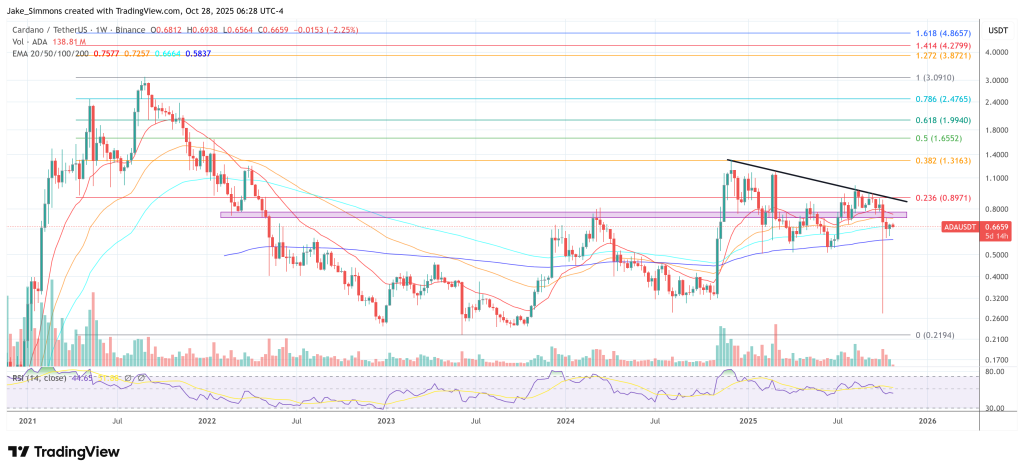
Cardano price
Disclaimer: The articles reposted on this site are sourced from public platforms and are provided for informational purposes only. They do not necessarily reflect the views of MEXC. All rights remain with the original authors. If you believe any content infringes on third-party rights, please contact service@support.mexc.com for removal. MEXC makes no guarantees regarding the accuracy, completeness, or timeliness of the content and is not responsible for any actions taken based on the information provided. The content does not constitute financial, legal, or other professional advice, nor should it be considered a recommendation or endorsement by MEXC.

You May Also Like

X to cut off InfoFi crypto projects from accessing its API

X to cut off InfoFi crypto projects from accessing its API

X, the most widely used app for crypto projects, is changing its API access policy. InfoFi projects, which proliferated non-organic bot content, will be cut off
Share
Cryptopolitan2026/01/16 02:50
X Just Killed Kaito and InfoFi Crypto, Several Tokens Crash

X Just Killed Kaito and InfoFi Crypto, Several Tokens Crash

The post X Just Killed Kaito and InfoFi Crypto, Several Tokens Crash appeared on BitcoinEthereumNews.com. X has revoked API access for apps that reward users for
Share
BitcoinEthereumNews2026/01/16 03:42
China Blocks Nvidia’s RTX Pro 6000D as Local Chips Rise

China Blocks Nvidia’s RTX Pro 6000D as Local Chips Rise

The post China Blocks Nvidia’s RTX Pro 6000D as Local Chips Rise appeared on BitcoinEthereumNews.com. China Blocks Nvidia’s RTX Pro 6000D as Local Chips Rise China’s internet regulator has ordered the country’s biggest technology firms, including Alibaba and ByteDance, to stop purchasing Nvidia’s RTX Pro 6000D GPUs. According to the Financial Times, the move shuts down the last major channel for mass supplies of American chips to the Chinese market. Why Beijing Halted Nvidia Purchases Chinese companies had planned to buy tens of thousands of RTX Pro 6000D accelerators and had already begun testing them in servers. But regulators intervened, halting the purchases and signaling stricter controls than earlier measures placed on Nvidia’s H20 chip. Image: Nvidia An audit compared Huawei and Cambricon processors, along with chips developed by Alibaba and Baidu, against Nvidia’s export-approved products. Regulators concluded that Chinese chips had reached performance levels comparable to the restricted U.S. models. This assessment pushed authorities to advise firms to rely more heavily on domestic processors, further tightening Nvidia’s already limited position in China. China’s Drive Toward Tech Independence The decision highlights Beijing’s focus on import substitution — developing self-sufficient chip production to reduce reliance on U.S. supplies. “The signal is now clear: all attention is focused on building a domestic ecosystem,” said a representative of a leading Chinese tech company. Nvidia had unveiled the RTX Pro 6000D in July 2025 during CEO Jensen Huang’s visit to Beijing, in an attempt to keep a foothold in China after Washington restricted exports of its most advanced chips. But momentum is shifting. Industry sources told the Financial Times that Chinese manufacturers plan to triple AI chip production next year to meet growing demand. They believe “domestic supply will now be sufficient without Nvidia.” What It Means for the Future With Huawei, Cambricon, Alibaba, and Baidu stepping up, China is positioning itself for long-term technological independence. Nvidia, meanwhile, faces…
Share
BitcoinEthereumNews2025/09/18 01:37