The post The Executive Order To Make Deregulation Permanent appeared on BitcoinEthereumNews.com. The White House Office of Management and Budget’s new Streamlining the Review of Regulatory Actions memorandum signals a preferential stance toward deregulation, urging agencies to quantify and document deregulatory gains just as rigorously as they do rule costs. WASHINGTON, DC – NOVEMBER 05: U.S. President Donald Trump speaks with Senate Republicans at a breakfast in the State Dining Room of the White House on November 5, 2025 in Washington, DC. Trump is speaking with Republican senators as the U.S. government shutdown has reached day 36. (Photo by Andrew Harnik/Getty Images) Getty Images It’s an important enough shift to need amplification, clarification and extension in a new Trump Executive Order—one that overhauls how White House regulatory review is conducted and, ideally, precludes most new regulation altogether. The current tentpole, the Clinton-era Executive Order 12866 (“Regulatory Planning and Review”) replaced the Reagan convention that benefits of regulation should “outweigh” costs with the weaker stipulation that benefits merely “justify” new burdens. Granted, Trump has already issued 212 executive orders along with numerous proclamations and memoranda, many targeting regulation in general or in specific sectors. Yet Congress has not codified any of Trump’s regulatory streamlining efforts. The new Streamlining directive accelerates agency and OMB review timetables to address the “ossification” of the rulemaking process—something acknowledged by both left and right. More entrepreneurially, it lays out an agenda for operationalizing the Administrative Procedure Act’s “good cause” exemption to eliminate certain “facially unlawful” rules without public comment based on recent Supreme Court jurisprudence. That’s a novel use in need of judicial testing (detailed here). But the memo’s closing section on Developing Better Deregulatory Records articulates a semi-philosophical shift toward making deregulation a permanent operational mode. It’s skeletal, and will be ditched at the first opportunity if the White House changes hands, but it could carry far… The post The Executive Order To Make Deregulation Permanent appeared on BitcoinEthereumNews.com. The White House Office of Management and Budget’s new Streamlining the Review of Regulatory Actions memorandum signals a preferential stance toward deregulation, urging agencies to quantify and document deregulatory gains just as rigorously as they do rule costs. WASHINGTON, DC – NOVEMBER 05: U.S. President Donald Trump speaks with Senate Republicans at a breakfast in the State Dining Room of the White House on November 5, 2025 in Washington, DC. Trump is speaking with Republican senators as the U.S. government shutdown has reached day 36. (Photo by Andrew Harnik/Getty Images) Getty Images It’s an important enough shift to need amplification, clarification and extension in a new Trump Executive Order—one that overhauls how White House regulatory review is conducted and, ideally, precludes most new regulation altogether. The current tentpole, the Clinton-era Executive Order 12866 (“Regulatory Planning and Review”) replaced the Reagan convention that benefits of regulation should “outweigh” costs with the weaker stipulation that benefits merely “justify” new burdens. Granted, Trump has already issued 212 executive orders along with numerous proclamations and memoranda, many targeting regulation in general or in specific sectors. Yet Congress has not codified any of Trump’s regulatory streamlining efforts. The new Streamlining directive accelerates agency and OMB review timetables to address the “ossification” of the rulemaking process—something acknowledged by both left and right. More entrepreneurially, it lays out an agenda for operationalizing the Administrative Procedure Act’s “good cause” exemption to eliminate certain “facially unlawful” rules without public comment based on recent Supreme Court jurisprudence. That’s a novel use in need of judicial testing (detailed here). But the memo’s closing section on Developing Better Deregulatory Records articulates a semi-philosophical shift toward making deregulation a permanent operational mode. It’s skeletal, and will be ditched at the first opportunity if the White House changes hands, but it could carry far…

The Executive Order To Make Deregulation Permanent

The White House Office of Management and Budget’s new Streamlining the Review of Regulatory Actions memorandum signals a preferential stance toward deregulation, urging agencies to quantify and document deregulatory gains just as rigorously as they do rule costs.

WASHINGTON, DC – NOVEMBER 05: U.S. President Donald Trump speaks with Senate Republicans at a breakfast in the State Dining Room of the White House on November 5, 2025 in Washington, DC. Trump is speaking with Republican senators as the U.S. government shutdown has reached day 36. (Photo by Andrew Harnik/Getty Images)

Getty Images

It’s an important enough shift to need amplification, clarification and extension in a new Trump Executive Order—one that overhauls how White House regulatory review is conducted and, ideally, precludes most new regulation altogether.

The current tentpole, the Clinton-era Executive Order 12866 (“Regulatory Planning and Review”) replaced the Reagan convention that benefits of regulation should “outweigh” costs with the weaker stipulation that benefits merely “justify” new burdens.

Granted, Trump has already issued 212 executive orders along with numerous proclamations and memoranda, many targeting regulation in general or in specific sectors. Yet Congress has not codified any of Trump’s regulatory streamlining efforts.

The new Streamlining directive accelerates agency and OMB review timetables to address the “ossification” of the rulemaking process—something acknowledged by both left and right. More entrepreneurially, it lays out an agenda for operationalizing the Administrative Procedure Act’s “good cause” exemption to eliminate certain “facially unlawful” rules without public comment based on recent Supreme Court jurisprudence. That’s a novel use in need of judicial testing (detailed here).

But the memo’s closing section on Developing Better Deregulatory Records articulates a semi-philosophical shift toward making deregulation a permanent operational mode. It’s skeletal, and will be ditched at the first opportunity if the White House changes hands, but it could carry far greater weight if fleshed out in a new executive order rewriting E.O. 12866. Ideally, Congress would codify the approach, not just for streamlining existing rules but for preemptive contemplation before any new rulemaking.

Bringing Agencies to Heel

Agencies have rarely met a regulation they disliked, and their incentives align with expanding “net benefits” largely without limit. Criticism of the new directive captures that protective stance. The Streamlining memorandum is “propaganda” according to Public Citizen, that “rests on the irrational proposition that all deregulation is good for America,” claiming it tells agencies to do the administration’s bidding by repealing “safeguards regardless of their benefits to consumers, workers, the economy and the environment.”

Agencies have been resisting such “bidding” since Trump’s first streamlining order, however. “To date,” the OMB memo vexedly notes, “agencies do not appear to be fully maximizing their energy in carrying out these directives.”

Benefits of Deregulation As A Policy Anchor

What the Streamlining memo reintroduces—with a vigor perhaps not seen since the long-forgotten Bush 1.0 Regulatory Program of the U.S. Government—is recognition of the benefits of deregulation in increasing “the scope of private freedom.”

Appealing to agencies to make OMB “your partner in the deregulation agenda,” the memo correctly observes that “deregulation will leave more individuals and firms free to pursue their own self-defined interests, unfettered.” So too will avoiding unnecessary regulation in the first place.

“Quantifying” The Benefits Of Deregulation

Deregulation itself produces real and sometimes “measurable” public benefits—freedom, innovation and prosperity—that deserve analytical weight and credit. The memorandum urges agencies to quantify and document these gains as rigorously as they assess regulatory costs. “Indeed, meaningful compliance with Section 3 of EO 14192 [Unleashing Prosperity Through Deregulation] necessitates agencies engaging in cost-benefit quantification, as that EO requires a quantitative netting of regulatory vs. deregulatory rules.”

Some of this over-reliance on quantification can backfire, however. The reality is that the vast sweep of regulatory costs remains unfathomed and unmeasured, and rules are often justified on qualitative or arbitrary grounds—terrain where pro-regulatory forces excel and Team Deregulation struggles.

“Aggregated Impacts”

The memorandum’s emphasis on the “Private-Conduct Liberty Benefits” of deregulation—such as “freedom of choice in the marketplace”—is paired with recognition of the compounded damage from the decades-long accumulation of rules, and of the consumer and societal benefits of unwinding them.

Codifying Streamlining

Near its conclusion on the importance of building fact-based deregulatory records, the memorandum notes the prevalence of “uncertainty” and observes that, “Whenever agencies can see that the predictions of costs and benefits it made when it once stood at the door to new regulation have not been borne out by experience,” a powerful case for deregulation emerges.

As the year’s end approaches, it’s worth recalling that this was when the first Trump administration would announce progress on the one-in, two-out deregulatory agenda—now a one-in, ten-out program.

There is much more that can be done quickly for Trump to advance this deregulatory agenda and make it permanent. At root in the clash over regulation vs. deregulation is a conflict of visions over the proper size and scope of government and its legitimate role in society; over separation of powers; over executive overreach; and even over the fundamental relation of the individual to the state.

In this sense, the OMB memo omits more than it contains, leaving the more complete agenda to be articulated and acted upon.

A Broader Deregulatory Blueprint

The administrative state remains nearly monolithic in its affirmation of an ever-expanding regulatory apparatus, its disregard for measuring and disclosing costs, its indifference to political or administrative failure (while quick to claim “market failure”), and its neglect of extending property rights and classical liberal institutions to complex modern problems. Under those faulty premises, what agencies practice is not regulation at all—but intervention for its own sake. The edifice needs to be dismantled.

The fundamental failure of the administrative state, even as it returns to work post-“shutdown,” is that rather than seeing regulation as a costly last resort, it defaults to centralized planning, displaces private sector competitive disciplines and imposes costly politicized and utilitarian “net-benefits.”

The Streamlining memo alone cannot override the administrative state’s nature. And Trump, for his part, harbors his own “swampy” impulses—price controls, partial nationalizations—that tend to escape the scrutiny the memo embodies.

To make deregulation permanent, economic and social governance must be transferred away from today’s dominant administrative institutions toward competitive ones. Reaffirmation of federalism and restoration of powers to states is also necessary (another lesson of the shutdown).

The Streamlining memo gives the wheel of reform an aggressive new spin, but additional components—including a governing Trump executive order to replace E.O. 12866 and congressional action on regulatory streamlining—are essential next steps.

Elements of such an agenda could include:

  • Prioritize the termination of agencies and their enabling statutes
  • Abolish private aid and end the practice of public/private partnerships that entwine business and government
  • Reassert compliance with existing laws on regulatory oversight that are routinely ignored, such as the Regulatory Flexibility Act, the Unfunded Mandates Act and requirements such as that for an aggregate regulatory cost estimate
  • Acknowledge political and administrative failure as more likely than “market failure” (as Competitive Enterprise Institute founder Fred L. Smith Jr. put it, often the problem is not market failure but “the failure to have markets.”)
  • Replace “net benefit” analysis with regulatory cost budgeting
  • Account for differential effects on small versus large businesses
  • Limit guidance documents and build disclosure portals for sub-regulatory actions, since much recent legislation—like the infrastructure law and the CHIPS Act—can operate through such “regulatory dark matter.” (The “Guidance Out Of Darkness (GOOD Act) would codify such portals.)

The Streamlining memo marks a significant step toward getting agencies to internalize the pursuit of deregulation. Trump should now issue an executive order that builds on this foundation and makes deregulation a standing principle of governance, not just a temporary policy, with at least the staying power of the Clinton-era directive.

Regulation renovation can then be made complete when Congress picks up the tools the Constitution left lying about the yard.

Source: https://www.forbes.com/sites/waynecrews/2025/11/12/regulation-renovation-the-executive-order-to-make-deregulation-permanent/

Market Opportunity
Orderly Network Logo
Orderly Network Price(ORDER)
$0.0924
$0.0924$0.0924
-1.70%
USD
Orderly Network (ORDER) Live Price Chart
Disclaimer: The articles reposted on this site are sourced from public platforms and are provided for informational purposes only. They do not necessarily reflect the views of MEXC. All rights remain with the original authors. If you believe any content infringes on third-party rights, please contact service@support.mexc.com for removal. MEXC makes no guarantees regarding the accuracy, completeness, or timeliness of the content and is not responsible for any actions taken based on the information provided. The content does not constitute financial, legal, or other professional advice, nor should it be considered a recommendation or endorsement by MEXC.

You May Also Like

Trump Media received 260 BTC from Coinbase, worth $21 million.

Trump Media received 260 BTC from Coinbase, worth $21 million.

PANews reported on December 31 that, according to Emmett Gallic, Trump Media received 260 BTC (worth $21 million) from Coinbase between last night and early this
Share
PANews2025/12/31 08:06
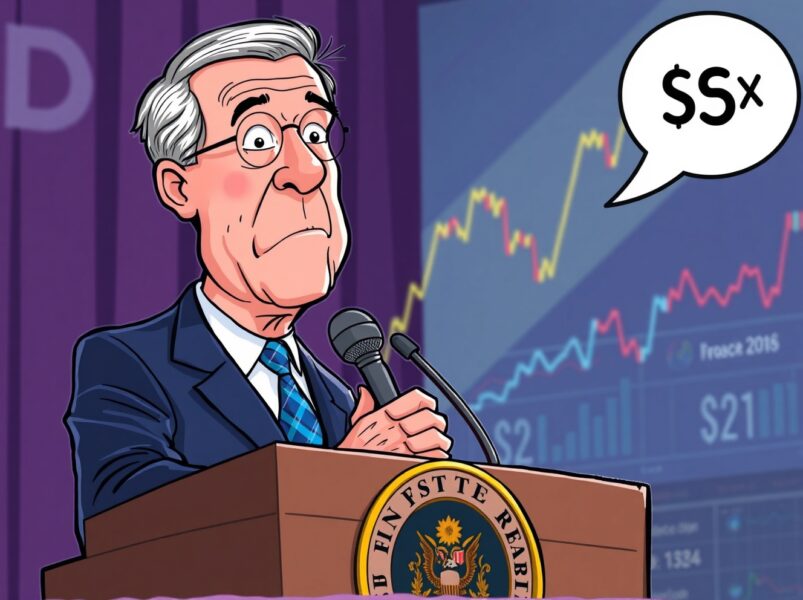
Jerome Powell’s Press Conference: Crucial Insights Unveiled for the Market’s Future

Jerome Powell’s Press Conference: Crucial Insights Unveiled for the Market’s Future

BitcoinWorld Jerome Powell’s Press Conference: Crucial Insights Unveiled for the Market’s Future The financial world, including the dynamic cryptocurrency market, often hangs on every word from the Federal Reserve. Recently, Jerome Powell’s press conference following the Federal Open Market Committee (FOMC) meeting concluded, leaving investors and analysts dissecting his remarks for clues about the future economic direction. This event is always a pivotal moment, shaping expectations for inflation, interest rates, and the overall stability of global markets. What Were the Key Takeaways from Jerome Powell’s Press Conference? During Jerome Powell’s press conference, the Fed Chair provided an update on the central bank’s monetary policy decisions and its economic outlook. His statements often reiterate the Fed’s dual mandate: achieving maximum employment and stable prices. This time was no different, with a strong emphasis on managing persistent inflation. Key points from the recent discussion included: Inflation Control: Powell emphasized the Fed’s unwavering commitment to bringing inflation back down to its 2% target. He reiterated that the fight against rising prices remains the top priority, even if it entails some economic slowdown. Interest Rate Policy: While the Fed’s stance on future interest rate adjustments was discussed, the path remains data-dependent. Powell indicated that decisions would continue to be made meeting-by-meeting, based on incoming economic data. Economic Projections: The updated Summary of Economic Projections (SEP) offered insights into the Fed’s forecasts for GDP growth, unemployment, and inflation. These projections help market participants gauge the central bank’s expectations for the economy’s trajectory. Quantitative Tightening (QT): The ongoing process of reducing the Fed’s balance sheet, known as quantitative tightening, was also a topic. This reduction in liquidity in the financial system has broad implications for asset prices. How Did Jerome Powell’s Remarks Impact Cryptocurrency Markets? The conclusion of Jerome Powell’s press conference often sends ripples through traditional financial markets, and cryptocurrencies are increasingly sensitive to these macroeconomic shifts. Digital assets, once thought to be uncorrelated, now frequently react to the Fed’s monetary policy signals. Higher interest rates, for instance, tend to make riskier assets like cryptocurrencies less attractive. This is because investors might prefer safer, interest-bearing investments. Consequently, we often see increased volatility in Bitcoin (BTC) and Ethereum (ETH) prices immediately following such announcements. The tightening of financial conditions, driven by the Fed, reduces overall liquidity in the system, which can put downward pressure on asset valuations across the board. However, some argue that this growing correlation signifies crypto’s increasing integration into the broader financial ecosystem. It suggests that institutional investors and mainstream finance are now paying closer attention to digital assets, treating them more like other risk-on investments. Navigating the Economic Landscape After Jerome Powell’s Press Conference For cryptocurrency investors, understanding the implications of Jerome Powell’s press conference is crucial for making informed decisions. The Fed’s policy trajectory directly influences the availability of capital and investor sentiment, which are key drivers for crypto valuations. Here are some actionable insights for navigating this environment: Stay Informed: Regularly monitor Fed announcements and economic data releases. Understanding the macroeconomic backdrop is as important as analyzing individual crypto projects. Assess Risk Tolerance: In periods of economic uncertainty and tighter monetary policy, a reassessment of personal risk tolerance is wise. Diversification within your crypto portfolio and across different asset classes can mitigate potential downsides. Focus on Fundamentals: While market sentiment can be swayed by macro news, projects with strong fundamentals, clear use cases, and robust development teams tend to perform better in the long run. Long-Term Perspective: Cryptocurrency markets are known for their volatility. Adopting a long-term investment horizon can help weather short-term fluctuations driven by macro events like Fed meetings. The challenges include potential continued volatility and reduced liquidity. However, opportunities may arise from market corrections, allowing strategic investors to accumulate assets at lower prices. In summary, Jerome Powell’s press conference provides essential guidance on the Fed’s economic strategy. Its conclusions have a profound impact on financial markets, including the dynamic world of cryptocurrencies. Staying informed, understanding the nuances of monetary policy, and maintaining a strategic investment approach are paramount for navigating the evolving economic landscape. The Fed’s actions underscore the interconnectedness of traditional finance and the burgeoning digital asset space. Frequently Asked Questions (FAQs) Q1: What is the Federal Open Market Committee (FOMC)? A1: The FOMC is the monetary policy-making body of the Federal Reserve System. It sets the federal funds rate target and directs open market operations, influencing the availability of money and credit in the U.S. economy. Q2: How do the Fed’s interest rate decisions typically affect cryptocurrency markets? A2: Generally, when the Fed raises interest rates, it makes borrowing more expensive and reduces liquidity in the financial system. This often leads investors to shy away from riskier assets like cryptocurrencies, potentially causing prices to decline. Conversely, lower rates can stimulate investment in riskier assets. Q3: What does “data-dependent” mean in the context of Fed policy? A3: “Data-dependent” means that the Federal Reserve’s future monetary policy decisions, such as interest rate adjustments, will primarily be based on the latest economic data. This includes inflation reports, employment figures, and GDP growth, rather than a predetermined schedule. Q4: Should I change my cryptocurrency investment strategy based on Jerome Powell’s press conference? A4: While it’s crucial to be aware of the macroeconomic environment shaped by Jerome Powell’s press conference, drastic changes to a well-researched investment strategy may not always be necessary. It’s recommended to review your portfolio, assess your risk tolerance, and consider if your strategy aligns with the current economic outlook, focusing on long-term fundamentals. If you found this analysis helpful, please consider sharing it with your network! Your insights and shares help us reach more readers interested in the intersection of traditional finance and the exciting world of cryptocurrencies. Spread the word! To learn more about the latest crypto market trends, explore our article on key developments shaping Bitcoin price action. This post Jerome Powell’s Press Conference: Crucial Insights Unveiled for the Market’s Future first appeared on BitcoinWorld.
Share
Coinstats2025/09/18 16:25
Sei Enhances Market Infrastructure with Real-Time Data and Transparency

Sei Enhances Market Infrastructure with Real-Time Data and Transparency

The post Sei Enhances Market Infrastructure with Real-Time Data and Transparency appeared on BitcoinEthereumNews.com. Rongchai Wang Dec 30, 2025 18:21 Sei introduces
Share
BitcoinEthereumNews2025/12/31 08:12