Is Solayer’s popularity a result of the market’s new expectations for the SVM track or does the project itself have the potential to be a dark horse?Is Solayer’s popularity a result of the market’s new expectations for the SVM track or does the project itself have the potential to be a dark horse?

The first community sale exceeded expectations by 15 times and was forced to be postponed. Will Solayer, which has a few more narratives, become a dark horse?

2025/01/14 11:42

Author: Frank, PANews

At the beginning of 2025, the new issuance activities of Solana's SVM track frequently set off various hair-pulling groups. First, the Sonic SVM airdrop triggered discussions on social media, and then another Solana ecological project Solayer announced that it would soon launch a community sale, which once again triggered the market's fanatical imagination of the code of wealth.

According to many social media accounts, due to Solayer's KYC rules, accounts that resell overseas KYC information in the market have increased their prices, and many bloggers have jokingly posted pictures of collecting KYC information in African countries. Faced with such popularity, Buidlpad, the partner of Solayer in this sale, urgently announced on January 13 that the Solayer community sale would be postponed for 3 days to January 16 to ensure fair distribution because the number of registrations far exceeded expectations.

Is Solayer’s popularity a result of the market’s new expectations for the SVM track or does the project itself have the potential to be a dark horse?

From re-staking to hardware acceleration, three narrative updates in one year

Solayer is a relatively young project, founded in 2024. In less than a year since its creation, Solayer has completed multiple narrative transformations, and it seems that it has hit the mark every time.

At the beginning of its creation, Solayer was positioned as a re-pledge protocol. After the mainnet was launched in August, it became a hot re-pledge protocol on the Solana chain. It successfully completed a $12 million seed round of financing that month. This round of financing was led by Polychain Capital, with Binance Labs and Arthur Hayes' family office Maelstrom participating in the investment. The post-investment valuation reached $80 million. Previously, Solayer also completed a round of Pre-Seed financing of an undisclosed size, with investors including Solana co-founder Anatoly Yakovenko and Polygon co-founder Sandeep Nailwal.
The first community sale exceeded expectations by 15 times and was forced to be postponed. Will Solayer, which has a few more narratives, become a dark horse?

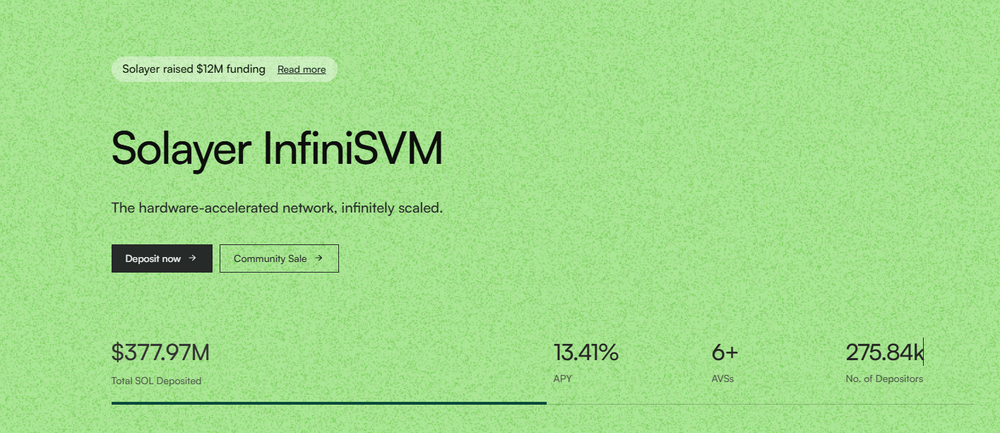
In the field of re-staking, Solayer has also achieved impressive results. As of January 13, its official data showed that the current TVL amount has reached 370 million US dollars, the number of depositors is about 275,000, and the average annualized rate of return has reached 13.41%. It ranks ninth among Solana's TVL and sixth among all re-staking protocols.

However, re-staking does not seem to be Solayer's ultimate goal. In October, Solayer launched the RWA narrative and launched the synthetic stablecoin Solayer USD, which is also a stablecoin asset based on government bonds. It is similar to the USD0 launched by Usual some time ago. The current market value of this stablecoin is about 30 million US dollars, ranking sixth in the Solana ecosystem. Of course, this volume is still relatively small in the entire network, ranking only 46th.

In December, Solayer quietly updated an article titled "Software Expansion Has Reached Its Limit - The Future Lies in Hardware Expansion" in his blog. The article pointed out that with the problems of state fragmentation, throughput limitation, delay and cost, system complexity, etc., the software upgrade of Ethereum EVM Layer 2 network has reached a bottleneck period, and the high performance of Solana and Sui also comes from the characteristics of software simplification and hardware acceleration. However, in this article, Solayer did not disclose his next plan to become the fastest network in the entire network by upgrading hardware.

Millions of TPS, 100Gbps, technical narratives are still effective

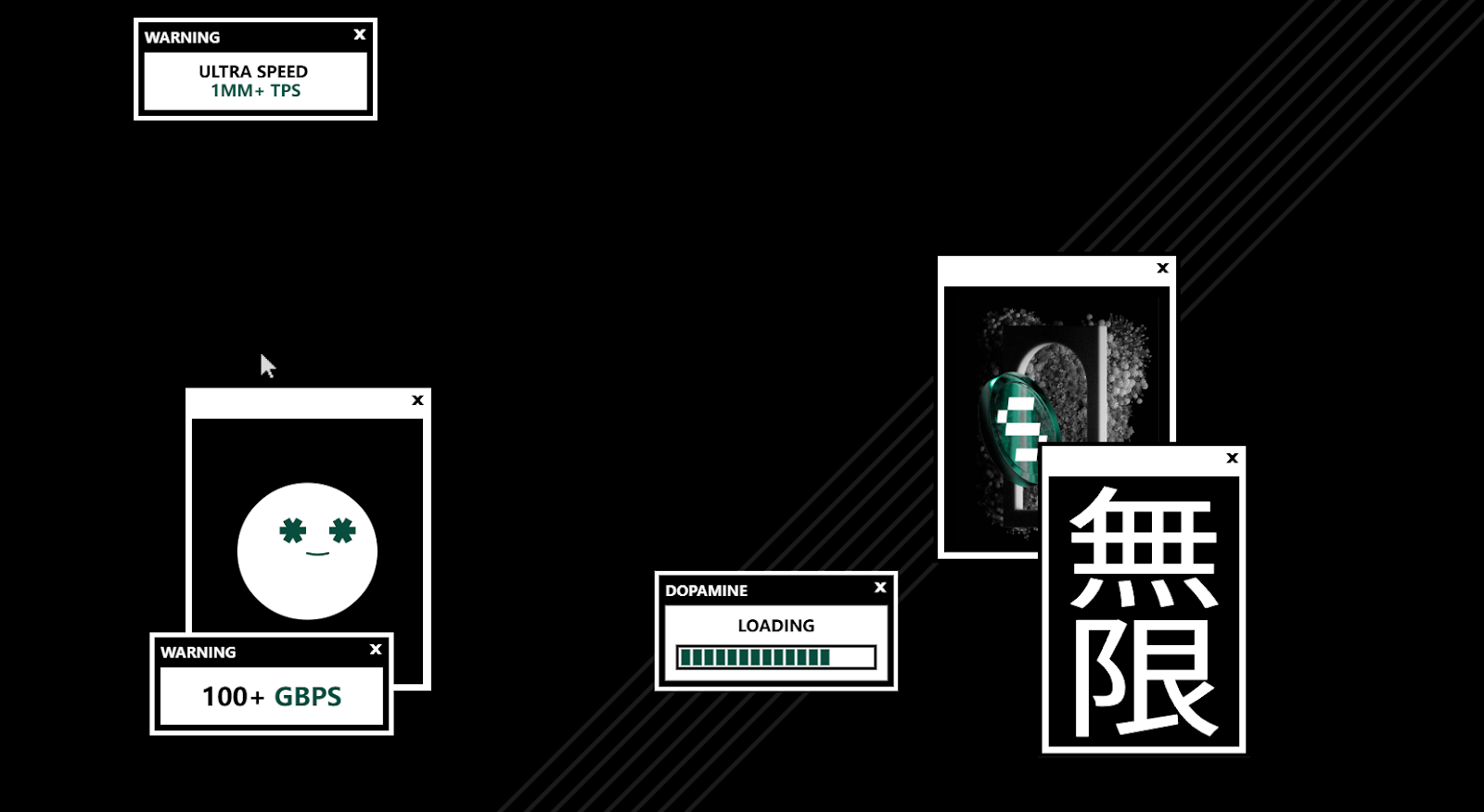
Until January 7, Solayer released its 2025 roadmap. Through hardware expansion, Solayer will launch the first novel hardware expansion SVM, which can achieve 1M TPS and 100Gbps. PANews learned from the white paper that Solayer proposed the technical principle of achieving millions of TPS and 100Gbps bandwidth. The core of the technology comes from a hardware acceleration technology called Infiniband RDMA, which can achieve microsecond-level cross-node communication. This technology can be divided into two parts. One part is Infiniband (wireless bandwidth), which is a high-performance network architecture used to efficiently connect computing nodes, storage systems and other devices, and is widely used in supercomputers and data centers.
The first community sale exceeded expectations by 15 times and was forced to be postponed. Will Solayer, which has a few more narratives, become a dark horse?

Another core technology is RDMA (Remote Direct Memory Access), which allows devices to directly access the memory of remote nodes without the intervention of the operating system. This "zero-copy" communication method greatly reduces the CPU load and communication latency. It is understood that these two technologies are currently mainly used in high-performance computing (HPC), artificial intelligence and machine learning, finance and distributed storage. Solayer should be the first to be adopted in blockchain networks. At present, it is not certain whether this technology can be realized.

From the team's experience, Solayer's founder Rachel Chu was a core developer of Sushiswap, and another co-founder Jason Li graduated from Berkeley University with a degree in computer science and previously created the non-custodial Web3 wallet MPCVault. In addition, on January 8, Solayer also announced the acquisition of Fuzzland, a smart contract hybrid fuzzer company. It is reported that one of the tasks of this acquisition is to focus on building a hardware-accelerated SVM chain.

Community sales spark participation boom

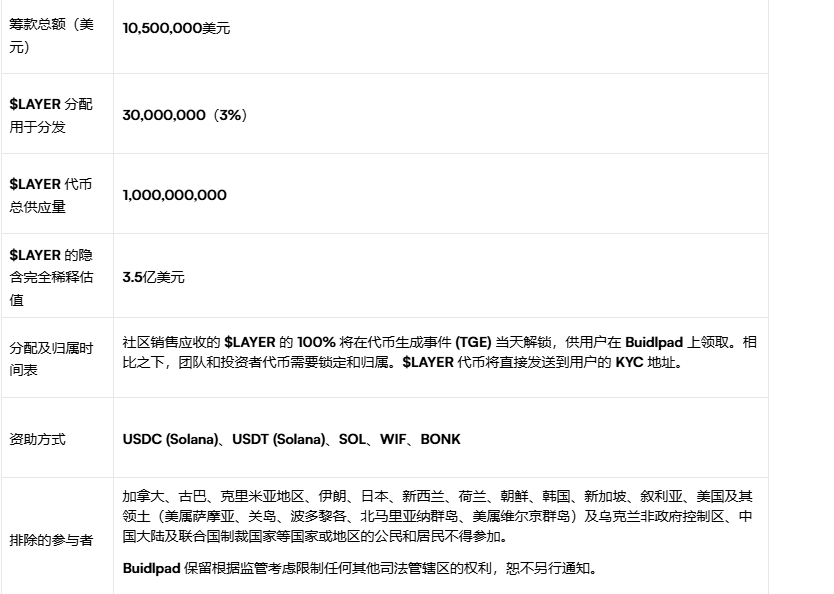
On January 9, Solayer announced the first community sale in cooperation with Builder. According to the information released, the total issuance of LAYER tokens is 1 billion, and this sale is 30 million, with a total fundraising of US$10.5 million. The average price of the token is about US$0.35, which is a token valuation of US$350 million. 100% of the LAYER tokens in the community sale will be unlocked on the day of the Token Generation Event (TGE).
The first community sale exceeded expectations by 15 times and was forced to be postponed. Will Solayer, which has a few more narratives, become a dark horse?

In addition to the token sale, Solayer also released a debit card called the Solayer Emerald Metal Card, a virtual + physical debit card in partnership with Visa that can be used online and offline for export and legal spending. The exact timeline for this product will be announced separately by Solayer. Users who participate in this sale have the opportunity to receive the Solayer Emerald Metal Card. Previously, it was often seen that token sales would issue whitelists to users who own certain hardware or products, but Solayer's model of buying coins and giving cards is relatively rare.

Regardless of the reasons, various bot studios and many crypto KOLs have posted KYC registration tweets on social media. Taking the newly launched Sonic SVM as an analogy, the current market value of SONIC tokens is about $240 million, and the fully diluted market value is about $1.6 billion. In addition, the market seems to have higher expectations for Solayer. Even at the $1.6 billion market value expectation, LAYER's expected appreciation seems to have 4 to 5 times the space.

As expected, the KYC subscription of LAYER was extremely popular. According to Buidlpad, the current number of registered people is more than 15 times the expected number, and they also noticed a large number of robots and furry studios. Therefore, they had to suspend registration and postpone the sale to January 16.

Of course, we cannot predict the performance of LAYER after it goes online. From the development history of Solayer in just one year, from re-staking to RWA, to hardware acceleration and encrypted payment cards, at least in terms of narrative and rhythm control, we can see that this team has a lot of experience, and has taken a route similar to Hyperliquid, which is to deliver products first and then deliver technology. If the technical strength and operational strength behind it can be matched synchronously, the goal of millions of TPS can be achieved, and the new technological milestone of millisecond-level transaction speed can be achieved, Solayer will truly become the next rising star that cannot be ignored. The result of all this depends on when Solayer can bring its products to market.

Market Opportunity
SolanaVM Logo
SolanaVM Price(SVM)
$0.00035978
$0.00035978$0.00035978
+18.95%
USD
SolanaVM (SVM) Live Price Chart
Disclaimer: The articles reposted on this site are sourced from public platforms and are provided for informational purposes only. They do not necessarily reflect the views of MEXC. All rights remain with the original authors. If you believe any content infringes on third-party rights, please contact service@support.mexc.com for removal. MEXC makes no guarantees regarding the accuracy, completeness, or timeliness of the content and is not responsible for any actions taken based on the information provided. The content does not constitute financial, legal, or other professional advice, nor should it be considered a recommendation or endorsement by MEXC.

You May Also Like

Huang Licheng Holds Controversial 25x ETH Long Position

Huang Licheng Holds Controversial 25x ETH Long Position

The post Huang Licheng Holds Controversial 25x ETH Long Position appeared on BitcoinEthereumNews.com. Key Points: Huang Licheng, known as “Machi,” holds a 25x leveraged
Share
BitcoinEthereumNews2025/12/22 03:49
Crucial Fed Rate Cut: October Probability Surges to 94%

Crucial Fed Rate Cut: October Probability Surges to 94%

BitcoinWorld Crucial Fed Rate Cut: October Probability Surges to 94% The financial world is buzzing with a significant development: the probability of a Fed rate cut in October has just seen a dramatic increase. This isn’t just a minor shift; it’s a monumental change that could ripple through global markets, including the dynamic cryptocurrency space. For anyone tracking economic indicators and their impact on investments, this update from the U.S. interest rate futures market is absolutely crucial. What Just Happened? Unpacking the FOMC Statement’s Impact Following the latest Federal Open Market Committee (FOMC) statement, market sentiment has decisively shifted. Before the announcement, the U.S. interest rate futures market had priced in a 71.6% chance of an October rate cut. However, after the statement, this figure surged to an astounding 94%. This jump indicates that traders and analysts are now overwhelmingly confident that the Federal Reserve will lower interest rates next month. Such a high probability suggests a strong consensus emerging from the Fed’s latest communications and economic outlook. A Fed rate cut typically means cheaper borrowing costs for businesses and consumers, which can stimulate economic activity. But what does this really signify for investors, especially those in the digital asset realm? Why is a Fed Rate Cut So Significant for Markets? When the Federal Reserve adjusts interest rates, it sends powerful signals across the entire financial ecosystem. A rate cut generally implies a more accommodative monetary policy, often enacted to boost economic growth or combat deflationary pressures. Impact on Traditional Markets: Stocks: Lower interest rates can make borrowing cheaper for companies, potentially boosting earnings and making stocks more attractive compared to bonds. Bonds: Existing bonds with higher yields might become more valuable, but new bonds will likely offer lower returns. Dollar Strength: A rate cut can weaken the U.S. dollar, making exports cheaper and potentially benefiting multinational corporations. Potential for Cryptocurrency Markets: The cryptocurrency market, while often seen as uncorrelated, can still react significantly to macro-economic shifts. A Fed rate cut could be interpreted as: Increased Risk Appetite: With traditional investments offering lower returns, investors might seek higher-yielding or more volatile assets like cryptocurrencies. Inflation Hedge Narrative: If rate cuts are perceived as a precursor to inflation, assets like Bitcoin, often dubbed “digital gold,” could gain traction as an inflation hedge. Liquidity Influx: A more accommodative monetary environment generally means more liquidity in the financial system, some of which could flow into digital assets. Looking Ahead: What Could This Mean for Your Portfolio? While the 94% probability for a Fed rate cut in October is compelling, it’s essential to consider the nuances. Market probabilities can shift, and the Fed’s ultimate decision will depend on incoming economic data. Actionable Insights: Stay Informed: Continue to monitor economic reports, inflation data, and future Fed statements. Diversify: A diversified portfolio can help mitigate risks associated with sudden market shifts. Assess Risk Tolerance: Understand how a potential rate cut might affect your specific investments and adjust your strategy accordingly. This increased likelihood of a Fed rate cut presents both opportunities and challenges. It underscores the interconnectedness of traditional finance and the emerging digital asset space. Investors should remain vigilant and prepared for potential volatility. The financial landscape is always evolving, and the significant surge in the probability of an October Fed rate cut is a clear signal of impending change. From stimulating economic growth to potentially fueling interest in digital assets, the implications are vast. Staying informed and strategically positioned will be key as we approach this crucial decision point. The market is now almost certain of a rate cut, and understanding its potential ripple effects is paramount for every investor. Frequently Asked Questions (FAQs) Q1: What is the Federal Open Market Committee (FOMC)? A1: The FOMC is the monetary policymaking body of the Federal Reserve System. It sets the federal funds rate, which influences other interest rates and economic conditions. Q2: How does a Fed rate cut impact the U.S. dollar? A2: A rate cut typically makes the U.S. dollar less attractive to foreign investors seeking higher returns, potentially leading to a weakening of the dollar against other currencies. Q3: Why might a Fed rate cut be good for cryptocurrency? A3: Lower interest rates can reduce the appeal of traditional investments, encouraging investors to seek higher returns in alternative assets like cryptocurrencies. It can also be seen as a sign of increased liquidity or potential inflation, benefiting assets like Bitcoin. Q4: Is a 94% probability a guarantee of a rate cut? A4: While a 94% probability is very high, it is not a guarantee. Market probabilities reflect current sentiment and data, but the Federal Reserve’s final decision will depend on all available economic information leading up to their meeting. Q5: What should investors do in response to this news? A5: Investors should stay informed about economic developments, review their portfolio diversification, and assess their risk tolerance. Consider how potential changes in interest rates might affect different asset classes and adjust strategies as needed. Did you find this analysis helpful? Share this article with your network to keep others informed about the potential impact of the upcoming Fed rate cut and its implications for the financial markets! To learn more about the latest crypto market trends, explore our article on key developments shaping Bitcoin price action. This post Crucial Fed Rate Cut: October Probability Surges to 94% first appeared on BitcoinWorld.
Share
Coinstats2025/09/18 02:25
Urgent: Coinbase CEO Pushes for Crucial Crypto Market Structure Bill

Urgent: Coinbase CEO Pushes for Crucial Crypto Market Structure Bill

BitcoinWorld Urgent: Coinbase CEO Pushes for Crucial Crypto Market Structure Bill The cryptocurrency world is buzzing with significant developments as Coinbase CEO Brian Armstrong recently took to Washington, D.C., advocating passionately for a clearer regulatory path. His mission? To champion the passage of a vital crypto market structure bill, specifically the Digital Asset Market Clarity (CLARITY) Act. This legislative push is not just about policy; it’s about safeguarding investor rights and fostering innovation in the digital asset space. Why a Clear Crypto Market Structure Bill is Essential Brian Armstrong’s visit underscores a growing sentiment within the crypto industry: the urgent need for regulatory clarity. Without clear guidelines, the market operates in a gray area, leaving both innovators and investors vulnerable. The proposed crypto market structure bill aims to bring much-needed definition to this dynamic sector. Armstrong explicitly stated on X that this legislation is crucial to prevent a recurrence of actions that infringe on investor rights, citing past issues with former U.S. Securities and Exchange Commission (SEC) Chair Gary Gensler. This proactive approach seeks to establish a stable and predictable environment for digital assets. Understanding the CLARITY Act: A Blueprint for Digital Assets The Digital Asset Market Clarity (CLARITY) Act is designed to establish a robust regulatory framework for the cryptocurrency industry. It seeks to delineate the responsibilities of key regulatory bodies, primarily the SEC and the Commodity Futures Trading Commission (CFTC). Here are some key provisions: Clear Jurisdiction: The bill aims to specify which digital assets fall under the purview of the SEC as securities and which are considered commodities under the CFTC. Investor Protection: By defining these roles, the act intends to provide clearer rules for market participants, thereby enhancing investor protection. Exemption Conditions: A significant aspect of the bill would exempt certain cryptocurrencies from the stringent registration requirements of the Securities Act of 1933, provided they meet specific criteria. This could reduce regulatory burdens for legitimate projects. This comprehensive approach promises to bring structure to a rapidly evolving market. The Urgency Behind the Crypto Market Structure Bill The call for a dedicated crypto market structure bill is not new, but Armstrong’s direct engagement highlights the increasing pressure for legislative action. The lack of a clear framework has led to regulatory uncertainty, stifling innovation and sometimes leading to enforcement actions that many in the industry view as arbitrary. Passing this legislation would: Foster Innovation: Provide a clear roadmap for developers and entrepreneurs, encouraging new projects and technologies. Boost Investor Confidence: Offer greater certainty and protection for individuals investing in digital assets. Prevent Future Conflicts: Reduce the likelihood of disputes between regulatory bodies and crypto firms, creating a more harmonious ecosystem. The industry believes that a well-defined regulatory landscape is essential for the long-term health and growth of the digital economy. What a Passed Crypto Market Structure Bill Could Mean for You If the CLARITY Act or a similar crypto market structure bill passes, its impact could be profound for everyone involved in the crypto space. For investors, it could mean a more secure and transparent market. For businesses, it offers a predictable environment to build and scale. Conversely, continued regulatory ambiguity could: Stifle Growth: Drive innovation overseas and deter new entrants. Increase Risks: Leave investors exposed to unregulated practices. Create Uncertainty: Lead to ongoing legal battles and market instability. The stakes are incredibly high, making the advocacy efforts of leaders like Brian Armstrong all the more critical. The push for a clear crypto market structure bill is a pivotal moment for the digital asset industry. Coinbase CEO Brian Armstrong’s efforts in Washington, D.C., reflect a widespread desire for regulatory clarity that protects investors, fosters innovation, and ensures the long-term viability of cryptocurrencies. The CLARITY Act offers a potential blueprint for this future, aiming to define jurisdictional boundaries and streamline regulatory requirements. Its passage could unlock significant growth and stability, cementing the U.S. as a leader in the global digital economy. Frequently Asked Questions (FAQs) What is the Digital Asset Market Clarity (CLARITY) Act? The CLARITY Act is a proposed crypto market structure bill aimed at establishing a clear regulatory framework for digital assets in the U.S. It seeks to define the roles of the SEC and CFTC and exempt certain cryptocurrencies from securities registration requirements under specific conditions. Why is Coinbase CEO Brian Armstrong advocating for this bill? Brian Armstrong is advocating for the CLARITY Act to bring regulatory certainty to the crypto industry, protect investor rights from unclear enforcement actions, and foster innovation within the digital asset space. He believes it’s crucial for the industry’s sustainable growth. How would this bill impact crypto investors? For crypto investors, the passage of this crypto market structure bill would mean greater clarity on which assets are regulated by whom, potentially leading to enhanced consumer protections, reduced market uncertainty, and a more stable investment environment. What are the primary roles of the SEC and CFTC concerning this bill? The bill aims to delineate the responsibilities of the SEC (Securities and Exchange Commission) and the CFTC (Commodity Futures Trading Commission) regarding digital assets. It seeks to clarify which assets fall under securities regulation and which are considered commodities, reducing jurisdictional ambiguity. What could happen if a crypto market structure bill like CLARITY Act does not pass? If a clear crypto market structure bill does not pass, the industry may continue to face regulatory uncertainty, potentially leading to stifled innovation, increased legal challenges for crypto companies, and a less secure environment for investors due to inconsistent enforcement and unclear rules. Did you find this article insightful? Share it with your network to help spread awareness about the crucial discussions shaping the future of digital assets! To learn more about the latest crypto market trends, explore our article on key developments shaping crypto regulation and institutional adoption. This post Urgent: Coinbase CEO Pushes for Crucial Crypto Market Structure Bill first appeared on BitcoinWorld.
Share
Coinstats2025/09/18 20:35