If you’ve been following the latest market trends in 2025, you’ll notice more investors, institutions, and even governments talking about tokenization. Why? Because RWAs are bridging traditional finance (TradFi) and Web3 in ways that could reshape how we save, invest, and build wealth.If you’ve been following the latest market trends in 2025, you’ll notice more investors, institutions, and even governments talking about tokenization. Why? Because RWAs are bridging traditional finance (TradFi) and Web3 in ways that could reshape how we save, invest, and build wealth.

The Rise of RWA (Real-World Assets) in Crypto: Why Tokenized Assets Are the Next Big Wave
2025/09/15 10:50

If you’ve been following the latest market trends in 2025, you’ll notice more investors, institutions, and even governments talking about tokenization. Why? Because RWAs are bridging traditional finance (TradFi) and Web3 in ways that could reshape how we save, invest, and build wealth.

Think about it owning a piece of real estate in Dubai, a fraction of a Picasso painting, or a slice of U.S. Treasury bonds, all from your phone. That’s not science fiction anymore. It’s happening right now through tokenization, and it might just be the foundation of the next big wave in crypto adoption.

So, let’s break it down: what RWAs are, why they matter, the benefits, the risks, and the projects leading the charge.

1.What Exactly Are Real World Assets (RWAs)?

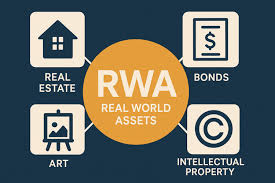
Real-World Assets are physical or financial assets represented digitally on a blockchain.

This could include:

Real estate (apartments, houses, commercial property)

Commodities (gold, silver, oil)

Government and corporate bonds

Equities (stocks)

Carbon credits and renewable energy assets

Art, collectibles, and luxury goods.

Unlike Bitcoin or Ethereum, which exist entirely in the digital world, RWAs are grounded in real world value. The token on the blockchain acts like a digital certificate that proves ownership of the underlying asset.

For example: instead of buying a $1 million building, you could own 0.1% of it in the form of a token. That token represents your share and can be traded, used as collateral in DeFi, or even sold instantly without waiting months for legal paperwork.

That combination of familiarity and flexibility makes RWAs appealing both to traditional investors and crypto native users.

RWA

2.Why RWAs Are Exploding in 2025

2.1 Institutional Adoption

Big players are moving in. BlackRock, Franklin Templeton, and JPMorgan are actively experimenting with tokenization. For institutions, RWAs offer yield, stability, and new markets something crypto badly needed after years of being labeled too volatile or speculative.

2.2 Market Growth

According to Token Terminal, RWAs are already approaching $300 billion in value tokenized. This milestone wasn’t expected until 2030, but the pace has accelerated thanks to investor demand and regulatory support.

2.3 Regulatory Clarity

Governments are catching up. In the U.S., the GENIUS Act is shaping clearer frameworks for stablecoins and tokenized assets. Meanwhile, Europe’s Savings and Investment Union is pushing for tokenized equities and bonds. This progress is critical it builds trust and reassures institutions and retail investors that RWAs aren’t just another passing trend. Together, these three factors, institutions, market growth, and clearer laws are fueling the surge of RWAs in 2025.

2.4 Why Tokenization Is a Game Changer

RWAs aren’t just a cool idea they bring tangible benefits that solve long standing problems in finance.

Accessibility: Imagine being able to invest in a $100 million office building in New York with just $100. Fractional ownership makes high value assets available to anyone, not just the wealthy.

Liquidity: Traditionally, assets like real estate, fine art, or bonds take months (sometimes years) to sell. Tokenization turns them into digital tokens you can trade 24/7, unlocking liquidity.

Transparency & Security: Every transaction and ownership record is stored on chain, reducing fraud and disputes. Smart contracts automate agreements, making transfers smoother and more reliable.

Efficiency & Cost Reduction: Tokenized transactions cut out middlemen like brokers and banks. Settlement can take minutes instead of weeks, saving time and reducing costs.

Think of it as finance upgraded faster, fairer, and open to anyone with an internet connection.

RWA

3.Top RWA Projects Making Noise in 2025

Some of the most exciting innovations in crypto today are coming from RWA 2focused projects. Here are a few leading the pack:

Centrifuge : Helps businesses access financing by tokenizing realworld credit assets.

Maple Finance : Builds tokenized lending and credit markets, connecting institutional borrowers with crypto liquidity.

Ondo Finance : Famous for tokenized U.S. Treasuries like USDY, offering safe, yield generating assets onchain.

Polymesh : A blockchain purpose built for regulated securities, making it easier for institutions to issue and trade tokenized assets.

And beyond these, we’re seeing buzz around MEXC backed initiatives exploring everything from fractionalize Dubai service apartments to tokenized franchise businesses offering retail investors access to previously exclusive opportunities.

RWA

4.Challenges and Risks to Keep in Mind

Of course, no innovation comes without hurdles. RWAs face some real challenges:

Regulation Isn’t Global Yet: While the U.S. and EU are moving forward, many countries still lack clear frameworks, slowing adoption.

Counterparty Risk: Does the token really represent the underlying asset? If custodians fail, investors could be left exposed.

Smart Contract Bugs: Like any blockchain project, vulnerabilities in code can lead to hacks or asset losses.

Adoption Barriers: Traditional investors still see crypto as complex, and it will take time (and education) for RWAs to gain mainstream acceptance.

Market Mismatch Risks: Real-world assets move slowly, but blockchain trades move instantly. If markets overheat, we could see an “on chain subprime” crisis where digital demand outpaces the stability of the underlying assets.

These risks don’t erase the potential of RWAs, but they remind us to approach the space with caution and proper due diligence.

5.The Future of RWAs in Web3

So where is this all heading? If we zoom out, the potential is massive.

Trillion Dollar Opportunity: Analysts predict tokenized assets could surpass $10 trillion by 2030.

Integration with DeFi: RWAs are being added to lending pools, yield farms, and stablecoin systems creating hybrid models of TradFi and DeFi.

Mainstream Gateway: RWAs might become the bridge that brings traditional investors into crypto. Owning U.S. Treasuries onchain feels safer for many than speculating on meme coins.

Everything Becomes Tokenized: From property to credit, art to renewable energy, tokenization could transform the way we perceive ownership itself.

In many ways, RWAs aren’t just a new trend they’re a necessary step toward making Web3 practical, sustainable, and inclusive.

6.Conclusion

The crypto industry has always thrived on innovation. RWAs are the latest chapter, offering a bridge between the familiar world of traditional finance and the flexible future of blockchain.

For investors, they unlock access to assets that were once out of reach. For institutions, they bring efficiency and transparency. And for the global financial system, they promise a shift toward a more inclusive, programmable economy.

Of course, challenges remain from regulations to risks but the direction is clear: tokenized RWAs are here to stay. They’re not just a passing buzzword. They could well be the foundation of the next generation of finance.

So whether you’re a seasoned trader, a curious beginner, or an institution exploring Web3, RWAs are worth watching closely. The future of crypto may be less about speculation and more about building real, sustainable value through tokenization.

Disclaimer: This content is for educational and reference purposes only and does not constitute any investment advice. Digital asset investments carry high risk. Please evaluate carefully and assume full responsibility for your own decisions.

Market Opportunity
RealLink Logo
RealLink Price(REAL)
$0.0746
$0.0746$0.0746
-1.32%
USD
RealLink (REAL) Live Price Chart
Disclaimer: The articles published on this page are written by independent contributors and do not necessarily reflect the official views of MEXC. All content is intended for informational and educational purposes only and is not responsible for any actions taken based on the information provided. The content does not constitute financial, legal, or other professional advice, nor should it be considered a recommendation or endorsement by MEXC. Cryptocurrency markets are highly volatile — please conduct your own research and consult a licensed financial advisor before making any investment decisions.

You May Also Like

FTX Trust Sues Genesis Digital for $1.15B Clawback Over Alleged Fraudulent Transfers

FTX Trust Sues Genesis Digital for $1.15B Clawback Over Alleged Fraudulent Transfers

The FTX Recovery Trust has filed a $1.15 billion lawsuit against the Bitcoin mining firm Genesis Digital Assets, alleging fraudulent transfers. The complaint, filed on Monday in U.S. Bankruptcy Court for the District of Delaware, alleges that Sam Bankman-Fried used misappropriated FTX customer funds to purchase Genesis Digital shares at “outrageously inflated prices” through his hedge fund, Alameda Research, between August 2021 and April 2022. Genesis Digital co-founders Rashit Makhat and Marco Krohn received $470 million and $80.9 million, respectively, for their shares in February 2022, according to court documents. The trust contends that only Alameda, and by extension Bankman-Fried, as its 90% owner, benefited from the investments, while FTX customers and creditors suffered losses from the diverted exchange funds.Court Document (Source: Bloomberg Law) Genesis Investment Timeline Reveals Systematic Fund Diversion Court documents reveal that discussions between Bankman-Fried and Genesis Digital began in July 2021, when the Kazakhstan-based mining company was seeking capital to expand its operations into the United States. Bankman-Fried joined Genesis Digital’s board in October 2021, according to Bloomberg, positioning himself to oversee what would become one of Alameda’s largest venture investments. The complaint describes how the FTX founder caused Alameda to purchase multiple tranches of Genesis shares over an eight-month period, with the lawsuit characterizing Genesis as “one of Bankman-Fried’s most reckless investments with commingled and misappropriated funds.“ Between August 2021 and April 2022, Alameda invested $1.15 billion across four distinct funding rounds: $100 million in August 2021, $550 million in January 2022, $250 million in February, and $250 million in April 2022. The trust alleges that FTX insiders regularly caused Alameda to “borrow” billions from the FTX.com exchange to fund “profligate lifestyles and vanity investments” while hiding the source of these funds from investors and creditors. Bankman-Fried resigned from Genesis Digital’s board one day before FTX filed for bankruptcy in November 2022, according to the court filing. Mining Sector Faces Renewed Scrutiny Amid FTX Fallout The Genesis Digital lawsuit is the latest effort by FTX’s bankruptcy estate to recover assets for creditors, with the trust having already distributed $6.2 billion across two previous rounds of payments. The trust completed a $1.2 billion distribution in February, followed by a larger $5 billion payout in May, with an additional $1.6 billion distribution scheduled for September 30, bringing total recoveries to nearly half of the $16.5 billion earmarked for victims. These recovery efforts come as Genesis Digital, which operates over 500 megawatts of mining capacity across 20 data centers on four continents, saw its valuation reach $5.5 billion during an April 2022 fundraising round shortly before cryptocurrency prices collapsed later that year. The mining company was exploring an initial public offering in the United States as recently as July 2024, working with advisors to evaluate a potential listing and planning a pre-IPO funding round amid the crypto industry’s recovery from the 2022 market downturn. However, the FTX lawsuit adds another layer of complexity to Genesis Digital’s corporate structure, which includes an extensive network of U.S. subsidiaries with names like Dog House TX-1, Mother Whale LLC, and White Deer LLC. The complaint alleges that these U.S. subsidiaries operate as “alter egos” of the parent company, potentially exposing the entire corporate structure to clawback claims under both federal bankruptcy law and Delaware state fraudulent transfer statutes. Meanwhile, Bankman-Fried continues to serve his 25-year prison sentence following his conviction on seven felony charges, with oral arguments for his appeal scheduled for November 4, 2025. The lawsuit adds to the complex web of litigation following the $175 million settlement earlier this year with Genesis Global, a subsidiary of Digital Currency Group, as creditors and bankruptcy trustees pursue recovery efforts across multiple jurisdictions and corporate entities tied to the failed exchange
Share
CryptoNews2025/09/24 03:14
Ripple-Backed Evernorth Faces $220M Loss on XRP Holdings Amid Market Slump

Ripple-Backed Evernorth Faces $220M Loss on XRP Holdings Amid Market Slump

TLDR Evernorth invested $947M in XRP, now valued at $724M, a loss of over $220M. XRP’s price dropped 16% in the last 30 days, leading to Evernorth’s paper losses
Share
Coincentral2025/12/26 03:56
New Trump appointee Miran calls for half-point cut in only dissent as rest of Fed bands together

New Trump appointee Miran calls for half-point cut in only dissent as rest of Fed bands together

The post New Trump appointee Miran calls for half-point cut in only dissent as rest of Fed bands together appeared on BitcoinEthereumNews.com. Stephen Miran, chairman of the Council of Economic Advisers and US Federal Reserve governor nominee for US President Donald Trump, arrives for a Senate Banking, Housing, and Urban Affairs Committee confirmation hearing in Washington, DC, US, on Thursday, Sept. 4, 2025. The Senate Banking Committee’s examination of Stephen Miran’s appointment will provide the first extended look at how prominent Republican senators balance their long-standing support of an independent central bank against loyalty to their party leader. Photographer: Daniel Heuer/Bloomberg via Getty Images Daniel Heuer | Bloomberg | Getty Images Newly-confirmed Federal Reserve Governor Stephen Miran dissented from the central bank’s decision to lower the federal funds rate by a quarter percentage point on Wednesday, choosing instead to call for a half-point cut. Miran, who was confirmed by the Senate to the Fed Board of Governors on Monday, was the sole dissenter in the Federal Open Market Committee’s statement. Governors Michelle Bowman and Christopher Waller, who had dissented at the Fed’s prior meeting in favor of a quarter-point move, were aligned with Fed Chair Jerome Powell and the others besides Miran this time. Miran was selected by Trump back in August to fill the seat that was vacated by former Governor Adriana Kugler after she suddenly announced her resignation without stating a reason for doing so. He has said that he will take an unpaid leave of absence as chair of the White House’s Council of Economic Advisors rather than fully resign from the position. Miran’s place on the board, which will last until Jan. 31, 2026 when Kugler’s term was due to end, has been viewed by critics as a threat from Trump to the Fed’s independence, as the president has nominated three of the seven members. Trump also said in August that he had fired Federal Reserve Board Governor…
Share
BitcoinEthereumNews2025/09/18 02:26