The US is reportedly pushing global regulators to amend bank crypto standards to address the regulatory shift of the past few years and the industry’s developments, including the recent push for stablecoin adoption. Related Reading: Coinbase CPO Challenges Banks’ Stablecoins Concerns, Says Narrative ‘Ignores Reality’ Global Regulators To Review Crypto Standards On Friday, Bloomberg affirmed […]The US is reportedly pushing global regulators to amend bank crypto standards to address the regulatory shift of the past few years and the industry’s developments, including the recent push for stablecoin adoption. Related Reading: Coinbase CPO Challenges Banks’ Stablecoins Concerns, Says Narrative ‘Ignores Reality’ Global Regulators To Review Crypto Standards On Friday, Bloomberg affirmed […]

US Urges Global Regulators To Review Bank Crypto Standards Amid Stablecoin Surge – Report

2025/11/01 14:00
3 min read

The US is reportedly pushing global regulators to amend bank crypto standards to address the regulatory shift of the past few years and the industry’s developments, including the recent push for stablecoin adoption.

Global Regulators To Review Crypto Standards

On Friday, Bloomberg affirmed that global regulators are in talks to review and potentially overhaul rules on banks’ crypto holdings, set to come into force in 2026. The US is reportedly leading the pushback against the original measures following the rapid surge of the stablecoin sector.

In 2022, the Basel Committee on Banking Supervision (BCBS) released its standard for the “prudential treatment of banks’ exposures to cryptoassets,” including tokenized traditional assets, stablecoins, and unbacked digital assets.

Senior finance executives reportedly affirmed that banks have largely interpreted the standards as “a signal to avoid crypto since they imposed a heavy capital burden on such holdings.” However, the crypto industry’s adoption has evolved in the past few years, with key players like the US changing their regulatory stance to embrace the sector.

According to people familiar with the talks, the shift has prompted debates at the BCBS regarding the suitability of these rules under the current environment, as major global jurisdictions, including the US and UK, haven’t committed to implementing them on time. The news media outlet noted that the Basel Committee updated its crypto standards in 2024 but delayed its implementation by one year.

As a result, the US has been seemingly leading calls to amend the standards, Bloomberg sources said, arguing that the rules are “incompatible with the industry’s evolution,” especially in the stablecoin sector.

Some countries allegedly see the US’s logic and favor reviewing the standards before they are widely implemented. Notably, the Bank of England (BoE) has stated that it “continues to work on the implementation of its prudential framework for cryptoasset exposures, and is engaging internationally with other jurisdictions to promote regulatory consistency.”

Meanwhile, the Monetary Authority of Singapore (MAS) recently announced a one-year delay of its new crypto prudential standards, which are based on the BSCS’s measures. On the contrary, the European Central Bank (ECB) considers that it’s best to implement the current standards and explore a revision later.

Global Stablecoin Regulatory Landscape

It’s worth noting that stablecoin regulation has faced challenges despite the global push to adopt the sector. The ECB has called for a ban on multi-issuance stablecoins in the bloc and other jurisdictions, following a recommendation by the European Systemic Risk Board (ESRB).

Additionally, the US banking industry has pushed back against the Guiding and Establishing National Innovation for U.S. Stablecoins (GENIUS) Act for potential loopholes that could pose major risks to the financial system.

Meanwhile, the Financial Stability Board (FSB), an international body that monitors and makes recommendations about the global financial system, recently vowed to address the evolving threats from private finance and the growing use of stablecoins.

In June, the Financial Action Task Force (FATF) expressed concerns about the increasing risks associated with the stablecoin adoption, arguing that the use of the digital assets by criminal parties poses a growing challenge to global financial security.

As reported by Bitcoinist, BoE Governor and FSB Chairman Andrew Bailey pledged earlier this month to increase the global watchdog’s policy response to the emerging risks related to the private finance sector and stablecoins, aiming to make it “more flexible and quicker to recognise, and respond to, emerging vulnerabilities.”

Bailey affirmed that the international watchdog will have “open and frank discussions among members” about the next steps, and will “increase outreach to the private sector to benefit from their expertise and perspectives on risks and vulnerabilities.”

Market Opportunity
Lorenzo Protocol Logo
Lorenzo Protocol Price(BANK)
$0.03821
$0.03821$0.03821
-2.10%
USD
Lorenzo Protocol (BANK) Live Price Chart
Disclaimer: The articles reposted on this site are sourced from public platforms and are provided for informational purposes only. They do not necessarily reflect the views of MEXC. All rights remain with the original authors. If you believe any content infringes on third-party rights, please contact service@support.mexc.com for removal. MEXC makes no guarantees regarding the accuracy, completeness, or timeliness of the content and is not responsible for any actions taken based on the information provided. The content does not constitute financial, legal, or other professional advice, nor should it be considered a recommendation or endorsement by MEXC.

You May Also Like

Pippin (PIPPIN) Price Prediction 2026–2030: Can PIPPIN Hit $0.70 Soon?

Pippin (PIPPIN) Price Prediction 2026–2030: Can PIPPIN Hit $0.70 Soon?

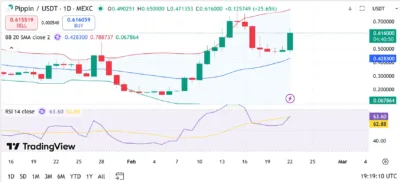
PIPPIN has surged sharply on the daily timeframe, printing a powerful bullish candle with over 25% gains. RSI is holding above 60, signaling strengthening momentum
Share
Coinstats2026/02/23 04:29
Will Cardano Reach $10 by 2030? Analysts Break Down ADA’s Growth Cycles

Will Cardano Reach $10 by 2030? Analysts Break Down ADA’s Growth Cycles

The post Will Cardano Reach $10 by 2030? Analysts Break Down ADA’s Growth Cycles appeared first on Coinpedia Fintech News Cardano (ADA) is trading at $0.9024 with a market cap of $32.91 billion. Experts say ADA has the potential to climb much higher, with some placing long-term targets as high as $10. The token continues to benefit from stronger visibility, rising liquidity, and increasing inflows from both institutional and retail markets. Can Cardano Hit $10 …
Share
CoinPedia2025/09/18 17:19
Crypto whale loses $6M to sneaky phishing scheme targeting staked Ethereum

Crypto whale loses $6M to sneaky phishing scheme targeting staked Ethereum

The post Crypto whale loses $6M to sneaky phishing scheme targeting staked Ethereum appeared on BitcoinEthereumNews.com. A crypto whale lost more than $6 million in staked Ethereum (stETH) and Aave-wrapped Bitcoin (aEthWBTC) after approving malicious signatures in a phishing scheme on Sept. 18, according to blockchain security firm Scam Sniffer. According to the firm, the attackers disguised their move as a routine wallet confirmation through “Permit” signatures, which tricked the victim into authorizing fund transfers without triggering obvious red flags. Yu Xian, founder of blockchain security company SlowMist, noted that the victim did not recognize the danger because the transaction required no gas fees. He wrote: “From the victim’s perspective, he just clicked a few times to confirm the wallet’s pop-up signature requests, didn’t spend a single penny of gas, and $6.28 million was gone.” How Permit exploits work Permit approvals were originally designed to simplify token transfers. Instead of submitting an on-chain approval and paying fees, a user can sign an off-chain message authorizing a spender. That efficiency, however, has created a new attack surface for malicious players. Once a user signs such a permit, attackers can combine two functions—Permit and TransferFrom—to drain assets directly. Because the authorization takes place off-chain, wallet dashboards show no unusual activity until the funds move. As a result, the assets are gone when the approval executes on-chain, and tokens are redirected to the attacker’s wallet. This loophole has made permit exploits increasingly attractive for malicious actors, who can siphon millions without needing complex hacks or high-cost gas wars. Phishing losses The latest theft highlights a wider trend of escalating phishing campaigns. Scam Sniffer reported that in August alone, attackers stole $12.17 million from more than 15,200 victims. That figure represented a 72% jump in losses compared with July. According to the firm, the most significant share of August’s damages came from three large accounts that accounted for nearly half…
Share
BitcoinEthereumNews2025/09/19 02:31