Which Crypto To Buy Today For Long-Term As Cardano Bears Regain Control After Key Resistance
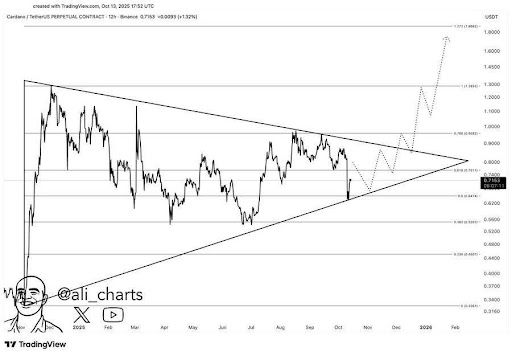
Cardano has encountered fresh downward pressure after sellers rebuffed a pivotal barrier at $0.734. Traders observed ADA hovering near $0.715 amid this retreat, which followed a modest rebound earlier in the week. On-chain metrics and derivatives painted a stark picture of seller dominance, as negative Spot Taker Cumulative Volume Delta persisted over recent months.
Yet, this turmoil in established tokens like Cardano spotlights emerging options poised for enduring value. Investors now eye altcoins that promise stability amid volatility. Which crypto to buy today for long-term? The query gains urgency as market sentiment sours, and more people start to look for the best crypto to buy in the current market cycle. In phases like this, capital often rotates toward projects with clearer catalysts—testnet releases, staged listings, and yield mechanics—rather than momentum alone.
Cardano Faces Deeper Correction
Sellers have solidified their hold on Cardano following that failed push against resistance. ADA had clawed back 15% over the weekend, only to falter at the 61.8% Fibonacci mark. Tuesday's action confirmed the stall, with prices easing back slightly. Technicals reinforced the gloom; daily RSI lingered at 40, well shy of neutral territory. Derivatives data echoed this caution, as short bets outnumbered longs substantially. Crypto predictions leaned bearish, with analysts warning of prolonged consolidation. Investors pondered why crypto is down, attributing it to broader fatigue in altcoin rallies. Cardano's stumble highlighted risks in overextended positions. Short bursts.
Yet long-term holders weighed accumulation chances if support held firm. This setup deterred fresh entries, steering capital toward fresher prospects. Transitions to brighter horizons beckoned, where utility outshines fleeting hype and investors search for top crypto to buy before Q4 momentum picks up. For allocators with longer horizons, screening which crypto to buy increasingly prioritizes tangible utility and conservative risk controls.
Mutuum Finance Presale Accelerates
Mutuum Finance (MUTM) has surged into focus as phase 6 of its presale unfolds at 70% capacity. Investors have poured $17,440,000 into the project since inception, swelling holder ranks to 17,220. Current pricing sits at $0.035 per token, a 250% leap from phase one's $0.01 entry.
Phase 6 sells out rapidly now, narrowing windows to secure tokens affordably. Phase 7 looms next, hiking costs 20% to $0.04. Launch awaits at $0.06, projecting 420% returns for phase 6 acquirers post-deployment. This strong presale trajectory has placed MUTM among the best crypto under $1 for investors looking for early exposure to a high-utility DeFi protocol. The staged, fixed-price structure provides transparency on entry points and helps define fair-value bands ahead of listing, a quality many consider when choosing the best crypto to buy now.
The team has unveiled a dashboard tracking the top 50 holders, including a 24-hour leaderboard that resets at 00:00 UTC daily. Top spot earns a $500 MUTM bonus, contingent on one transaction in the period.
Recent leaders snapped up $796.54, $535.76, $505.32, $474.72, and $440.60 worth in the last day. Such engagement underscores crypto investment fervor around this protocol and why it’s increasingly appearing on top crypto watchlists. Broader participation can also support healthier price discovery once market makers and early liquidity join at listing.

Protocol Development Advances
Mutuum Finance announced its lending and borrowing framework recently, targeting Sepolia Testnet in Q4 2025 for V1 rollout. Core elements include liquidity pools, mtTokens for deposits, debt tokens for loans, and liquidator bots to enforce stability.
Initial pairings feature ETH and USDT for lending, borrowing, or collateral duties. Borrow rates tie to utilization, dipping low during surplus to spur uptake, then climbing in scarcity to draw deposits. Stable options lock predictable costs for borrowers, starting higher than variables but shielding against spikes; rebalances kick in if gaps widen beyond 90% thresholds. The testnet phase is expected to validate oracle behavior, partial liquidations under stress, and utilization-based rate curves—useful milestones for investors evaluating a new cryptocurrency on readiness, not just narrative.
Only stable assets qualify, dodging volatility pitfalls. Overcollateralization mandates extra buffers against swings, with liquidations triggering at set debt ratios—say 70% of collateral value—to summon bonuses for swift rescuers. Deposit and borrow caps curb excesses, especially for illiquid tokens, while restricted modes limit high-risk collateral to same-asset loans.
Enhanced efficiency boosts limits for correlated pairs like stablecoins, optimizing yields without inflating dangers. Reserve factors skim interest slices—10% for steadier coins, up to 35% for wilder ones—to fortify against shocks. Chainlink oracles feed prices, backed by fallbacks and aggregates for resilience. These mechanics promise robust crypto investing via non-custodial access, letting holders borrow without sales.
Security and Community Initiatives
The Mutuum Finance team wrapped its CertiK audit triumphantly, earning a 90/100 token score that affirms sturdy defenses. They kicked off a Bug Bounty Program alongside CertiK, earmarking $50,000 USDT across critical, major, minor, and low tiers to hunt flaws rigorously.
Enthusiasm builds around a $100,000 MUTM giveaway, divvying $10,000 to each of 10 winners. Participants submit wallets, tackle quests fully, and stake at least $50 in the presale for eligibility. Such moves foster trust in this DeFi contender.
Holders relish mtTokens that accrue yields seamlessly, redeemable anytime with principal intact. Borrowers pledge excess collateral, repaying it instantly via smart contracts. Dual markets—pooled for speed, peer-to-peer for customization—cater to varied needs, from quick ETH loans to tailored niche deals. This blend equips users for sustained gains in fluctuating crypto prices today. For long-term allocators considering what crypto to invest in, third-party audits, bounties, and a dated testnet roadmap are baseline signals that complement presale momentum.
Long-Term Altcoin Pivot
Which crypto to buy today for long-term? Cardano's bearish stall underscores the wisdom in diversifying toward utility-driven altcoins like Mutuum Finance. As ADA tests fragile supports, MUTM's protocol gears up for testnet trials, blending secure lending with yield opportunities.
Investors have flocked, signaling confidence in its overcollateralized model that safeguards assets amid downturns. Crypto predictions favor such innovations over weary giants. Secure your stake in phase 6 before it closes. For balanced exposure, many investors pair majors with one or two top crypto to buy names that have 6–12 month catalysts, aligning near-term milestones with a longer-term thesis on defi crypto adoption.
For more information about Mutuum Finance (MUTM) visit the links below:
Website: https://mutuum.com/
Linktree:
:::tip This story was published as a press release by Btcwire under HackerNoon’s Business Blogging Program. Do Your Own Research before making any financial decision.
:::
\n
\n
\n
\n
\ \n
\n
\ \ \n
\n
\n
You May Also Like

Trust Wallet’s Decisive Move: Full Compensation for $7M Hack Victims

Cashing In On University Patents Means Giving Up On Our Innovation Future