The post WTI rises on Russian depot strike, US sanctions amid oversupply risks appeared on BitcoinEthereumNews.com. West Texas Intermediate (WTI) US Oil trades around $59.50 on Friday at the time of writing, up 1.60% on the day, after hitting a daily high at $60.47. The Crude Oil recovers after a Ukrainian drone strike damaged an Oil depot at Russia’s Black Sea port of Novorossiysk, one of the country’s key export hubs. According to regional authorities cited by Reuters, debris from the strike hit a trans-shipment facility and several coast-side structures, immediately stoking fears of supply disruptions. Oil prices are also gaining support from risks surrounding upcoming United States (US) sanctions targeting Russian Oil flows, which come into force on November 21. Lukoil, one of Russia’s largest private producers, has reportedly begun reducing staff across its global trading units, a sign that market participants are preparing for reduced operational flexibility.  Analysts warn that a significant portion of Russia’s seaborne Crude exports could become stranded, as rerouting is hampered by India and China recently halting their Russian crude purchases. However, this geopolitical boost collides with much heavier fundamental pressures. The International Energy Agency (IEA) expects a surplus of over 2.4 million barrels per day in 2025 and more than 4 million in 2026, even as global demand continues to grow. These projections align with those from the Organization of the Petroleum Exporting Countries and its allies (OPEC+), which has been increasing output since April and anticipates another modest market surplus next year. In the United States, the Energy Information Administration (EIA) reported a much larger-than-expected increase in Crude Oil inventories this week, reinforcing concerns about an already oversupplied market. These rising stockpiles come as US Oil production approaches record levels, adding structural downward pressure on prices. Against this backdrop, WTI manages to rebound primarily on geopolitical risk, but the move remains constrained by fundamentals that still point to… The post WTI rises on Russian depot strike, US sanctions amid oversupply risks appeared on BitcoinEthereumNews.com. West Texas Intermediate (WTI) US Oil trades around $59.50 on Friday at the time of writing, up 1.60% on the day, after hitting a daily high at $60.47. The Crude Oil recovers after a Ukrainian drone strike damaged an Oil depot at Russia’s Black Sea port of Novorossiysk, one of the country’s key export hubs. According to regional authorities cited by Reuters, debris from the strike hit a trans-shipment facility and several coast-side structures, immediately stoking fears of supply disruptions. Oil prices are also gaining support from risks surrounding upcoming United States (US) sanctions targeting Russian Oil flows, which come into force on November 21. Lukoil, one of Russia’s largest private producers, has reportedly begun reducing staff across its global trading units, a sign that market participants are preparing for reduced operational flexibility.  Analysts warn that a significant portion of Russia’s seaborne Crude exports could become stranded, as rerouting is hampered by India and China recently halting their Russian crude purchases. However, this geopolitical boost collides with much heavier fundamental pressures. The International Energy Agency (IEA) expects a surplus of over 2.4 million barrels per day in 2025 and more than 4 million in 2026, even as global demand continues to grow. These projections align with those from the Organization of the Petroleum Exporting Countries and its allies (OPEC+), which has been increasing output since April and anticipates another modest market surplus next year. In the United States, the Energy Information Administration (EIA) reported a much larger-than-expected increase in Crude Oil inventories this week, reinforcing concerns about an already oversupplied market. These rising stockpiles come as US Oil production approaches record levels, adding structural downward pressure on prices. Against this backdrop, WTI manages to rebound primarily on geopolitical risk, but the move remains constrained by fundamentals that still point to…

WTI rises on Russian depot strike, US sanctions amid oversupply risks

West Texas Intermediate (WTI) US Oil trades around $59.50 on Friday at the time of writing, up 1.60% on the day, after hitting a daily high at $60.47. The Crude Oil recovers after a Ukrainian drone strike damaged an Oil depot at Russia’s Black Sea port of Novorossiysk, one of the country’s key export hubs. According to regional authorities cited by Reuters, debris from the strike hit a trans-shipment facility and several coast-side structures, immediately stoking fears of supply disruptions.

Oil prices are also gaining support from risks surrounding upcoming United States (US) sanctions targeting Russian Oil flows, which come into force on November 21. Lukoil, one of Russia’s largest private producers, has reportedly begun reducing staff across its global trading units, a sign that market participants are preparing for reduced operational flexibility. 

Analysts warn that a significant portion of Russia’s seaborne Crude exports could become stranded, as rerouting is hampered by India and China recently halting their Russian crude purchases.

However, this geopolitical boost collides with much heavier fundamental pressures. The International Energy Agency (IEA) expects a surplus of over 2.4 million barrels per day in 2025 and more than 4 million in 2026, even as global demand continues to grow. These projections align with those from the Organization of the Petroleum Exporting Countries and its allies (OPEC+), which has been increasing output since April and anticipates another modest market surplus next year.

In the United States, the Energy Information Administration (EIA) reported a much larger-than-expected increase in Crude Oil inventories this week, reinforcing concerns about an already oversupplied market. These rising stockpiles come as US Oil production approaches record levels, adding structural downward pressure on prices.

Against this backdrop, WTI manages to rebound primarily on geopolitical risk, but the move remains constrained by fundamentals that still point to persistent weakness. Traders will now watch for developments on US sanctions, Russian supply flows, and upcoming monthly reports from the IEA and OPEC+, which will be key to assessing whether the recent recovery in Oil prices can last.

WTI Oil FAQs

WTI Oil is a type of Crude Oil sold on international markets. The WTI stands for West Texas Intermediate, one of three major types including Brent and Dubai Crude. WTI is also referred to as “light” and “sweet” because of its relatively low gravity and sulfur content respectively. It is considered a high quality Oil that is easily refined. It is sourced in the United States and distributed via the Cushing hub, which is considered “The Pipeline Crossroads of the World”. It is a benchmark for the Oil market and WTI price is frequently quoted in the media.

Like all assets, supply and demand are the key drivers of WTI Oil price. As such, global growth can be a driver of increased demand and vice versa for weak global growth. Political instability, wars, and sanctions can disrupt supply and impact prices. The decisions of OPEC, a group of major Oil-producing countries, is another key driver of price. The value of the US Dollar influences the price of WTI Crude Oil, since Oil is predominantly traded in US Dollars, thus a weaker US Dollar can make Oil more affordable and vice versa.

The weekly Oil inventory reports published by the American Petroleum Institute (API) and the Energy Information Agency (EIA) impact the price of WTI Oil. Changes in inventories reflect fluctuating supply and demand. If the data shows a drop in inventories it can indicate increased demand, pushing up Oil price. Higher inventories can reflect increased supply, pushing down prices. API’s report is published every Tuesday and EIA’s the day after. Their results are usually similar, falling within 1% of each other 75% of the time. The EIA data is considered more reliable, since it is a government agency.

OPEC (Organization of the Petroleum Exporting Countries) is a group of 12 Oil-producing nations who collectively decide production quotas for member countries at twice-yearly meetings. Their decisions often impact WTI Oil prices. When OPEC decides to lower quotas, it can tighten supply, pushing up Oil prices. When OPEC increases production, it has the opposite effect. OPEC+ refers to an expanded group that includes ten extra non-OPEC members, the most notable of which is Russia.

Source: https://www.fxstreet.com/news/wti-rebounds-on-russian-depot-strike-us-sanctions-despite-oversupply-fears-202511141334

Market Opportunity
StrikeBit AI Logo
StrikeBit AI Price(STRIKE)
$0.006338
$0.006338$0.006338
-0.03%
USD
StrikeBit AI (STRIKE) Live Price Chart
Disclaimer: The articles reposted on this site are sourced from public platforms and are provided for informational purposes only. They do not necessarily reflect the views of MEXC. All rights remain with the original authors. If you believe any content infringes on third-party rights, please contact service@support.mexc.com for removal. MEXC makes no guarantees regarding the accuracy, completeness, or timeliness of the content and is not responsible for any actions taken based on the information provided. The content does not constitute financial, legal, or other professional advice, nor should it be considered a recommendation or endorsement by MEXC.

You May Also Like

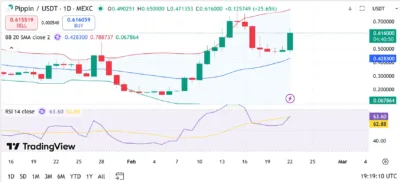
Pippin (PIPPIN) Price Prediction 2026–2030: Can PIPPIN Hit $0.70 Soon?

Pippin (PIPPIN) Price Prediction 2026–2030: Can PIPPIN Hit $0.70 Soon?

PIPPIN has surged sharply on the daily timeframe, printing a powerful bullish candle with over 25% gains. RSI is holding above 60, signaling strengthening momentum
Share
Coinstats2026/02/23 04:29
Will Cardano Reach $10 by 2030? Analysts Break Down ADA’s Growth Cycles

Will Cardano Reach $10 by 2030? Analysts Break Down ADA’s Growth Cycles

The post Will Cardano Reach $10 by 2030? Analysts Break Down ADA’s Growth Cycles appeared first on Coinpedia Fintech News Cardano (ADA) is trading at $0.9024 with a market cap of $32.91 billion. Experts say ADA has the potential to climb much higher, with some placing long-term targets as high as $10. The token continues to benefit from stronger visibility, rising liquidity, and increasing inflows from both institutional and retail markets. Can Cardano Hit $10 …
Share
CoinPedia2025/09/18 17:19
Crypto whale loses $6M to sneaky phishing scheme targeting staked Ethereum

Crypto whale loses $6M to sneaky phishing scheme targeting staked Ethereum

The post Crypto whale loses $6M to sneaky phishing scheme targeting staked Ethereum appeared on BitcoinEthereumNews.com. A crypto whale lost more than $6 million in staked Ethereum (stETH) and Aave-wrapped Bitcoin (aEthWBTC) after approving malicious signatures in a phishing scheme on Sept. 18, according to blockchain security firm Scam Sniffer. According to the firm, the attackers disguised their move as a routine wallet confirmation through “Permit” signatures, which tricked the victim into authorizing fund transfers without triggering obvious red flags. Yu Xian, founder of blockchain security company SlowMist, noted that the victim did not recognize the danger because the transaction required no gas fees. He wrote: “From the victim’s perspective, he just clicked a few times to confirm the wallet’s pop-up signature requests, didn’t spend a single penny of gas, and $6.28 million was gone.” How Permit exploits work Permit approvals were originally designed to simplify token transfers. Instead of submitting an on-chain approval and paying fees, a user can sign an off-chain message authorizing a spender. That efficiency, however, has created a new attack surface for malicious players. Once a user signs such a permit, attackers can combine two functions—Permit and TransferFrom—to drain assets directly. Because the authorization takes place off-chain, wallet dashboards show no unusual activity until the funds move. As a result, the assets are gone when the approval executes on-chain, and tokens are redirected to the attacker’s wallet. This loophole has made permit exploits increasingly attractive for malicious actors, who can siphon millions without needing complex hacks or high-cost gas wars. Phishing losses The latest theft highlights a wider trend of escalating phishing campaigns. Scam Sniffer reported that in August alone, attackers stole $12.17 million from more than 15,200 victims. That figure represented a 72% jump in losses compared with July. According to the firm, the most significant share of August’s damages came from three large accounts that accounted for nearly half…
Share
BitcoinEthereumNews2025/09/19 02:31