

- Quick Buy/SellBuy & sell with cards and mobile payments
- P2PTrade with local payments at best prices
- Fiat DepositDeposit in BRL, COP, EUR, and more
- Global Bank TransferBuy and sell via local banks
- MEXC CardSpend your crypto worldwide
- SpotBuy and sell crypto with ease
- RealStocksTrade top US equities directly with crypto
- ConvertSwap hot tokens instantly with 0 fees
- Pre-MarketGet in early before official listings
- MX ZoneUnlock exclusive perks with MX
- Spot DCASteady growth through ups and downs
- Spot GridBuy low and sell high 24/7
- Meme+Discover on-chain gems early
- On-ChainYour unified hub for discovering, trading, and managing on-chain assets
- USDT-MPerpetual Futures settled in USDT
- USDC-MPerpetual Futures settled in USDC
- USD1-MPerpetual Futures settled in USD1
- Coin-MPerpetual Futures settled in other cryptos
- Futures EarnEarn up to 20% APR on your Futures funds
- AI StrategyConvert ideas into strategic action
- Grid TradingCapture volatility with automated trading
- Copy Trade × AIFollow seasoned traders or strategize with AI
- Demo TradingSimulate Futures trading risk-free
- Futures OverviewExplore Futures tools, products, and features
- GOLD Futures24/7 access to top liquidity & leveraged power
- OIL Futures24/7 access to top liquidity & leveraged trading
- SILVER FuturesTrade with 0 fees, top liquidity, and flexible leverage.
- BTC FuturesMarket's lowest fees and high leverage
- ETH FuturesMarket's lowest fees and high leverage
- ZEC Futures SurgeEnjoy 0 fees, up to 150× leverage, and top position capacity at 21×+ leverage
- MEXC EarnEarn high APR on your crypto
- Hold and EarnHold assets and earn interest daily
- Futures EarnEarn on balance and unlock higher APR as you trade
- On-Chain EarnEasy staking. Real on-chain yield
- MEXC LoansBorrow instantly at competitive rates
- Rewards HubGet started with $10,000 in bonuses
- Event CenterHigher rewards, 0 fees
- Invite and EarnInvite friends and earn 140 USDT each
- LaunchpadAccess top tokens early or at a discount
- $500K TSLA FeverWin TSLAX, TSLAON & more!
- Airdrop+Deposit and trade to claim new airdrops
- KickstarterHold MX to earn new tokens
- RealStocks PNL Rate LeaderboardTrade $100 to win up to $10,000 in stock rewards
- 0 FeesTrade hot futures, enjoy limited 0 fees
- Futures M-DayTrade Futures and claim daily rewards
- Futures Loss Coverage PlanGet triple protection and win $5,000 in XAUT
- Referral ProgramInvite friends and unlock commissions from 40%
- Affiliate ProgramTop-tier affiliate commissions up to 70%
- MEXC VVIPM-Score into Wealth, 10+ Elite Benefits Upgrading
- MEXC × TradingViewConnect MEXC to trade directly on TradingView
- Crypto NewsFollow the latest crypto headlines
- AnnouncementsStay on top of every happening on MEXC
- LearnStrong crypto fundamentals for every beginner
- MEXC InstitutionalTailored solutions for institutional clients
Kalshi S&P 500 Event Contracts: What Comes Next?
Kalshi and S&P Dow Jones Indices (S&P DJI) announced a strategic collaboration on October 26, 2026, connecting established financial benchmarks with prediction-market products and data. Under the agreement, Kalshi becomes a preferred prediction-market platform licensed to offer event contracts tied to S&P DJI indices, while S&P DJI becomes a preferred provider for creating new indices derived from Kalshi event-market data. The collaboration introduces two distinct commercial opportunities: using recognized financial indices to settle event contracts and transforming prediction-market expectations into standardized information products.
The Kalshi S&P 500 Event Contracts initiative could strengthen the relationship between prediction markets and traditional financial infrastructure, but the agreement does not establish that all proposed contracts are already trading. Specific product launch dates and methodologies for new prediction-derived indices have not yet been disclosed. Index-linked event contracts also differ fundamentally from S&P 500 ETFs and conventional index futures because their payouts depend on defined outcomes rather than continuous ownership or exposure to an equity index.
The partnership's more significant implication is the possibility of a two-way financial data business. Traditional benchmarks could provide reliable reference values for event settlement, while prediction-market prices could become inputs for new measures of economic and financial expectations. Whether this model becomes commercially important will depend on market liquidity, transparent contract rules, index methodology, and demand for information generated by event-based trading.
Key Takeaways
- Kalshi and S&P DJI announced a preferred-provider collaboration on October 26, 2026, covering benchmark licensing and prediction-market data.
- Forthcoming index-linked event contracts will use official S&P DJI values as settlement references.
- S&P DJI may develop new indices using prices generated by Kalshi event markets.
- Index event contracts are not equivalent to index ETFs or conventional futures, even when they reference the same benchmark.
- The partnership's lasting value depends on liquidity, methodological transparency, and whether prediction-market data becomes useful to financial institutions.
A Two-Way Partnership Between Indices and Prediction Markets
The defining feature of the Kalshi–S&P DJI agreement is that financial information is intended to move in both directions. In traditional index-linked products, benchmark providers calculate reference values that exchanges, fund managers and derivative issuers use to structure investment products. Kalshi's agreement follows part of that established model by licensing S&P DJI indices for future event contracts. A trader could take a position on a defined outcome involving a recognized financial benchmark, with the eventual result determined according to the official index value and the contract's published rules. This can improve confidence in the settlement reference, although it does not guarantee liquidity or favorable trading outcomes.
The second part of the agreement reverses the relationship. S&P DJI plans to examine how Kalshi's market data can be transformed into indices reflecting expectations about future events. Rather than supplying an existing benchmark to a trading platform, the index provider would use prices formed through that platform as inputs for new financial information products. The announcement identifies areas such as economics, politics and sports as potential categories, but does not establish final methodologies or launch dates for these indices.
The collaboration therefore contains two separate data flows:
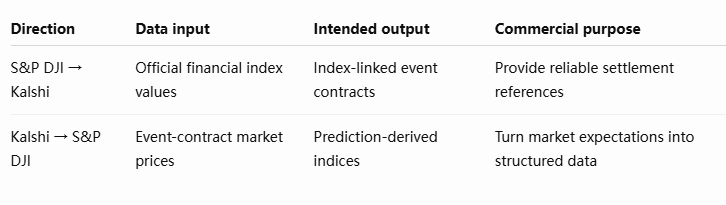
The two activities could reinforce one another, but this is an analytical possibility rather than a confirmed financial outcome. More widely recognized settlement references might support additional event trading, producing data that can subsequently be evaluated for index construction. Those new indices could then attract attention from researchers and professional market participants. However, greater product availability does not ensure that underlying markets develop enough liquidity to produce reliable information. The commercial viability of each direction must be assessed separately.
Kalshi S&P 500 Event Contracts: What Would Investors Trade?
An index-linked event contract allows participants to express a view about a clearly defined financial-market outcome. A contract might, for example, settle according to whether an index finishes above a specified level on a particular date. This is an illustration of the product mechanism, not a confirmed specification for a newly announced Kalshi contract. The final payout would be determined by the contract's settlement conditions, while the market price before settlement would reflect the positions of participants trading the expected outcome.
This differs from the way investors obtain index exposure through established securities and derivatives markets. An S&P 500 ETF generally provides fund-based exposure to a portfolio designed to track the index, while conventional index futures change in value according to the relevant futures price. An event contract instead focuses on a defined result. That can make it useful for expressing targeted views about particular scenarios, but it also creates discontinuous exposure around settlement thresholds.
Are Kalshi Index Contracts the Same as S&P 500 Futures?
No. The products can reference the same benchmark while producing substantially different financial outcomes.
ProductEconomic exposureTypical useMain limitationKalshi index event contractDefined index outcomeEvent-specific tradingOutcome-dependent payoutS&P 500 futuresContinuous index futures price exposureTrading and portfolio hedgingMargin, leverage and basis riskS&P 500 ETFFund-based index performanceInvestment and asset allocationFund fees and tracking differencesPrediction-derived indexAggregated event-market expectationsFinancial research and market analysisLiquidity and methodology dependence
The distinction affects how traders should interpret event-contract prices. A market price associated with a defined outcome may be interpreted as a market-implied estimate of that outcome, but it is not necessarily a statistically unbiased probability. Risk preferences, transaction costs, liquidity conditions and the composition of market participants can influence prices. Similarly, a contract whose result depends on an S&P 500 closing level does not provide ownership of the companies included in the index.
Official index licensing can reduce uncertainty over which benchmark value determines settlement. It does not change the underlying nature of the contract or turn the product into a substitute for conventional long-term equity exposure.
Why Official Benchmark Data Matters
The reliability of an event contract depends partly on how clearly its outcome is defined. Economic releases and financial market data can involve revisions, differing publication schedules, multiple sources and methodological changes. If a contract relies on an ambiguous reference, participants may disagree about how the result should be determined. Established index providers address these challenges through published calculation methodologies, governance processes and procedures for maintaining reference values.
S&P DJI brings that infrastructure to the proposed Kalshi products. Its indices are widely used across asset management and derivatives markets, making the underlying data familiar to institutional investors. For event contracts referencing these benchmarks, official values can provide a defined settlement source rather than requiring participants to rely on independently assembled market data.
Benchmark credibility, however, should not be confused with contract endorsement or investment quality. S&P DJI's announcement explicitly states that Kalshi contracts based on the S&P 500 and other S&P indices are not sponsored, sold or endorsed by S&P DJI. The licensing arrangement concerns the use of intellectual property and reference data, not a guarantee of trading performance.
The remaining challenge is market quality. Even a contract based on a recognized benchmark may have limited usefulness if trading volumes are low, bid-ask spreads are wide or settlement conditions attract only a narrow group of participants. Institutional traders also consider whether positions can be established and closed efficiently, particularly when the contracts are used alongside existing futures, options or other portfolio exposures.
The partnership strengthens the foundations of product design, but a credible settlement reference is only one requirement for a successful financial market.
Could Prediction-Market Prices Become Financial Benchmarks?
The second direction of the partnership may have greater long-term significance than the introduction of additional event contracts. Kalshi's markets generate prices associated with expectations about future outcomes. As participants respond to economic announcements, financial developments and new information, these prices can change continuously. S&P DJI intends to explore whether such observations can be organized into indices that provide a more consistent way to monitor market expectations.
That possibility creates a different role for prediction markets. Rather than serving exclusively as venues where participants trade event outcomes, they could become sources of structured financial information used by institutions that do not necessarily trade the underlying contracts.
The analytical challenge is that a prediction-market price is not automatically a reliable index input.
Three conditions would be particularly important:
- Liquidity quality: Contracts must have sufficient trading activity and market depth for prices to contain meaningful information rather than reflect isolated orders.
- Methodological consistency: Selected contracts need comparable definitions, observation periods and treatment of changing event conditions.
- Representative participation: Market prices should not be dominated by a narrow group whose incentives or information differ substantially from the broader population the index intends to represent.
An index combining event prices without addressing these issues could produce misleading results. Two markets may concern similar economic developments while using different settlement dates or outcome definitions. One contract may attract considerable institutional participation, while another may be thinly traded. Treating their prices as directly comparable would ignore important differences in information quality.
S&P DJI's expertise may help develop rules governing contract eligibility, weighting, observations and maintenance. However, the usefulness of any resulting index will need to be demonstrated through historical analysis and performance under different market conditions. The collaboration establishes an opportunity to develop new benchmark products, not proof that such products already deliver superior forecasts.
From Trading Activity to Market Information
Traditional financial institutions use a variety of indicators to assess future economic conditions. These include analyst surveys, derivatives-implied measures, bond yields, inflation expectations and statistical forecasts. Prediction-derived indices could add another perspective by aggregating prices formed through direct trading in defined outcomes.
Their value would depend on whether they capture information not already reflected in existing indicators. A market-based measure can adjust rapidly when participants incorporate new developments, but speed does not necessarily guarantee accuracy. Prices can respond to speculation, temporary liquidity imbalances and changes in participant behavior. An index provider therefore needs to establish whether the resulting measures remain meaningful over time and across different economic environments.
This creates two possible commercial applications with different requirements:
Trading-oriented benchmarks would need clear settlement references, strong underlying market integrity and sufficient liquidity to support financial products.
Research-oriented expectation indices would need transparent methodologies, stable historical records and evidence that they provide useful signals for analysts and institutions.
The partnership could support both directions, but their business models should not be conflated. A prediction-derived index may become valuable as information without becoming directly investable. Conversely, an actively traded event contract may generate substantial transactions without producing a particularly useful broader economic indicator.
That distinction is central to assessing the long-term value of the agreement.
Can Kalshi Challenge Traditional Financial Exchanges?
The collaboration moves Kalshi closer to the infrastructure associated with established financial exchanges, but competition will not necessarily involve identical products. Traditional index futures are used for continuous exposure, hedging and price discovery, while ETFs serve investment and allocation needs. Kalshi event contracts concentrate on specified outcomes, potentially attracting participants interested in narrower market scenarios.
This differentiation could allow Kalshi to develop markets that complement conventional derivatives rather than simply replace them. However, institutional adoption would require reliable execution, clearing, transparent contract rules and sufficient participation from liquidity providers. Recognized index data cannot solve those requirements independently.
The partnership also gives Kalshi an opportunity to expand beyond transaction-based activity. If the platform generates high-quality event data that can be incorporated into financial indices, its information products might become relevant to researchers, risk managers and asset managers who have no intention of trading individual event contracts. Such diversification could create a business opportunity, although the agreement does not disclose any confirmed revenue contribution from future prediction-derived indices.
The appropriate measure of success will therefore extend beyond the number of index-related markets launched. Contract liquidity, recurring institutional activity, data-product adoption and methodological reliability will provide more meaningful evidence of whether the collaboration creates lasting commercial value.
MEXC View: Prediction Markets Are Becoming Information Infrastructure
The Kalshi–S&P DJI partnership suggests that prediction markets may increasingly compete not only as trading platforms but also as sources of financial information. The distinctive opportunity lies in the ability to convert decentralized expectations about future outcomes into standardized measures that other market participants can evaluate. Traditional index providers have long transformed market data into benchmarks; prediction markets introduce a different category of source information, generated through contracts linked to specific future events.
This development does not imply that prediction-market prices should replace established economic forecasts or financial indicators. Instead, they may become complementary measures whose usefulness depends on market quality and index methodology. MEXC's overview of Kalshi's regulated event contract model provides background on how such markets translate expectations into tradable positions. The S&P DJI collaboration adds a potential institutional data layer, allowing selected observations to be organized into more widely accessible financial reference products.
If this approach proves useful, the competitive position of prediction-market operators may increasingly depend on the quality of the information their markets generate, not simply total trading volume. That would represent a meaningful expansion of the industry's economic role.
Benchmark Access Opens the Door, but Liquidity Decides
Kalshi's collaboration with S&P Dow Jones Indices marks a potentially significant step in the development of event-based financial markets. The agreement creates an opportunity to use established index values as settlement references while exploring how prediction-market prices can be transformed into new financial data products. These two directions address different market needs: the first improves the reference infrastructure available to event contracts, while the second tests whether trading-based expectations can become useful benchmarks.
The Kalshi S&P 500 Event Contracts initiative should nevertheless be evaluated as a developing product opportunity rather than a completed transformation of traditional derivatives markets. Referencing the S&P 500 or another recognized index does not give an event contract the same economic exposure as an ETF or conventional futures contract. Nor does access to official benchmark data ensure institutional demand or reliable trading liquidity. The success of future products will depend on how well their contract designs correspond to actual investment and risk-management needs.
The longer-term opportunity may lie in data. Prediction markets continuously generate observations about expected future outcomes, and systematic index construction could make selected observations more useful to financial researchers and institutions. Yet methodological quality, representative participation and sufficient market liquidity must be established before such indices can be treated as dependable indicators.
The next developments worth monitoring are the publication of specific index-linked contract rules, confirmed launch dates, live trading activity, and the introduction of formal methodologies for prediction-derived indices. These will provide the evidence necessary to assess whether the collaboration creates sustainable financial products or remains primarily a licensing and development initiative.
The partnership's distinctive value is its two-way structure: established financial benchmarks can improve the definition of prediction-market contracts, while sufficiently robust prediction markets may generate information suitable for new benchmarks. Whether this relationship becomes a meaningful part of financial market infrastructure will depend on the quality of both the contracts and the data they produce.
Sources
MEXC internal link used:
https://blog.mexc.com/news/what-is-kalshi-a-cftc-licensed-prediction-market-in-the-united-states/
S&P Dow Jones Indices — Official Partnership Announcement, October 26, 2026:
https://press.spglobal.com/2026-10-26-S-P-Dow-Jones-Indices-and-Kalshi-Announce-Collaboration-to-Bring-the-Worlds-Most-Trusted-Benchmarks-to-Prediction-Markets
Risk Disclaimer: This article is for reference only and does not constitute investment advice. The cryptocurrency market is highly volatile. Please make decisions cautiously based on your individual circumstances.
More Related News
Stay ahead of the curve with Trending News—your daily pulse on the crypto and traditional finance markets. We cut through the noise to bring you the most critical headlines, macro shifts, and market-moving events as they happen. From breaking regulatory updates to sudden price actions and institutional trends, this is where you'll find real-time insights to keep your trading strategy sharp and informed.
Comments
Only preset comments and emojis can be selected