KPMG 2025 Consumer & Retail Report Signals India’s AI Retail Shift
KPMG 2025 Consumer & Retail Report Signals India’s Shift Toward AI-Led Retail Intelligence
The KPMG 2025 Consumer & Retail Report arrives at a moment when India’s retail economy is becoming simultaneously more digital, more fragmented, and more unpredictable.
Consumers are upgrading and downgrading at the same time. Premiumization is accelerating in categories like beauty, electronics, and lifestyle, while value-conscious buying behavior remains deeply embedded across essentials. This dual-speed demand environment is forcing retailers and consumer brands to rethink how they forecast demand, manage pricing, personalize engagement, and build resilience.
Against this backdrop, argues that AI is becoming the defining operational lever for the next phase of consumer and retail transformation.
The report, based on insights from 120 global consumer and retail CEOs, outlines how enterprises are moving AI from experimentation into scaled deployment across supply chains, workforce planning, customer engagement, merchandising, and governance systems.
“AI is emerging as a key transformation driver, with companies increasingly scaling its use across customer engagement, pricing, demand forecasting and operations,” — Nikhil Sethi, Partner and National Leader Consumer Goods and Co-Lead Customer & Operations, KPMG in India
Why the KPMG 2025 Consumer & Retail Report Matters Beyond AI Hype
The report’s most important contribution is that it reframes AI not as a technology experiment but as a retail operating model.
That distinction matters.
For years, digital transformation in retail focused heavily on customer-facing channels: mobile apps, online commerce, loyalty programs, and omnichannel experiences. The current transition is structurally deeper. AI is now influencing the internal mechanics of retail itself.
This includes:
- Demand forecasting
- Pricing optimization
- Inventory planning
- Fraud detection
- Workforce orchestration
- Supplier visibility
- Customer engagement automation
Strategically, this indicates a shift from digitized retail toward intelligent retail.
The older retail model optimized for efficiency under stable market assumptions. The new environment demands adaptive systems capable of responding to volatility in near real time. Supply-chain shocks, climate disruptions, geopolitical instability, and fragmented consumer behavior have made static operating models increasingly fragile.
This becomes critical when Indian retail complexity is considered. India is not a single-speed consumer market. Regional demand patterns, purchasing power differences, urban-rural divergence, and platform-led commerce behavior create operational unpredictability at scale.
The deeper implication is that retailers capable of converting fragmented consumer signals into operational intelligence will likely outperform competitors still dependent on periodic forecasting cycles.
AI Is Becoming the New Retail Infrastructure
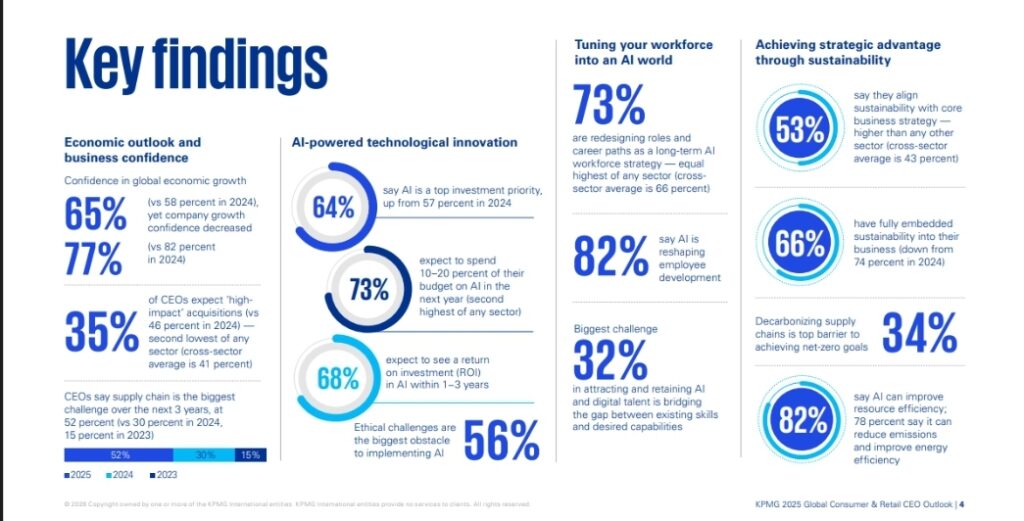
The KPMG 2025 Consumer & Retail Report reveals that 64 percent of CEOs now identify AI as a top investment priority, up from 57 percent in 2024.
That statistic alone is significant, but the operational context behind it matters more.
Retail AI deployment is no longer limited to chatbots or marketing automation. Enterprises are integrating AI into:
- Warehouse operations
- Inventory balancing
- Demand sensing
- Personalized commerce
- Route optimization
- Dynamic pricing
- Returns management
“AI’s shift from pilots to scaled adoption is driving smarter operations and deeper consumer engagement,” — Dr. Puneet Mansukhani, Global Head of Digital and Technology Transformation for Retail at KPMG International and Sector Head for Retail at KPMG in India
This transition reflects a broader enterprise realization: customer experience quality increasingly depends on operational intelligence quality.
Consumers experience supply chains indirectly through:
- Delivery speed
- Product availability
- Pricing consistency
- Fulfillment reliability
- Recommendation relevance
In other words, logistics is becoming part of CX.
The report notes that 52 percent of CEOs now view supply-chain resilience as the top operational challenge, up sharply from previous years. That escalation illustrates how operational continuity has become a boardroom-level customer experience issue.
The Rise of the Dual-Speed Consumer Economy
One of the strongest India-specific implications in the report is the emergence of a polarized demand environment.
Consumers are simultaneously seeking:
- Premium experiences
- Greater personalization
- Lower prices
- Faster delivery
- Higher convenience
This forces enterprises into a difficult balancing act.
Traditional mass-market segmentation strategies become less effective in such environments because consumer behavior itself becomes inconsistent. The same household may splurge in one category while aggressively optimizing value in another.
Operationally, this translates into:
- SKU rationalization
- Micro-segmentation
- Dynamic pricing
- Faster inventory reallocation
- Personalized engagement models
This is where AI becomes structurally important rather than merely useful.
“For India’s FMCG and consumer companies, the real opportunity lies in using AI to better understand and respond to a highly diverse and fast-changing consumer base,” — Nikhil Sethi, KPMG in India
The report suggests that enterprises capable of combining AI-led forecasting with flexible supply-chain systems will likely gain disproportionate competitive advantage.
Trust, Governance, and the New AI Risk Layer
The report does not frame AI as universally frictionless.
In fact, one of its most consequential findings is that 56 percent of CEOs identify ethical and governance challenges as major barriers to AI implementation.
This becomes especially important in consumer-facing industries where AI systems directly influence:
- Pricing decisions
- Product recommendations
- Consumer targeting
- Demand forecasting
- Fraud monitoring
From a CX standpoint, trust becomes infrastructure.
Poor governance can damage:
- Brand credibility
- Consumer trust
- Regulatory standing
- Data security confidence
The report also highlights rising concern around fraud detection, cybersecurity, and identity theft.
This indicates that future retail competitiveness may increasingly depend on responsible intelligence systems rather than aggressive automation alone.
“AI should not be considered merely a tool, but rather as a transformative partner,” — Duleep Rodrigo, Head of Consumer and Retail, Americas and the US, KPMG US
Workforce Transformation Is Becoming Non-Negotiable
Another critical signal in the report is workforce restructuring.
Seventy-three percent of CEOs say they are redesigning roles and career paths as part of long-term AI workforce strategy.
This is not simply about replacing labor.
The more significant shift is the redesign of human-machine collaboration models.
Retail organizations increasingly require employees who can:
- Interpret AI-generated insights
- Manage automated workflows
- Supervise AI-driven systems
- Combine data analysis with customer empathy
The report also identifies talent shortages as a major barrier, particularly around AI and digital capability development.
“For C&R companies, developing AI capability across both senior management and frontline teams is critical to building a future-ready workforce,” — Anson Bailey, Head of Consumer and Retail, ASPAC region, KPMG China
This indicates that workforce adaptability may become as strategically important as technology investment itself.
Sustainability Is Moving From Compliance to Resilience
The report also reframes sustainability.
Rather than treating ESG solely as compliance or branding, CEOs increasingly view sustainability as operational resilience.
That is an important distinction.
Climate volatility, resource scarcity, and energy cost pressures are directly impacting supply-chain reliability. The report notes that 82 percent of CEOs believe AI can improve resource efficiency, while 78 percent say it can reduce emissions and improve energy efficiency.
From a strategic perspective, sustainability is becoming intertwined with:
- Cost efficiency
- Inventory resilience
- Supply continuity
- Risk reduction
This becomes particularly important for sectors dependent on agriculture, commodities, and global logistics networks.
“Whilst regulations must be complied with, for consumer and retail leaders, sustainability is increasingly about business resilience and efficiency,” — Linda Ellett, Head of Consumer, Retail and Leisure, KPMG UK
The Future of Retail May Become Agent-to-Agent Commerce
Perhaps the most forward-looking insight in the report involves agentic AI.
KPMG suggests the retail industry may gradually evolve toward “agent-to-agent” commerce environments where AI systems assist or autonomously execute consumer decisions.
This could fundamentally reshape:
- Search behavior
- Brand discovery
- Purchase journeys
- Recommendation systems
- Loyalty models
The implication is profound.
Retailers may eventually compete not only for human attention but also for algorithmic relevance within AI-mediated commerce ecosystems.
That transition could redefine digital commerce architecture itself.
Conclusion
The KPMG 2025 Consumer & Retail Report ultimately signals that consumer and retail transformation is no longer primarily about digitization. It is about adaptive intelligence.
The companies most likely to lead the next phase of retail growth may not necessarily be those with the largest footprints or the biggest advertising budgets. Instead, leadership may increasingly depend on who can:
- Operationalize AI responsibly
- Build resilient supply chains
- Interpret fragmented consumer demand
- Redesign workforce capabilities
- Convert data into real-time decision intelligence
For India’s consumer and retail ecosystem, that transition is already underway.
The post KPMG 2025 Consumer & Retail Report Signals India’s AI Retail Shift appeared first on CX Quest.


You May Also Like

Trump treating DC like 'personal property' to abuse when he gets bored: analysis

Markets, AI Rally Rattled as Trump Calls Iran Ceasefire “On Life Support”