Ethereum developer Vitalik Buterin states that the PeerDAS component of the Fusaka upgrade allows Ethereum nodes to authenticate blockchain data without downloading it, eliminating scaling. Vitalik Buterin, the co-founder of Ethereum, disclosed that the main functionality of the Fusaka upgrade, which is known as PeerDAS (Peer Data Availability Sampling), will transform the scalability of Ethereum.  […] The post Fusaka’s PeerDAS Is Ethereum’s Scaling Breakthrough appeared first on Live Bitcoin News.Ethereum developer Vitalik Buterin states that the PeerDAS component of the Fusaka upgrade allows Ethereum nodes to authenticate blockchain data without downloading it, eliminating scaling. Vitalik Buterin, the co-founder of Ethereum, disclosed that the main functionality of the Fusaka upgrade, which is known as PeerDAS (Peer Data Availability Sampling), will transform the scalability of Ethereum.  […] The post Fusaka’s PeerDAS Is Ethereum’s Scaling Breakthrough appeared first on Live Bitcoin News.

Fusaka’s PeerDAS Is Ethereum’s Scaling Breakthrough

Ethereum developer Vitalik Buterin states that the PeerDAS component of the Fusaka upgrade allows Ethereum nodes to authenticate blockchain data without downloading it, eliminating scaling.

Vitalik Buterin, the co-founder of Ethereum, disclosed that the main functionality of the Fusaka upgrade, which is known as PeerDAS (Peer Data Availability Sampling), will transform the scalability of Ethereum. 

Fusaka is planned to be released on December 3, 2025, and it deals with an important blockchain problem. PeerDAS allows nodes to check the availability of data without downloading the whole blocks. 

This has the effect of reducing network congestion without compromising security or decentralization, as Buterin explained on X, but the live blockchain will not make any particular node download all data.

This is in part done by PeerDAS by requesting small chunks of data randomly from nodes. Then, when more than half of the chunks are available, erasure-coding can be used to recover missing pieces using the remaining chunks. 

The approach guarantees the network is resilient even in the event that a large number of nodes are dishonest. In the first phase, a few nodes temporarily store full data to be broadcast or reassembled; however, this is a distributed and untrusted role. 

The technology is the first in live blockchain devices, which are essential in scaling Layer 2 solutions in the present and eventually Layer 1 with a rise in the gas limit.

Ether Usage Hits New Heights as Fusaka is Implemented.

Recent network statistics indicate that Ethereum reached six blobs per block, the first time, indicating an increase in block usage. 
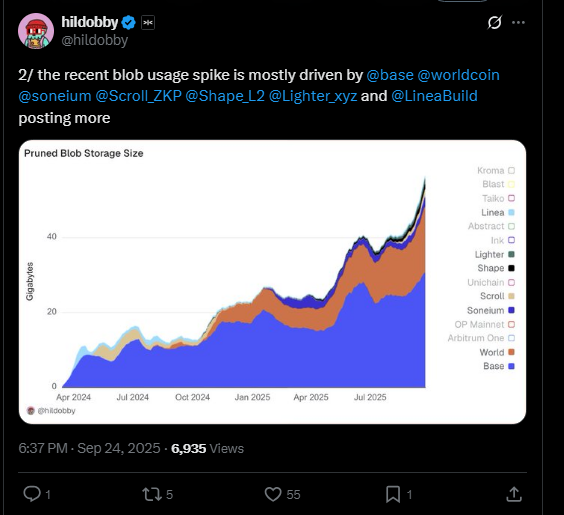
Source – X

Blockchain analyst Hildobby on X argues that this demand is being driven by large Layer 2 networks such as Base, Worldcoin, and Scroll. 

These L2s together spend more than 200,000 dollars per week on mainnet fees, using blobs to save on transaction fees.  Fusaka will increase blob capacity (6-9) to 14-21 blobs per block using phased forks, which will allow more comfortable L2 scaling and reduce fees to less than $0.1.

Vitalik Buterin emphasized that careful and slow increments in using blobs were required in order to be secure. He elaborated that there is complete availability of data, but this is limited and shared between nodes. 

The next versions will make distribution even more efficient with cell-level messaging and distributed block building. This will decrease the dependency on any one actor and enhance the decentralization of Ethereum.

PeerDAS is one of the innovations that Ethereum will use in scaling. It addresses the issue of data availability that has impeded the smooth layer 2 development. 

Fusaka offers better node verification and reconstruction of blockchain data, paving the way to the widespread use of Ethereum-based applications, such as DeFi, AI, and consumer tools.

This improvement is in line with the gas throughput expansion roadmap of Ethereum, which, in the coming years the throughput is expected to reach 150 million gas per block. 

Ethereum appears to be prepared to retain its decentralization and expand with increased user demand with Fusaka.

The post Fusaka’s PeerDAS Is Ethereum’s Scaling Breakthrough appeared first on Live Bitcoin News.


Market Opportunity
SecondLive Logo
SecondLive Price(LIVE)
$0.00004204
$0.00004204$0.00004204
+4.62%
USD
SecondLive (LIVE) Live Price Chart
Disclaimer: The articles reposted on this site are sourced from public platforms and are provided for informational purposes only. They do not necessarily reflect the views of MEXC. All rights remain with the original authors. If you believe any content infringes on third-party rights, please contact service@support.mexc.com for removal. MEXC makes no guarantees regarding the accuracy, completeness, or timeliness of the content and is not responsible for any actions taken based on the information provided. The content does not constitute financial, legal, or other professional advice, nor should it be considered a recommendation or endorsement by MEXC.

You May Also Like

Unleashing A New Era Of Seller Empowerment

Unleashing A New Era Of Seller Empowerment

The post Unleashing A New Era Of Seller Empowerment appeared on BitcoinEthereumNews.com. Amazon AI Agent: Unleashing A New Era Of Seller Empowerment Skip to content Home AI News Amazon AI Agent: Unleashing a New Era of Seller Empowerment Source: https://bitcoinworld.co.in/amazon-ai-seller-tools/
Share
BitcoinEthereumNews2025/09/18 00:10
CME Group to launch Solana and XRP futures options in October

CME Group to launch Solana and XRP futures options in October

The post CME Group to launch Solana and XRP futures options in October appeared on BitcoinEthereumNews.com. CME Group is preparing to launch options on SOL and XRP futures next month, giving traders new ways to manage exposure to the two assets.  The contracts are set to go live on October 13, pending regulatory approval, and will come in both standard and micro sizes with expiries offered daily, monthly and quarterly. The new listings mark a major step for CME, which first brought bitcoin futures to market in 2017 and added ether contracts in 2021. Solana and XRP futures have quickly gained traction since their debut earlier this year. CME says more than 540,000 Solana contracts (worth about $22.3 billion), and 370,000 XRP contracts (worth $16.2 billion), have already been traded. Both products hit record trading activity and open interest in August. Market makers including Cumberland and FalconX plan to support the new contracts, arguing that institutional investors want hedging tools beyond bitcoin and ether. CME’s move also highlights the growing demand for regulated ways to access a broader set of digital assets. The launch, which still needs the green light from regulators, follows the end of XRP’s years-long legal fight with the US Securities and Exchange Commission. A federal court ruling in 2023 found that institutional sales of XRP violated securities laws, but programmatic exchange sales did not. The case officially closed in August 2025 after Ripple agreed to pay a $125 million fine, removing one of the biggest uncertainties hanging over the token. This is a developing story. This article was generated with the assistance of AI and reviewed by editor Jeffrey Albus before publication. Get the news in your inbox. Explore Blockworks newsletters: Source: https://blockworks.co/news/cme-group-solana-xrp-futures
Share
BitcoinEthereumNews2025/09/17 23:55
SEC flags Bitcoin miner hosting services as subject to securities laws

SEC flags Bitcoin miner hosting services as subject to securities laws

                                                                               In a lawsuit, the SEC says some hosted Bitcoin mining services could trigger 
Share
Coinstats2025/12/19 11:23