

Whale vs. Retail Divergence: What Metrics Reveal for Altcoin Season
In mid-May 2026, Bitcoin hovered near $80,000 amid mixed macro signals and hotter-than-expected CPI data. Yet something striking emerged in the on-chain wallets holding 10–10,000 BTC quietly accumulated 16,622 BTC in recent days, while the smallest retail wallets (under 0.01 BTC) dumped 28 BTC. Santiment flagged this as “ideal conditions” for a sustainable move—smart money buying the dip as retail shows fear.
At the same time, CryptoQuant highlighted sustained profit-taking: short-term holders realized coins at a profit, daily realized profits spiked earlier in May, and the April rally was powered almost entirely by perpetual futures demand while spot demand contracted. Large holders (1K–10K BTC) have swung from aggressive accumulators to net distributors over the past year in one of the most pronounced distribution cycles on record.
This is not noise. It is the classic whale-vs-retail divergence—a recurring on-chain signal that has preceded major turning points in every Bitcoin cycle. Understanding it separates reactive traders from those who position ahead of structural shifts, especially when capital begins rotating into altcoins.
What “Whale vs. Retail” Actually Means on Chain
On-chain analytics platforms like Santiment and CryptoQuant slice Bitcoin’s supply by wallet size and behavior, revealing who is buying, selling, or simply holding through the noise.
- Whales & Key Stakeholders (typically 10–10K BTC or 100+ BTC cohorts): These are often institutions, high-net-worth individuals, or sophisticated funds. Their moves are deliberate, low-frequency, and high-conviction. Santiment tracks them via large-transaction counts ($100K+ and $1M+), exchange inflows/outflows, and wallet-tier accumulation. CryptoQuant adds realized profit/loss, SOPR (Spent Output Profit Ratio), and CVD (Cumulative Volume Delta) to show whether they are absorbing or distributing supply.
- Retail / Shrimp & Dolphins (under 0.01 BTC up to mid-tier 100–1K BTC): Smaller addresses represent everyday investors. Their behavior is more emotional—FOMO buys on green candles, panic sells on red. CryptoQuant’s exchange deposit flows and retail-dominated futures activity often capture this; Santiment highlights when small wallets aggressively accumulate or dump while whales stay quiet.
Key metrics that expose the divergence:
- SOPR & Realized Profits (CryptoQuant): Short-term holder SOPR above 1.0 signals profit-taking. In early May 2026, daily realized profits hit multi-month highs while long-term holders remained relatively disciplined.
- Wallet-Tier Accumulation (Santiment): The 10–10K BTC cohort adding thousands of BTC while <0.01 BTC wallets sell is a textbook bullish setup.
- Futures vs. Spot Demand (CryptoQuant): Perpetual futures open interest growth with contracting spot demand = speculative rally, not organic buying.
- Whale Transactions & Exchange Flows: Spikes in $100K+ moves to cold storage signal accumulation; inflows to exchanges from large wallets signal distribution.
Analogy: Think of the Bitcoin market as an ocean. Whales swim deep and move slowly, creating currents that smaller fish (retail) react to. When whales quietly stockpile while shrimp scatter, the tide is about to turn—even if the surface looks calm.
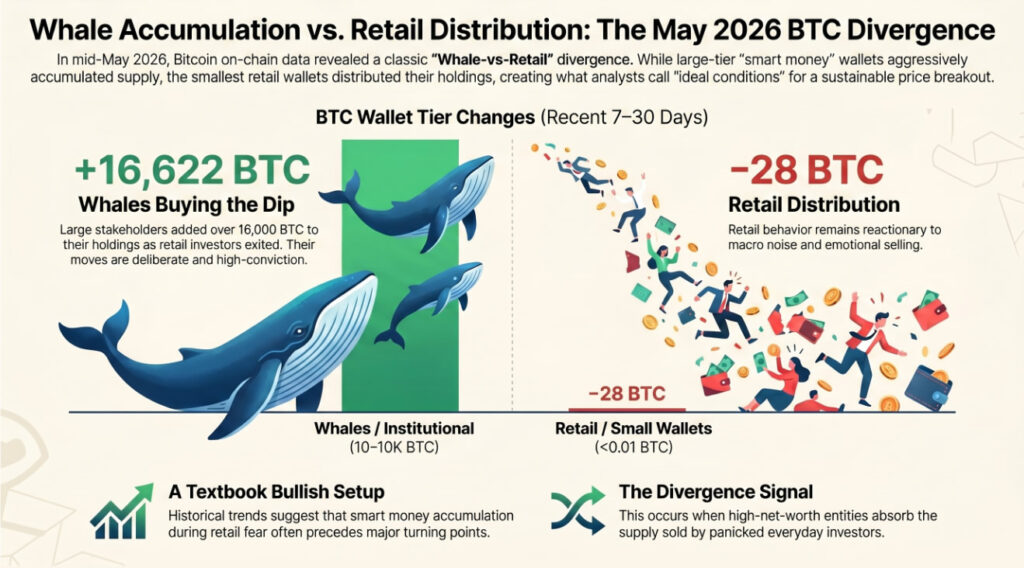 Whale accumulation vs retail distribution, May 2026.
Historical Context: Divergence as Cycle Compass
This pattern is not new.
In late 2021, whales distributed into the final blow-off top while retail FOMOed in. The 2022 bear market saw the reverse: whales accumulated at $15K–$20K ranges while retail capitulated. By late 2024 into early 2025, Santiment repeatedly noted whales stacking 50K+ BTC in quiet periods while retail sold into rallies—preceding the post-election surge.
CryptoQuant’s April 2026 analysis explicitly compared the futures-driven rally to the 2022 bear-market relief rally that ultimately failed when spot demand never recovered. History shows the divergence is most powerful when:
- Whales accumulate on dips.
- Retail sells or stays sidelined (FUD or exhaustion).
- Spot demand lags futures (signaling leverage, not conviction).
When these align, capital rotation often follows: BTC consolidates or corrects mildly, and whales rotate profits into high-conviction alts with strong fundamentals and developer activity.
2026 Price Action: Speculative Rally Meets Structural Divergence
Fast-forward to 2026. Bitcoin’s post-halving year has been defined by institutional maturity and macro sensitivity.
CryptoQuant’s research (April–May 2026) painted the recent surge as a “bear market rally”: perpetual futures demand exploded, spot demand contracted, and short-term holders took profits at the highest daily rate since December 2025. Unrealized profit margins hit 18%—levels that historically precede intensified distribution. Large 1K–10K BTC holders swung net negative on a yearly basis.
Yet Santiment’s wallet data tells a more nuanced story. In May, the 10–10K tier resumed accumulation while retail showed hesitation amid hotter inflation prints. This is the exact “smart money accumulates, retail dumps” setup Santiment has called bullish for breakouts in prior cycles.
Table: Whale vs. Retail Behavior Snapshot – May 2026
| Cohort | Recent Action | Implication (CryptoQuant/Santiment) | Historical Parallel |
|---|---|---|---|
| 10–10K BTC (Whales) | +16,622 BTC accumulation | High-conviction buying on dip | 2024–2025 bottom |
| <0.01 BTC (Retail) | –28 BTC distribution | Fear/FUD; classic contrarian signal | Pre-rally phases |
| Short-Term Holders | Elevated SOPR & profit-taking | Rally fatigue, but absorption capacity remains | April 2026 rally |
| Futures vs. Spot | Futures-driven, spot contracting | Speculative, not organic—watch for reversal | 2022 relief rally |
How Divergence Fuels Altcoin Season
Altseason does not start with retail euphoria—it starts when whales, having secured BTC profits or rebalanced, seek higher-beta opportunities.
Santiment’s May 2026 observations already hint at rotation: XRP 10M+ wallets hit their highest supply concentration since 2018; Ethena saw whale activity spike alongside network growth ahead of its fee-switch vote. When BTC dominance stabilizes or dips while whale transaction counts rise on alt L1s and DeFi protocols, the rotation accelerates.
Watch these on-chain signals for altcoin confirmation:
- Surging $100K+ transactions on specific altcoin networks.
- Whale wallets (tracked via Santiment) moving capital from BTC/ETH exchanges into alt treasuries.
- Rising developer activity + whale accumulation in projects still below prior ATHs.
- CryptoQuant exchange reports showing BTC outflows coinciding with alt inflows.
Retail FOMO usually arrives last—often after the smartest money has already positioned.
Risks: When Divergence Misleads
Divergence is a powerful signal, not a crystal ball.
- False positives: Whales can distribute aggressively (as seen in 1K–10K net selling phases) or move coins for custody/OTC reasons unrelated to price direction.
- Leverage traps: Futures-driven rallies can unwind violently if funding flips and spot demand stays weak.
- Macro override: Geopolitical shocks or policy surprises can override on-chain setups overnight.
- Data lag: Wallet labels evolve; what looks like “whale” today may include new institutional custody solutions.
Always cross-reference multiple platforms and timeframes. No single metric wins alone.
Practical Takeaways for Crypto Investors
- Track the divergence weekly: Use Santiment’s wallet-tier charts and CryptoQuant’s SOPR, realized profit, and CVD dashboards.
- Position defensively in BTC during heavy profit-taking phases, then rotate selectively into alts with whale support and real utility.
- Ignore retail sentiment noise: When social FOMO spikes while whales stay patient, prepare for volatility.
- Dollar-cost average into dips where on-chain data shows accumulation—especially when retail fear peaks.
- Build conviction in fundamentals: Whales rotate to projects with actual adoption, not hype.
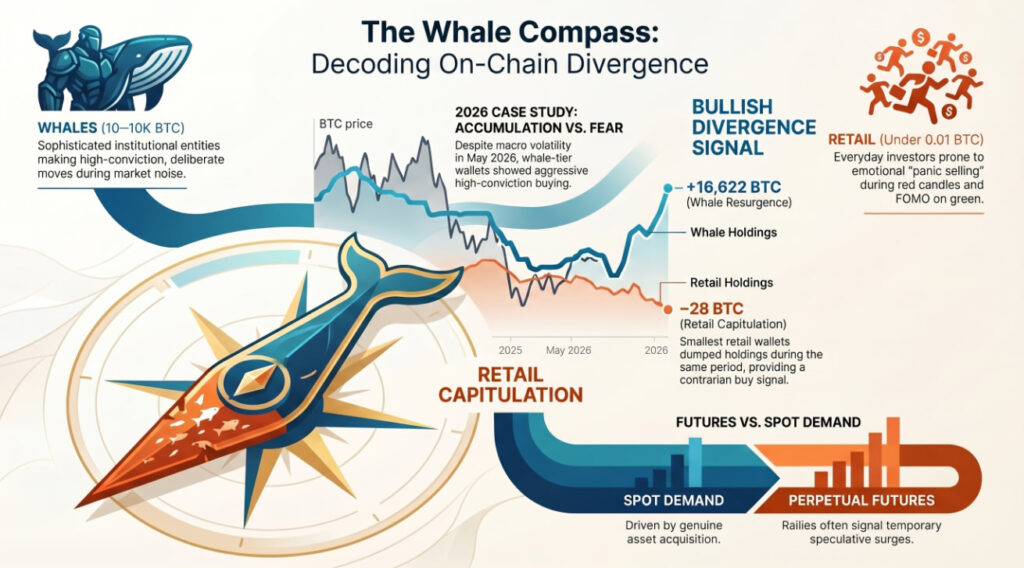 Historical whale accumulation leading price moves.
Future Outlook: Toward a More Mature Cycle
As Bitcoin matures into a macro asset, whale-vs-retail divergence becomes even more pronounced. Institutional custody, ETFs, and on-chain transparency make large-player moves easier to read—and harder to fake.
The 2026 environment—post-halving, higher institutional participation, and clearer regulatory paths—favors structural bulls who respect on-chain reality over headline noise. When whales accumulate while retail hesitates, history suggests the next leg belongs to those who positioned early, often in the assets whales quietly rotate into.
The data does not predict exact prices. It reveals market structure: who is truly in control and where conviction lies.
Bottom line: In May 2026, the on-chain story is clear—whales are buying the narrative retail is still afraid to embrace. That divergence has launched every major leg higher in Bitcoin’s history. The question is whether you will watch from the sidelines or use the metrics to get ahead of the rotation.
Ready to go deeper? Subscribe to Cryptopress.site for weekly on-chain deep dives, Santiment/CryptoQuant metric breakdowns, and evergreen guides that outlast the news cycle.
All data referenced as of mid-May 2026 from public Santiment and CryptoQuant reports. On-chain analysis is probabilistic, not financial advice. DYOR and manage risk.
The post Whale vs. Retail Divergence: What Metrics Reveal for Altcoin Season appeared first on Cryptopress.


You May Also Like

Samsung One UI 9 beta is here: What Galaxy users should know

GOP civil war growing as party 'splinters' over Israel ties: report




