TLDRs; HPE stock fell 5% after issuing weaker fiscal 2026 revenue and EPS guidance than analysts expected. The company forecasts 5%–10% revenue growth and $2.20–$2.40 EPS, missing Wall Street’s 17% growth outlook. HPE plans $3.7 billion in share buybacks and 2,500 job cuts as part of its Juniper Networks integration. Long-term growth depends on executing [...] The post Hewlett Packard Enterprise Company (HPE)Stock: Declines as Revenue and EPS Guidance Disappoints appeared first on CoinCentral.TLDRs; HPE stock fell 5% after issuing weaker fiscal 2026 revenue and EPS guidance than analysts expected. The company forecasts 5%–10% revenue growth and $2.20–$2.40 EPS, missing Wall Street’s 17% growth outlook. HPE plans $3.7 billion in share buybacks and 2,500 job cuts as part of its Juniper Networks integration. Long-term growth depends on executing [...] The post Hewlett Packard Enterprise Company (HPE)Stock: Declines as Revenue and EPS Guidance Disappoints appeared first on CoinCentral.

Hewlett Packard Enterprise Company (HPE)Stock: Declines as Revenue and EPS Guidance Disappoints

TLDRs;

  • HPE stock fell 5% after issuing weaker fiscal 2026 revenue and EPS guidance than analysts expected.
  • The company forecasts 5%–10% revenue growth and $2.20–$2.40 EPS, missing Wall Street’s 17% growth outlook.
  • HPE plans $3.7 billion in share buybacks and 2,500 job cuts as part of its Juniper Networks integration.
  • Long-term growth depends on executing AI and networking strategies while managing cost synergies.

Hewlett Packard Enterprise (NYSE: HPE) shares dropped 5% in after-hours trading on October 15 before stabilizing at weeks end after the company released weaker-than-expected guidance for fiscal 2026.

The decline came despite HPE’s growing focus on networking technology and artificial intelligence (AI), as investors reacted negatively to the subdued financial outlook.

For fiscal 2026, the company projected adjusted earnings per share (EPS) between $2.20 and $2.40, slightly below Wall Street’s forecast of $2.40. HPE also expects revenue growth of 5% to 10%, well under the 17% analysts anticipated. The muted projections raised concerns about HPE’s near-term performance, even as it continues to integrate Juniper Networks and expand its AI portfolio.
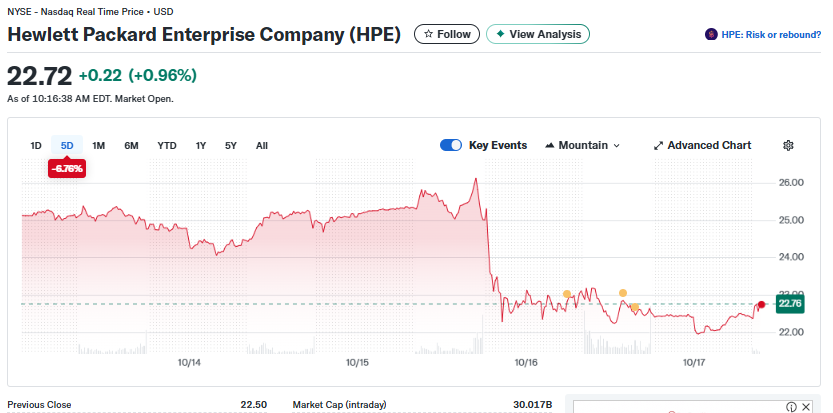
Hewlett Packard Enterprise Company (HPE)

Juniper Deal Shapes Future Strategy

HPE’s management emphasized that its outlook reflects a strategic realignment toward networking and AI-driven solutions, particularly following its $14 billion acquisition of Juniper Networks, which officially closed in July 2025.

The company said the integration is expected to yield at least $600 million in cost synergies by fiscal 2028, strengthening its position in enterprise networking and edge computing.

Executives highlighted that the Juniper merger will allow HPE to deliver more unified networking products across campus, data center, and wide-area environments, a key growth driver as organizations modernize their infrastructure. Despite these long-term benefits, investors appear focused on the near-term costs and slower revenue growth accompanying the integration process.

Workforce Reduction and Buyback Boost

Earlier in March, HPE announced plans to cut about 5% of its global workforce, approximately 2,500 jobs, over 12 to 18 months as part of a cost-optimization initiative linked to the Juniper acquisition.

The restructuring aims to deliver $350 million in savings by fiscal 2027 and streamline overlapping operations.

At the same time, the board authorized an additional $3 billion in share repurchases, bringing the total buyback program to $3.7 billion. Analysts noted that while the buyback may provide short-term support to the stock, it underscores management’s effort to reassure investors amid a challenging guidance cycle.

Non-GAAP Metrics Paint a Mixed Picture

HPE’s fiscal 2026 projections exclude several non-GAAP items, including approximately $1.63 per share in amortization of intangible assets, stock-based compensation, and other acquisition-related charges.

On a non-GAAP basis, the company expects operating profit margins to remain stable, but GAAP results could be distorted by the $1.4 billion goodwill impairment recorded in fiscal 2025.

The company’s pro forma forecast, which adjusts for Juniper-related changes, calls for compound annual revenue growth of 5% to 7% between FY25 and FY28. Meanwhile, under GAAP standards, operating profit growth is expected to rise sharply by 435% to 445% in FY26 as HPE recovers from prior-year write-downs.

Investor Sentiment

While HPE’s pivot toward AI and networking could yield long-term rewards, investors remain cautious. The weaker-than-expected guidance highlights the challenges of integrating large acquisitions amid macroeconomic headwinds and increased competition in enterprise IT services.

Market watchers say that success in delivering on Juniper synergies and AI expansion will be crucial for restoring investor confidence. Until then, the company’s financial outlook may continue to act as a drag on short-term performance.

The post Hewlett Packard Enterprise Company (HPE)Stock: Declines as Revenue and EPS Guidance Disappoints appeared first on CoinCentral.


Market Opportunity
Particl Logo
Particl Price(PART)
$0.2703
$0.2703$0.2703
+3.44%
USD
Particl (PART) Live Price Chart
Disclaimer: The articles reposted on this site are sourced from public platforms and are provided for informational purposes only. They do not necessarily reflect the views of MEXC. All rights remain with the original authors. If you believe any content infringes on third-party rights, please contact service@support.mexc.com for removal. MEXC makes no guarantees regarding the accuracy, completeness, or timeliness of the content and is not responsible for any actions taken based on the information provided. The content does not constitute financial, legal, or other professional advice, nor should it be considered a recommendation or endorsement by MEXC.

You May Also Like

The Channel Factories We’ve Been Waiting For

The Channel Factories We’ve Been Waiting For

The post The Channel Factories We’ve Been Waiting For appeared on BitcoinEthereumNews.com. Visions of future technology are often prescient about the broad strokes while flubbing the details. The tablets in “2001: A Space Odyssey” do indeed look like iPads, but you never see the astronauts paying for subscriptions or wasting hours on Candy Crush.  Channel factories are one vision that arose early in the history of the Lightning Network to address some challenges that Lightning has faced from the beginning. Despite having grown to become Bitcoin’s most successful layer-2 scaling solution, with instant and low-fee payments, Lightning’s scale is limited by its reliance on payment channels. Although Lightning shifts most transactions off-chain, each payment channel still requires an on-chain transaction to open and (usually) another to close. As adoption grows, pressure on the blockchain grows with it. The need for a more scalable approach to managing channels is clear. Channel factories were supposed to meet this need, but where are they? In 2025, subnetworks are emerging that revive the impetus of channel factories with some new details that vastly increase their potential. They are natively interoperable with Lightning and achieve greater scale by allowing a group of participants to open a shared multisig UTXO and create multiple bilateral channels, which reduces the number of on-chain transactions and improves capital efficiency. Achieving greater scale by reducing complexity, Ark and Spark perform the same function as traditional channel factories with new designs and additional capabilities based on shared UTXOs.  Channel Factories 101 Channel factories have been around since the inception of Lightning. A factory is a multiparty contract where multiple users (not just two, as in a Dryja-Poon channel) cooperatively lock funds in a single multisig UTXO. They can open, close and update channels off-chain without updating the blockchain for each operation. Only when participants leave or the factory dissolves is an on-chain transaction…
Share
BitcoinEthereumNews2025/09/18 00:09
Zwitserse bankgigant UBS wil crypto beleggen mogelijk maken

Zwitserse bankgigant UBS wil crypto beleggen mogelijk maken

De grootste vermogensbeheerder ter wereld, UBS, maakt zich op om een stap te zetten richting crypto. Volgens bronnen binnen de bank kijkt het Zwitserse concern
Share
Coinstats2026/01/24 02:48
Trump Nears Decision on New Federal Reserve Chair

Trump Nears Decision on New Federal Reserve Chair

The post Trump Nears Decision on New Federal Reserve Chair appeared on BitcoinEthereumNews.com. Key Points: Trump nears decision on Federal Reserve Chair, evaluating
Share
BitcoinEthereumNews2026/01/24 02:53