China’s central bank escalated its warning on stablecoins and reiterated a hard line against domestic crypto activity on Monday, with Governor Pan Gongsheng arguing that the rise of privately issued “virtual currencies”—particularly stablecoins—exposes gaps in global financial oversight and increases systemic fragility. Speaking at the opening of the 2025 Financial Street Forum in Beijing on […]China’s central bank escalated its warning on stablecoins and reiterated a hard line against domestic crypto activity on Monday, with Governor Pan Gongsheng arguing that the rise of privately issued “virtual currencies”—particularly stablecoins—exposes gaps in global financial oversight and increases systemic fragility. Speaking at the opening of the 2025 Financial Street Forum in Beijing on […]

Chinese Central Bank Warns Of Crypto Loopholes In Global Regulation

China’s central bank escalated its warning on stablecoins and reiterated a hard line against domestic crypto activity on Monday, with Governor Pan Gongsheng arguing that the rise of privately issued “virtual currencies”—particularly stablecoins—exposes gaps in global financial oversight and increases systemic fragility. Speaking at the opening of the 2025 Financial Street Forum in Beijing on October 27, Pan said stablecoins are still “at an early stage” but are already amplifying regulatory blind spots across borders and posing challenges to monetary sovereignty in weaker economies.

China Reaffirms Crypto Crackdown

Pan anchored his remarks in the policy debates that dominated the IMF/World Bank Annual Meetings held in Washington 10 days earlier, telling attendees that the prevailing view among finance ministers and central bank governors was that stablecoins, “as a financial activity, at this stage cannot effectively meet basic requirements in customer identification and anti-money-laundering,” thereby “magnifying loopholes in global financial regulation,” fueling “speculative hype,” increasing “the fragility of the global financial system,” and “impacting the monetary sovereignty of some underdeveloped economies.”

The governor coupled that assessment with a firm domestic enforcement posture: “Since 2017, the People’s Bank of China, together with relevant departments, has issued multiple policy documents to prevent and deal with risks from domestic crypto trading and speculation, and these documents remain effective. Next, the PBOC will work with law-enforcement authorities to continue cracking down on the operation and speculation of cryptocurrencies within China, maintain economic and financial order, and closely track and dynamically evaluate the development of offshore stablecoins.”

His statement effectively reaffirms the legal status quo—comprehensive restrictions on crypto trading and mining within China’s borders—while signaling ongoing surveillance of offshore instruments that touch Chinese users and firms.

Pan’s comments land at a moment when stablecoins have become embedded in cross-border commerce and crypto market plumbing, with dollar-pegged tokens dominating global volumes. They also intersect with a live policy debate inside China about whether and how to tolerate offshore, yuan-linked instruments to complement the official e-CNY.

Over the summer, major Chinese tech groups lobbied the PBOC to authorize an offshore, yuan-based stablecoin in Hong Kong to counter US dollar stablecoin dominance—an initiative that, if ever approved, would likely be ring-fenced from the mainland’s prohibitions.

For market participants, the signal is twofold. First, there is no domestic policy thaw for crypto trading or mining: the 2017–2021 crackdown architecture remains intact, and enforcement will be coordinated with police and other agencies.

Second, Chinese authorities are sharpening their scrutiny of offshore stablecoins used by exporters, importers, and savers, a vector that has grown as stablecoins have become de facto settlement media in parts of Asia and emerging markets. The central bank’s language—“continue cracking down” at home while “dynamically evaluating” offshore developments—suggests that any future experimentation will occur through official government channels rather than market-driven stablecoin adoption.

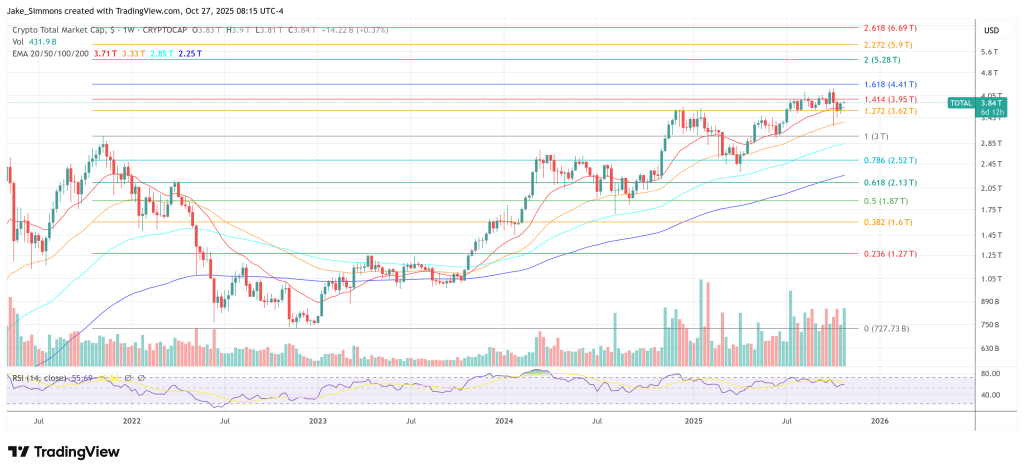
At press time, the total crypto market cap stood at $3.84 trillion.
Total crypto market cap
Market Opportunity
Lorenzo Protocol Logo
Lorenzo Protocol Price(BANK)
$0,05174
$0,05174$0,05174
-1,16%
USD
Lorenzo Protocol (BANK) Live Price Chart
Disclaimer: The articles reposted on this site are sourced from public platforms and are provided for informational purposes only. They do not necessarily reflect the views of MEXC. All rights remain with the original authors. If you believe any content infringes on third-party rights, please contact service@support.mexc.com for removal. MEXC makes no guarantees regarding the accuracy, completeness, or timeliness of the content and is not responsible for any actions taken based on the information provided. The content does not constitute financial, legal, or other professional advice, nor should it be considered a recommendation or endorsement by MEXC.

You May Also Like

Tether CEO Delivers Rare Bitcoin Price Comment

Tether CEO Delivers Rare Bitcoin Price Comment

Bitcoin price receives rare acknowledgement from Tether CEO Ardoino
Share
Coinstats2025/09/17 23:39
The Manchester City Donnarumma Doubters Have Missed Something Huge

The Manchester City Donnarumma Doubters Have Missed Something Huge

The post The Manchester City Donnarumma Doubters Have Missed Something Huge appeared on BitcoinEthereumNews.com. MANCHESTER, ENGLAND – SEPTEMBER 14: Gianluigi Donnarumma of Manchester City celebrates the second City goal during the Premier League match between Manchester City and Manchester United at Etihad Stadium on September 14, 2025 in Manchester, England. (Photo by Visionhaus/Getty Images) Visionhaus/Getty Images For a goalkeeper who’d played an influential role in the club’s first-ever Champions League triumph, it was strange to see Gianluigi Donnarumma so easily discarded. Soccer is a brutal game, but the sudden, drastic demotion of the Italian from Paris Saint-Germain’s lineup for the UEFA Super Cup clash against Tottenham Hotspur before he was sold to Manchester City was shockingly brutal. Coach Luis Enrique isn’t a man who minces his words, so he was blunt when asked about the decision on social media. “I am supported by my club and we are trying to find the best solution,” he told a news conference. “It is a difficult decision. I only have praise for Donnarumma. He is one of the very best goalkeepers out there and an even better man. “But we were looking for a different profile. It’s very difficult to take these types of decisions.” The last line has really stuck, especially since it became clear that Manchester City was Donnarumma’s next destination. Pep Guardiola, under whom the Italian will be playing this season, is known for brutally axing goalkeepers he didn’t feel fit his profile. The most notorious was Joe Hart, who was jettisoned many years ago for very similar reasons to Enrique. So how can it be that the Catalan coach is turning once again to a so-called old-school keeper? Well, the truth, as so often the case, is not quite that simple. As Italian soccer expert James Horncastle pointed out in The Athletic, Enrique’s focus on needing a “different profile” is overblown. Lucas Chevalier,…
Share
BitcoinEthereumNews2025/09/18 07:38
Zepto Life Technology Launches Plasma-Based FungiFlex® Mold Panel as CLIA Reference Laboratory Test

Zepto Life Technology Launches Plasma-Based FungiFlex® Mold Panel as CLIA Reference Laboratory Test

ST. PAUL, Minn., Jan. 21, 2026 /PRNewswire/ — Zepto Life Technology has announced the launch of the FungiFlex® Mold Panel, a plasma-based molecular diagnostic test
Share
AI Journal2026/01/21 23:47