Investors have poured more than $280 million into new U.S. Solana exchange-traded funds (ETFs) in just six trading days, with analysts now projecting as much as $5 billion in inflows over the next year. As Solana becomes a centerpiece of institutional portfolios, questions are mounting over whether its infrastructure can sustain high-frequency activity across ETFs, wallets, and consumer apps. Web3 infrastructure firm Alchemy said to meet this rising demand it has completely re-architected its Solana stack. The overhaul aims to deliver near-zero downtime, faster responses, and greater throughput, ensuring institutional and retail users experience a seamless network even under heavy load. This week Solana appears to have shrugged off broader Fed-induced FUD, with policymakers reiterating that December rate cuts are “not a foregone conclusion” this week. BSOL has opened the floodgates to $417 million in fresh capital for Solana’s ecosystem as a fresh touch point for U.S. investors to gain regulated access to SOL staking yields. Built for Scale and Speed Alchemy explains its Solana rebuild was the culmination of two years of collaboration with developers across the ecosystem. Working alongside teams from Bags.fm, Solflare, and Robinhood, the company studied the real bottlenecks developers faced when accessing Solana data and processing transactions. The result is an all-new generation of RPC and Streaming APIs built specifically for Solana. The upgraded infrastructure delivers 20 times faster archive calls, 99.95% uptime, and double the throughput of its previous version. Alchemy’s engineering team has also improved the system to handle large data sets with greater reliability, enabling near-instant responses on transaction-heavy workloads. The result is faster user experiences on exchanges, wallets, and analytics platforms that depend on constant access to on-chain data. Solving the “Chewing Glass” Challenge Solana developers have long referred to the network’s complexity as “chewing glass” — a metaphor for the demanding technical environment they’ve embraced to build next-generation financial products. While Solana’s core protocol has matured, the surrounding tooling and infrastructure often struggled to keep pace. Alchemy’s research found that many developers encountered recurring issues accessing historical data due to limitations in Bigtable-based RPC systems, which caused missing records, throttling, or incomplete data sets. This forced teams to build complex workarounds that slowed iteration and inflated costs. The new Solana architecture eliminates those constraints, dramatically accelerating heavy data methods such as getTransaction and getProgramAccounts while maintaining reliability under scale. Infrastructure for the Institutional Era With ETF adoption accelerating and Western Union preparing to launch a stablecoin on Solana in 2026, the chain is entering an institutional era where uptime and precision matter as much as speed. By rebuilding Solana’s “plumbing” from the ground up, Alchemy has positioned the network to handle sustained institutional traffic and mass-market consumer applications without compromising performance. As Solana’s ecosystem matures, Alchemy’s overhaul signals a crucial inflection point — one where the network evolves from “chewing glass” to powering finance at scaleInvestors have poured more than $280 million into new U.S. Solana exchange-traded funds (ETFs) in just six trading days, with analysts now projecting as much as $5 billion in inflows over the next year. As Solana becomes a centerpiece of institutional portfolios, questions are mounting over whether its infrastructure can sustain high-frequency activity across ETFs, wallets, and consumer apps. Web3 infrastructure firm Alchemy said to meet this rising demand it has completely re-architected its Solana stack. The overhaul aims to deliver near-zero downtime, faster responses, and greater throughput, ensuring institutional and retail users experience a seamless network even under heavy load. This week Solana appears to have shrugged off broader Fed-induced FUD, with policymakers reiterating that December rate cuts are “not a foregone conclusion” this week. BSOL has opened the floodgates to $417 million in fresh capital for Solana’s ecosystem as a fresh touch point for U.S. investors to gain regulated access to SOL staking yields. Built for Scale and Speed Alchemy explains its Solana rebuild was the culmination of two years of collaboration with developers across the ecosystem. Working alongside teams from Bags.fm, Solflare, and Robinhood, the company studied the real bottlenecks developers faced when accessing Solana data and processing transactions. The result is an all-new generation of RPC and Streaming APIs built specifically for Solana. The upgraded infrastructure delivers 20 times faster archive calls, 99.95% uptime, and double the throughput of its previous version. Alchemy’s engineering team has also improved the system to handle large data sets with greater reliability, enabling near-instant responses on transaction-heavy workloads. The result is faster user experiences on exchanges, wallets, and analytics platforms that depend on constant access to on-chain data. Solving the “Chewing Glass” Challenge Solana developers have long referred to the network’s complexity as “chewing glass” — a metaphor for the demanding technical environment they’ve embraced to build next-generation financial products. While Solana’s core protocol has matured, the surrounding tooling and infrastructure often struggled to keep pace. Alchemy’s research found that many developers encountered recurring issues accessing historical data due to limitations in Bigtable-based RPC systems, which caused missing records, throttling, or incomplete data sets. This forced teams to build complex workarounds that slowed iteration and inflated costs. The new Solana architecture eliminates those constraints, dramatically accelerating heavy data methods such as getTransaction and getProgramAccounts while maintaining reliability under scale. Infrastructure for the Institutional Era With ETF adoption accelerating and Western Union preparing to launch a stablecoin on Solana in 2026, the chain is entering an institutional era where uptime and precision matter as much as speed. By rebuilding Solana’s “plumbing” from the ground up, Alchemy has positioned the network to handle sustained institutional traffic and mass-market consumer applications without compromising performance. As Solana’s ecosystem matures, Alchemy’s overhaul signals a crucial inflection point — one where the network evolves from “chewing glass” to powering finance at scale

As SOL ETFs Surge Alchemy Rebuilds Solana’s Infrastructure for Institutional Scale

2025/11/06 20:18
3 min read
For feedback or concerns regarding this content, please contact us at crypto.news@mexc.com

Investors have poured more than $280 million into new U.S. Solana exchange-traded funds (ETFs) in just six trading days, with analysts now projecting as much as $5 billion in inflows over the next year.

As Solana becomes a centerpiece of institutional portfolios, questions are mounting over whether its infrastructure can sustain high-frequency activity across ETFs, wallets, and consumer apps.

Web3 infrastructure firm Alchemy said to meet this rising demand it has completely re-architected its Solana stack. The overhaul aims to deliver near-zero downtime, faster responses, and greater throughput, ensuring institutional and retail users experience a seamless network even under heavy load.

This week Solana appears to have shrugged off broader Fed-induced FUD, with policymakers reiterating that December rate cuts are “not a foregone conclusion” this week.

BSOL has opened the floodgates to $417 million in fresh capital for Solana’s ecosystem as a fresh touch point for U.S. investors to gain regulated access to SOL staking yields.

Built for Scale and Speed

Alchemy explains its Solana rebuild was the culmination of two years of collaboration with developers across the ecosystem. Working alongside teams from Bags.fm, Solflare, and Robinhood, the company studied the real bottlenecks developers faced when accessing Solana data and processing transactions.

The result is an all-new generation of RPC and Streaming APIs built specifically for Solana. The upgraded infrastructure delivers 20 times faster archive calls, 99.95% uptime, and double the throughput of its previous version.
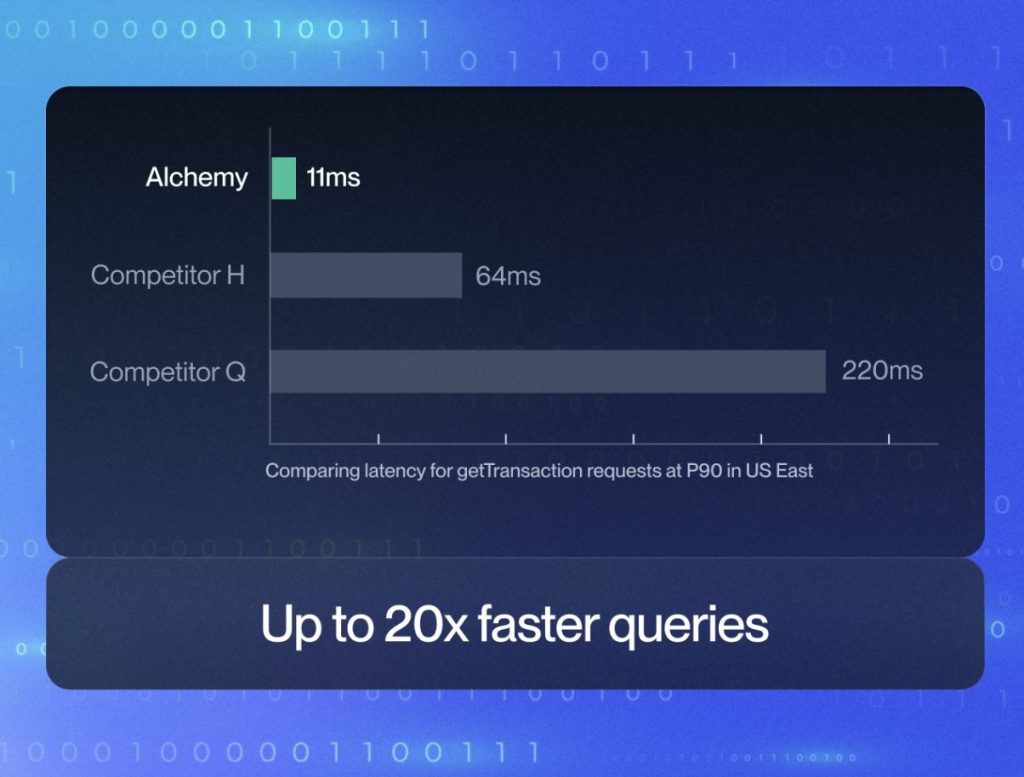
Alchemy’s engineering team has also improved the system to handle large data sets with greater reliability, enabling near-instant responses on transaction-heavy workloads. The result is faster user experiences on exchanges, wallets, and analytics platforms that depend on constant access to on-chain data.

Solving the “Chewing Glass” Challenge

Solana developers have long referred to the network’s complexity as “chewing glass” — a metaphor for the demanding technical environment they’ve embraced to build next-generation financial products. While Solana’s core protocol has matured, the surrounding tooling and infrastructure often struggled to keep pace.

Alchemy’s research found that many developers encountered recurring issues accessing historical data due to limitations in Bigtable-based RPC systems, which caused missing records, throttling, or incomplete data sets.

This forced teams to build complex workarounds that slowed iteration and inflated costs. The new Solana architecture eliminates those constraints, dramatically accelerating heavy data methods such as getTransaction and getProgramAccounts while maintaining reliability under scale.

Infrastructure for the Institutional Era

With ETF adoption accelerating and Western Union preparing to launch a stablecoin on Solana in 2026, the chain is entering an institutional era where uptime and precision matter as much as speed.

By rebuilding Solana’s “plumbing” from the ground up, Alchemy has positioned the network to handle sustained institutional traffic and mass-market consumer applications without compromising performance.

As Solana’s ecosystem matures, Alchemy’s overhaul signals a crucial inflection point — one where the network evolves from “chewing glass” to powering finance at scale.


Disclaimer: The articles reposted on this site are sourced from public platforms and are provided for informational purposes only. They do not necessarily reflect the views of MEXC. All rights remain with the original authors. If you believe any content infringes on third-party rights, please contact crypto.news@mexc.com for removal. MEXC makes no guarantees regarding the accuracy, completeness, or timeliness of the content and is not responsible for any actions taken based on the information provided. The content does not constitute financial, legal, or other professional advice, nor should it be considered a recommendation or endorsement by MEXC.

You May Also Like

Ethereum unveils roadmap focusing on scaling, interoperability, and security at Japan Dev Conference

Ethereum unveils roadmap focusing on scaling, interoperability, and security at Japan Dev Conference

The post Ethereum unveils roadmap focusing on scaling, interoperability, and security at Japan Dev Conference appeared on BitcoinEthereumNews.com. Key Takeaways Ethereum’s new roadmap was presented by Vitalik Buterin at the Japan Dev Conference. Short-term priorities include Layer 1 scaling and raising gas limits to enhance transaction throughput. Vitalik Buterin presented Ethereum’s development roadmap at the Japan Dev Conference today, outlining the blockchain platform’s priorities across multiple timeframes. The short-term goals focus on scaling solutions and increasing Layer 1 gas limits to improve transaction capacity. Mid-term objectives target enhanced cross-Layer 2 interoperability and faster network responsiveness to create a more seamless user experience across different scaling solutions. The long-term vision emphasizes building a secure, simple, quantum-resistant, and formally verified minimalist Ethereum network. This approach aims to future-proof the platform against emerging technological threats while maintaining its core functionality. The roadmap presentation comes as Ethereum continues to compete with other blockchain platforms for market share in the smart contract and decentralized application space. Source: https://cryptobriefing.com/ethereum-roadmap-scaling-interoperability-security-japan/
Share
BitcoinEthereumNews2025/09/18 00:25
Spot Demand Rises as Bull Flag Breaks

Spot Demand Rises as Bull Flag Breaks

The post Spot Demand Rises as Bull Flag Breaks appeared on BitcoinEthereumNews.com. Bitcoin is showing two fresh bullish signals as spot demand rises and a bull
Share
BitcoinEthereumNews2026/03/17 01:29
Trading time: Tonight, the US GDP and the upcoming non-farm data will become the market focus. Institutions are bullish on BTC to $120,000 in the second quarter.

Trading time: Tonight, the US GDP and the upcoming non-farm data will become the market focus. Institutions are bullish on BTC to $120,000 in the second quarter.

Daily market key data review and trend analysis, produced by PANews.
Share
PANews2025/04/30 13:50