Proves Q-Former is a Multi-Head MIL module due to permutation invariance in its cross-attention. Notes its limitation: it assumes i.i.d. instances, overlooking crucial instance correlation.Proves Q-Former is a Multi-Head MIL module due to permutation invariance in its cross-attention. Notes its limitation: it assumes i.i.d. instances, overlooking crucial instance correlation.

MIL Perspective: Analyzing Q-Former as a Multi-Head Mechanism

Abstract and 1 Introduction

  1. Related Work

    2.1. Multimodal Learning

    2.2. Multiple Instance Learning

  2. Methodology

    3.1. Preliminaries and Notations

    3.2. Relations between Attention-based VPG and MIL

    3.3. MIVPG for Multiple Visual Inputs

    3.4. Unveiling Instance Correlation in MIVPG for Enhanced Multi-instance Scenarios

  3. Experiments and 4.1. General Setup

    4.2. Scenario 1: Samples with Single Image

    4.3. Scenario 2: Samples with Multiple Images, with Each Image as a General Embedding

    4.4. Scenario 3: Samples with Multiple Images, with Each Image Having Multiple Patches to be Considered and 4.5. Case Study

  4. Conclusion and References

\ Supplementary Material

A. Detailed Architecture of QFormer

B. Proof of Proposition

C. More Experiments

3.2. Relations between Attention-based VPG and MIL

\ In AB-MIL[16], weights are calculated as Equation 5.

\
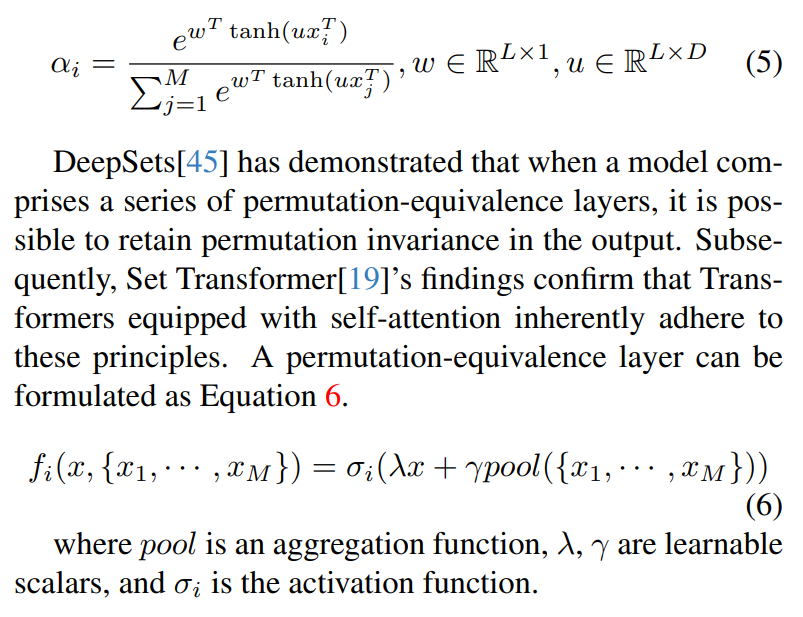
\ Proposition 1. QFormer belongs to the category of Multiple Instance Learning modules.

\ Within the cross-attention layer of QFormer, every query token computes weights for image embeddings. Query embeddings, being learnable parameters, can be seen as a linear transformation from an instance to its weight. To provide further clarification, each row in the attention map A signifies the weights assigned to instances for aggregation. Consequently, the cross-attention between the learnable query embeddings and the input is permutation invariance.

\ The result of cross-attention is combined with the original query embeddings using a residual connection. This process can be expressed as shown in Equation 6, by replacing pool with Equation 1, and setting λ = γ = I, as illustrated in Equation 7, which is permutation equivalence.

\

\ Figure 2. Overview of MIVPG. 2a: When handling multiple visual inputs, the initial step involves aggregating them at the image-level. QFormer can be treated as a Multiple Instance Learning module that takes multiple samples as instances. The MIVPG complements QFormer by introducing a correlated self-attention module and the pyramid positional encoding module, depending on specific scenarios. 2b: Image-level aggregation can employ various MIL strategies, either learnable, such as AB-MIL, or fixed, for example, always selecting a specific token. 2c: The visual prompt embeddings produced by Q-Former are combined with textual prompt embeddings and forwarded to the LLM for generating outputs.
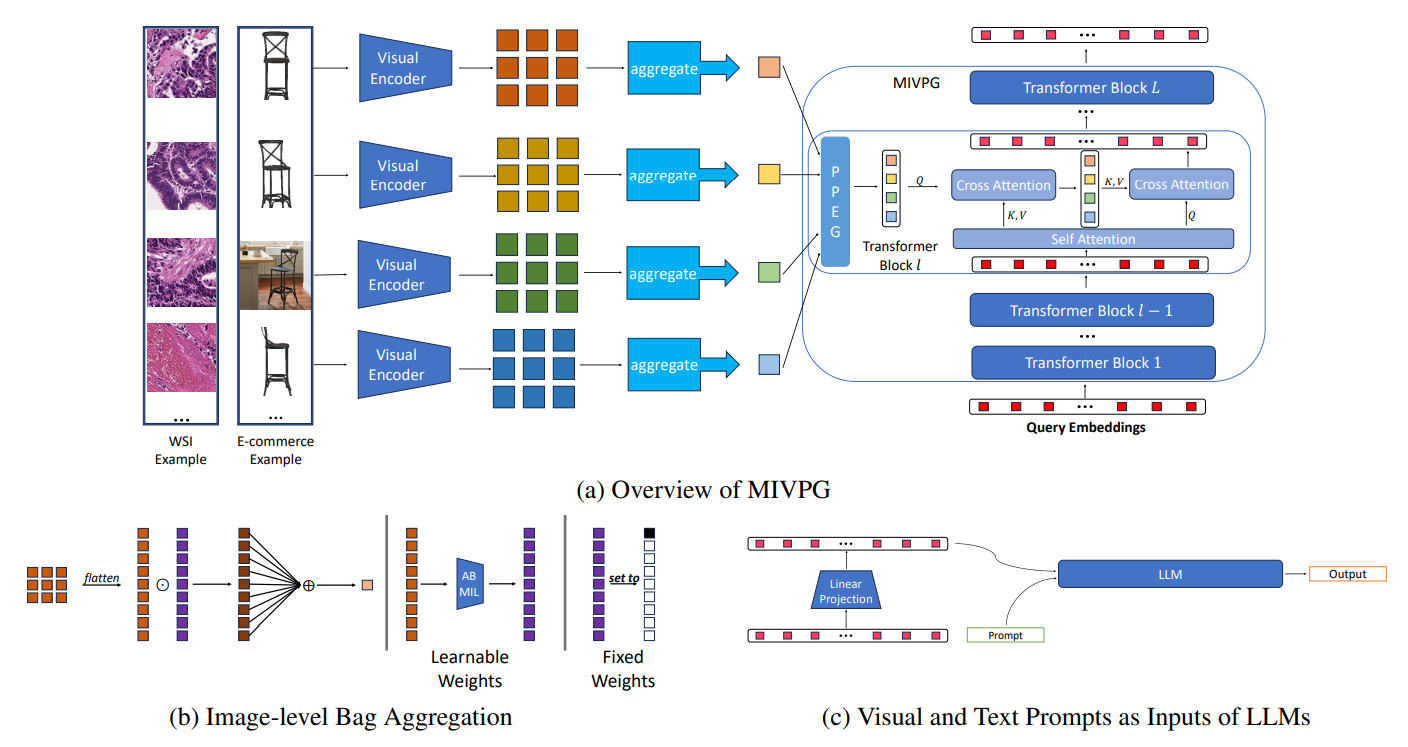
\ Considering that the self-attention layer within the QFormer block adheres to the principles of permutation equivalence, we can conceptualize the QFormer as a multi-head MIL mechanism.

\ From the standpoint of MIL, the weighted pooling in Equation 1 operates under the assumption that instances are independent and identically distributed (i.i.d)[34]. However, in practical scenarios, instances may exhibit correlations, and accounting for instance correlation can lead to improved performance. It’s worth noting that when each sample contains only one image, the input to QFormer comprises patch embeddings that have already incorporated correlations through the self-attention layer in ViT. Moreover, performance enhancement is attainable through the integration of a Pyramid Positional Encoding Generator (PPEG)[34], which complements the proposed MIVPG when handling single-image inputs.

\

:::info Authors:

(1) Wenliang Zhong, The University of Texas at Arlington (wxz9204@mavs.uta.edu);

(2) Wenyi Wu, Amazon (wenyiwu@amazon.com);

(3) Qi Li, Amazon (qlimz@amazon.com);

(4) Rob Barton, Amazon (rab@amazon.com);

(5) Boxin Du, Amazon (boxin@amazon.com);

(6) Shioulin Sam, Amazon (shioulin@amazon.com);

(7) Karim Bouyarmane, Amazon (bouykari@amazon.com);

(8) Ismail Tutar, Amazon (ismailt@amazon.com);

(9) Junzhou Huang, The University of Texas at Arlington (jzhuang@uta.edu).

:::


:::info This paper is available on arxiv under CC by 4.0 Deed (Attribution 4.0 International) license.

:::

\

Market Opportunity
Quack AI Logo
Quack AI Price(Q)
$0,013937
$0,013937$0,013937
+1,02%
USD
Quack AI (Q) Live Price Chart
Disclaimer: The articles reposted on this site are sourced from public platforms and are provided for informational purposes only. They do not necessarily reflect the views of MEXC. All rights remain with the original authors. If you believe any content infringes on third-party rights, please contact service@support.mexc.com for removal. MEXC makes no guarantees regarding the accuracy, completeness, or timeliness of the content and is not responsible for any actions taken based on the information provided. The content does not constitute financial, legal, or other professional advice, nor should it be considered a recommendation or endorsement by MEXC.

You May Also Like

Unleashing A New Era Of Seller Empowerment

Unleashing A New Era Of Seller Empowerment

The post Unleashing A New Era Of Seller Empowerment appeared on BitcoinEthereumNews.com. Amazon AI Agent: Unleashing A New Era Of Seller Empowerment Skip to content Home AI News Amazon AI Agent: Unleashing a New Era of Seller Empowerment Source: https://bitcoinworld.co.in/amazon-ai-seller-tools/
Share
BitcoinEthereumNews2025/09/18 00:10
Foreigner’s Lou Gramm Revisits The Band’s Classic ‘4’ Album, Now Reissued

Foreigner’s Lou Gramm Revisits The Band’s Classic ‘4’ Album, Now Reissued

The post Foreigner’s Lou Gramm Revisits The Band’s Classic ‘4’ Album, Now Reissued appeared on BitcoinEthereumNews.com. American-based rock band Foreigner performs onstage at the Rosemont Horizon, Rosemont, Illinois, November 8, 1981. Pictured are, from left, Mick Jones, on guitar, and vocalist Lou Gramm. (Photo by Paul Natkin/Getty Images) Getty Images Singer Lou Gramm has a vivid memory of recording the ballad “Waiting for a Girl Like You” at New York City’s Electric Lady Studio for his band Foreigner more than 40 years ago. Gramm was adding his vocals for the track in the control room on the other side of the glass when he noticed a beautiful woman walking through the door. “She sits on the sofa in front of the board,” he says. “She looked at me while I was singing. And every now and then, she had a little smile on her face. I’m not sure what that was, but it was driving me crazy. “And at the end of the song, when I’m singing the ad-libs and stuff like that, she gets up,” he continues. “She gives me a little smile and walks out of the room. And when the song ended, I would look up every now and then to see where Mick [Jones] and Mutt [Lange] were, and they were pushing buttons and turning knobs. They were not aware that she was even in the room. So when the song ended, I said, ‘Guys, who was that woman who walked in? She was beautiful.’ And they looked at each other, and they went, ‘What are you talking about? We didn’t see anything.’ But you know what? I think they put her up to it. Doesn’t that sound more like them?” “Waiting for a Girl Like You” became a massive hit in 1981 for Foreigner off their album 4, which peaked at number one on the Billboard chart for 10 weeks and…
Share
BitcoinEthereumNews2025/09/18 01:26
One Of Frank Sinatra’s Most Famous Albums Is Back In The Spotlight

One Of Frank Sinatra’s Most Famous Albums Is Back In The Spotlight

The post One Of Frank Sinatra’s Most Famous Albums Is Back In The Spotlight appeared on BitcoinEthereumNews.com. Frank Sinatra’s The World We Knew returns to the Jazz Albums and Traditional Jazz Albums charts, showing continued demand for his timeless music. Frank Sinatra performs on his TV special Frank Sinatra: A Man and his Music Bettmann Archive These days on the Billboard charts, Frank Sinatra’s music can always be found on the jazz-specific rankings. While the art he created when he was still working was pop at the time, and later classified as traditional pop, there is no such list for the latter format in America, and so his throwback projects and cuts appear on jazz lists instead. It’s on those charts where Sinatra rebounds this week, and one of his popular projects returns not to one, but two tallies at the same time, helping him increase the total amount of real estate he owns at the moment. Frank Sinatra’s The World We Knew Returns Sinatra’s The World We Knew is a top performer again, if only on the jazz lists. That set rebounds to No. 15 on the Traditional Jazz Albums chart and comes in at No. 20 on the all-encompassing Jazz Albums ranking after not appearing on either roster just last frame. The World We Knew’s All-Time Highs The World We Knew returns close to its all-time peak on both of those rosters. Sinatra’s classic has peaked at No. 11 on the Traditional Jazz Albums chart, just missing out on becoming another top 10 for the crooner. The set climbed all the way to No. 15 on the Jazz Albums tally and has now spent just under two months on the rosters. Frank Sinatra’s Album With Classic Hits Sinatra released The World We Knew in the summer of 1967. The title track, which on the album is actually known as “The World We Knew (Over and…
Share
BitcoinEthereumNews2025/09/18 00:02