CryptoQuant founder and CEO Ki Young Ju pushed back on a renewed wave of forced Bitcoin liquidation and bankruptcy chatter around Strategy (formerly MicroStrategy, MSTR), arguing that the bearish thesis misreads the company’s capital structure and shareholder incentives. In a Nov. 20, 2025 post on X, Ju wrote, “MSTR only goes bankrupt if an asteroid hits Earth,” adding that critics should “bring a single piece of evidence” before claiming Michael Saylor would be liquidated. The comments came as Bitcoin and high-beta crypto proxies retraced into late November, reviving legacy narratives that Strategy’s debt stack could compel BTC sales. Why Strategy Will Never Sell Bitcoin Ju’s central claim is that Strategy is not structurally set up like a margin trader. Addressing the most common fear—that convertible notes “missing” their conversion price forces liquidation—he stated: “Convertible debt not reaching the conversion price is not liquidation. It simply means the notes get repaid in cash […] Failing to convert is not a bankruptcy trigger. It is just normal debt maturity.” Related Reading: Is The Bitcoin Bottom In? Fidelity Research Lead Weighs The Odds In his view, the repayment pathways are conventional corporate finance tools: refinancing, rolling into new notes, secured borrowing, or operating cash flow. That framing aligns with how convertibles function in practice; if equity is below strike at maturity, the embedded option expires and the instrument reverts to straight debt rather than a forced-sale event. He also grounded his argument in governance and identity. “Saylor would never sell Bitcoin unless shareholders want it,” Ju wrote, warning that “selling even a single BTC would destroy MSTR’s identity as a Bitcoin treasury company and trigger a death spiral for both Bitcoin and MSTR.” Strategy has repeatedly defined itself as a BTC-treasury vehicle, and its shareholder base largely bought into that mandate, making voluntary divestment politically and strategically improbable absent a radical shift in investor preference. Balance-sheet data underpins Ju’s confidence. Strategy reported 640,808 BTC as of Oct. 30, 2025, acquired for about $47.44 billion; subsequent filings cited major November additions taking holdings to roughly 649,870 BTC. Even after accounting for the growing convertible and preferred layers, the BTC treasury remains the dominant asset, meaning solvency stress would require an extreme, prolonged Bitcoin collapse rather than a cyclical drawdown. Related Reading: Why Bitwise Thinks Bitcoin Still Hits $200,000 In 2026 Ju did not claim the equity is risk-free. “This does not mean MSTR’s stock price will always stay high,” he wrote, but called the idea that Strategy would sell BTC to support the stock or face imminent bankruptcy “completely absurd.” He added that even at a price of $10,000 per coin, Strategy would face “a debt restructuring, nothing more.” On preferred shares, he acknowledged dividend obligations, noting payments have not been missed and can be covered via new share issuance—dilutive, but not a liquidation vector. Posting BTC as collateral, he said, would be a last resort because that would introduce real margin risk. In short, Ju’s rebuttal draws a hard line between volatility and insolvency: Strategy may trade like leveraged Bitcoin, but its liabilities do not mechanically force BTC sales. The “Saylor liquidation” narrative, he argues, is a Twitter myth unless the world ends—by asteroid. At press time, BTC traded at $82,050. Featured image created with DALL.E, chart from TradingView.comCryptoQuant founder and CEO Ki Young Ju pushed back on a renewed wave of forced Bitcoin liquidation and bankruptcy chatter around Strategy (formerly MicroStrategy, MSTR), arguing that the bearish thesis misreads the company’s capital structure and shareholder incentives. In a Nov. 20, 2025 post on X, Ju wrote, “MSTR only goes bankrupt if an asteroid hits Earth,” adding that critics should “bring a single piece of evidence” before claiming Michael Saylor would be liquidated. The comments came as Bitcoin and high-beta crypto proxies retraced into late November, reviving legacy narratives that Strategy’s debt stack could compel BTC sales. Why Strategy Will Never Sell Bitcoin Ju’s central claim is that Strategy is not structurally set up like a margin trader. Addressing the most common fear—that convertible notes “missing” their conversion price forces liquidation—he stated: “Convertible debt not reaching the conversion price is not liquidation. It simply means the notes get repaid in cash […] Failing to convert is not a bankruptcy trigger. It is just normal debt maturity.” Related Reading: Is The Bitcoin Bottom In? Fidelity Research Lead Weighs The Odds In his view, the repayment pathways are conventional corporate finance tools: refinancing, rolling into new notes, secured borrowing, or operating cash flow. That framing aligns with how convertibles function in practice; if equity is below strike at maturity, the embedded option expires and the instrument reverts to straight debt rather than a forced-sale event. He also grounded his argument in governance and identity. “Saylor would never sell Bitcoin unless shareholders want it,” Ju wrote, warning that “selling even a single BTC would destroy MSTR’s identity as a Bitcoin treasury company and trigger a death spiral for both Bitcoin and MSTR.” Strategy has repeatedly defined itself as a BTC-treasury vehicle, and its shareholder base largely bought into that mandate, making voluntary divestment politically and strategically improbable absent a radical shift in investor preference. Balance-sheet data underpins Ju’s confidence. Strategy reported 640,808 BTC as of Oct. 30, 2025, acquired for about $47.44 billion; subsequent filings cited major November additions taking holdings to roughly 649,870 BTC. Even after accounting for the growing convertible and preferred layers, the BTC treasury remains the dominant asset, meaning solvency stress would require an extreme, prolonged Bitcoin collapse rather than a cyclical drawdown. Related Reading: Why Bitwise Thinks Bitcoin Still Hits $200,000 In 2026 Ju did not claim the equity is risk-free. “This does not mean MSTR’s stock price will always stay high,” he wrote, but called the idea that Strategy would sell BTC to support the stock or face imminent bankruptcy “completely absurd.” He added that even at a price of $10,000 per coin, Strategy would face “a debt restructuring, nothing more.” On preferred shares, he acknowledged dividend obligations, noting payments have not been missed and can be covered via new share issuance—dilutive, but not a liquidation vector. Posting BTC as collateral, he said, would be a last resort because that would introduce real margin risk. In short, Ju’s rebuttal draws a hard line between volatility and insolvency: Strategy may trade like leveraged Bitcoin, but its liabilities do not mechanically force BTC sales. The “Saylor liquidation” narrative, he argues, is a Twitter myth unless the world ends—by asteroid. At press time, BTC traded at $82,050. Featured image created with DALL.E, chart from TradingView.com

Only An Asteroid Can Sink MSTR’s Bitcoin Bet, CryptoQuant CEO Says

2025/11/22 00:00

CryptoQuant founder and CEO Ki Young Ju pushed back on a renewed wave of forced Bitcoin liquidation and bankruptcy chatter around Strategy (formerly MicroStrategy, MSTR), arguing that the bearish thesis misreads the company’s capital structure and shareholder incentives.

In a Nov. 20, 2025 post on X, Ju wrote, “MSTR only goes bankrupt if an asteroid hits Earth,” adding that critics should “bring a single piece of evidence” before claiming Michael Saylor would be liquidated. The comments came as Bitcoin and high-beta crypto proxies retraced into late November, reviving legacy narratives that Strategy’s debt stack could compel BTC sales.

Why Strategy Will Never Sell Bitcoin

Ju’s central claim is that Strategy is not structurally set up like a margin trader. Addressing the most common fear—that convertible notes “missing” their conversion price forces liquidation—he stated: “Convertible debt not reaching the conversion price is not liquidation. It simply means the notes get repaid in cash […] Failing to convert is not a bankruptcy trigger. It is just normal debt maturity.”

In his view, the repayment pathways are conventional corporate finance tools: refinancing, rolling into new notes, secured borrowing, or operating cash flow. That framing aligns with how convertibles function in practice; if equity is below strike at maturity, the embedded option expires and the instrument reverts to straight debt rather than a forced-sale event.

He also grounded his argument in governance and identity. “Saylor would never sell Bitcoin unless shareholders want it,” Ju wrote, warning that “selling even a single BTC would destroy MSTR’s identity as a Bitcoin treasury company and trigger a death spiral for both Bitcoin and MSTR.” Strategy has repeatedly defined itself as a BTC-treasury vehicle, and its shareholder base largely bought into that mandate, making voluntary divestment politically and strategically improbable absent a radical shift in investor preference.

Balance-sheet data underpins Ju’s confidence. Strategy reported 640,808 BTC as of Oct. 30, 2025, acquired for about $47.44 billion; subsequent filings cited major November additions taking holdings to roughly 649,870 BTC. Even after accounting for the growing convertible and preferred layers, the BTC treasury remains the dominant asset, meaning solvency stress would require an extreme, prolonged Bitcoin collapse rather than a cyclical drawdown.

Ju did not claim the equity is risk-free. “This does not mean MSTR’s stock price will always stay high,” he wrote, but called the idea that Strategy would sell BTC to support the stock or face imminent bankruptcy “completely absurd.”

He added that even at a price of $10,000 per coin, Strategy would face “a debt restructuring, nothing more.” On preferred shares, he acknowledged dividend obligations, noting payments have not been missed and can be covered via new share issuance—dilutive, but not a liquidation vector. Posting BTC as collateral, he said, would be a last resort because that would introduce real margin risk.

In short, Ju’s rebuttal draws a hard line between volatility and insolvency: Strategy may trade like leveraged Bitcoin, but its liabilities do not mechanically force BTC sales. The “Saylor liquidation” narrative, he argues, is a Twitter myth unless the world ends—by asteroid.

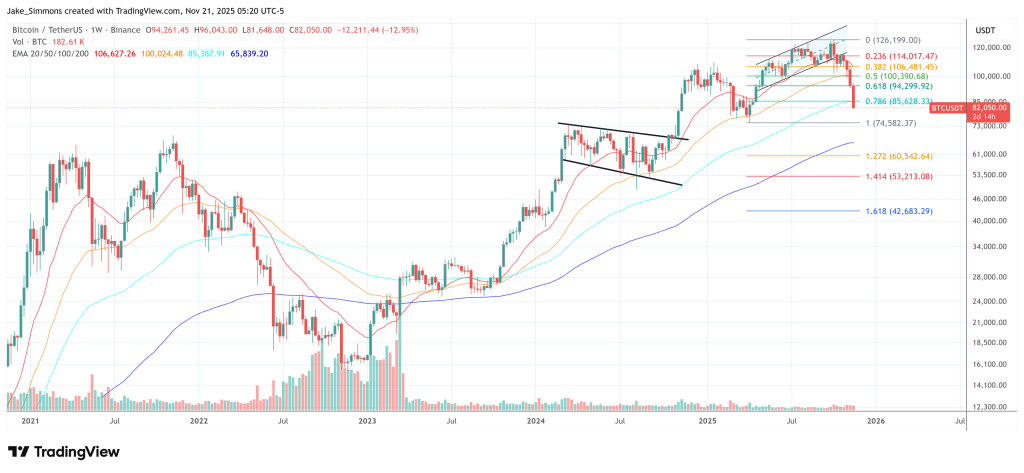
At press time, BTC traded at $82,050.
Bitcoin price
Market Opportunity
Bitcoin Logo
Bitcoin Price(BTC)
$87,563.17
$87,563.17$87,563.17
-0.31%
USD
Bitcoin (BTC) Live Price Chart
Disclaimer: The articles reposted on this site are sourced from public platforms and are provided for informational purposes only. They do not necessarily reflect the views of MEXC. All rights remain with the original authors. If you believe any content infringes on third-party rights, please contact service@support.mexc.com for removal. MEXC makes no guarantees regarding the accuracy, completeness, or timeliness of the content and is not responsible for any actions taken based on the information provided. The content does not constitute financial, legal, or other professional advice, nor should it be considered a recommendation or endorsement by MEXC.

You May Also Like

First Arrest Made in Hyderabad

First Arrest Made in Hyderabad

The post First Arrest Made in Hyderabad appeared on BitcoinEthereumNews.com. Key Points: Coinbase data breach leads to arrest in India. CEO confirms ongoing police
Share
BitcoinEthereumNews2025/12/29 02:53
Fed Decides On Interest Rates Today—Here’s What To Watch For

Fed Decides On Interest Rates Today—Here’s What To Watch For

The post Fed Decides On Interest Rates Today—Here’s What To Watch For appeared on BitcoinEthereumNews.com. Topline The Federal Reserve on Wednesday will conclude a two-day policymaking meeting and release a decision on whether to lower interest rates—following months of pressure and criticism from President Donald Trump—and potentially signal whether additional cuts are on the way. President Donald Trump has urged the central bank to “CUT INTEREST RATES, NOW, AND BIGGER” than they might plan to. Getty Images Key Facts The central bank is poised to cut interest rates by at least a quarter-point, down from the 4.25% to 4.5% range where they have been held since December to between 4% and 4.25%, as Wall Street has placed 100% odds of a rate cut, according to CME’s FedWatch, with higher odds (94%) on a quarter-point cut than a half-point (6%) reduction. Fed governors Christopher Waller and Michelle Bowman, both Trump appointees, voted in July for a quarter-point reduction to rates, and they may dissent again in favor of a large cut alongside Stephen Miran, Trump’s Council of Economic Advisers’ chair, who was sworn in at the meeting’s start on Tuesday. It’s unclear whether other policymakers, including Kansas City Fed President Jeffrey Schmid and St. Louis Fed President Alberto Musalem, will favor larger cuts or opt for no reduction. Fed Chair Jerome Powell said in his Jackson Hole, Wyoming, address last month the central bank would likely consider a looser monetary policy, noting the “shifting balance of risks” on the U.S. economy “may warrant adjusting our policy stance.” David Mericle, an economist for Goldman Sachs, wrote in a note the “key question” for the Fed’s meeting is whether policymakers signal “this is likely the first in a series of consecutive cuts” as the central bank is anticipated to “acknowledge the softening in the labor market,” though they may not “nod to an October cut.” Mericle said he…
Share
BitcoinEthereumNews2025/09/18 00:23
CME to launch Solana and XRP futures options on October 13, 2025

CME to launch Solana and XRP futures options on October 13, 2025

The post CME to launch Solana and XRP futures options on October 13, 2025 appeared on BitcoinEthereumNews.com. Key Takeaways CME Group will launch futures options for Solana (SOL) and XRP. The launch date is set for October 13, 2025. CME Group will launch futures options for Solana and XRP on October 13, 2025. The Chicago-based derivatives exchange will add the new crypto derivatives products to its existing digital asset offerings. The launch will provide institutional and retail traders with additional tools to hedge positions and speculate on price movements for both digital assets. The futures options will be based on CME’s existing Solana and XRP futures contracts. Trading will be conducted through CME Globex, the exchange’s electronic trading platform. Source: https://cryptobriefing.com/cme-solana-xrp-futures-options-launch-2025/
Share
BitcoinEthereumNews2025/09/18 01:07