The post Crypto User Loses $50M in One Copy-Paste Mistake Address Poisoning Scam appeared first on Coinpedia Fintech News A crypto user has lost nearly $50 millionThe post Crypto User Loses $50M in One Copy-Paste Mistake Address Poisoning Scam appeared first on Coinpedia Fintech News A crypto user has lost nearly $50 million

Crypto User Loses $50M in One Copy-Paste Mistake Address Poisoning Scam

Crypto user lost millions

The post Crypto User Loses $50M in One Copy-Paste Mistake Address Poisoning Scam appeared first on Coinpedia Fintech News

A crypto user has lost nearly $50 million in USDT after falling victim to an address poisoning scam, according to on-chain analytics platform Lookonchain. The incident happened due to a simple copy-paste mistake during a large transfer and is now being described as one of the costliest errors in crypto history.

How the $50 Million Transfer Went Wrong

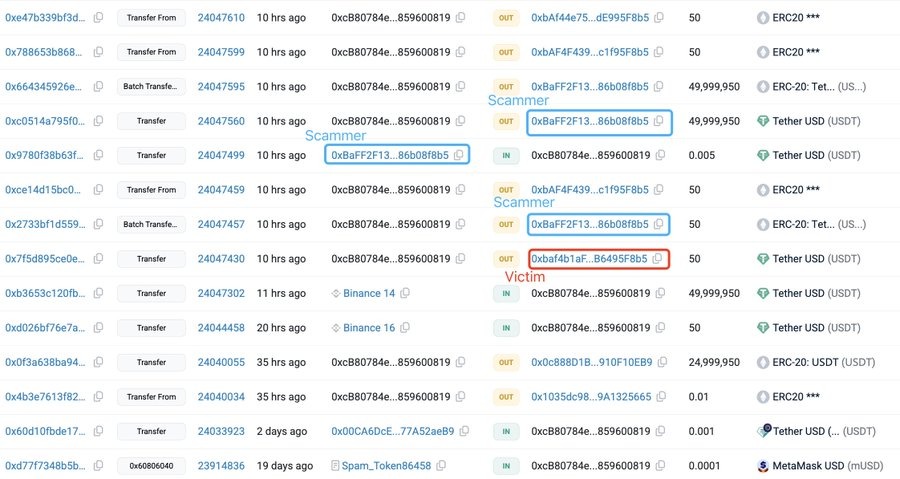
The incident began with what looked like a careful move. Before sending a large amount, the victim first transferred 50 USDT as a test transaction to their own wallet address. This is a common habit among crypto users to avoid errors.

However, scammers were closely monitoring the wallet.

Soon after the test transaction, the scammer created a fake wallet address that looked almost identical to the victim’s real address, matching the same first and last four characters. 

The scammer then sent small transactions to the victim so the fake address appeared in the transaction history. This tactic is the core of an address poisoning scam.

  • Also Read :
  •   US Senators Introduce SAFE Crypto Act to Target Rising Crypto Scams
  •   ,

The Costly Copy-Paste Error

When the victim later sent the remaining 49,999,950 USDT, they copied the address directly from their transaction history. Unfortunately, they unknowingly copied the spoofed address instead of their real one.

Within seconds, the entire amount was sent straight to the scammer’s wallet. Since blockchain transactions are irreversible, the funds were lost instantly with no recovery option.

Why Address Poisoning Scams Are So Dangerous

This type of scam, known as address poisoning, does not hack wallets or steal private keys. Instead, they exploit human habits and wallet design limitations. Many users only check the beginning and ending characters of an address, which scammers take advantage of.

Lookonchain’s shared image clearly shows how repeated small transfers were used to trick the victim into copying the wrong address.
scam chart
Never Miss a Beat in the Crypto World!

Stay ahead with breaking news, expert analysis, and real-time updates on the latest trends in Bitcoin, altcoins, DeFi, NFTs, and more.

bell icon Subscribe to News

FAQs

What is an address poisoning scam in crypto?

An address poisoning scam tricks users into sending crypto to a fake wallet by mimicking their real address.

How can I prevent address poisoning in crypto?

Always double-check full wallet addresses, avoid relying on transaction history, and test with small transfers.

Can lost crypto be recovered after a scam?

Blockchain transactions are irreversible, so once funds are sent to a scammer, they cannot be recovered.

What are the warning signs of a crypto address poisoning scam?

Look for unusual small transactions in your wallet history and addresses that closely resemble your own.

How can businesses avoid losing large crypto transfers to scams?

Use multi-step verification, test small transactions, and confirm addresses outside wallet history logs.


Market Opportunity
Scamcoin Logo
Scamcoin Price(SCAM)
$0.000839
$0.000839$0.000839
+0.35%
USD
Scamcoin (SCAM) Live Price Chart
Disclaimer: The articles reposted on this site are sourced from public platforms and are provided for informational purposes only. They do not necessarily reflect the views of MEXC. All rights remain with the original authors. If you believe any content infringes on third-party rights, please contact service@support.mexc.com for removal. MEXC makes no guarantees regarding the accuracy, completeness, or timeliness of the content and is not responsible for any actions taken based on the information provided. The content does not constitute financial, legal, or other professional advice, nor should it be considered a recommendation or endorsement by MEXC.

You May Also Like

China Launches Cross-Border QR Code Payment Trial

China Launches Cross-Border QR Code Payment Trial

The post China Launches Cross-Border QR Code Payment Trial appeared on BitcoinEthereumNews.com. Key Points: Main event involves China initiating a cross-border QR code payment trial. Alipay and Ant International are key participants. Impact on financial security and regulatory focus on illicit finance. China’s central bank, led by Deputy Governor Lu Lei, initiated a trial of a unified cross-border QR code payment gateway with Alipay and Ant International as participants. This pilot addresses cross-border fund risks, aiming to enhance financial security amid rising money laundering through digital channels, despite muted crypto market reactions. China’s Cross-Border Payment Gateway Trial with Alipay The trial operation of a unified cross-border QR code payment gateway marks a milestone in China’s financial landscape. Prominent entities such as Alipay and Ant International are at the forefront, participating as the initial institutions in this venture. Lu Lei, Deputy Governor of the People’s Bank of China, highlighted the systemic risks posed by increased cross-border fund flows. Changes are expected in the dynamics of digital transactions, potentially enhancing transaction efficiency while tightening regulations around illicit finance. The initiative underscores China’s commitment to bolstering financial security amidst growing global fund movements. “The scale of cross-border fund flows is expanding, and the frequency is accelerating, providing opportunities for risks such as cross-border money laundering and terrorist financing. Some overseas illegal platforms transfer funds through channels such as virtual currencies and underground banks, creating a ‘resonance’ of risks at home and abroad, posing a challenge to China’s foreign exchange management and financial security.” — Lu Lei, Deputy Governor, People’s Bank of China Bitcoin and Impact of China’s Financial Initiatives Did you know? China’s latest initiative echoes the Payment Connect project of June 2025, furthering real-time cross-boundary remittances and expanding its influence on global financial systems. As of September 17, 2025, Bitcoin (BTC) stands at $115,748.72 with a market cap of $2.31 trillion, showing a 0.97%…
Share
BitcoinEthereumNews2025/09/18 05:28
Ethereum Price Prediction: ETH Targets $10,000 In 2026 But Layer Brett Could Reach $1 From $0.0058

Ethereum Price Prediction: ETH Targets $10,000 In 2026 But Layer Brett Could Reach $1 From $0.0058

Ethereum price predictions are turning heads, with analysts suggesting ETH could climb to $10,000 by 2026 as institutional demand and network upgrades drive growth. While Ethereum remains a blue-chip asset, investors looking for sharper multiples are eyeing Layer Brett (LBRETT). Currently in presale at just $0.0058, the Ethereum Layer 2 meme coin is drawing huge [...] The post Ethereum Price Prediction: ETH Targets $10,000 In 2026 But Layer Brett Could Reach $1 From $0.0058 appeared first on Blockonomi.
Share
Blockonomi2025/09/17 23:45
ZEC Jumps 10%, Is It The Best Crypto to Buy Now?

ZEC Jumps 10%, Is It The Best Crypto to Buy Now?

The post ZEC Jumps 10%, Is It The Best Crypto to Buy Now? appeared on BitcoinEthereumNews.com. While Bitcoin and many altcoins remain stuck around critical price
Share
BitcoinEthereumNews2025/12/20 17:53



