????AI is so much more than LLM! In his latest Ultimate AI Plan, Musk boasted that 80% of Tesla's future value will come from robots! With robotics stocks skyrocketing, Web3 robotics projects are accelerating and igniting a new wave of enthusiasm. How will a decentralized, on-chain collaborative intelligent ecosystem reshape our future? Follow Biteye and unlock new stars in the Web3 robot race! ???? @openmind_agi Keywords: operating system, decentralized coordination layer OpenMind has raised $20 million in funding, hoping to improve robots' understanding and learning capabilities through open source systems. Its main products include: OM1: An AI-native operating system, known as the "Android for robots," is hardware-independent and open source. It empowers machines with perception, memory, planning, and control capabilities, helping them understand the world and take contextually relevant actions. A previous hackathon participant used OM1 to build an Alzheimer's care robot in 48 hours. FABRIC: A decentralized coordination layer. Through blockchain, it allows robots to share data, rapidly learn (e.g., language), and support consensus, execution, and settlement. @peaq Keywords: Layer 1, Machine Economy peaq has raised $21 million and is a Layer 1 focused on DePIN and machine economy. Peaq enables robots, drones, sensors, and other machine devices to obtain self-sovereign IDs on the blockchain, conduct peer-to-peer payments, store data, and automate operations. This enables use cases such as robot rentals, drone deliveries, and autonomous machine collaboration, building a complete "machine economy" where robots and other devices can earn money and interact independently, just like AI agents. Built on the Substrate framework and compatible with Polkadot, the project has connected to over 90 blockchains. Currently, there are over 50 DePIN projects on the peaq chain, including Silencio (noise monitoring), MapMetrics (earning money while driving), Farmsent (agricultural supply chain), and Natix (smart driving). The network connects over 4.5 million devices and machines, providing decentralized network services for over 20 industries, including energy, mobility, transportation, agriculture, and the environment. @GEODNET_ Keywords: Real-time Positioning Network GEODNET has raised $15 million and focuses on positioning services - building the world's largest real-time kinematic (RTK) positioning network in a decentralized manner, providing centimeter-level accuracy of the Global Navigation Satellite System (GNSS) service. The project was originally built on Polygon and has now expanded to Solana. The network allows anyone to purchase and install GEODNET hardware mining equipment ("satellite miners"), collect and upload RTK correction data to the network, earn $GEOD token rewards, and ultimately enable the network to provide high-precision positioning support for applications such as robots, autonomous vehicles, drones, and the metaverse. The network currently covers 145 countries, more than 19,000 sites, and has delivered more than 207,178 GB of RTK data. @psdnai Keywords: Physical Data Collection Poseidon, incubated by @StoryProtocol, raised $15 million in seed funding, primarily to address the shortage of training data for applications such as robots and multimodal AI agents at the physical level of displays. Poseidon has built a decentralized data layer based on Story to collect, organize and manage real-world data (such as video, audio, images, location, etc.), ultimately providing IP-protected training data to help accelerate innovation in AI models. The APP is currently online, starting with sound information, allowing users to upload sound information in the APP to train the AI model so that it can process voices in different accents, dialects and environments. @PrismaXai Keywords: Tele-op, training data PrismaX, led by a16z CSX, has raised $11 million in total funding. It aims to help robots achieve a high degree of autonomy through human intervention. The tele-op platform currently available allows users to remotely operate robotic arms through a browser, converting this operational data into high-quality training data for model optimization. Operators will receive platform token rewards during this process. The platform is expected to be able to remotely connect to many well-known robots such as Yushu and UBTECH in the future. In the short term, we will focus on remote control and visual data for model training; In the medium term, robots will be able to complete actual tasks through remote human control; In the long run, the ultimate goal is to achieve complete or high autonomy of robots. @NRNAgents Keywords: Tele-op, reinforcement learning, AI Agent NRN Agents is a decentralized AI agent development and training platform running on Arbitrum. Initially focused on AI agents in games, the platform is now expanding to AI agents behind embodied robots. Through a "Sim-to-Real" framework, NRN Agents provides efficient training and deployment solutions for robotic AI agents. Users can directly control the simulated robot through the browser, and each operation generates high-quality behavioral data, providing training materials for imitation learning for the robot system; at the same time, the AI agent in the system can also be continuously optimized based on real-world interactions through reinforcement learning, without the need for complete retraining. The project is currently in its early stages, focusing primarily on the operation of the robotic arm (RME-1). Future developments will include the robot's combat capabilities, athletics, and other competitive sports. @AukiNetwork Keywords: DePIN network, physical world data, positioning data Auki Network aims to build a decentralized neural network for robots and intelligent machines, giving them a deeper understanding of the physical world. Its core business is to build a DePIN network that allows various devices (such as robots and smart glasses) to share location and perception data in real time, forming a collaborative spatial understanding. The network, based on the Posemesh protocol, consists of compute nodes that provide computing resources, motion nodes (made up of intelligent devices like robots) that provide motion and sensor data, reconstruction nodes that use the former and latter to generate 3D maps or spatial models, and domain name nodes that manage these 3D spaces. These nodes are rewarded with $AUKI tokens based on their contributions. @RoboStack_io Keywords: Abstracting hardware complexity, simplifying hardware and software integration RoboStack is a cloud-native simulation and integration platform. It not only provides realistic environment modeling and scalable computing infrastructure for robot development and deployment, but also establishes a standardized communication protocol through the Robot Context Protocol (RCP) across diverse hardware, software, and communication standards, simplifying the connection between underlying robot hardware and AI agents at the software level. The native token $ROBOT has been launched on the virtuals platform. Users can participate in $ROBOT staking in virtuals and vote for their favorite robot projects in SIM lord for a chance to win rewards. @frodobots Keywords: sidewalk robot FrodoBots Lab is a robotics lab that uses gamification to promote real-world data collection and the development of embodied intelligence. Its core product, the Earth Rover, is a remote-controlled sidewalk robot (a robot that walks on sidewalks), priced between $249 and $399. It can be used for gaming, data collection, and AI research. FrodoBots has deployed hundreds of Earth Rovers worldwide and has open-sourced 2,000 hours of real-world driving datasets. FrodoBots has built an ecosystem that integrates entertainment and scientific research through innovative robotic hardware, a decentralized platform, and an AI framework. The following are its main projects: 9.1. @BitRobotNetwork Keywords: decentralized subnet architecture The BitRobot Network, a decentralized platform built on Solana and jointly developed by FrodoBots Lab and Protocol Labs, has secured $6 million in funding. The network utilizes a subnet architecture, with each subnet contributing specific resources such as computing power, a fleet of robots, datasets (real or synthetic), or AI models. These subnets cover a wide range of form factors, from sidewalk robots to humanoid robots. The first subnet, ET Fuji, has launched and is described in detail below. 9.2. @ET_Fugi Keywords: Games, Remote Control Platform Tele-op ET Fugi (Extra-Terrestrial Fugitives) is a real-world robotics game where players remotely control the Earth Rover to capture “alien” NFTs, while generating valuable sidewalk data for robot AI training and earning rewards such as FrodoBots Points (FBP). 9.3. @samismoving Keywords: AI Agent, Framework SAM was originally developed by FrodoBots and @virtuals_io as an AI agent for remotely operating the Earth Rover. It later evolved into the core framework for launching AI agents on the Robots.Fun (Launchpad) platform. All subsequent AI agents are built on SAM's architecture and pay a 5% commission to it. SAM collects operational data through Earth Rover to improve the overall AI agent's capabilities. It also livestreams portions of its adventures via X (Twitter), showcasing specific interactions, competitions, and data collection scenarios, providing both entertainment and educational value. 9.4. @robotsdotfun Keywords: AI Agent Launch Platform Robots.Fun is a platform for launching robotic AI agents. It collects data and strengthens the AI agents through daily competitions (such as capturing alien NFTs). To create an AI agent on Robots.Fun, you must own or purchase an Earth Rover robot, which serves as the "body" of the AI agent. 9.5. @UFBots Keywords: Robot fighting, remote control platform Tele-op Ultimate Fighting Bots is a free robot battle club where users remotely control Booster T1-based humanoid robots to engage in combat. The platform generates real-world data for training embodied AI while providing users with an immersive entertainment experience. Summarize After understanding the above projects, we can clearly see the two core advantages of the Web3 robot track: The decentralized advantage of blockchain is expected to break the scarcity barriers of robot models and data. The on-chain property rights and incentive mechanisms have injected new vitality and sustainability into the robotic economy. What are your thoughts on the future of Web3 bots? What other opportunities or challenges do you think are worth watching? Share your thoughts with Biteye in the comments! ????????AI is so much more than LLM! In his latest Ultimate AI Plan, Musk boasted that 80% of Tesla's future value will come from robots! With robotics stocks skyrocketing, Web3 robotics projects are accelerating and igniting a new wave of enthusiasm. How will a decentralized, on-chain collaborative intelligent ecosystem reshape our future? Follow Biteye and unlock new stars in the Web3 robot race! ???? @openmind_agi Keywords: operating system, decentralized coordination layer OpenMind has raised $20 million in funding, hoping to improve robots' understanding and learning capabilities through open source systems. Its main products include: OM1: An AI-native operating system, known as the "Android for robots," is hardware-independent and open source. It empowers machines with perception, memory, planning, and control capabilities, helping them understand the world and take contextually relevant actions. A previous hackathon participant used OM1 to build an Alzheimer's care robot in 48 hours. FABRIC: A decentralized coordination layer. Through blockchain, it allows robots to share data, rapidly learn (e.g., language), and support consensus, execution, and settlement. @peaq Keywords: Layer 1, Machine Economy peaq has raised $21 million and is a Layer 1 focused on DePIN and machine economy. Peaq enables robots, drones, sensors, and other machine devices to obtain self-sovereign IDs on the blockchain, conduct peer-to-peer payments, store data, and automate operations. This enables use cases such as robot rentals, drone deliveries, and autonomous machine collaboration, building a complete "machine economy" where robots and other devices can earn money and interact independently, just like AI agents. Built on the Substrate framework and compatible with Polkadot, the project has connected to over 90 blockchains. Currently, there are over 50 DePIN projects on the peaq chain, including Silencio (noise monitoring), MapMetrics (earning money while driving), Farmsent (agricultural supply chain), and Natix (smart driving). The network connects over 4.5 million devices and machines, providing decentralized network services for over 20 industries, including energy, mobility, transportation, agriculture, and the environment. @GEODNET_ Keywords: Real-time Positioning Network GEODNET has raised $15 million and focuses on positioning services - building the world's largest real-time kinematic (RTK) positioning network in a decentralized manner, providing centimeter-level accuracy of the Global Navigation Satellite System (GNSS) service. The project was originally built on Polygon and has now expanded to Solana. The network allows anyone to purchase and install GEODNET hardware mining equipment ("satellite miners"), collect and upload RTK correction data to the network, earn $GEOD token rewards, and ultimately enable the network to provide high-precision positioning support for applications such as robots, autonomous vehicles, drones, and the metaverse. The network currently covers 145 countries, more than 19,000 sites, and has delivered more than 207,178 GB of RTK data. @psdnai Keywords: Physical Data Collection Poseidon, incubated by @StoryProtocol, raised $15 million in seed funding, primarily to address the shortage of training data for applications such as robots and multimodal AI agents at the physical level of displays. Poseidon has built a decentralized data layer based on Story to collect, organize and manage real-world data (such as video, audio, images, location, etc.), ultimately providing IP-protected training data to help accelerate innovation in AI models. The APP is currently online, starting with sound information, allowing users to upload sound information in the APP to train the AI model so that it can process voices in different accents, dialects and environments. @PrismaXai Keywords: Tele-op, training data PrismaX, led by a16z CSX, has raised $11 million in total funding. It aims to help robots achieve a high degree of autonomy through human intervention. The tele-op platform currently available allows users to remotely operate robotic arms through a browser, converting this operational data into high-quality training data for model optimization. Operators will receive platform token rewards during this process. The platform is expected to be able to remotely connect to many well-known robots such as Yushu and UBTECH in the future. In the short term, we will focus on remote control and visual data for model training; In the medium term, robots will be able to complete actual tasks through remote human control; In the long run, the ultimate goal is to achieve complete or high autonomy of robots. @NRNAgents Keywords: Tele-op, reinforcement learning, AI Agent NRN Agents is a decentralized AI agent development and training platform running on Arbitrum. Initially focused on AI agents in games, the platform is now expanding to AI agents behind embodied robots. Through a "Sim-to-Real" framework, NRN Agents provides efficient training and deployment solutions for robotic AI agents. Users can directly control the simulated robot through the browser, and each operation generates high-quality behavioral data, providing training materials for imitation learning for the robot system; at the same time, the AI agent in the system can also be continuously optimized based on real-world interactions through reinforcement learning, without the need for complete retraining. The project is currently in its early stages, focusing primarily on the operation of the robotic arm (RME-1). Future developments will include the robot's combat capabilities, athletics, and other competitive sports. @AukiNetwork Keywords: DePIN network, physical world data, positioning data Auki Network aims to build a decentralized neural network for robots and intelligent machines, giving them a deeper understanding of the physical world. Its core business is to build a DePIN network that allows various devices (such as robots and smart glasses) to share location and perception data in real time, forming a collaborative spatial understanding. The network, based on the Posemesh protocol, consists of compute nodes that provide computing resources, motion nodes (made up of intelligent devices like robots) that provide motion and sensor data, reconstruction nodes that use the former and latter to generate 3D maps or spatial models, and domain name nodes that manage these 3D spaces. These nodes are rewarded with $AUKI tokens based on their contributions. @RoboStack_io Keywords: Abstracting hardware complexity, simplifying hardware and software integration RoboStack is a cloud-native simulation and integration platform. It not only provides realistic environment modeling and scalable computing infrastructure for robot development and deployment, but also establishes a standardized communication protocol through the Robot Context Protocol (RCP) across diverse hardware, software, and communication standards, simplifying the connection between underlying robot hardware and AI agents at the software level. The native token $ROBOT has been launched on the virtuals platform. Users can participate in $ROBOT staking in virtuals and vote for their favorite robot projects in SIM lord for a chance to win rewards. @frodobots Keywords: sidewalk robot FrodoBots Lab is a robotics lab that uses gamification to promote real-world data collection and the development of embodied intelligence. Its core product, the Earth Rover, is a remote-controlled sidewalk robot (a robot that walks on sidewalks), priced between $249 and $399. It can be used for gaming, data collection, and AI research. FrodoBots has deployed hundreds of Earth Rovers worldwide and has open-sourced 2,000 hours of real-world driving datasets. FrodoBots has built an ecosystem that integrates entertainment and scientific research through innovative robotic hardware, a decentralized platform, and an AI framework. The following are its main projects: 9.1. @BitRobotNetwork Keywords: decentralized subnet architecture The BitRobot Network, a decentralized platform built on Solana and jointly developed by FrodoBots Lab and Protocol Labs, has secured $6 million in funding. The network utilizes a subnet architecture, with each subnet contributing specific resources such as computing power, a fleet of robots, datasets (real or synthetic), or AI models. These subnets cover a wide range of form factors, from sidewalk robots to humanoid robots. The first subnet, ET Fuji, has launched and is described in detail below. 9.2. @ET_Fugi Keywords: Games, Remote Control Platform Tele-op ET Fugi (Extra-Terrestrial Fugitives) is a real-world robotics game where players remotely control the Earth Rover to capture “alien” NFTs, while generating valuable sidewalk data for robot AI training and earning rewards such as FrodoBots Points (FBP). 9.3. @samismoving Keywords: AI Agent, Framework SAM was originally developed by FrodoBots and @virtuals_io as an AI agent for remotely operating the Earth Rover. It later evolved into the core framework for launching AI agents on the Robots.Fun (Launchpad) platform. All subsequent AI agents are built on SAM's architecture and pay a 5% commission to it. SAM collects operational data through Earth Rover to improve the overall AI agent's capabilities. It also livestreams portions of its adventures via X (Twitter), showcasing specific interactions, competitions, and data collection scenarios, providing both entertainment and educational value. 9.4. @robotsdotfun Keywords: AI Agent Launch Platform Robots.Fun is a platform for launching robotic AI agents. It collects data and strengthens the AI agents through daily competitions (such as capturing alien NFTs). To create an AI agent on Robots.Fun, you must own or purchase an Earth Rover robot, which serves as the "body" of the AI agent. 9.5. @UFBots Keywords: Robot fighting, remote control platform Tele-op Ultimate Fighting Bots is a free robot battle club where users remotely control Booster T1-based humanoid robots to engage in combat. The platform generates real-world data for training embodied AI while providing users with an immersive entertainment experience. Summarize After understanding the above projects, we can clearly see the two core advantages of the Web3 robot track: The decentralized advantage of blockchain is expected to break the scarcity barriers of robot models and data. The on-chain property rights and incentive mechanisms have injected new vitality and sustainability into the robotic economy. What are your thoughts on the future of Web3 bots? What other opportunities or challenges do you think are worth watching? Share your thoughts with Biteye in the comments! ????
????AI is so much more than LLM! In his latest Ultimate AI Plan, Musk boasted that 80% of Tesla's future value will come from robots! With robotics stocks skyrocketing, Web3 robotics projects are accelerating and igniting a new wave of enthusiasm. How will a decentralized, on-chain collaborative intelligent ecosystem reshape our future?
Follow Biteye and unlock new stars in the Web3 robot race! ????
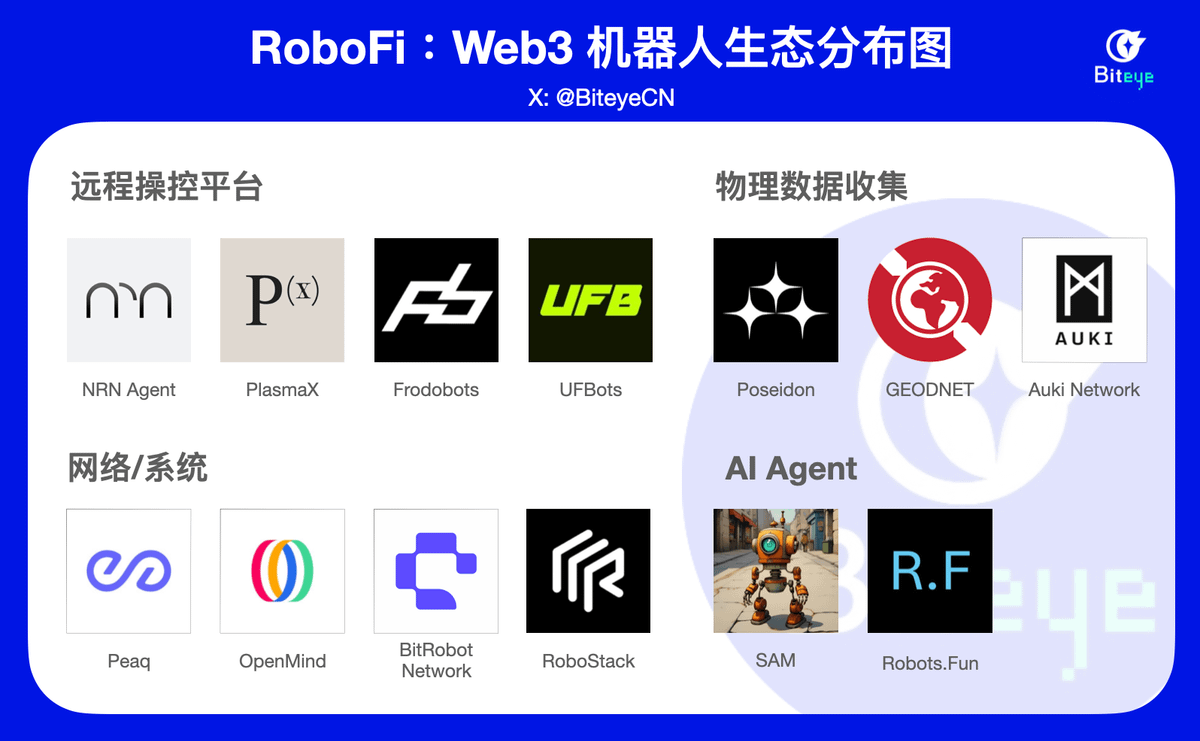
- @openmind_agi
Keywords: operating system, decentralized coordination layer
OpenMind has raised $20 million in funding, hoping to improve robots' understanding and learning capabilities through open source systems. Its main products include:
OM1: An AI-native operating system, known as the "Android for robots," is hardware-independent and open source. It empowers machines with perception, memory, planning, and control capabilities, helping them understand the world and take contextually relevant actions. A previous hackathon participant used OM1 to build an Alzheimer's care robot in 48 hours.
FABRIC: A decentralized coordination layer. Through blockchain, it allows robots to share data, rapidly learn (e.g., language), and support consensus, execution, and settlement.
- @peaq
Keywords: Layer 1, Machine Economy
peaq has raised $21 million and is a Layer 1 focused on DePIN and machine economy.
Peaq enables robots, drones, sensors, and other machine devices to obtain self-sovereign IDs on the blockchain, conduct peer-to-peer payments, store data, and automate operations. This enables use cases such as robot rentals, drone deliveries, and autonomous machine collaboration, building a complete "machine economy" where robots and other devices can earn money and interact independently, just like AI agents.
Built on the Substrate framework and compatible with Polkadot, the project has connected to over 90 blockchains. Currently, there are over 50 DePIN projects on the peaq chain, including Silencio (noise monitoring), MapMetrics (earning money while driving), Farmsent (agricultural supply chain), and Natix (smart driving). The network connects over 4.5 million devices and machines, providing decentralized network services for over 20 industries, including energy, mobility, transportation, agriculture, and the environment.
- @GEODNET_
Keywords: Real-time Positioning Network
GEODNET has raised $15 million and focuses on positioning services - building the world's largest real-time kinematic (RTK) positioning network in a decentralized manner, providing centimeter-level accuracy of the Global Navigation Satellite System (GNSS) service.
The project was originally built on Polygon and has now expanded to Solana.
The network allows anyone to purchase and install GEODNET hardware mining equipment ("satellite miners"), collect and upload RTK correction data to the network, earn $GEOD token rewards, and ultimately enable the network to provide high-precision positioning support for applications such as robots, autonomous vehicles, drones, and the metaverse.
The network currently covers 145 countries, more than 19,000 sites, and has delivered more than 207,178 GB of RTK data.
-
@psdnai
Keywords: Physical Data Collection
Poseidon, incubated by @StoryProtocol, raised $15 million in seed funding, primarily to address the shortage of training data for applications such as robots and multimodal AI agents at the physical level of displays.
Poseidon has built a decentralized data layer based on Story to collect, organize and manage real-world data (such as video, audio, images, location, etc.), ultimately providing IP-protected training data to help accelerate innovation in AI models.
The APP is currently online, starting with sound information, allowing users to upload sound information in the APP to train the AI model so that it can process voices in different accents, dialects and environments.
- @PrismaXai
Keywords: Tele-op, training data
PrismaX, led by a16z CSX, has raised $11 million in total funding. It aims to help robots achieve a high degree of autonomy through human intervention.
The tele-op platform currently available allows users to remotely operate robotic arms through a browser, converting this operational data into high-quality training data for model optimization. Operators will receive platform token rewards during this process.
The platform is expected to be able to remotely connect to many well-known robots such as Yushu and UBTECH in the future.
In the short term, we will focus on remote control and visual data for model training;
In the medium term, robots will be able to complete actual tasks through remote human control;
In the long run, the ultimate goal is to achieve complete or high autonomy of robots.
- @NRNAgents
Keywords: Tele-op, reinforcement learning, AI Agent
NRN Agents is a decentralized AI agent development and training platform running on Arbitrum. Initially focused on AI agents in games, the platform is now expanding to AI agents behind embodied robots. Through a "Sim-to-Real" framework, NRN Agents provides efficient training and deployment solutions for robotic AI agents.
Users can directly control the simulated robot through the browser, and each operation generates high-quality behavioral data, providing training materials for imitation learning for the robot system; at the same time, the AI agent in the system can also be continuously optimized based on real-world interactions through reinforcement learning, without the need for complete retraining.
The project is currently in its early stages, focusing primarily on the operation of the robotic arm (RME-1). Future developments will include the robot's combat capabilities, athletics, and other competitive sports.
- @AukiNetwork
Keywords: DePIN network, physical world data, positioning data
Auki Network aims to build a decentralized neural network for robots and intelligent machines, giving them a deeper understanding of the physical world. Its core business is to build a DePIN network that allows various devices (such as robots and smart glasses) to share location and perception data in real time, forming a collaborative spatial understanding.
The network, based on the Posemesh protocol, consists of compute nodes that provide computing resources, motion nodes (made up of intelligent devices like robots) that provide motion and sensor data, reconstruction nodes that use the former and latter to generate 3D maps or spatial models, and domain name nodes that manage these 3D spaces. These nodes are rewarded with $AUKI tokens based on their contributions.
- @RoboStack_io
Keywords: Abstracting hardware complexity, simplifying hardware and software integration
RoboStack is a cloud-native simulation and integration platform. It not only provides realistic environment modeling and scalable computing infrastructure for robot development and deployment, but also establishes a standardized communication protocol through the Robot Context Protocol (RCP) across diverse hardware, software, and communication standards, simplifying the connection between underlying robot hardware and AI agents at the software level.
The native token $ROBOT has been launched on the virtuals platform. Users can participate in $ROBOT staking in virtuals and vote for their favorite robot projects in SIM lord for a chance to win rewards.
- @frodobots
Keywords: sidewalk robot
FrodoBots Lab is a robotics lab that uses gamification to promote real-world data collection and the development of embodied intelligence. Its core product, the Earth Rover, is a remote-controlled sidewalk robot (a robot that walks on sidewalks), priced between $249 and $399. It can be used for gaming, data collection, and AI research. FrodoBots has deployed hundreds of Earth Rovers worldwide and has open-sourced 2,000 hours of real-world driving datasets.
FrodoBots has built an ecosystem that integrates entertainment and scientific research through innovative robotic hardware, a decentralized platform, and an AI framework. The following are its main projects:
9.1. @BitRobotNetwork
Keywords: decentralized subnet architecture
The BitRobot Network, a decentralized platform built on Solana and jointly developed by FrodoBots Lab and Protocol Labs, has secured $6 million in funding. The network utilizes a subnet architecture, with each subnet contributing specific resources such as computing power, a fleet of robots, datasets (real or synthetic), or AI models. These subnets cover a wide range of form factors, from sidewalk robots to humanoid robots. The first subnet, ET Fuji, has launched and is described in detail below.
9.2. @ET_Fugi
Keywords: Games, Remote Control Platform Tele-op
ET Fugi (Extra-Terrestrial Fugitives) is a real-world robotics game where players remotely control the Earth Rover to capture “alien” NFTs, while generating valuable sidewalk data for robot AI training and earning rewards such as FrodoBots Points (FBP).
9.3. @samismoving
Keywords: AI Agent, Framework
SAM was originally developed by FrodoBots and @virtuals_io as an AI agent for remotely operating the Earth Rover. It later evolved into the core framework for launching AI agents on the Robots.Fun (Launchpad) platform. All subsequent AI agents are built on SAM's architecture and pay a 5% commission to it.
SAM collects operational data through Earth Rover to improve the overall AI agent's capabilities. It also livestreams portions of its adventures via X (Twitter), showcasing specific interactions, competitions, and data collection scenarios, providing both entertainment and educational value.
9.4. @robotsdotfun
Keywords: AI Agent Launch Platform
Robots.Fun is a platform for launching robotic AI agents. It collects data and strengthens the AI agents through daily competitions (such as capturing alien NFTs). To create an AI agent on Robots.Fun, you must own or purchase an Earth Rover robot, which serves as the "body" of the AI agent.
9.5. @UFBots
Keywords: Robot fighting, remote control platform Tele-op
Ultimate Fighting Bots is a free robot battle club where users remotely control Booster T1-based humanoid robots to engage in combat. The platform generates real-world data for training embodied AI while providing users with an immersive entertainment experience.
Summarize
After understanding the above projects, we can clearly see the two core advantages of the Web3 robot track:
- The decentralized advantage of blockchain is expected to break the scarcity barriers of robot models and data.
- The on-chain property rights and incentive mechanisms have injected new vitality and sustainability into the robotic economy.
What are your thoughts on the future of Web3 bots? What other opportunities or challenges do you think are worth watching? Share your thoughts with Biteye in the comments! ????
Market Opportunity
$0.003881$0.003881$0.003881
Gravity (G) Live Price Chart
Disclaimer: The articles reposted on this site are sourced from public platforms and are provided for informational purposes only. They do not necessarily reflect the views of MEXC. All rights remain with the original authors. If you believe any content infringes on third-party rights, please contact
crypto.news@mexc.com for removal. MEXC makes no guarantees regarding the accuracy, completeness, or timeliness of the content and is not responsible for any actions taken based on the information provided. The content does not constitute financial, legal, or other professional advice, nor should it be considered a recommendation or endorsement by MEXC.