

Zcash Explodes Past $280: Is $400 Next?
Cryptsy - Latest Cryptocurrency News and Predictions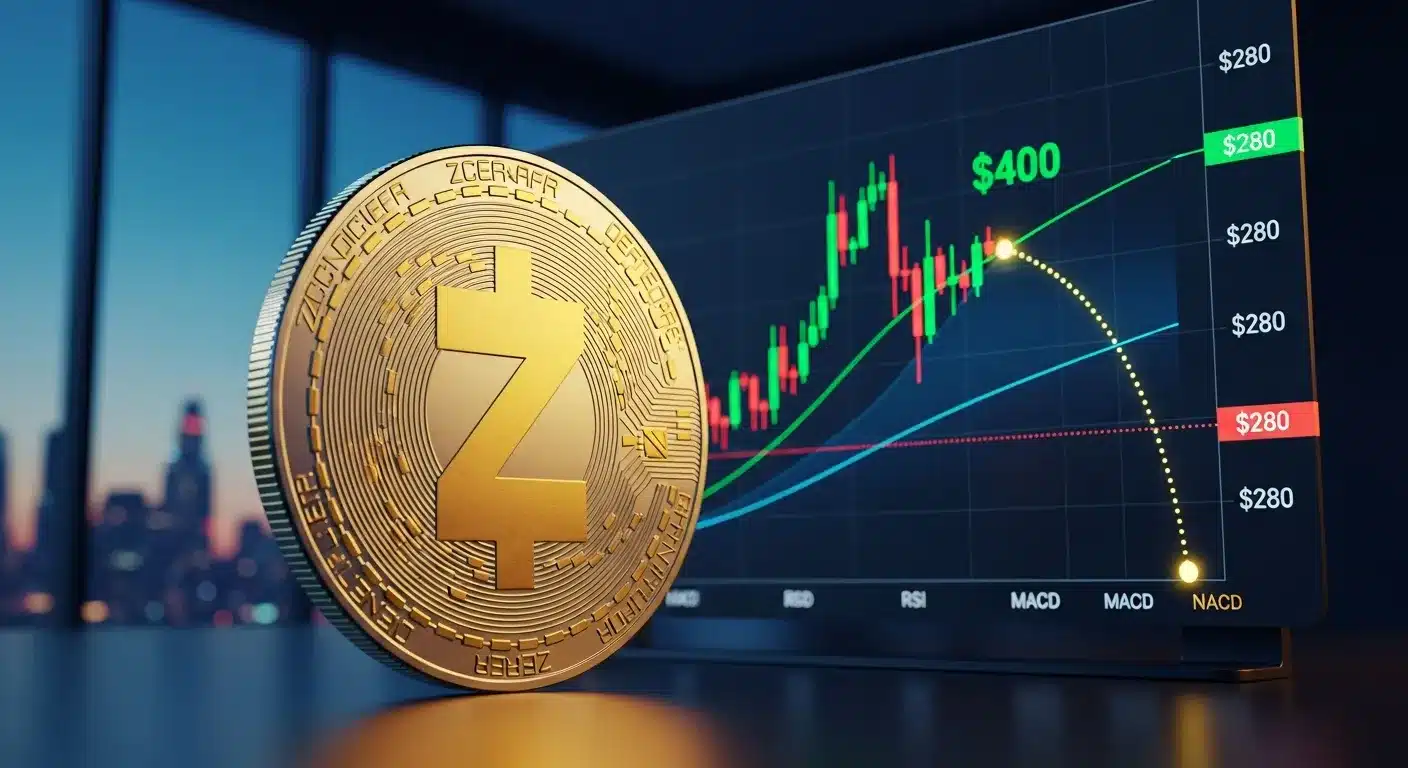
Cryptsy - Latest Cryptocurrency News and Predictions - Experts in Crypto Casinos
Zcash has been turning heads. After months of sideways action that tested even the most patient holders, ZEC broke above $280 with a conviction that’s hard to ignore, and now the question on every serious investor’s mind is whether $400 is a realistic next stop or just wishful thinking.
This isn’t just another altcoin blip. The move carries weight, and understanding what’s driving it matters more than the price headline itself. Whether you’re already holding ZEC or watching from the sidelines trying to decide your next move, here’s what the data, the charts, and the broader market are actually telling you right now.
Key Takeaways
- Zcash surged past $280 driven by renewed institutional interest in privacy-focused blockchains, growing shielded transaction volume, and favorable altcoin rotation conditions in early 2026.
- A textbook measured-move projection from ZEC’s breakout point places the $400 price target squarely in the $390–$420 range, making it a credible and structurally supported milestone rather than speculation.
- The $260–$270 zone is now the critical support level to watch — a healthy pullback into this range would be constructive, while a drop below $230–$240 would signal a meaningful short-term reversal.
- Zcash’s biggest risks include potential exchange delistings, adverse privacy coin regulations in the US or EU, growing competition from zero-knowledge Ethereum Layer-2 projects, and sharp correlation to Bitcoin during risk-off market moves.
- Investors already holding ZEC should consider taking partial profits near the $310–$320 resistance zone, while those not yet positioned may find a better risk-reward entry on a pullback to the $260–$270 support range.
- Disciplined position sizing and clear exit conditions matter more than entry precision when trading Zcash, given its regulatory exposure and the heightened risk of overlooking downsides during a strong rally.
What’s Behind Zcash’s Recent Price Surge
Zcash doesn’t move in a vacuum, and this recent surge is no exception. There are specific, identifiable forces at work here, and knowing them separates a well-reasoned position from a gut-feel trade.
Key Market Catalysts Driving ZEC Higher
One of the clearest drivers has been renewed institutional and developer interest in privacy-focused blockchains. As global regulatory conversations around financial surveillance intensify, assets that offer genuine transactional privacy are seeing a second look from sophisticated money. Zcash, with its zero-knowledge proof architecture (zk-SNARKs), sits in a unique position, it’s not just marketed as a privacy coin, it’s built as one from the ground up.
Beyond that, Zcash’s ongoing protocol development has been a quiet but meaningful catalyst. The Electric Coin Company has continued pushing forward on improvements to shielded transaction adoption, and on-chain data shows that shielded transaction volume has been climbing steadily. When usage goes up, price attention often follows. You’re also seeing increased listings and trading pair availability on mid-tier and larger exchanges, which expands the pool of buyers organically.
There’s also the narrative angle. In a market where investors are hunting for assets with a compelling story, Zcash’s combination of proven cryptographic technology and the ongoing privacy debate in Washington, Brussels, and beyond gives it a story worth telling.
Broader Crypto Market Conditions Supporting the Rally
You can’t talk about ZEC’s surge without acknowledging the macro backdrop. Bitcoin’s continued consolidation above key levels has given altcoins room to breathe. When BTC stabilizes, rather than dominates headlines with volatility, capital rotates. Zcash, sitting in the privacy coin category alongside Monero, tends to attract that rotational capital during these windows.
Liquidity conditions in the broader market have also been more favorable. With risk appetite returning to crypto markets in early 2026, assets further down the market cap ladder are getting a lift. Zcash, while not a top-10 asset, carries enough name recognition and liquidity to benefit from this tide without the wild, unsustainable pumps seen in low-cap tokens. That combination, credible fundamentals plus favorable macro, is exactly the kind of setup that produces meaningful, sustained moves rather than one-day wicks.
Technical Analysis: Reading the ZEC Price Chart
Price action tells a story, and right now, ZEC’s chart is telling a fairly clear one, if you know what to look for.
Critical Support and Resistance Levels to Watch
The $280 level was more than just a round number. It acted as a multi-month resistance zone, meaning every time ZEC approached it, sellers stepped in. When an asset finally clears that kind of entrenched resistance with volume behind it, the move tends to have follow-through. That’s exactly what you saw here.
Now that $280 has been breached, the immediate support you want to watch sits in the $260–$270 range, the zone that was previously resistance and has now flipped. A healthy pullback into this range would actually be constructive rather than bearish: it’s the market testing whether former resistance holds as new support. Below that, the $230–$240 range is the next significant floor, and losing it would change the short-term picture meaningfully.
On the upside, the $310–$320 range is the first notable resistance cluster based on prior price action. Clear that, and you’re looking at relatively open air until the $360–$380 zone, which is where the $400 target conversation really begins.
Momentum Indicators and What They Signal
The RSI on the weekly chart moved out of neutral territory and is currently trending in a range that suggests momentum without yet being technically overbought, which is meaningful. When weekly RSI starts climbing from the mid-range rather than already sitting at elevated levels, it typically means there’s room left in the move before any natural exhaustion sets in.
MACD on the daily chart is showing a bullish crossover that has been sustained rather than fading quickly, which adds confidence to the near-term directional read. Volume has also been above average on the up-days and below average on any pullback sessions, a pattern that signals accumulation rather than distribution. You want to see that dynamic continue as ZEC approaches the next resistance zones.
Why $400 Is the Next Logical Price Target for Zcash
Calling $400 a “logical” target isn’t optimism, it’s math and structure combined with momentum context.
From a pure technical standpoint, measuring the prior consolidation range and projecting it forward from the breakout point at $280 lands you squarely in the $390–$420 territory. That’s a textbook measured move, and while crypto rarely plays out textbook-perfectly, it gives you an anchor for expectations.
Fundamentally, there’s a case to be made as well. Zcash’s market cap at $400 would still place it well below where comparable privacy-centric assets have traded in prior cycles relative to Bitcoin’s market cap. If you believe in mean reversion and the privacy coin narrative regaining traction, both reasonable assumptions given current trends, then $400 isn’t aggressive, it’s actually fairly conservative.
The catalysts that would likely push ZEC into the $400 range include continued growth in shielded transaction volumes, any favorable regulatory commentary around privacy technology specifically (as opposed to blanket crypto regulation), and sustained Bitcoin price stability allowing capital to stay in altcoin rotation mode. None of these require extraordinary conditions. They’re extensions of what’s already happening.
That said, targets are checkpoints, not guarantees. What makes $400 worth watching is that it’s a level where a significant portion of early-cycle sellers would be sitting on meaningful gains, meaning it’s also where you’d naturally expect some profit-taking pressure. How ZEC handles that zone will tell you a lot about whether the rally has legs beyond it.
Risks and Challenges That Could Stall the Rally
Any serious analysis of Zcash’s upside has to be paired with an honest look at what could go wrong. And there are real risks here.
The regulatory environment is the most significant one. Privacy coins have been in regulators’ crosshairs for years, and while no outright ban has materialized in major markets, the pressure is ongoing. Several major exchanges have already delisted Monero and other privacy-focused assets in certain jurisdictions, and ZEC has not been immune to similar delistings in the past. A new wave of exchange delistings or an adverse regulatory ruling in the US or EU could hit ZEC’s price hard and fast, regardless of where technical momentum is pointing.
There’s also the competition question. Zcash isn’t the only project working on privacy at the protocol level. Ethereum’s own privacy-focused developments, along with newer zero-knowledge focused layer-2 projects, are encroaching on territory that ZEC once occupied alone. If institutional money decides that privacy-enabled Ethereum infrastructure is a cleaner regulatory play than a dedicated privacy coin, that’s a narrative headwind for ZEC.
Liquidity depth is another consideration. While Zcash has more liquidity than many altcoins its size, it’s still relatively thin compared to top-tier assets. A large seller, an early miner, a fund rebalancing, or a whale taking profits, can move the price more than you’d expect in a short window. You need to account for that volatility in your position sizing.
Finally, broader market risk matters. If Bitcoin makes a significant move downward for macro or structural reasons, the altcoin rotation that’s been supporting ZEC reverses quickly. Correlation to BTC doesn’t disappear in a risk-off environment, it intensifies.
What Investors and Traders Should Consider Right Now
Where you sit in this moment depends a lot on your time horizon and your current exposure.
If you’re already holding ZEC, the primary question is risk management around the rally. Trailing your stop up as price advances and taking partial profits into key resistance zones is a reasonable approach. The $310–$320 range is worth watching as a first target for trimming, not exiting, but reducing risk. This locks in gains without forcing you out of a position that may have significantly more room.
If you’re not yet positioned, chasing a move that’s already made a significant leg higher is where a lot of investors get burned. The better approach is watching for a pullback into the $260–$270 support zone and entering there with defined risk. That gives you a cleaner entry with a logical stop below $240 rather than buying at the top of a candle and hoping.
For longer-term investors, the thesis is slightly different. If you believe in the privacy coin narrative and Zcash’s specific technological positioning, the entry point matters less than conviction in the thesis. Dollar-cost averaging across multiple levels rather than putting a full position on at once is a time-tested way to build exposure without the anxiety of timing.
Regardless of your approach, position sizing matters more than entry precision. Don’t let a compelling narrative push you into an oversized position in an asset with the volatility profile of ZEC. Resources like Cryptsy’s real-time market analysis can help you stay grounded in data rather than emotion as the price moves, and in a market like this one, that discipline is what separates good outcomes from costly mistakes.
ZEC Returns to $180 — And Why This Might Be Just the Beginning
It’s worth stepping back and remembering what this rally actually looks like in historical context. Not long ago, ZEC was trading around the $180 range, a level that felt, to many, like a permanent new baseline after a prolonged downtrend. The move from $180 to above $280 represents a roughly 55% gain. That’s not noise. That’s a structural shift in how the market is pricing this asset.
What’s particularly telling is where that $180 base came from. ZEC spent months building a base at that level, absorbing selling pressure and consolidating before the move higher. That kind of base-building is generally a healthier foundation for a sustained rally than a vertical spike from a low. When assets grind sideways and then break out, it usually reflects genuine accumulation rather than speculative momentum alone.
For context, look at Zcash’s prior cycle behavior. In previous bull phases, ZEC has historically outperformed when privacy narratives gain traction and when altcoin season takes hold in earnest. The $180 base followed by a breakout above multi-month resistance is a pattern worth taking seriously, not as a prediction of what will happen, but as context for evaluating the probability of further upside.
The return to $180, and the strong rejection of lower levels, is the market telling you that there’s a credible floor here now. The question you should be asking is whether the current move is the beginning of a larger re-rating of ZEC’s value, or a trading opportunity with a defined end. The honest answer is that it could be both, and sizing your position accordingly is the smart way to approach it.
How Are Zcash Investors Overlooking the Risks?
Here’s something you don’t hear discussed enough when an asset is making big moves: the psychology of overlooking risk during a rally.
When ZEC is up 55% and momentum is strong, it’s genuinely difficult to think clearly about what could go wrong. The brain starts anchoring to price targets and discounting risks that it would take seriously in a flat or declining market. This isn’t a personal flaw, it’s a well-documented pattern in investor behavior, and it affects experienced traders as much as newcomers.
The risks that Zcash investors are most likely underweighting right now are the regulatory ones. Because no major adverse ruling has landed yet, there’s a tendency to assume one won’t. That’s not analysis, that’s hope. The regulatory pipeline in the US and EU still contains proposals that could directly impact privacy coin trading, and the lack of resolution means the risk is deferred, not eliminated.
There’s also a tendency to read the current rally as validation of the fundamentals rather than as a combination of fundamentals and favorable market conditions. ZEC’s shielded transaction adoption is growing, yes, but it’s still a relatively small percentage of total transactions. The gap between what Zcash promises and what it delivers in actual usage remains real, even if it’s narrowing.
None of this means you should avoid ZEC. It means you should hold it with clear eyes. Know your exit conditions. Know how much of your portfolio you’re comfortable putting at risk in a single asset with this regulatory exposure. The investors who do well in moves like this one are rarely the most optimistic ones, they’re the most disciplined ones.
Conclusion
Zcash’s move above $280 is real, it’s supported by both technical and fundamental factors, and $400 is a credible target worth watching, but it’s not a certainty, and the risks are equally real.
What the current environment calls for is clear thinking over enthusiasm. You have a well-structured rally with identifiable support levels, a plausible fundamental thesis around privacy technology, and meaningful risks tied to regulation, competition, and market correlation. That’s the full picture, and any investment decision you make should account for all of it.
The investors who come out ahead in moves like this one are those who stay grounded in analysis, manage their risk actively, and don’t let a 55% run cloud their judgment about what could still go wrong. Keep watching those support levels, stay informed on the regulatory landscape, and make sure your position reflects your conviction, not just the price action.
Frequently Asked Questions
Why is Zcash price surging past $280 in 2026?
Zcash’s breakout above $280 is driven by renewed institutional interest in privacy-focused blockchains, rising shielded transaction volumes, broader altcoin capital rotation as Bitcoin stabilizes, and expanded exchange listings. Its zero-knowledge proof architecture (zk-SNARKs) gives it a unique, credible narrative amid growing financial surveillance debates globally.
Is $400 a realistic Zcash price target, and what would drive it there?
Yes, $400 is a technically grounded target. A measured-move projection from ZEC’s $280 breakout lands in the $390–$420 range. Catalysts include continued shielded transaction growth, sustained Bitcoin stability enabling altcoin rotation, and favorable regulatory commentary on privacy technology specifically. It’s achievable without requiring extraordinary market conditions.
What are the biggest risks that could stall Zcash’s rally?
The most significant risks are regulatory — privacy coins remain in crosshairs in the US and EU, with past exchange delistings a real precedent. Competition from Ethereum’s privacy-layer developments, ZEC’s relatively thin liquidity making it vulnerable to whale moves, and a broader Bitcoin downturn reversing altcoin rotation are also key threats investors must weigh seriously.
What support levels should Zcash investors watch during a pullback?
The $260–$270 zone is the immediate support to monitor — it’s the former resistance level that has now flipped. A pullback into this range would be healthy and constructive. Below that, $230–$240 is the next significant floor. Losing that level would materially change the short-term bullish outlook for ZEC.
How does Zcash’s zk-SNARKs technology differ from other privacy coins like Monero?
Zcash uses zk-SNARKs (zero-knowledge succinct non-interactive arguments of knowledge) to enable fully shielded transactions with cryptographic proof, without revealing sender, receiver, or amount. Monero uses ring signatures and stealth addresses. Zcash’s approach is considered more mathematically rigorous and is increasingly relevant to institutional-grade privacy applications.
What is the best strategy for investing in Zcash during a strong rally?
Existing holders should trail stops upward and consider partial profit-taking near the $310–$320 resistance zone. New investors are better served waiting for a pullback to the $260–$270 support range for a cleaner entry. Long-term believers in the privacy coin thesis can dollar-cost average across levels, always prioritizing disciplined position sizing over narrative-driven conviction.
The post Zcash Explodes Past $280: Is $400 Next? first appeared on Cryptsy - Latest Cryptocurrency News and Predictions and is written by Ethan Blackburn


You May Also Like

Roaring Kitty hack drains $2.8M from traders
Bitcoin at Crucial Pivot Point, Here's Why Fed Can Tilt Balance




