

PewBeam: All you should know about Dara Sobaloju’s scripture rendering AI app
On August 21, 2025, Nigerian technologist Dara Sobaloju posted on X with a simple but radical idea. “I want to build a Bible presentation AI agent for church use,” he wrote. “Imagine Bible verses coming up on screen as the pastor preaches just based on what he’s talking about or his paraphrases and quotes. I want to build this application completely in public, starting today.”
Six months later, that public experiment has become a finished product. Over the weekend, Sobaloju returned to the platform with the announcement many followers had been waiting for: “Pewbeam is live.”
The desktop application he and his small team built is now available for Windows and macOS, and churches that tested it over the past four weeks say it already feels indispensable.
PewBeam is an AI-native presentation tool designed specifically for live preaching. Its core feature is astonishingly simple in concept and technically impressive in execution. As the pastor speaks, the software listens, understands the topic, paraphrases, or directly quotes, and surfaces the most relevant Bible verse on the projection screen in under 80 milliseconds.
No volunteers frantically searching a concordance or awkward pauses while someone hunts for the right slide. The congregation sees the scripture instantly, in real time, exactly when the pastor references it.
That 80-millisecond latency in technological terms is effectively instantaneous, faster than most human reflexes. For churches, it removes one of the most persistent friction points in modern worship: the gap between the spoken word and the written Word.
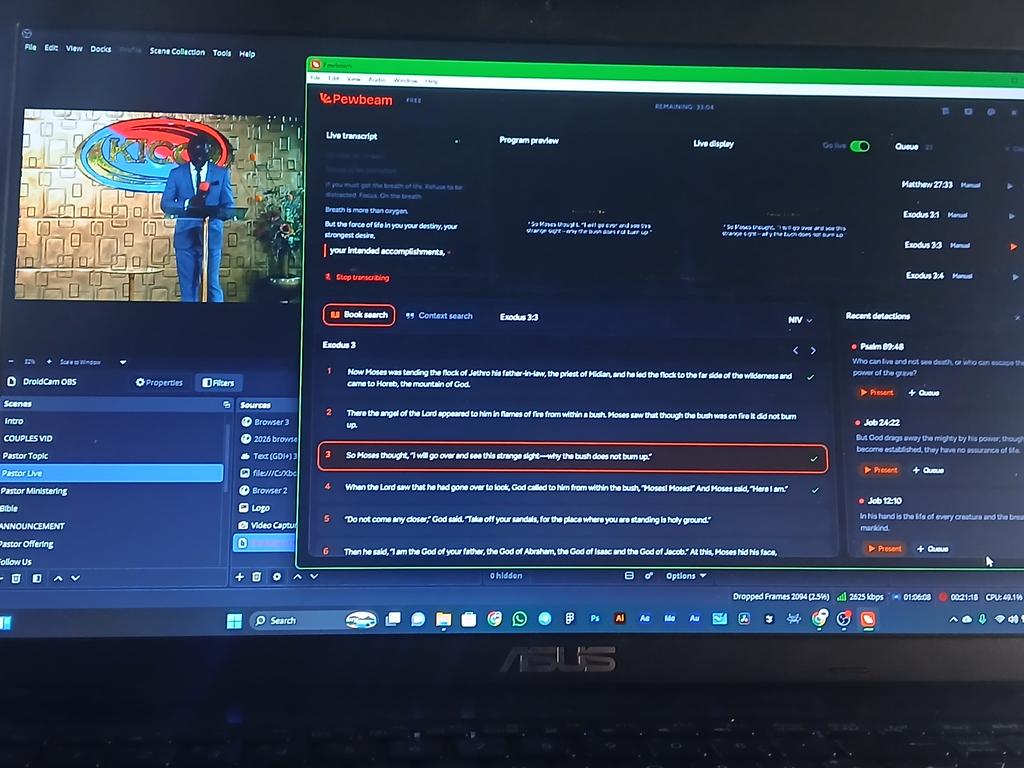 PewBeam AI
Pastors can now preach without glancing at a laptop or signalling to the media team. Members can follow along, highlight verses on their phones, and take notes that actually match what is happening in the moment.
One test church attendee captured the transformation in a single sentence: “Pewbeam changed the way I follow sermons in church completely.”
PewBeam, from tweet to launch
The journey from tweet to launch tells a classic founder’s story. Sobaloju spent half a year pushing himself and his team, iterating in public, gathering feedback from pastors and congregants alike.
He has been open about the support he received, encouragement from local churches, techies who volunteered advice, and even reporters who picked up the story early. The result is not a minimal viable product but a polished desktop app already battle-tested in real Sunday services.
Right now PewBeam focuses on scripture display, but the roadmap is ambitious. Full slide presentation capabilities are scheduled for next month, turning the tool into a comprehensive worship presentation suite. Sobaloju stated the mission is bigger: “to ensure the Church is not left behind in the AI era.”
He envisions a family of tools that support discipleship, developed hand-in-hand with pastors and church leaders.
Pricing reflects that inclusive philosophy. There is a generous free tier for small churches and fellowships, exactly the congregations that often struggle most with technology budgets. Paid plans use location-based pricing, acknowledging economic realities across different countries and making premium features accessible without pricing out ministries in rural Africa.
I find PewBeam’s launch genuinely exciting for three main reasons:
First, the technical execution. Achieving sub-80 milliseconds contextual scripture matching in a live audio environment is no mean feat.
It requires accurate speech recognition, semantic understanding of sermon flow, and an extremely efficient retrieval system from the entire Bible. The fact that it already works well enough for four weeks of church testing suggests the team has solved the hardest parts.
Second, the user-experience focus. Too many “church tech” tools force pastors to adapt their preaching style to the software. PewBeam does the opposite: it adapts to the pastor. That respect for the preaching moment feels culturally attuned rather than imposed upon.
 PewBeam AI
Finally, the timing. Churches have been cautious adopters of technology, rightly so. Previous waves (projection systems, live streaming, and mobile apps) each required years of trust-building.
AI is arriving faster and more powerfully than any of those. Projects like PewBeam prove that faith communities can move first, shaping the technology to serve spiritual goals rather than retrofitting spiritual goals to fit the technology.
Of course, any honest review must note the unknowns. Accuracy will be tested as the user base grows across accents, preaching styles, and Bible translations. Long-term reliability in noisy worship centres, integration with existing sound systems, and data privacy around audio processing are questions early adopters will answer.
But the initial feedback from test churches is overwhelmingly positive, and the transparent development process gives confidence that the team will iterate quickly.
Also read: Meet Kagi Translator, an AI bot that will turn any idea into a LinkedIn caption
The post PewBeam: All you should know about Dara Sobaloju’s scripture rendering AI app first appeared on Technext.


You May Also Like

Samsung profit surges eight-fold on AI demand, beating estimates

Vitalik Clears Meme Tokens, Nets $355K




