क्रिप्टो खरीदें
मार्केट
स्पॉट
फ़्यूचर्सBTC
कमाएँ
इवेंट सेंटर
रिवॉर्ड हब
अधिक
Time in Force (TIF) for Futures Trading: A Complete GuideTime in Force (TIF) for Futures Trading: A Complete Guide
कैटेगरी की लिस्ट
कैंसिल करें

Time in Force (TIF) for Futures Trading: A Complete Guide

In cryptocurrency futures trading, some users may encounter situations where an order is automatically canceled after being placed. In most cases, this is related to Time in Force (TIF) settings. This guide provides a comprehensive explanation of Time in Force in Futures trading, helping you understand how different TIF options work and how to use them effectively to improve execution efficiency.

1. What Is Time in Force (TIF) in Futures Trading?


Time in Force (TIF) defines the period during which an order remains active before it is executed or automatically canceled. Simply put, it determines how long your order can remain "active" in the order book.

Understanding TIF is essential because choosing the right setting can significantly improve order execution, help you avoid missing ideal entry opportunities, and better manage risk exposure by preventing orders from being triggered unexpectedly during periods of high market volatility.

On the MEXC Futures trading platform, there are six order types available: limit, market, chase limit, trigger, trailing stop, and post only orders. Among these, limit orders, market orders, and trigger orders support Time in Force settings.


2. Time in Force Options by Order Type


2.1 Time in Force for Limit Orders


Limit orders are the most commonly used order type in Futures trading. MEXC offers three Time in Force options for limit orders:

GTC (Good-Till-Canceled)

A GTC order remains active until it is fully filled or manually canceled by the user. The system will not cancel the order due to time constraints. This option is suitable for traders who are not in a rush to enter a position and are willing to wait for their target price. It is commonly used in swing trading strategies or passive order placement.

Example: If the current BTC price is 100,000 USDT and you believe 90,000 USDT is an ideal entry price, you can place a GTC limit buy order at 90,000 USDT. Even if the price does not reach this level immediately, the order will remain active until it is filled or canceled.

IOC (Immediate-Or-Cancel)

An IOC order requires the system to attempt immediate execution at the specified price. Any portion that can be filled immediately will be executed, while the unfilled portion will be automatically canceled.

Example: You place an order to buy 10 cont. Of BTCUSD at $91,000, but only 6 cont. are available at that price. With IOC, the system will immediately fill the 6 cont. and cancel the remaining 4 cont. This option is suitable for high-frequency trading or large orders where partial immediate execution is acceptable.

FOK (Fill-Or-Kill)

An FOK order must be filled in its entirety immediately. If the market does not have sufficient depth to fill the full order at once, the entire order will be canceled without any execution.

Example: You attempt to buy 10 cont. of BTCUSD Futures at $91,000, but only 8 cont. are available. Since the full quantity cannot be filled, the system will cancel the entire order. This option is ideal for large trades, arbitrage, or hedging strategies where execution certainty and price consistency are critical.

2.2 Time in Force for Market Orders


Market orders prioritize fast execution but may be subject to slippage during volatile market conditions. To balance execution speed and price control, MEXC provides Market-to-Limit (MTL) orders.

An MTL order is first submitted as a market order and executes immediately at the best available price. If the order is only partially filled, the remaining portion is automatically converted into a limit order at the average execution price and placed in the order book.

Example: If the BTC market price is $91,000 and you place an MTL order for 10 cont. of BTCUSD, the system may immediately fill 7 cont. at market price. The remaining 3 cont. will then be placed as a limit order at $91,000, waiting for further execution. This mechanism helps reduce the risk of the entire order being executed at unfavorable prices during sharp market movements.

2.3 Time in Force for Trigger Orders


Trigger orders are conditional orders that are submitted only when a predefined price condition is met. MEXC offers three validity time options for trigger orders:

  • 24-hour: Suitable for short-term traders tracking intraday price movements and breakout opportunities.
  • 7-day: Ideal for swing trading or event-driven strategies, such as positioning ahead of major economic announcements.
  • Long-term: Designed for trend-following strategies or gradual position building. Orders remain valid until triggered or manually canceled.

Note that trigger orders are submitted as market or limit orders only after the trigger condition is met. Setting an appropriate validity period helps prevent forgotten orders from being triggered unexpectedly.

2.4 How to Set Time in Force


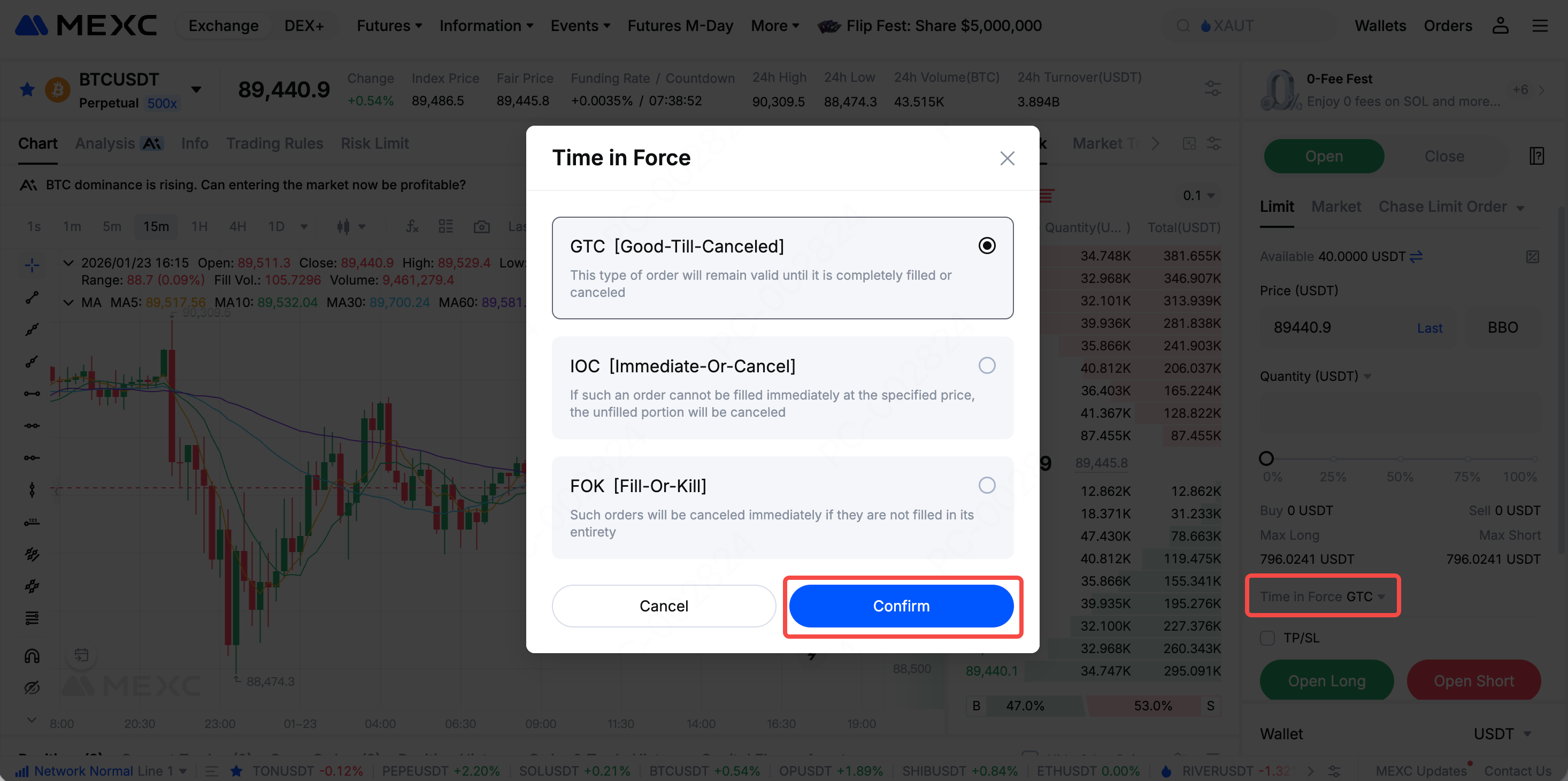
On the MEXC Futures trading page, select your desired order type (Limit, Market, or Trigger) in the order placement panel. The Time in Force options can be found above the Open Long and Open Short buttons, where you can choose the setting that best fits your trading strategy.

3. Why Time in Force Matters


Setting Time in Force correctly is critical for Futures traders for several reasons:

  • Improved execution efficiency: Ensures your order remains active within your intended time window, reducing missed opportunities.
  • Avoid forgotten orders: Shorter validity periods such as 24 hours or 7 days help prevent outdated orders from being filled after market reversals.
  • Precise strategy execution: Options like GTC, IOC, and FOK support different risk management needs, whether you prioritize immediacy or full execution.
  • Better risk control: Prevents orders from remaining in the market too long, reducing the risk of unintended fills during extreme volatility.

Suggested configurations by trading style:
  • Day traders: IOC or 24-hour trigger orders
  • Swing traders: GTC or 7-day trigger orders
  • Market-making and arbitrage: FOK combined with post only orders
  • Trend followers: Long-term trigger orders or trailing stop strategies

4. Time in Force FAQ


4.1 What does GTC mean?


GTC (Good-Till-Canceled) means the order remains active until it is fully filled or manually canceled. It will not be automatically canceled due to time expiration.

4.2 What is the difference between IOC and FOK?


IOC allows partial execution, with any unfilled portion canceled immediately. FOK requires the entire order to be filled at once; otherwise, the entire order is canceled.

4.3 Why was my Futures order automatically canceled?


The most common reason is an unsuitable Time in Force setting. If you use IOC or FOK and the market depth cannot meet the execution conditions, the order will be canceled. Trigger orders may also be canceled if their validity period expires.

4.4 When should I use an MTL order?


MTL is ideal when you want fast execution but also want to limit slippage during volatile conditions. It combines the speed of market orders with the price protection of limit orders.

4.5 Do trailing stop orders and post only orders support Time in Force?


No. Trailing stop orders and post only orders do not support Time in Force settings on MEXC. However, they remain important tools: trailing stops are used for dynamic profit-taking and risk management, while post only orders ensure liquidity provision and potential maker fee benefits.


Time in Force (TIF) for Futures Trading: A Complete Guide

In cryptocurrency futures trading, some users may encounter situations where an order is automatically canceled after being placed. In most cases, this is related to Time in Force (TIF) settings. This guide provides a comprehensive explanation of Time in Force in Futures trading, helping you understand how different TIF options work and how to use them effectively to improve execution efficiency.

1. What Is Time in Force (TIF) in Futures Trading?


Time in Force (TIF) defines the period during which an order remains active before it is executed or automatically canceled. Simply put, it determines how long your order can remain "active" in the order book.

Understanding TIF is essential because choosing the right setting can significantly improve order execution, help you avoid missing ideal entry opportunities, and better manage risk exposure by preventing orders from being triggered unexpectedly during periods of high market volatility.

On the MEXC Futures trading platform, there are six order types available: limit, market, chase limit, trigger, trailing stop, and post only orders. Among these, limit orders, market orders, and trigger orders support Time in Force settings.


2. Time in Force Options by Order Type


2.1 Time in Force for Limit Orders


Limit orders are the most commonly used order type in Futures trading. MEXC offers three Time in Force options for limit orders:

GTC (Good-Till-Canceled)

A GTC order remains active until it is fully filled or manually canceled by the user. The system will not cancel the order due to time constraints. This option is suitable for traders who are not in a rush to enter a position and are willing to wait for their target price. It is commonly used in swing trading strategies or passive order placement.

Example: If the current BTC price is 100,000 USDT and you believe 90,000 USDT is an ideal entry price, you can place a GTC limit buy order at 90,000 USDT. Even if the price does not reach this level immediately, the order will remain active until it is filled or canceled.

IOC (Immediate-Or-Cancel)

An IOC order requires the system to attempt immediate execution at the specified price. Any portion that can be filled immediately will be executed, while the unfilled portion will be automatically canceled.

Example: You place an order to buy 10 cont. Of BTCUSD at $91,000, but only 6 cont. are available at that price. With IOC, the system will immediately fill the 6 cont. and cancel the remaining 4 cont. This option is suitable for high-frequency trading or large orders where partial immediate execution is acceptable.

FOK (Fill-Or-Kill)

An FOK order must be filled in its entirety immediately. If the market does not have sufficient depth to fill the full order at once, the entire order will be canceled without any execution.

Example: You attempt to buy 10 cont. of BTCUSD Futures at $91,000, but only 8 cont. are available. Since the full quantity cannot be filled, the system will cancel the entire order. This option is ideal for large trades, arbitrage, or hedging strategies where execution certainty and price consistency are critical.

2.2 Time in Force for Market Orders


Market orders prioritize fast execution but may be subject to slippage during volatile market conditions. To balance execution speed and price control, MEXC provides Market-to-Limit (MTL) orders.

An MTL order is first submitted as a market order and executes immediately at the best available price. If the order is only partially filled, the remaining portion is automatically converted into a limit order at the average execution price and placed in the order book.

Example: If the BTC market price is $91,000 and you place an MTL order for 10 cont. of BTCUSD, the system may immediately fill 7 cont. at market price. The remaining 3 cont. will then be placed as a limit order at $91,000, waiting for further execution. This mechanism helps reduce the risk of the entire order being executed at unfavorable prices during sharp market movements.

2.3 Time in Force for Trigger Orders


Trigger orders are conditional orders that are submitted only when a predefined price condition is met. MEXC offers three validity time options for trigger orders:

  • 24-hour: Suitable for short-term traders tracking intraday price movements and breakout opportunities.
  • 7-day: Ideal for swing trading or event-driven strategies, such as positioning ahead of major economic announcements.
  • Long-term: Designed for trend-following strategies or gradual position building. Orders remain valid until triggered or manually canceled.

Note that trigger orders are submitted as market or limit orders only after the trigger condition is met. Setting an appropriate validity period helps prevent forgotten orders from being triggered unexpectedly.

2.4 How to Set Time in Force


On the MEXC Futures trading page, select your desired order type (Limit, Market, or Trigger) in the order placement panel. The Time in Force options can be found above the Open Long and Open Short buttons, where you can choose the setting that best fits your trading strategy.


3. Why Time in Force Matters


Setting Time in Force correctly is critical for Futures traders for several reasons:

  • Improved execution efficiency: Ensures your order remains active within your intended time window, reducing missed opportunities.
  • Avoid forgotten orders: Shorter validity periods such as 24 hours or 7 days help prevent outdated orders from being filled after market reversals.
  • Precise strategy execution: Options like GTC, IOC, and FOK support different risk management needs, whether you prioritize immediacy or full execution.
  • Better risk control: Prevents orders from remaining in the market too long, reducing the risk of unintended fills during extreme volatility.

Suggested configurations by trading style:
  • Day traders: IOC or 24-hour trigger orders
  • Swing traders: GTC or 7-day trigger orders
  • Market-making and arbitrage: FOK combined with post only orders
  • Trend followers: Long-term trigger orders or trailing stop strategies

4. Time in Force FAQ


4.1 What does GTC mean?


GTC (Good-Till-Canceled) means the order remains active until it is fully filled or manually canceled. It will not be automatically canceled due to time expiration.

4.2 What is the difference between IOC and FOK?


IOC allows partial execution, with any unfilled portion canceled immediately. FOK requires the entire order to be filled at once; otherwise, the entire order is canceled.

4.3 Why was my Futures order automatically canceled?


The most common reason is an unsuitable Time in Force setting. If you use IOC or FOK and the market depth cannot meet the execution conditions, the order will be canceled. Trigger orders may also be canceled if their validity period expires.

4.4 When should I use an MTL order?


MTL is ideal when you want fast execution but also want to limit slippage during volatile conditions. It combines the speed of market orders with the price protection of limit orders.

4.5 Do trailing stop orders and post only orders support Time in Force?


No. Trailing stop orders and post only orders do not support Time in Force settings on MEXC. However, they remain important tools: trailing stops are used for dynamic profit-taking and risk management, while post only orders ensure liquidity provision and potential maker fee benefits.