

Maersk (MAERSK) Stock Tumbles 7.5% Despite Beating Q1 Estimates Amid Iran Conflict Concerns
Key Takeaways
- Shares of Maersk declined 7.5% in Copenhagen following first-quarter results
- First-quarter EBITDA reached $1.73bn, surpassing the $1.66bn estimate but down significantly from $2.71bn year-over-year
- Company maintained full-year outlook with global container volume growth expected between 2%–4%
- Strait of Hormuz closure by Iran is driving fuel expenses and operational costs higher
- Asia-Europe shipping rates have surrendered nearly all post-conflict gains
Despite delivering better-than-expected first-quarter results on Thursday, Maersk witnessed a sharp selloff as market participants turned their attention to deteriorating forward conditions.
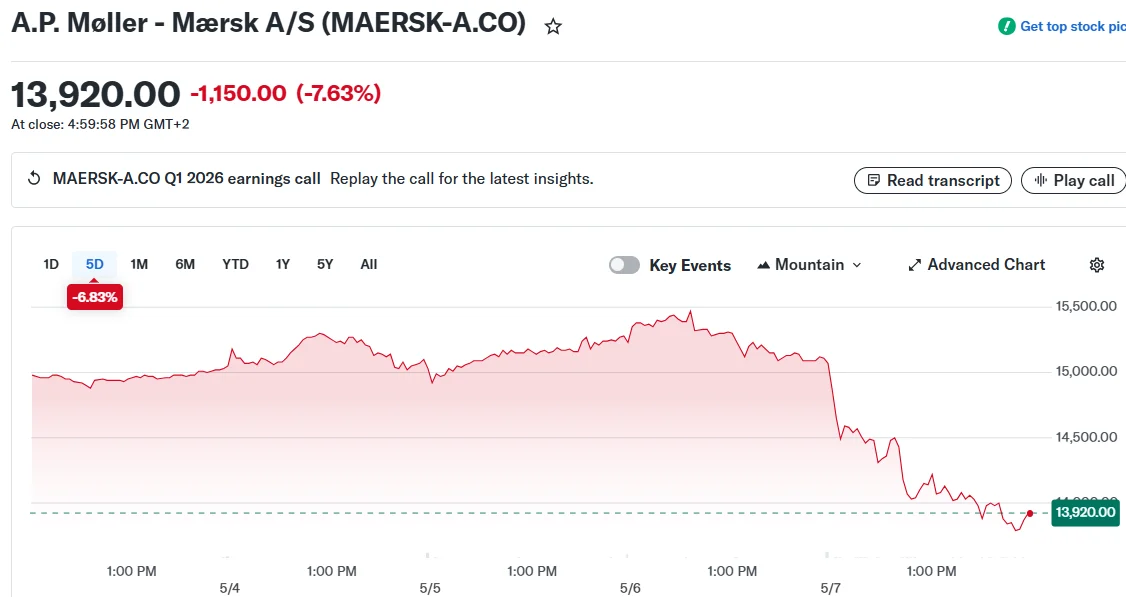 A.P. Møller – Mærsk A/S (MAERSK-A.CO)
The Copenhagen-based shipping behemoth delivered first-quarter EBITDA of $1.73bn, topping the analyst consensus estimate of $1.66bn. However, this represented a substantial decline from the $2.71bn recorded during the comparable quarter last year.
Shares tumbled 7.5% in Copenhagen, significantly underperforming the broader market benchmark which remained essentially flat.
Shipping rates experienced downward pressure throughout most of the three-month period amid persistent capacity surplus conditions. A sharp reversal materialized only in the final weeks of the quarter following the intensification of hostilities involving Iran in late February.
The conflict commenced on February 28 when coordinated military operations by the United States and Israel targeted Iranian positions. This timing means the first-quarter financial results capture only a limited portion of the conflict’s disruption to international logistics networks.
Tehran’s blockade of the Strait of Hormuz to commercial maritime traffic has compelled shipping companies to adopt alternative routing strategies, driving fuel expenditures higher and fragmenting established trade corridors throughout the sector.
Ongoing Conflict Sustains Cost Pressures
Maersk has implemented routing changes that direct vessels around the African continent, bypassing both the Suez Canal and the Bab el-Mandeb Strait. This represents a strategic pivot away from previous intentions to progressively restore certain Suez route operations.
The company left its annual guidance intact, reaffirming projections for worldwide container volume expansion of 2% to 4%. Nevertheless, management emphasized that operating conditions remain highly unpredictable.
Executives highlighted that elevated energy prices combined with commercial restrictions in the Upper Gulf region — representing approximately 6% of global container commerce in 2025 — create meaningful downside risks to growth projections.
Wall Street Analysts Express Caution
Morgan Stanley research analysts indicated they perceive “limited scope for earnings upgrades” stemming from the quarterly report, suggesting any forecast adjustments will likely correspond with freight rate fluctuations.
The investment bank observed that shipping rates on principal European corridors have retraced virtually all appreciation recorded since hostilities began involving Iran. Meanwhile, new vessel capacity additions continue exceeding demand growth — Maersk itself commissioned eight new ships in February.
Morgan Stanley identified one potential offsetting factor: bunker fuel supply constraints, which could accelerate vessel idling across the industry. The firm acknowledged this dynamic hasn’t materialized in current data but recommended continued surveillance.
Maersk indicated it is attempting to transfer elevated operating expenses to customers through pricing adjustments, though the likelihood of success remains uncertain given prevailing rate trajectories.
The Asia-Europe freight rate benchmark has retreated to near pre-conflict levels despite fuel costs remaining elevated — a dynamic that market observers warn could compress profitability margins in upcoming quarters.
The post Maersk (MAERSK) Stock Tumbles 7.5% Despite Beating Q1 Estimates Amid Iran Conflict Concerns appeared first on Blockonomi.


You May Also Like

Genius Group (GNS) Stock Climbs 8% After Q1 Revenue Soars 171% and Returns to Profit

Hegseth Hails First Test Of America's 'Golden Dome' Missile Defense Shield

JD Vance raises eyebrows with surprising claim during Nixon Library talk: 'So close'



