

Memecoins, Launchpads, and Viral Consumer Crypto: Pump.fun’s Cycles and Wars
The $2 Launch That Changed Solana
In January 2024, launching a token on Solana typically required technical know-how, liquidity provision, and often insider allocations. By mid-2025, anyone with a wallet and under $2 in SOL could create a fully tradeable memecoin in seconds—no code, no liquidity pool, no permission required. That frictionless experience came from Pump.fun, a platform that turned meme culture into a live trading casino and became one of crypto’s most profitable applications ever.
As of early 2026, Pump.fun has facilitated over 18 million token launches, generated more than $1.09 billion in cumulative protocol revenue, and powered nearly $89 billion in DEX volume. It captured up to 90% market share of Solana token launches at peaks and survived (and often won) aggressive “launchpad wars” against rivals like LetsBonk.fun.
This is not just another DeFi tool. Pump.fun represents the consumer crypto attention economy in its rawest form: virality as product, social momentum as liquidity, and bonding curves as the engine of discovery. In this deep dive, we explore its origins, mechanics, explosive growth cycles, competitive battles, broader implications for token sales, and what it reveals about retail participation in blockchain.
The Fundamentals: How Pump.fun Works
Bonding Curve Mechanics – Step by Step
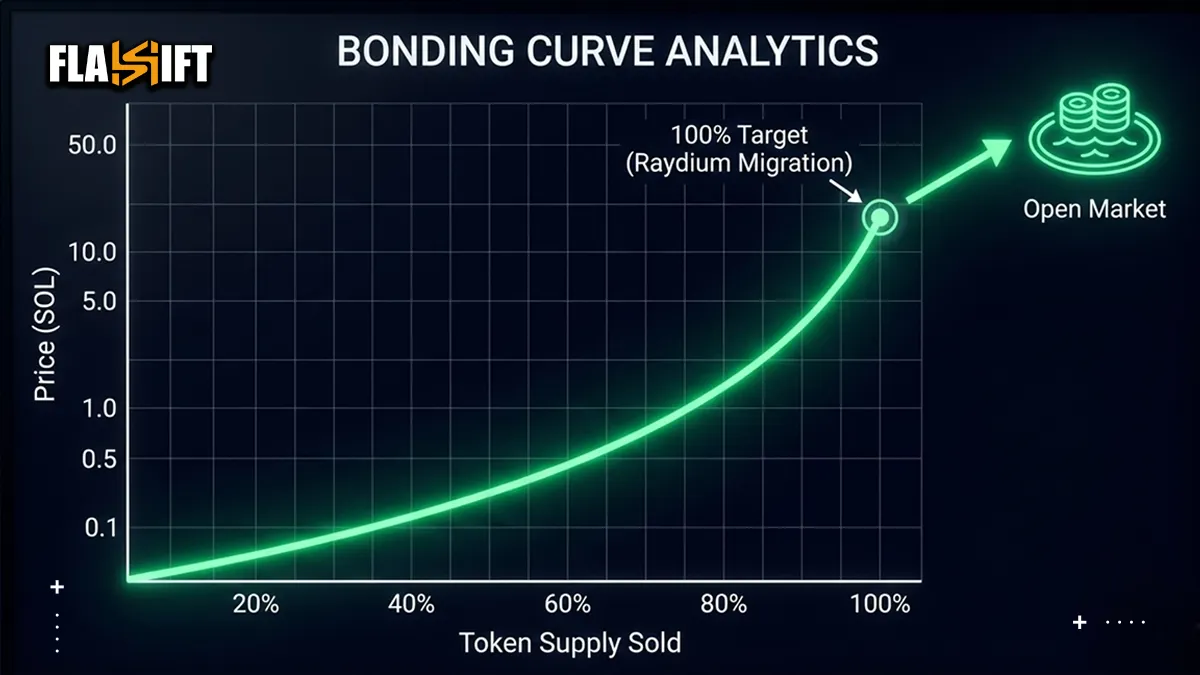
Every token on Pump.fun starts with a fixed supply of 1 billion tokens and a mathematical pricing curve:
- Creator deploys the token for ~0.02 SOL.
- Early buyers purchase along an exponential bonding curve. Price rises as more SOL accumulates in the curve.
- When the curve reaches a market cap threshold (historically around $69K), the token “graduates”: liquidity is automatically added to Raydium (or similar DEX), and remaining tokens are burned or unlocked fairly.

binance.com
flashift.app
Key Advantages of This Model:
- Instant liquidity and trading — No need for manual LP setup.
- Fair launch ethos — No team tokens or presales; everything is on-curve from minute one.
- Gamified progression — Community can “pump” it to graduation through coordinated buying and social hype.
Platform Fees and Revenue Engine
Pump.fun takes a ~1% trading fee on the platform (plus smaller creation and graduation fees). In high-volume periods, daily revenue exceeded $10-15 million. Much of this has been directed toward protocol sustainability, token buybacks, and creator incentives post-PUMP token launch.
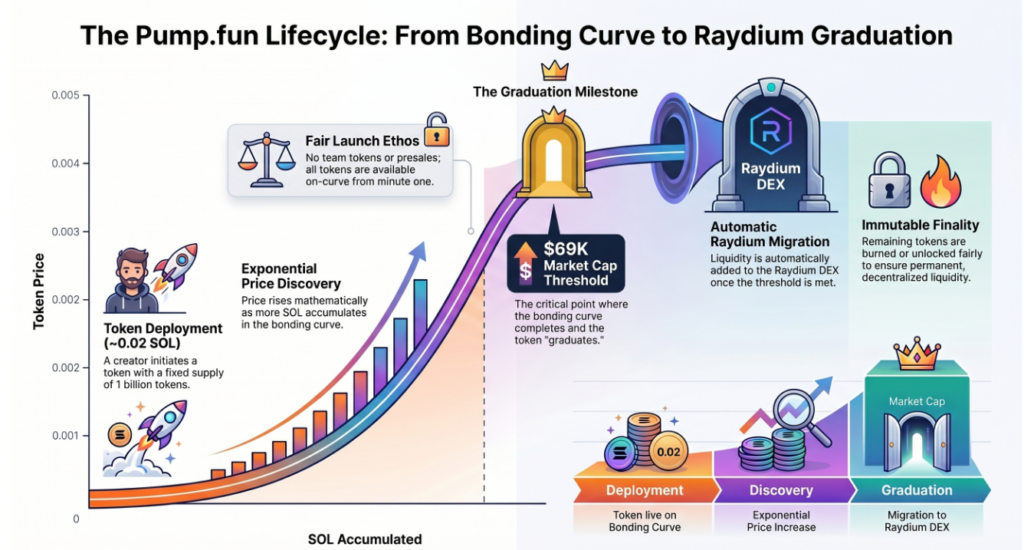 Bonding Curve Diagram
Historical Context and Explosive Growth Cycles
Pump.fun launched quietly in January 2024 amid a recovering crypto market. Its timing was perfect: Solana offered low fees and high throughput, meme culture was exploding on social media, and retail was hungry for accessible on-chain speculation after years of complex DeFi.
Cycle 1: Viral Ignition (2024)
- Millions of tokens launched.
- Hits like $FARTCOIN and others reached billion-dollar market caps purely through social virality.
- Platform became the fastest crypto app to significant revenue milestones.
Cycle 2: Peak Mania and Wars (Mid-2025) Daily launches often exceeded 20,000-30,000. Revenue peaked with monthly figures in the hundreds of millions. This drew competitors.
Cycle 3: Maturation and Adaptation (Late 2025–2026) Post-PUMP token ICO (raising ~$1.3B total), focus shifted to multi-chain hints, live streaming features, creator rewards (Project Ascend), and revenue sharing. Even in cooler markets, Pump.fun maintained dominance and crossed $1B cumulative revenue.
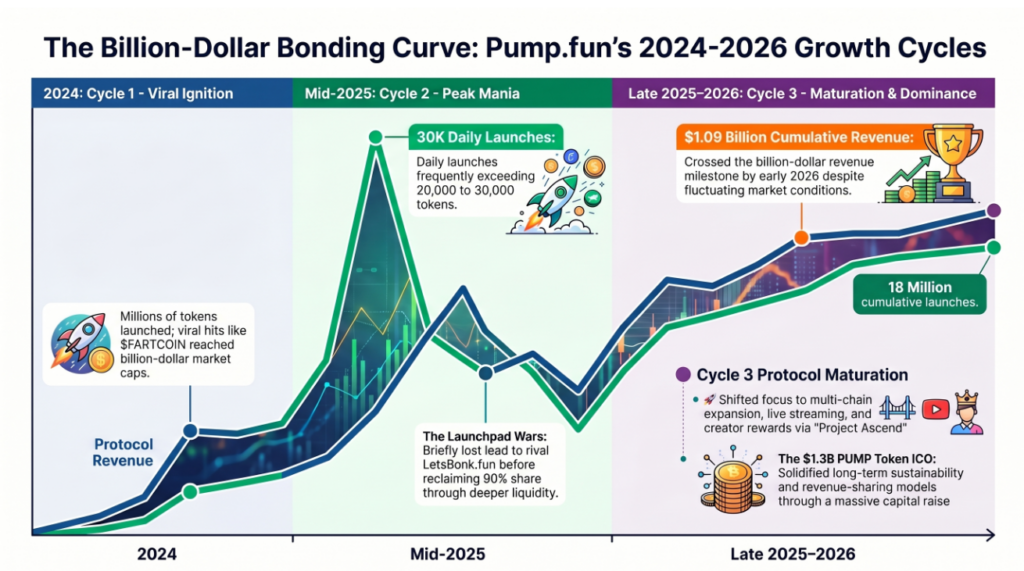 Pump.fun Revenue and Launch Volume Over Time
The Launchpad Wars: Competition and Market Share Battles
No success goes unchallenged. In 2025, “Memecoin Wars” erupted on Solana.

tradingview.com
How Pump.fun captured 80% of Solana memecoins, and can it last? — TradingView News
Key Rivals and Dynamics:
- LetsBonk.fun (later Bonk.fun): Community-focused with fee redistribution to BONK holders and validators. Briefly overtook Pump.fun in daily launches and revenue (64% share at peak) by promising better alignment.
- Believe, LaunchLab, Moonshot, etc.: Niche features or lower barriers drew temporary flows.
- Pump.fun Response: Stronger network effects, deeper liquidity, cultural brand, and iterative features (e.g., dynamic fees favoring smaller caps for creators) helped it reclaim 70-90% shares repeatedly.
Why Pump.fun Often Wins:
- Liquidity concentration and discoverability.
- First-mover brand as “the” memecoin casino.
- Data flywheel: More launches → more volume → better opportunities → more users.
Dune dashboards tracking these wars became essential reading for on-chain analysts.
| Platform | Peak Daily Share | Key Differentiator | Outcome vs Pump.fun |
|---|---|---|---|
| LetsBonk.fun | ~64% | Fee redistribution | Temporary lead, then decline |
| Pump.fun | 90%+ | Liquidity + brand | Dominant long-term |
| Others | <20% | Niche features | Fragmented |
Broader Implications: Token Sales, Valuations, and Consumer Crypto
Pump.fun didn’t just launch memecoins—it redefined consumer token launches:
- Democratization vs. Noise: Lowered barriers massively but created a high-failure environment (graduation rates often <1-2%, with many “rugs” or quick dumps).
- Attention as Primitive: Success correlates strongly with social momentum (X trends, KOLs, live streams) rather than fundamentals. Santiment-style social data became critical alpha.
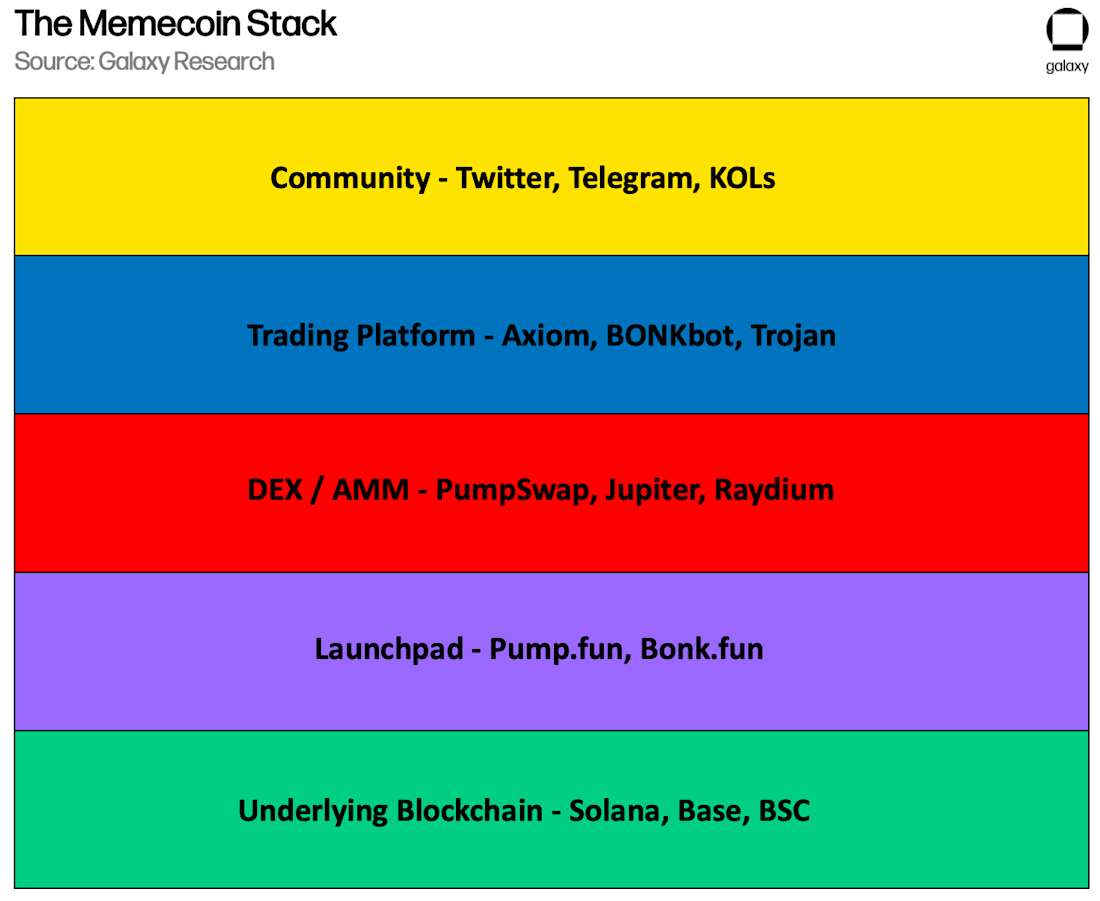
galaxy.com
The State of Memecoins: Culture, Trading, and Infrastructure | Galaxy
- Revenue as Moat: Billions in fees funded a war chest, enabling resilience and innovation unavailable to copycats.
- Impact on Solana: Drove massive on-chain activity, DEX volume, and network fees, cementing Solana’s retail narrative.
It also highlighted risks in the attention economy: extreme volatility, bot activity, and potential for predatory content (e.g., controversial live streams).
Challenges and Risks
- High Failure Rate: Vast majority of tokens go to zero quickly.
- Regulatory Scrutiny: Pure speculation vehicles attract attention from authorities.
- Sustainability: Meme cycles are volatile; platform must evolve beyond pure launches (multi-chain, utilities, better creator tools).
- User Protection: Easy onboarding means easy losses for inexperienced participants.
- Competition Evolution: New chains and improved UX could erode dominance.
Solutions observed: Better incentives, data tools for quality signals, and gradual professionalization of top creators.
Future Outlook: Beyond the Meme Casino?
Pump.fun has proven the power of viral consumer crypto infrastructure. Forward-looking possibilities include:
- Multi-chain expansion.
- Integration of AI/social features for better discovery.
- Revenue-sharing models maturing via PUMP token.
- Influence on traditional token sales—fairer, more liquid launches as the norm.
Its cycles mirror broader crypto: hype, competition, consolidation, and adaptation. The platform that best aligns incentives with sustained attention will lead the next wave.
Key Takeaways
- Accessibility Wins: Reducing friction to near-zero unlocked unprecedented participation.
- Mechanics Matter: Bonding curves created fair, engaging price discovery.
- Wars Drive Innovation: Competition forces continuous improvement.
- Data and Social Are King: Track volumes, launches, and sentiment via Dune, Messari, and on-chain tools.
- Evergreen Lesson: In consumer crypto, product-market fit is often cultural first, technical second.
Conclusion
Pump.fun turned the chaos of internet memes into a sophisticated, revenue-generating machine that powers Solana’s consumer layer. Its story—from scrappy launchpad to billion-dollar protocol enduring wars—offers timeless insights into virality, incentive design, and the attention economy on-chain. Whether you’re a curious beginner dipping into your first memecoin or a builder studying launch mechanics, the platform demonstrates both the exhilarating upside and sobering risks of democratized crypto.
Subscribe to Cryptopress.site for more evergreen blockchain education. Explore related articles on bonding curves, Solana ecosystem dynamics, or DeFi launchpad mechanics. What’s your take on the next evolution of consumer crypto? Share in the comments.
The post Memecoins, Launchpads, and Viral Consumer Crypto: Pump.fun’s Cycles and Wars appeared first on Cryptopress.


You May Also Like
Ondo’s Broadridge Deal Could Transform Tokenized Stock Ownership

Stakestone (STO) Soars: Token Surpasses $1.14 After Stunning 367% Rally




