

SpaceX Move Boosts Tokenization as Crypto Markets Reprice Growth
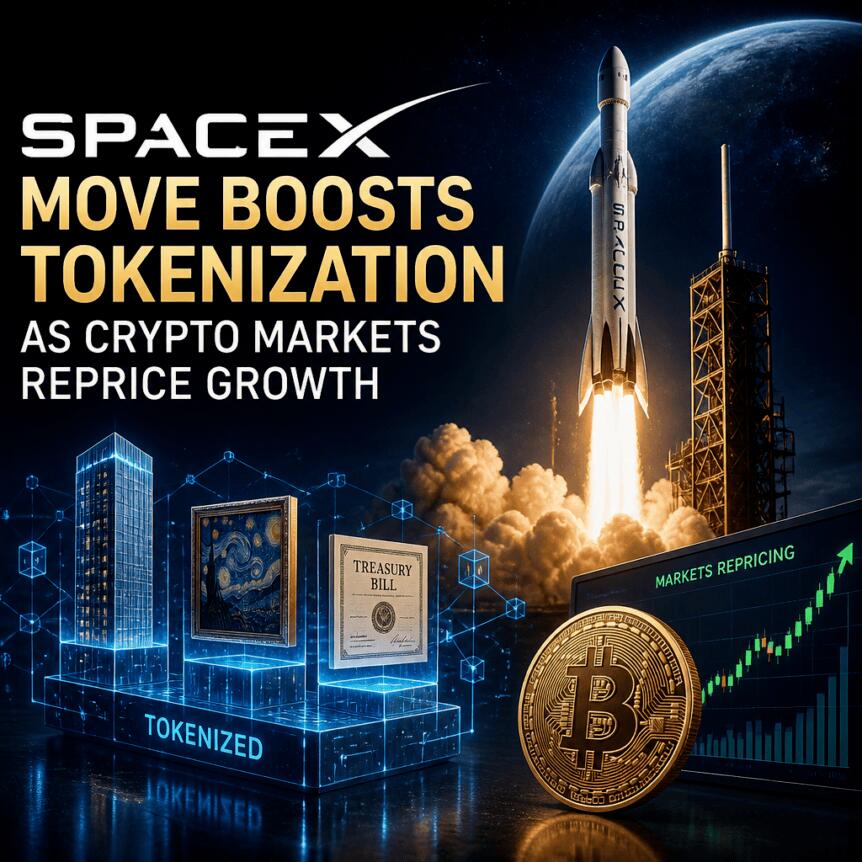
Crypto markets may still be buffeted by macro news and uneven regulatory signals, but tokenization continues to look like the sector’s most durable theme. This week’s developments underscored that shift: Binance Research data points to accelerating demand for tokenized real-world assets (RWAs), while Kraken expanded tokenized access to SpaceX’s IPO via its xStocks platform.
Beyond tokenization, blockchain activity is also evolving. Prediction markets have now outpaced onchain gambling by volume for the first time, according to TRM Labs, and former FTX CEO Sam Bankman-Fried has filed a formal request for a U.S. presidential pardon.
Key takeaways
- Binance Research reports active tokenized RWAs rose 589% since early 2025, with tokenized bonds and money market funds adding $6.5 billion and tokenized stocks up 422%.
- Kraken says eligible users in more than 110 markets can access the SpaceX IPO through xStocks, receiving an allocation that maps 1:1 to tokenized shares.
- TRM Labs data shows prediction markets generated $36.6 billion in Q1 2026 volume versus $14 billion for onchain gambling—an inflection point after both surpassed $50 billion annually in 2025.
- Sam Bankman-Fried has formally applied for a presidential pardon through the U.S. DOJ Office of the Pardon Attorney, alongside ongoing appeals tied to his 2023 fraud conviction.
Tokenized RWAs keep expanding as asset mix broadens
Even as the broader crypto tape has been less cooperative, tokenized RWAs have continued to gain traction. According to Cointelegraph’s coverage citing Binance Research, the market for active tokenized RWAs has climbed 589% since early 2025.
Within that growth, Binance Research highlights meaningful contributions from multiple asset classes. Tokenized bonds and money market funds accounted for $6.5 billion in added value, while tokenized stocks increased by 422%. The message for investors is straightforward: tokenization demand is not confined to a single category—it’s spreading across products that resemble traditional fixed income and equity exposures.
The sector’s expansion also appears to be getting more diversified in terms of what investors can access. Platforms such as Ondo Global Markets have contributed to momentum in tokenized equities, while tokenized precious metals reportedly added $1.5 billion amid earlier demand for safe-haven exposure.
Meanwhile, traditional market infrastructure is also moving deeper into blockchain-related initiatives. Developments range from Apex Group’s tokenized fund services to The Clearing House’s planned tokenized deposit network, reflecting a wider industry push beyond purely crypto-native experiments. While these efforts differ in execution and maturity, taken together they point to a broader acceptance of tokenization as an infrastructure direction—not just an asset-narrative fad.
Kraken brings SpaceX IPO exposure to xStocks users in 110+ markets
One of the most immediate real-world catalysts this week came from Kraken, which rolled out tokenized access to the SpaceX IPO for eligible customers through its xStocks product. Cointelegraph previously reported on Kraken’s plan to provide access in more than 110 markets.
Kraken states that investors who received an allocation will be issued SPCXx, a tokenized representation backed 1:1 by the underlying equity. The exchange also says SPCXx can be traded 24/7 across participating platforms—an operational detail that matters for users comparing tokenized IPO access with traditional allocation and settlement timelines.
The rollout is also arriving at a moment when tokenized equities are benefiting from IPO-level demand. SpaceX reportedly targeted a $75 billion raise in its Nasdaq debut, and the offering was reported as oversubscribed by roughly four times ahead of public trading. If realized, this would align SpaceX with the “high-interest” characteristics that often draw participation into new issuance formats—whether through conventional retail channels or tokenized access.
For investors, the practical question is not only whether tokenization enables broader access, but also how liquidity and trading behavior work after allocation. Kraken’s promise of 24/7 tradability could be a differentiator, but market participants will still want to watch custody, trading venues, and how post-IPO pricing converges with the underlying shares across platforms.
Prediction markets overtake onchain gambling in Q1 2026
While tokenization expands into markets that look increasingly like traditional finance, speculative activity is also shifting. TRM Labs data shows that prediction markets surpassed onchain gambling for the first time in the first quarter of 2026.
According to Cointelegraph’s coverage of TRM Labs, prediction markets recorded $36.6 billion in volume in Q1 2026, compared with gambling’s $14 billion. The milestone follows a period where both categories exceeded $50 billion in annual volume in 2025, reinforcing that this is not a one-off seasonal swing.
Importantly, onchain gambling has not stalled. TRM Labs attributes gambling’s resilience to a loyal and growing user base, with quarterly wagering volume remaining near record highs despite broader market pullbacks. High rollers still dominate betting volume—TRM notes that these users averaged $13,558 per bet and $378,000 in lifetime gambling volume—yet the fastest growth is reportedly coming from casual bettors and daily participants, suggesting an opening of the market beyond a narrow set of whales.
For builders and traders, this change in relative volume has implications for product focus and liquidity. Prediction markets may increasingly attract more capital flow, but gambling’s continued user expansion implies both segments are likely to remain competitive. Watching which category sustains growth once the initial attention cycle fades will be key to understanding where the next wave of onchain engagement concentrates.
Sam Bankman-Fried files pardon request as appeals continue
Legal processes remain a live variable for crypto’s mainstream narrative. Former FTX CEO Sam Bankman-Fried has formally applied for a presidential pardon from U.S. President Donald Trump, according to reporting that ties the request to the U.S. Department of Justice Office of the Pardon Attorney.
The request appears on the DOJ’s Office of the Pardon Attorney’s list of pending clemency applications. The pardon effort is occurring alongside ongoing legal attempts to overturn his conviction—Bankman-Fried continues to appeal his 2023 fraud conviction and the 25-year prison sentence, while an additional request for a new trial was denied per Cointelegraph’s coverage.
Separately, recent months have also seen Bankman-Fried posting messages that appear increasingly aligned with Trump, even though the president has previously said he did not plan to pardon him. That tension highlights why the next steps matter: a pardon request may keep the issue in public view, but it does not change the underlying posture of an active appeal process.
Readers should watch how the DOJ process proceeds and whether any legal updates arrive that alter the timeline. In the meantime, the broader crypto industry will likely continue treating executive-level legal outcomes as an important—if unpredictable—risk factor for regulatory and reputational dynamics.
This article was originally published as SpaceX Move Boosts Tokenization as Crypto Markets Reprice Growth on Crypto Breaking News – your trusted source for crypto news, Bitcoin news, and blockchain updates.


You May Also Like

Ohio Police Chief Arrested Amid Serious Allegations of Sexual Abuse and Assault Claims

Something Just Happened to XRP on Binance

New York City Reports Safest Start to Year in Recorded History as Major



