

MiCA Deadline Threatens EU Exchange Access
The European Union’s Markets in Crypto-Assets regulation, known as MiCA, is approaching a critical transition deadline that could force exchanges to restrict or cut off services for EU-based crypto users who rely on non-compliant platforms.
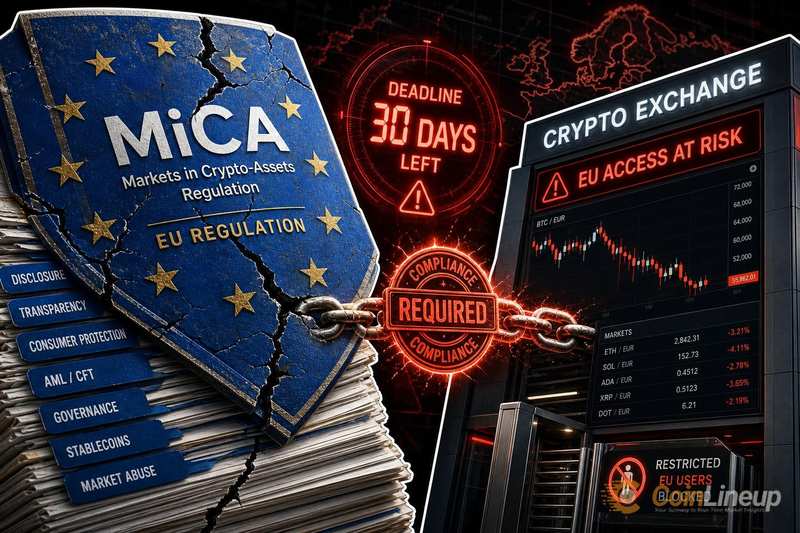
What the MiCA deadline means for exchanges
Key Takeaways
- MiCA’s transitional grace period ends on July 1, 2026, after which unlicensed exchanges face restrictions in the EU.
- EU crypto users on non-compliant platforms may lose access to trading, deposits, or specific tokens.
- Impacts will vary by exchange and by EU member state, so holders should check their platform’s compliance status now.
MiCA is the EU’s comprehensive framework for regulating crypto-asset service providers, stablecoins, and token issuers across all 27 member states. It establishes licensing requirements, consumer protection rules, and operational standards for any firm offering crypto services to European customers.
The regulation entered into force in stages, but the key pressure point now is the end of transitional periods that allowed exchanges to continue operating under old national rules. Once those grace periods expire, platforms without proper MiCA authorization will no longer be permitted to serve EU clients legally.
Crypto firms face a July 1 cutoff as the grace period ends. Exchanges that have not secured the required licenses by that date may be forced to wind down EU operations, restrict account functionality, or delist tokens that do not meet MiCA’s classification requirements. This is not a ban on crypto in the EU, but a compliance gate that separates licensed operators from those that have not met the regulatory bar.
Why EU crypto users could see delistings or service cutoffs
For regular holders, the most immediate risk is platform-level disruption. Exchanges that fail to obtain MiCA authorization may freeze deposits, disable trading pairs, or force withdrawals for EU-based accounts. Users who hold assets on these platforms could face compressed timelines to move funds.
Token delistings are another likely outcome. MiCA imposes specific requirements on crypto-assets offered to EU customers, including whitepaper disclosures and issuer accountability. Tokens that do not meet these standards may be removed from compliant exchanges, reducing liquidity and trading access for holders in the region. Similar regulatory tightening is already playing out elsewhere, as seen with the Philippines BSP tightening its own crypto token listing rules.
Stablecoin access is a particular concern. MiCA sets strict reserve and licensing rules for stablecoin issuers, and tokens that fail to comply could be restricted or delisted on EU-serving platforms. This could disrupt trading pairs that rely on non-compliant stablecoins as base currencies.
The broader effect is a potential fragmentation of liquidity. If major exchanges pull certain assets or services from EU users, trading volumes in the region could shift, spreads could widen, and some users may turn to decentralized alternatives or non-EU platforms to maintain access. The pattern mirrors how India’s recent crypto tax enforcement pushed some activity into less transparent channels.
What EU holders should watch before the deadline
The most important step for EU crypto users is to check whether their exchange has obtained or applied for MiCA authorization. Most major platforms have published compliance updates or regional notices, and these should be the first source of information.
Holders should monitor supported-asset lists closely in the coming weeks. Exchanges that are adjusting for MiCA compliance may announce token delistings or trading pair removals with limited advance notice. Knowing which assets are at risk allows users to plan withdrawals or transfers before access is restricted.
Impacts will vary by jurisdiction. Some EU member states granted longer transitional periods than others, and local regulators may enforce MiCA requirements on different timelines. Users should check guidance from their national financial authority in addition to exchange-level communications. As the regulatory landscape for digital assets tightens globally, including new developments like the SEC’s approval of multi-asset crypto ETFs in the U.S., the EU’s approach with MiCA represents one of the most structured compliance frameworks to date.
The practical takeaway: verify your exchange’s MiCA status, review your holdings for tokens that may face delisting, and ensure you have withdrawal plans in place before July 1.
Disclaimer: This article is for informational purposes only and does not constitute financial or investment advice. Cryptocurrency and digital asset markets carry significant risk. Always do your own research before making decisions.


You May Also Like
Ethereum Price Outlook: ETF Outflows Clash with Rising Staking Demand

Stephen Miller rails against ‘monstrous’ wind farms: ‘Visual assault on God’s creation’

Arbitrum Nova Enters Maintenance and Botanix Winds Down Bitcoin Layer 2 Network



