Wallets linked to the Alameda Research estate moved a significant block of Solana off a staking contract on March 12, the latest step in a court-supervised liquidationWallets linked to the Alameda Research estate moved a significant block of Solana off a staking contract on March 12, the latest step in a court-supervised liquidation

FTX Estate Unstakes 1.1 Million SOL as Creditor Repayments Enter Second Year

2026/03/13 09:20
4 min read
For feedback or concerns regarding this content, please contact us at crypto.news@mexc.com

Wallets linked to the Alameda Research estate moved a significant block of Solana off a staking contract on March 12, the latest step in a court-supervised liquidation program that has been quietly converting the collapsed exchange’s remaining digital assets into cash for creditors.

On-chain data monitored by Lookonchain flagged the transaction as it occurred.

The unstaked amount totaled approximately 1.1 million SOL, valued at roughly $17 million at the time of the move. The assets were transferred from a designated cold staking contract to a central settlement wallet operated by the FTX and Alameda Debtors estate.

The transaction is part of a court-approved liquidation strategy that deliberately releases assets in staggered tranches rather than in bulk, a structure designed to limit downward pressure on market prices. Despite the move, the estate retains over 18.4 million SOL across various locked and vesting positions, representing approximately $290 million in remaining exposure to the asset.
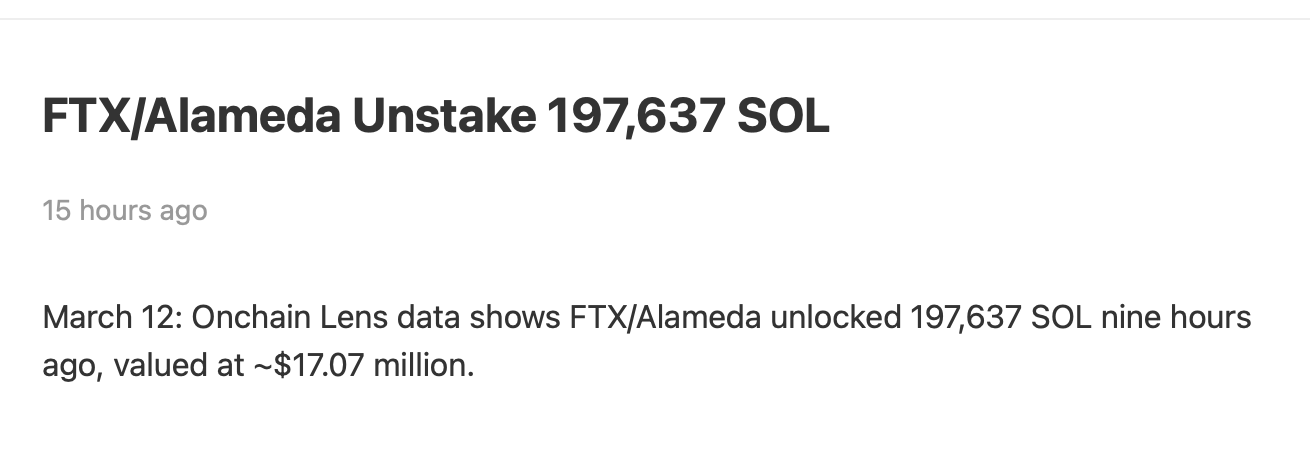
Source: https://www.lookonchain.com/feeds/49915

Where the Money Goes

The unstaked SOL feeds directly into the FTX Distribution Fund, the vehicle through which the estate is executing monthly payments to verified creditors. The repayment program is now in its second year, and the progress among smaller claimants has been substantial. As of March 2026, over 94% of Customer Class claimants, defined as those who held balances under $50,000 at the time of the November 2022 bankruptcy, have been fully reimbursed for the dollar value of their accounts at the time of collapse.

The picture is more complicated for larger creditors. Institutional claimants and those with disputed claims are currently in the Tier 2 phase of distributions, receiving pro-rata payments as the estate works through its remaining altcoin holdings. SOL is the largest single position, but the estate is also converting SRM and MAPS into cash as part of the same process. Each conversion feeds back into the distribution pool on a monthly cadence.

How the Estate Avoids Moving the Market

The staggered tranche approach is not simply a legal formality. Selling 18 million SOL on open markets without structure would almost certainly suppress prices significantly, reducing the total recovery for creditors in the process. To manage this, the estate routes liquidations through over-the-counter desks, which match large block trades off-exchange and avoid the slippage that comes with placing large orders into public order books.

The strategy appears to be working. SOL dipped less than 1.2% following the March 12 unstaking news, a reaction analysts describe as markets having largely priced in these periodic liquidations. Each prior tranche has produced a similar muted response, suggesting the OTC routing and advance visibility of the program have reduced the element of surprise that typically amplifies selling pressure.

Crypto Lost Half Its Developers to AI in 12 Months: The Ones Who Stayed Are Building More Than Ever

What Remains

The $290 million in remaining SOL holdings means the estate has considerable liquidation work still ahead. Monthly distributions and a disciplined conversion strategy suggest the process will continue well into 2026 and potentially beyond, depending on how quickly disputed claims are resolved and how Tier 2 distributions are structured. The 94% completion rate among small claimants is a milestone, but the dollar value concentrated in institutional and disputed claims likely represents a disproportionate share of total outstanding obligations.

For SOL holders watching the estate’s wallet activity, the signal from March 12 is consistent with what has come before: structured, telegraphed, and absorbed by the market without significant disruption. Whether that pattern holds as the estate moves deeper into its larger and more complex positions is the question the next several months will answer.

The post FTX Estate Unstakes 1.1 Million SOL as Creditor Repayments Enter Second Year appeared first on ETHNews.


Market Opportunity
Ucan fix life in1day Logo
Ucan fix life in1day Price(1)
$0.0003556
$0.0003556$0.0003556
-6.14%
USD
Ucan fix life in1day (1) Live Price Chart
Disclaimer: The articles reposted on this site are sourced from public platforms and are provided for informational purposes only. They do not necessarily reflect the views of MEXC. All rights remain with the original authors. If you believe any content infringes on third-party rights, please contact crypto.news@mexc.com for removal. MEXC makes no guarantees regarding the accuracy, completeness, or timeliness of the content and is not responsible for any actions taken based on the information provided. The content does not constitute financial, legal, or other professional advice, nor should it be considered a recommendation or endorsement by MEXC.

You May Also Like

XAG/USD regains $85.00, bearish risks persist

XAG/USD regains $85.00, bearish risks persist

The post XAG/USD regains $85.00, bearish risks persist appeared on BitcoinEthereumNews.com. Silver (XAG/USD) gains some positive traction during the Asian session
Share
BitcoinEthereumNews2026/03/13 10:21
Trend Research Stuns Market: Deposits $57.1M in Borrowed ETH to Binance After Catastrophic $747M Loss

Trend Research Stuns Market: Deposits $57.1M in Borrowed ETH to Binance After Catastrophic $747M Loss

BitcoinWorld Trend Research Stuns Market: Deposits $57.1M in Borrowed ETH to Binance After Catastrophic $747M Loss In a stunning move that underscores the volatile
Share
bitcoinworld2026/03/13 09:55
First U.S. XRP ETF Launches Sept. 18, CME to List Options on XRP Futures Oct. 13

First U.S. XRP ETF Launches Sept. 18, CME to List Options on XRP Futures Oct. 13

XRP is drawing fresh attention from traditional finance as new products roll out in both securities and derivatives markets, broadening access points for exposure to the token.At the time of writing, according to CoinDesk Data, XRP was trading around $3.0263, down nearly 1% over the past 24 hours.On Sept. 18, REX Shares and Osprey Funds will debut the first U.S.-listed exchange-traded funds (ETFs) tied to XRP and Dogecoin (DOGE) on the Cboe BZX Exchange, under the tickers XRPR and DOJE. These products are not entirely “pure” spot funds, however. Bloomberg Intelligence analyst James Seyffart wrote on X that the funds aren’t “pure” spot products. Instead, they are structured to hold XRP and DOGE directly, while also investing in other spot ETFs from outside the U.S. to achieve exposure. Their filings also include language that would allow the use of derivatives for exposure if needed, though Seyffart emphasized that this is not the primary approach.The structure reflects the realities of building regulated crypto ETFs in the U.S., where sponsors have sometimes layered in indirect exposure. Even so, the launches mark the first time American brokerage accounts will have access to XRP- and DOGE-focused ETFs, expanding beyond bitcoin and ether, which dominate the ETF landscape.Less than a month later, CME Group plans to deepen its crypto derivatives lineup by listing options on XRP and Solana (SOL) futures, targeted for Oct. 13 pending regulatory review. Options will be listed on both the standard contracts and their smaller “micro” versions, designed to serve institutions, trading desks, and active individuals alike. Expiry choices will include every business day, each month, and each quarter, creating a wider term structure for managing exposures.The exchange said the decision follows strong growth in its newer altcoin futures. Since March, SOL futures have logged over 540,000 contracts traded (about $22.3 billion notional), while XRP futures, introduced in May, have seen more than 370,000 contracts change hands (roughly $16.2 billion notional). Market participants including Cumberland and FalconX welcomed the additions, citing the need for hedging tools beyond bitcoin and ether.Headquartered in Chicago, CME Group runs the world’s largest regulated derivatives marketplace, where listed crypto futures and options allow participants to hedge positions with central clearing and margining. Adding XRP and SOL options builds on the firm’s progression from bitcoin and ether into a wider set of liquid tokens.
Share
Coinstats2025/09/18 05:30