Lending

Lending protocols form the backbone of the decentralized money market, allowing users to lend or borrow digital assets without intermediaries. Using smart contracts, platforms like Aave and Morpho automate interest rates based on supply and demand while requiring over-collateralization for security. The 2026 lending landscape features advanced permissionless vaults and institutional-grade credit lines. This tag covers the evolution of capital efficiency, liquidations, and the integration of diverse collateral types, including LSTs and tokenized RWAs.

14584 Articles
Created: 2026/02/02 18:52
Updated: 2026/02/02 18:52
Ripple advances institutional DeFi with lending and privacy tools

Ripple advances institutional DeFi with lending and privacy tools

The post Ripple advances institutional DeFi with lending and privacy tools appeared on BitcoinEthereumNews.com. The XRP Ledger (XRPL) is accelerating its institutional finance strategy, introducing a slate of compliance and credit tools while preparing to launch a native lending protocol later this year. Ripple confirmed the developments in a roadmap update, published Monday. Three compliance features — Credentials, Deep Freeze, and Simulate — are now live. Credentials, tied to decentralized identifiers (DIDs), allow issuers to verify user attributes such as KYC or accreditation. Deep Freeze enables issuers to halt transfers from sanctioned accounts, while Simulate lets developers test transactions without committing them to the ledger. Together, these tools expand XRPL’s compliance toolkit for regulated institutions. The upcoming lending protocol, defined in the XLS-65 and XLS-66 specifications, will introduce pooled lending and underwritten credit directly at the protocol level. Institutions will be able to source low-cost, compliant loans while smaller investors gain access to yield opportunities. Looking further ahead, the XRPL community is developing zero-knowledge proofs (ZKPs) to balance privacy and regulatory accountability. Confidential multi-purpose tokens (MPTs), expected in early 2026, will allow collateral management without exposing sensitive transaction data. The roadmap signals Ripple’s intent to position XRPL as a leading chain for institutional finance, combining compliance, programmability, and privacy. As validator voting continues and Version 3.0 approaches, institutional adoption will hinge on the network’s ability to scale securely while meeting regulatory demands. This is a developing story. This article was generated with the assistance of AI and reviewed by editor Jeffrey Albus before publication. Get the news in your inbox. Explore Blockworks newsletters: Source: https://blockworks.co/news/ripple-lending-privacy-tools

Author: BitcoinEthereumNews
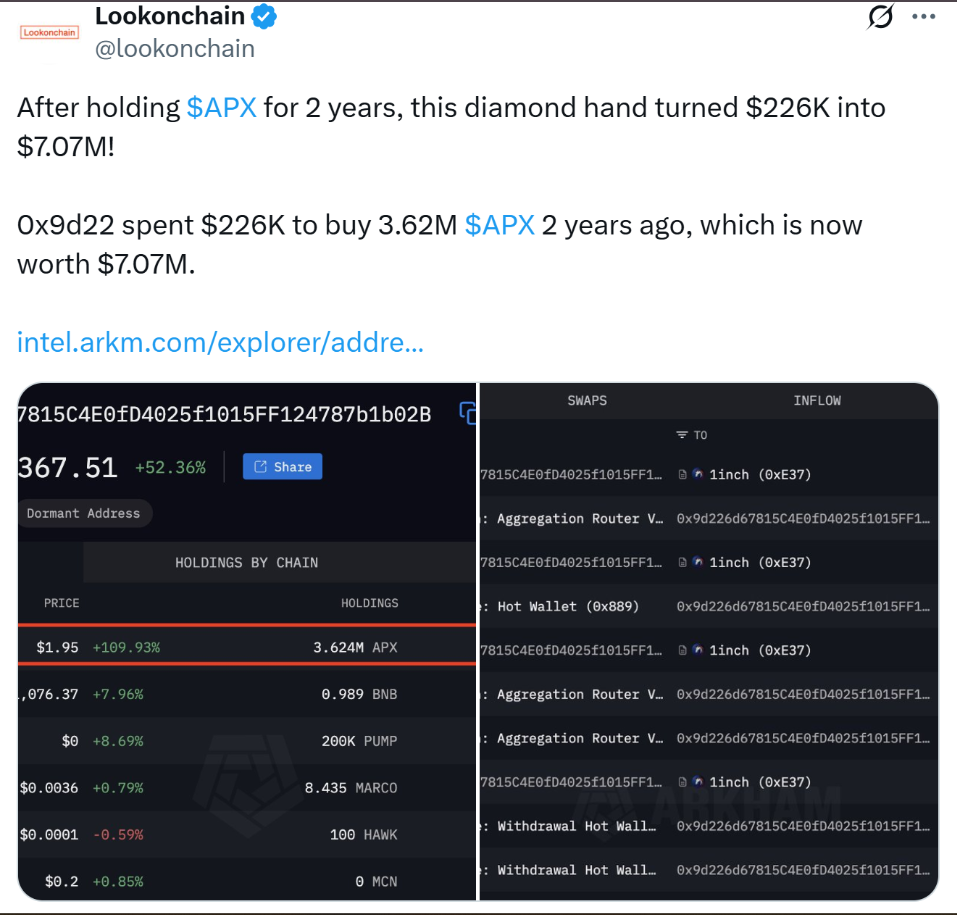
APX Holder Turns $226K Into $7M—Why Early Crypto Bets Still Create Massive Fortunes

APX Holder Turns $226K Into $7M—Why Early Crypto Bets Still Create Massive Fortunes

In crypto, fortunes are made not by following the crowd, but by moving before the world catches on. This truth was reinforced again when an APX investor who put in about $226,000 back in 2022 saw their holdings surge to more than $7 million during the recent ASTER swap rally. The story shows how powerful [...] The post APX Holder Turns $226K Into $7M—Why Early Crypto Bets Still Create Massive Fortunes appeared first on Blockonomi.

Author: Blockonomi
XRP’s DeFi Utility Expands With Launch of Liquid Staking Token ‘mXRP’

XRP’s DeFi Utility Expands With Launch of Liquid Staking Token ‘mXRP’

The post XRP’s DeFi Utility Expands With Launch of Liquid Staking Token ‘mXRP’ appeared on BitcoinEthereumNews.com. Tokenization platform Midas has partnered with Interop Labs and Axelar to launch the liquid staking token ‘mXRP’, which expands XRP’s DeFi utility and offers token holders yields of up to 8%. This development follows the launch of the first XRP-backed stablecoin, which has also helped boost the altcoin’s utility. mXRP Launches on Axelar, Boosting XRP’s Utility In a press release, Midas announced the launch of the liquid staking token on Axelar, which it described as a first-of-its-kind tokenized exposure product “offering meaningful, XRP-denominated yield strategies.” The tokenization platform revealed that they issued mXRP token on the new XRPL EVM through audited smart contracts. As CoinGape reported earlier, the XRP Ledger EVM sidechain is connected to the XRPL through an Axelar Bridge. Midas will provide the structuring and infrastructure behind the liquid staking token. Meanwhile, Axelar helps bridge the XRP asset into the protocol. The network will also enable the tokenization of this XRP product across over 80 blockchains, which Midas noted makes it the ideal platform to broaden access to this token. The mXRP launch follows the launch of the first XRP-backed stablecoin, which has also helped to boost the altcoin’s use case in the DeFi space. As to how this XRP product will work, Midas stated that by minting the product, users will deposit XRP collateral into a tokenized certificate structure that tracks the performance of underlying on-chain and off-chain yield strategies. Hyperithm will help provide risk curation services for the liquid staking token at launch. Meanwhile, the tokenization platform noted that they have fully integrated the token within the XRPL EVM ecosystem and that users can deploy it across DeFi protocols to access other opportunities, including lending markets and native integrations. Midas stated that the targeted net return range for the mXRP token is currently between 6% 8%…

Author: BitcoinEthereumNews
DeFi Lending Rules Examined by SEC Task Force in Crypto Meeting

DeFi Lending Rules Examined by SEC Task Force in Crypto Meeting

TLDR The SEC Crypto Task Force met with DeFi firm Term Finance to discuss regulatory challenges surrounding DeFi lending rules. Term Finance explained its model of short-term, fixed-rate lending using overcollateralized crypto assets in tri-party repurchase structures. The SEC examined the Reves and Howey tests to assess whether Term Finance’s loans and tokens could be [...] The post DeFi Lending Rules Examined by SEC Task Force in Crypto Meeting appeared first on CoinCentral.

Author: Coincentral
Polkadot’s Largest DeFi Protocol Hydration Launches Decentralized Stablecoin

Polkadot’s Largest DeFi Protocol Hydration Launches Decentralized Stablecoin

The post Polkadot’s Largest DeFi Protocol Hydration Launches Decentralized Stablecoin appeared on BitcoinEthereumNews.com. HOLLAR is a USD-pegged, over-collateralized stablecoin backed by DOT, ETH, and BTC. Hydration, the largest Polkadot-based decentralized finance (DeFi) protocol by total value locked (TVL), has launched its native stablecoin, HOLLAR, today, Sept. 22. According to a press release viewed by The Defiant, HOLLAR is designed as a decentralized, over-collateralized stablecoin — meaning the value of its reserves is more than the stablecoin’s circulating supply — backed by a basket of cryptocurrencies, including Polkadot’s native token DOT, Ether (ETH), and Bitcoin (BTC). DOT is currently changing hands around $4, down about 7% on the day. HOLLAR’s Stability Module provides real-time price support and partial liquidations to protect user positions. The stablecoin also integrates with Hydration’s trading, lending, and staking products. The launch comes as the stablecoin sector continues to grow. Total market capitalization is nearly $293 billion, up 69% from this time last year, according to DefiLlama. The team behind HOLLAR pointed to the risks of traditional stablecoins in the press release, raising concerns around centralization and reliance on the traditional banking system. HOLLAR aims to differentiate itself as a safer, fully decentralized alternative, they said. “The DeFi space deserves better than half-baked experiments or centralized compromises,” said Jakub Gregus, founder of Hydration “HOLLAR represents a reimagining of what stablecoins can achieve when you control the entire execution environment, rather than being constrained by generalized smart contract environments.” The initial supply is capped at 2,000,000 HOLLAR, the press release states, and users can mint the asset at a 5% annual borrow rate. “I’m looking forward to the release of HOLLAR and making sure it is well integrated with the direction of using stablecoins where they need to be used,” Dr. Gavin Wood, creator of Polkadot, was quoted as saying in the release: “I particularly like Hollar because it’s decentralized and…

Author: BitcoinEthereumNews
Cardano (ADA) vs Mutuum Finance (MUTM): Which Of These Altcoins Will Hit $3 First?

Cardano (ADA) vs Mutuum Finance (MUTM): Which Of These Altcoins Will Hit $3 First?

Cardano (ADA) has developed a robust reputation over time as one of the leading proof-of-stake networks, with steady ecosystem growth and ongoing development. Even with its development, however, ADA price action has generally been sedate, with large-cap status limiting explosive potential. Conversely, Mutuum Finance (MUTM) is still in presale for $0.035 and gathering momentum with […]

Author: Cryptopolitan
Analysts Tip Bitcoin Hyper for 100x Gains as Whale Investments Surge

Analysts Tip Bitcoin Hyper for 100x Gains as Whale Investments Surge

The cryptocurrency market is facing a broad downturn, with market capitalization down nearly 4% and most major assets, including popular meme coins, trading in the red. Despite this weakness, analysts are tipping Bitcoin Hyper as a potential 100x presale opportunity, drawing attention from both retail and institutional investors. Strong whale activity has already been recorded, […]

Author: The Cryptonomist
XRP Price Prediction: Ripple Holders Wait on $5 in 2025, But This Coin Below $0.0025 Could Turn $550 Into $55,000

XRP Price Prediction: Ripple Holders Wait on $5 in 2025, But This Coin Below $0.0025 Could Turn $550 Into $55,000

For some cryptocurrency investors, presale tokens are looking like a more compelling bet than established assets such as Ripple’s XRP. While some XRP holders are holding for $5 in 2025, altcoins with smaller price tags offer more aggressive short- to mid-term multipliers. Little Pepe (LILPEPE) is one such presale, with LILPEPE being a meme token […]

Author: Cryptopolitan
The Gravity of a System: Decoding Vitalik’s Thesis in an Era of Technical and Market Maturation

The Gravity of a System: Decoding Vitalik’s Thesis in an Era of Technical and Market Maturation

Introduction: The Declaration in the Quiet In the fog of a market oscillating between institutional adoption and retail speculation, Vitalik Buterin’s latest post, “Low-risk defi can be for Ethereum what search was for Google,” lands not as a proposal, but as a declaration of an achieved reality. To interpret this piece as a mere suggestion for future focus is to miss its profound significance. It is the intellectual framework laid over a new equilibrium that has been slowly, methodically materializing for years, forged in the twin crucibles of a maturing market and a relentlessly evolving protocol. This analysis will not re-litigate Buterin’s arguments at length; they are elegant and self-evident. Instead, we will treat his thesis as a lens through which to examine the powerful, tangible forces that make his declaration not just plausible, but inevitable. We will argue that Vitalik’s post is the capstone on a structure built by the market’s “flight to quality,” and made possible by a technical roadmap that is aggressively shaping Ethereum into the global settlement layer for both human and machine economies. Concisely, Buterin posits that the long-standing tension between Ethereum’s revenue-generating applications (often speculative) and its value-aligned ones (often unprofitable) has been resolved. The synthesis is “Low-Risk DeFi” — a suite of foundational financial tools like payments, savings via fully-collateralized lending, and exchange. He analogizes this to Google’s economic model: just as Search and Ads provide the stable revenue that allows Google to pursue its more ambitious goals, Low-Risk DeFi can and should be the boringly profitable engine that funds Ethereum’s security and allows its experimental applications to flourish. This model works, he argues, because it provides irreplaceable value in a world of rising traditional finance risk, and it is culturally and technically congruent with the L1’s mission of decentralized security. I: The Technical Preconditions — How the 2025–2026 Roadmap Forged the Rails Before the market could embrace Low-Risk DeFi, the rails had to be laid. Buterin’s thesis is only viable today because the underlying technology has been deliberately engineered to support it. The Ethereum roadmap of 2025–2026 is a masterclass in strategic infrastructure development, focused on three pillars: enabling mass-market scale, perfecting the user experience, and expanding the very definition of “settlement.”

  1. The Scalability Endgame: Pectra and Fusaka The core of Buterin’s argument is that Low-Risk DeFi requires a robust L1 for security, but its user-facing activity must occur on Layer 2s to be economically viable. The 2025 hard fork schedule is a direct and aggressive execution of this vision.
Pectra (Q2 2025): This upgrade continues the vital work of embedding Account Abstraction (AA) deeper into the protocol. For Low-Risk DeFi to onboard the next billion users, the experience must be seamless and secure. Pectra’s enhancements are critical steps in transforming the arcane process of managing a private key into a user-friendly experience with familiar features like social recovery and gas sponsorship. It’s the infrastructure for making DeFi as accessible as a neobank. Fusaka (Q4 2025): Confirmed for December 3rd, the Fusaka hard fork is the most significant step in “The Surge” phase. Its primary impact is the projected doubling of blob capacity, which directly translates to a significant reduction in transaction costs on L2s like Arbitrum and Optimism. This isn’t an incremental improvement; it’s a step-change in economic feasibility. It makes micro-payments and regular savings deposits — the lifeblood of a global financial system — orders of magnitude cheaper, making the “global democratized access” promise a practical reality.
  1. The Settlement Layer Expands: From Crypto Assets to Bank Deposits Perhaps the most potent validation of the thesis is the successful cross-bank payment test conducted on the Ethereum mainnet by UBS, PostFinance, and Sygnum Bank. Using deposit tokens — fully regulated, 1:1 backed digital representations of commercial bank money — they achieved compliant interbank settlement without traditional payment rails. This proves that Ethereum’s utility is not confined to its native assets. It is being actively tested as the neutral, programmable infrastructure for the tokenization of all forms of value, positioning it as a potential backbone for the future of the entire banking system.
  2. The Next Frontier: Ethereum as the Settlement Layer for AI Looking further ahead, the newly formed DAI (Decentralized AI) Team within the Ethereum Foundation signals the next logical evolution. Led by core developer Davide Crapis, its mission is to make Ethereum the premier platform for the burgeoning machine economy. Proposals like ERC-8004 (Trustless Agents) aim to create on-chain standards for AI agents to interact and transact. This radically expands the potential user base beyond humans, ensuring that the Low-Risk DeFi infrastructure being built today will serve as the financial bedrock for the autonomous economies of tomorrow. II: The Market’s Verdict — How the 2025 Price Action Confirms the Thesis With the technical rails in place, the market has responded. The character of demand in the current cycle is fundamentally different from the speculative frenzies of the past. Ethereum’s trajectory — recovering from post-bear market lows around ~$1,350 to over $4,400 by August 2025 — is underpinned by a structural “flight to quality” and a demand for sustainable, native yield.
  3. The ETF Effect: Institutional Capital Seeks a Productive Asset The initial spot Ether ETFs were just the beginning. The financial innovation of 2025, such as the Defiance Leveraged Long + Income Ethereum ETF (ETHI), demonstrates a deeper integration. This product, which uses complex option strategies to generate income, treats ETH not just as a commodity, but as a versatile, productive financial primitive. This deepens institutional demand beyond simple spot exposure and creates a feedback loop, requiring more on-chain liquidity and strengthening the core DeFi protocols.
  4. The Primacy of Native Yield: Staking and Re-staking as the Gravity Well The yield that matters in 2025 is the sustainable, protocol-native yield from staking ETH. This has become the “risk-free” rate of the crypto economy. Platforms like Lido and, more critically, re-staking protocols like EigenLayer, have become behemoths not by creating artificial incentives, but by providing more efficient access to this fundamental, low-risk yield. Billions of dollars in ETH are locked for a long-term, sustainable return, representing a structural demand for ETH as a savings and collateral asset.
  5. Collateral Demand in a High-Rate Environment ETH serves as the primary asset used to borrow stablecoins on platforms like Aave, Compound, and MakerDAO. Users are borrowing to gain liquidity without selling their core holding, a classic financial maneuver. The health of these overcollateralized lending markets — the very heart of Low-Risk DeFi — is a direct driver of demand for ETH. The more utility these platforms provide, the more ETH is required as collateral, creating a powerful, reflexive demand. In summary, the 2025 bull market is quieter, more structural, and driven by a demand for the very things Buterin highlights: secure savings, reliable collateral, and institutional-grade access. The market itself has voted, and it has voted for Low-Risk DeFi. III: The “Stable Core” Protocols — Manifestations of the New Equilibrium Given this alignment of market demand and technical readiness, the “Stable Core” Buterin refers to comes into sharp focus. These are the entities that are both the cause and the effect of this maturation.
Lending & Savings Platforms (Aave, Compound): The primary venues where the demand for yield on stablecoins and the use of ETH as collateral are expressed. Decentralized Stablecoin Issuers (MakerDAO): The decentralized central bank of the ecosystem, fundamental to the entire system’s health. Core Exchange Infrastructure (Uniswap, Curve): The essential liquidity rails that enable the seamless flow of value required by a global payments and savings system. Liquid Staking & Re-staking Protocols (Lido, EigenLayer): The “asset managers” of the new era, providing efficient access to ETH’s native yield and unlocking new layers of security and innovation. These are not the flashy, high-APY protocols of yesteryear. They are the emerging financial utilities of a new, more stable on-chain economy. They are the concrete manifestations of a system that has found its gravitational center. Conclusion: A Thesis of Inevitability Vitalik Buterin’s latest post is powerful not because it charts a new course, but because it provides the definitive map for a course the ship is already on. The convergence of institutional demand for a productive digital asset, a technical roadmap focused on creating a secure and scalable modular system for all forms of value, and the battle-hardening of a core set of financial protocols has created a new reality. Low-Risk DeFi has become Ethereum’s economic engine out of strategic necessity and market evolution. It is the most logical and sustainable use case for a credibly neutral, globally accessible settlement layer. By articulating this so clearly, Buterin has not only given the Ethereum community a proud and honorable narrative but has also sent a clear signal to the wider world: the era of chaotic speculation is giving way to an era of profound, sustainable utility. The search for a viable economic model is over. The era of building a truly global financial system on top of it has just begun. The Gravity of a System: Decoding Vitalik’s Thesis in an Era of Technical and Market Maturation was originally published in Coinmonks on Medium, where people are continuing the conversation by highlighting and responding to this story

Author: Medium
Crypto.com Capital bets on Moonlander: shake-up for Cronos derivatives

Crypto.com Capital bets on Moonlander: shake-up for Cronos derivatives

Strategic move: Crypto.com Capital invests in Moonlander to accelerate the development of derivatives on the Cronos network.

Author: The Cryptonomist