The Federal Reserve’s first rate cut of 2025 has landed—25 basis points on September 17—and, in Trader Mayne’s telling, that removes the last macro “X-factor” hanging over the crypto market. In a video analysis posted the same day, the veteran price-action trader argued that with the policy move now in the rear-view mirror, crypto can “just focus on the charts,” sketching a roadmap in which Bitcoin posts one more leg higher into new all-time highs before a pullback ushers in a classic altseason blow-off. “We had FOMC today and the rates got cut finally… It’s 25 basis points,” he said. “Now the market’s going to digest it.” Where Is Bitcoin Price Going Next? The policy backdrop he’s reacting to is straightforward: the FOMC lowered the fed funds target range by a quarter point to 4.00%–4.25% on Sept. 17, with Chair Jerome Powell describing the move as a risk-management response to weakening labor dynamics and leaving the door open to additional easing this year. The decision drew an 11–1 vote, with newly appointed Governor Stephen Miran dissenting in favor of a larger, 50 bps cut—an unusually hawkish dissent in a dovish direction—while the Board’s implementation note reset key administered rates effective Sept. 18. Markets read the statement and projections as signaling scope for further cuts into year-end. Related Reading: Crucial Ten Days Ahead For Crypto: Will They Ignite Mega Altcoin Season? From here, Mayne’s framework is unapologetically technical. He characterizes Bitcoin’s most recent upswing as corrective relative to the prior impulse and expects price to “push above the mid-range” toward a range high around $120,000–$121,000, where he will watch for rejection at a higher-time-frame confluence defined by a weekly swing-failure pattern (SFP) and an H12 breaker. If momentum stalls there, he plans to short into a washout to clear out built-up leverage—“HYPE made another all-time high today. PUMP has tripled in the last two weeks… there’s some leverage in the system”—and then buy the dip for what he calls the last parabolic leg of the cycle. “Any sort of dip on BTC, I want to be looking for a long,” he said, adding that a shallow retest in the $110,000–$111,000 area or a deeper sweep of recent lows would both be acceptable springboards if the rebound is decisive. If, instead, price grinds through the $120,000 s with no signs of exhaustion, Mayne says he has “no problem” flipping to breakout longs above the all-time high once strength is confirmed intraday—an approach that mirrors his playbook from prior expansions (“Once this thing broke out aggressively… you’re looking for longs”). He emphasizes sequence over prediction: the short he’s eyeing is counter-trend—“a pullback in an uptrend”—and the prime objective remains to position for the next impulsive advance. When Will The Crypto Market Top? Timing-wise, he situates the prospective cycle top in Q4 2025 or Q1 2026, describing a pattern in which Bitcoin’s final vertical leg into the $150,000 to $180,000 region is followed by distribution while altcoins reprice higher—the archetypal altseason. “This parabolic leg I think would be the last leg of the bull run,” he said, before outlining notional alt targets consistent with a late-cycle melt-up: Ethereum $5,000–$7,000, Solana $300–$500, Dogecoin $0.50–$0.70. The mechanics, as he narrates them: a last BTC push, a corrective wash, a V-shaped reclaim of the 2024 ATH “very quickly,” then Q4 “mania” with breadth shifting to large-cap alts as Bitcoin distributes. Related Reading: December 2024 Crypto Crash Signal Returns As Altcoins Go Wild The technical scaffolding behind that view leans on concepts familiar to discretionary price-action traders. Weekly SFPs (failed breaks of prior extremes) set the trap line at range edges; H12 breakers and order blocks frame high-probability reaction zones; and fair-value gaps guide where liquidity vacuums might fill during a corrective flush. On structure, he insists the weekly trend remains up, so any short is tactical and any deeper dip must resolve in a swift V-bottom and reclaim of the former highs to keep the cyclical script intact. His invalidation is equally clear: “If we spend any significant time back below [the 2024 all-time high], it’s really bad… I’m probably going to reassess my thoughts.” Macro, in Mayne’s view, now recedes to the background. The rate cut may have helped pull forward some September strength—“you could argue… the up move we’ve seen on Bitcoin… is in anticipation of this rate cut”—but with the decision made and Powell hinting there “could be another one… there could be two,” his emphasis is squarely on execution: wait for price to trade into the $120,000s and signal weakness for the clean counter-trend short; or, absent weakness, wait for the breakout continuation and ride it. Either way, he’s explicit about the north star for the coming weeks: “Focus on Bitcoin… Any sort of dip on BTC, I want to be looking for a long… Then altseason.” At press time, BTC traded at $117,176. Featured image created with DALL.E, chart from TradingView.comThe Federal Reserve’s first rate cut of 2025 has landed—25 basis points on September 17—and, in Trader Mayne’s telling, that removes the last macro “X-factor” hanging over the crypto market. In a video analysis posted the same day, the veteran price-action trader argued that with the policy move now in the rear-view mirror, crypto can “just focus on the charts,” sketching a roadmap in which Bitcoin posts one more leg higher into new all-time highs before a pullback ushers in a classic altseason blow-off. “We had FOMC today and the rates got cut finally… It’s 25 basis points,” he said. “Now the market’s going to digest it.” Where Is Bitcoin Price Going Next? The policy backdrop he’s reacting to is straightforward: the FOMC lowered the fed funds target range by a quarter point to 4.00%–4.25% on Sept. 17, with Chair Jerome Powell describing the move as a risk-management response to weakening labor dynamics and leaving the door open to additional easing this year. The decision drew an 11–1 vote, with newly appointed Governor Stephen Miran dissenting in favor of a larger, 50 bps cut—an unusually hawkish dissent in a dovish direction—while the Board’s implementation note reset key administered rates effective Sept. 18. Markets read the statement and projections as signaling scope for further cuts into year-end. Related Reading: Crucial Ten Days Ahead For Crypto: Will They Ignite Mega Altcoin Season? From here, Mayne’s framework is unapologetically technical. He characterizes Bitcoin’s most recent upswing as corrective relative to the prior impulse and expects price to “push above the mid-range” toward a range high around $120,000–$121,000, where he will watch for rejection at a higher-time-frame confluence defined by a weekly swing-failure pattern (SFP) and an H12 breaker. If momentum stalls there, he plans to short into a washout to clear out built-up leverage—“HYPE made another all-time high today. PUMP has tripled in the last two weeks… there’s some leverage in the system”—and then buy the dip for what he calls the last parabolic leg of the cycle. “Any sort of dip on BTC, I want to be looking for a long,” he said, adding that a shallow retest in the $110,000–$111,000 area or a deeper sweep of recent lows would both be acceptable springboards if the rebound is decisive. If, instead, price grinds through the $120,000 s with no signs of exhaustion, Mayne says he has “no problem” flipping to breakout longs above the all-time high once strength is confirmed intraday—an approach that mirrors his playbook from prior expansions (“Once this thing broke out aggressively… you’re looking for longs”). He emphasizes sequence over prediction: the short he’s eyeing is counter-trend—“a pullback in an uptrend”—and the prime objective remains to position for the next impulsive advance. When Will The Crypto Market Top? Timing-wise, he situates the prospective cycle top in Q4 2025 or Q1 2026, describing a pattern in which Bitcoin’s final vertical leg into the $150,000 to $180,000 region is followed by distribution while altcoins reprice higher—the archetypal altseason. “This parabolic leg I think would be the last leg of the bull run,” he said, before outlining notional alt targets consistent with a late-cycle melt-up: Ethereum $5,000–$7,000, Solana $300–$500, Dogecoin $0.50–$0.70. The mechanics, as he narrates them: a last BTC push, a corrective wash, a V-shaped reclaim of the 2024 ATH “very quickly,” then Q4 “mania” with breadth shifting to large-cap alts as Bitcoin distributes. Related Reading: December 2024 Crypto Crash Signal Returns As Altcoins Go Wild The technical scaffolding behind that view leans on concepts familiar to discretionary price-action traders. Weekly SFPs (failed breaks of prior extremes) set the trap line at range edges; H12 breakers and order blocks frame high-probability reaction zones; and fair-value gaps guide where liquidity vacuums might fill during a corrective flush. On structure, he insists the weekly trend remains up, so any short is tactical and any deeper dip must resolve in a swift V-bottom and reclaim of the former highs to keep the cyclical script intact. His invalidation is equally clear: “If we spend any significant time back below [the 2024 all-time high], it’s really bad… I’m probably going to reassess my thoughts.” Macro, in Mayne’s view, now recedes to the background. The rate cut may have helped pull forward some September strength—“you could argue… the up move we’ve seen on Bitcoin… is in anticipation of this rate cut”—but with the decision made and Powell hinting there “could be another one… there could be two,” his emphasis is squarely on execution: wait for price to trade into the $120,000s and signal weakness for the clean counter-trend short; or, absent weakness, wait for the breakout continuation and ride it. Either way, he’s explicit about the north star for the coming weeks: “Focus on Bitcoin… Any sort of dip on BTC, I want to be looking for a long… Then altseason.” At press time, BTC traded at $117,176. Featured image created with DALL.E, chart from TradingView.com

The Fed Just Changed Everything For Crypto, Says Top Trader

2025/09/18 20:00
Okuma süresi: 4 dk

The Federal Reserve’s first rate cut of 2025 has landed—25 basis points on September 17—and, in Trader Mayne’s telling, that removes the last macro “X-factor” hanging over the crypto market. In a video analysis posted the same day, the veteran price-action trader argued that with the policy move now in the rear-view mirror, crypto can “just focus on the charts,” sketching a roadmap in which Bitcoin posts one more leg higher into new all-time highs before a pullback ushers in a classic altseason blow-off. “We had FOMC today and the rates got cut finally… It’s 25 basis points,” he said. “Now the market’s going to digest it.”

Where Is Bitcoin Price Going Next?

The policy backdrop he’s reacting to is straightforward: the FOMC lowered the fed funds target range by a quarter point to 4.00%–4.25% on Sept. 17, with Chair Jerome Powell describing the move as a risk-management response to weakening labor dynamics and leaving the door open to additional easing this year. The decision drew an 11–1 vote, with newly appointed Governor Stephen Miran dissenting in favor of a larger, 50 bps cut—an unusually hawkish dissent in a dovish direction—while the Board’s implementation note reset key administered rates effective Sept. 18. Markets read the statement and projections as signaling scope for further cuts into year-end.

From here, Mayne’s framework is unapologetically technical. He characterizes Bitcoin’s most recent upswing as corrective relative to the prior impulse and expects price to “push above the mid-range” toward a range high around $120,000–$121,000, where he will watch for rejection at a higher-time-frame confluence defined by a weekly swing-failure pattern (SFP) and an H12 breaker.

If momentum stalls there, he plans to short into a washout to clear out built-up leverage—“HYPE made another all-time high today. PUMP has tripled in the last two weeks… there’s some leverage in the system”—and then buy the dip for what he calls the last parabolic leg of the cycle. “Any sort of dip on BTC, I want to be looking for a long,” he said, adding that a shallow retest in the $110,000–$111,000 area or a deeper sweep of recent lows would both be acceptable springboards if the rebound is decisive.

If, instead, price grinds through the $120,000 s with no signs of exhaustion, Mayne says he has “no problem” flipping to breakout longs above the all-time high once strength is confirmed intraday—an approach that mirrors his playbook from prior expansions (“Once this thing broke out aggressively… you’re looking for longs”). He emphasizes sequence over prediction: the short he’s eyeing is counter-trend—“a pullback in an uptrend”—and the prime objective remains to position for the next impulsive advance.

When Will The Crypto Market Top?

Timing-wise, he situates the prospective cycle top in Q4 2025 or Q1 2026, describing a pattern in which Bitcoin’s final vertical leg into the $150,000 to $180,000 region is followed by distribution while altcoins reprice higher—the archetypal altseason.
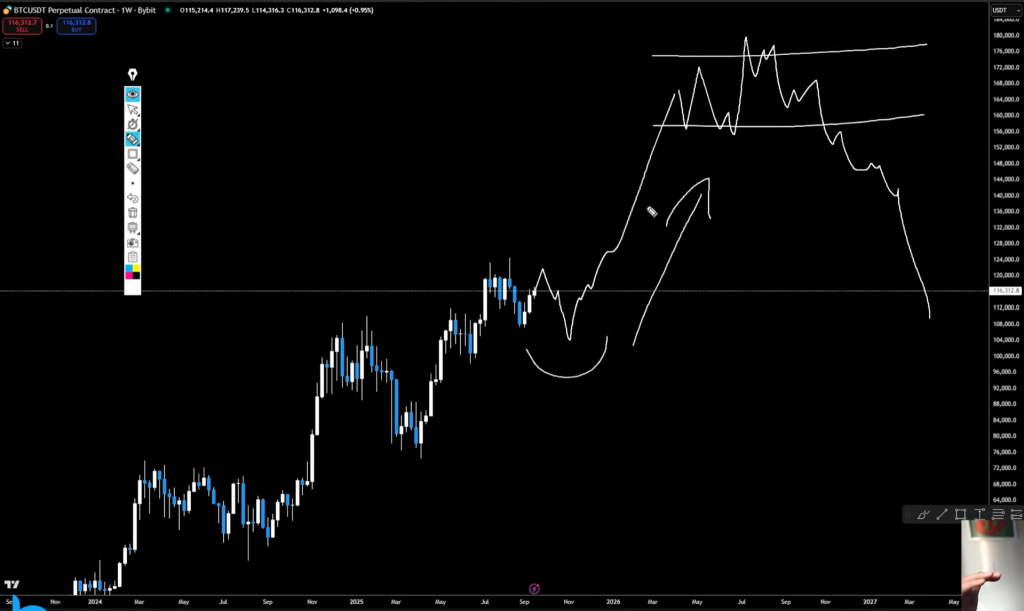
Bitcoin price prediction

“This parabolic leg I think would be the last leg of the bull run,” he said, before outlining notional alt targets consistent with a late-cycle melt-up: Ethereum $5,000–$7,000, Solana $300–$500, Dogecoin $0.50–$0.70. The mechanics, as he narrates them: a last BTC push, a corrective wash, a V-shaped reclaim of the 2024 ATH “very quickly,” then Q4 “mania” with breadth shifting to large-cap alts as Bitcoin distributes.

The technical scaffolding behind that view leans on concepts familiar to discretionary price-action traders. Weekly SFPs (failed breaks of prior extremes) set the trap line at range edges; H12 breakers and order blocks frame high-probability reaction zones; and fair-value gaps guide where liquidity vacuums might fill during a corrective flush.

On structure, he insists the weekly trend remains up, so any short is tactical and any deeper dip must resolve in a swift V-bottom and reclaim of the former highs to keep the cyclical script intact. His invalidation is equally clear: “If we spend any significant time back below [the 2024 all-time high], it’s really bad… I’m probably going to reassess my thoughts.”

Macro, in Mayne’s view, now recedes to the background. The rate cut may have helped pull forward some September strength—“you could argue… the up move we’ve seen on Bitcoin… is in anticipation of this rate cut”—but with the decision made and Powell hinting there “could be another one… there could be two,” his emphasis is squarely on execution: wait for price to trade into the $120,000s and signal weakness for the clean counter-trend short; or, absent weakness, wait for the breakout continuation and ride it. Either way, he’s explicit about the north star for the coming weeks: “Focus on Bitcoin… Any sort of dip on BTC, I want to be looking for a long… Then altseason.”

At press time, BTC traded at $117,176.
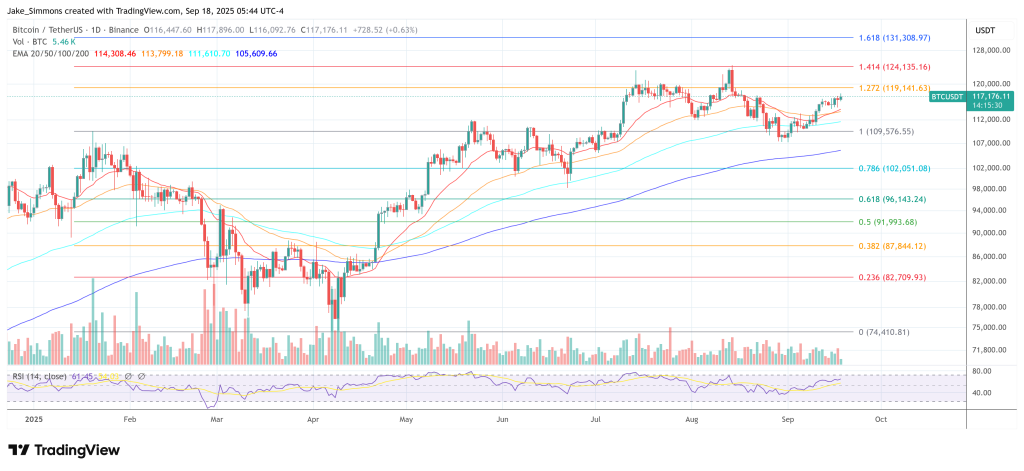
Bitcoin price
Piyasa Fırsatı
MemeCore Logosu
MemeCore Fiyatı(M)
$1.29105
$1.29105$1.29105
-2.23%
USD
MemeCore (M) Canlı Fiyat Grafiği
Sorumluluk Reddi: Bu sitede yeniden yayınlanan makaleler, halka açık platformlardan alınmıştır ve yalnızca bilgilendirme amaçlıdır. MEXC'nin görüşlerini yansıtmayabilir. Tüm hakları telif sahiplerine aittir. Herhangi bir içeriğin üçüncü taraf haklarını ihlal ettiğini düşünüyorsanız, kaldırılması için lütfen service@support.mexc.com ile iletişime geçin. MEXC, içeriğin doğruluğu, eksiksizliği veya güncelliği konusunda hiçbir garanti vermez ve sağlanan bilgilere dayalı olarak alınan herhangi bir eylemden sorumlu değildir. İçerik, finansal, yasal veya diğer profesyonel tavsiye niteliğinde değildir ve MEXC tarafından bir tavsiye veya onay olarak değerlendirilmemelidir.

Ayrıca Şunları da Beğenebilirsiniz

The Role of Blockchain in Building Safer Web3 Gaming Ecosystems

The Role of Blockchain in Building Safer Web3 Gaming Ecosystems

The gaming industry is in the midst of a historic shift, driven by the rise of Web3. Unlike traditional games, where developers and publishers control assets and dictate in-game economies, Web3 gaming empowers players with ownership and influence. Built on blockchain technology, these ecosystems are decentralized by design, enabling true digital asset ownership, transparent economies, and a future where players help shape the games they play. However, as Web3 gaming grows, security becomes a focal point. The range of security concerns, from hacking to asset theft to vulnerabilities in smart contracts, is a significant issue that will undermine or erode trust in this ecosystem, limiting or stopping adoption. Blockchain technology could be used to create security processes around secure, transparent, and fair Web3 gaming ecosystems. We will explore how security is increasing within gaming ecosystems, which challenges are being overcome, and what the future of security looks like. Why is Security Important in Web3 Gaming? Web3 gaming differs from traditional gaming in that players engage with both the game and assets with real value attached. Players own in-game assets that exist as tokens or NFTs (Non-Fungible Tokens), and can trade and sell them. These game assets usually represent significant financial value, meaning security failure could represent real monetary loss. In essence, without security, the promises of owning “something” in Web3, decentralized economies within games, and all that comes with the term “fair” gameplay can easily be eroded by fraud, hacking, and exploitation. This is precisely why the uniqueness of blockchain should be emphasized in securing Web3 gaming. How Blockchain Ensures Security in Web3 Gaming?
  1. Immutable Ownership of Assets Blockchain records can be manipulated by anyone. If a player owns a sword, skin, or plot of land as an NFT, it is verifiably in their ownership, and it cannot be altered or deleted by the developer or even hacked. This has created a proven track record of ownership, providing control back to the players, unlike any centralised gaming platform where assets can be revoked.
  2. Decentralized Infrastructure Blockchain networks also have a distributed architecture where game data is stored in a worldwide network of nodes, making them much less susceptible to centralised points of failure and attacks. This decentralised approach makes it exponentially more difficult to hijack systems or even shut off the game’s economy.
  3. Secure Transactions with Cryptography Whether a player buys an NFT or trades their in-game tokens for other items or tokens, the transactions are enforced by cryptographic algorithms, ensuring secure, verifiable, and irreversible transactions and eliminating the risks of double-spending or fraudulent trades.
  4. Smart Contract Automation Smart contracts automate the enforcement of game rules and players’ economic exchanges for the developer, eliminating the need for intermediaries or middlemen, and trust for the developer. For example, if a player completes a quest that promises a reward, the smart contract will execute and distribute what was promised.
  5. Anti-Cheating and Fair Gameplay The naturally transparent nature of blockchain makes it extremely simple for anyone to examine a specific instance of gameplay and verify the economic outcomes from that play. Furthermore, multi-player games that enforce smart contracts on things like loot sharing or win sharing can automate and measure trustlessness and avoid cheating, manipulations, and fraud by developers.
  6. Cross-Platform Security Many Web3 games feature asset interoperability across platforms. This interoperability is made viable by blockchain, which guarantees ownership is maintained whenever assets transition from one game or marketplace to another, thereby offering protection to players who rely on transfers for security against fraud. Key Security Dangers in Web3 Gaming Although blockchain provides sound first principles of security, the Web3 gaming ecosystem is susceptible to threats. Some of the most serious threats include:

Smart Contract Vulnerabilities: Smart contracts that are poorly written or lack auditing will leave openings for exploitation and thereby result in asset loss. Phishing Attacks: Unintentionally exposing or revealing private keys or signing transactions that are not possible to reverse, under the assumption they were genuine transaction requests. Bridge Hacks: Cross-chain bridges, which allow players to move their assets between their respective blockchains, continually face hacks, requiring vigilance from players and developers. Scams and Rug Pulls: Rug pulls occur when a game project raises money and leaves, leaving player assets worthless. Regulatory Ambiguity: Global regulations remain unclear; risks exist for players and developers alike. While blockchain alone won’t resolve every issue, it remediates the responsibility of the first principles, more so when joined by processes such as auditing, education, and the right governance, which can improve their contribution to the security landscapes in game ecosystems. Real Life Examples of Blockchain Security in Web3 Gaming Axie Infinity (Ronin Hack): The Axie Infinity game and several projects suffered one of the biggest hacks thus far on its Ronin bridge; however, it demonstrated the effectiveness of multi-sig security and the effective utilization of decentralization. The industry benefited through learning and reflection, thus, as projects have implemented changes to reduce the risks of future hacks or misappropriation. Immutable X: This Ethereum scaling solution aims to ensure secure NFT transactions for gaming, allowing players to trade an asset without the burden of exorbitant fees and fears of being a victim of fraud. Enjin: Enjin is providing a trusted infrastructure for Web3 games, offering secure NFT creation and transfer while reiterating that ownership and an asset securely belong to the player. These examples indubitably illustrate that despite challenges to overcome, blockchain remains the foundational layer on which to build more secure Web3 gaming environments. Benefits of Blockchain Security for Players and Developers For Players: Confidence in true ownership of assets Transparency in in-game economies Protection against nefarious trades/scams For Developers: More trust between players and the platform Less reliance on centralized infrastructure Ability to attract wealth and players based on provable fairness By incorporating blockchain security within the mechanics of game design, developers can create and enforce resilient ecosystems where players feel reassured in investing time, money, and ownership within virtual worlds. The Future of Secure Web3 Gaming Ecosystems As the wisdom of blockchain technology and industry knowledge improves, the future for secure Web3 gaming looks bright. New growing trends include: Zero-Knowledge Proofs (ZKPs): A new wave of protocols that enable private transactions and secure smart contracts while managing user privacy with an element of transparency. Decentralized Identity Solutions (DID): Helping players control their identities and decrease account theft risks. AI-Enhanced Security: Identifying irregularities in user interactions by sampling pattern anomalies to avert hacks and fraud by time-stamping critical events. Interoperable Security Standards: Allowing secured and seamless asset transfers across blockchains and games. With these innovations, blockchain will not only secure gaming assets but also enhance the overall trust and longevity of Web3 gaming ecosystems. Conclusion Blockchain is more than a buzzword in Web3; it is the only way to host security, fairness, and transparency. With blockchain, players confirm immutable ownership of digital assets, there is a decentralized infrastructure, and finally, it supports smart contracts to automate code that protects players and developers from the challenges of digital economies. The threats, vulnerabilities, and scams that come from smart contracts still persist, but the industry is maturing with better security practices, cross-chain solutions, and increased formal cryptographic tools. In the coming years, blockchain will remain the base to digital economies and drive Web3 gaming environments that allow players to safely own, trade, and enjoy their digital experiences free from fraud and exploitation. While blockchain and gaming alone entertain, we will usher in an era of secure digital worlds where trust complements innovation. The Role of Blockchain in Building Safer Web3 Gaming Ecosystems was originally published in Coinmonks on Medium, where people are continuing the conversation by highlighting and responding to this story
Paylaş
Medium2025/09/18 14:40
Knocking Bitcoin's lack of yield shows your ‘Western financial privilege’

Knocking Bitcoin's lack of yield shows your ‘Western financial privilege’

                                                                               Macro analyst Luke Gromen’s comments come amid an ongoing debate over whether Bitcoin or Ether is the more attractive long-term option for traditional investors.                     Macro analyst Luke Gromen says the fact that Bitcoin doesn’t natively earn yield isn’t a weakness; it’s what makes it a safer store of value.“If you’re earning a yield, you are taking a risk,” Gromen told Natalie Brunell on the Coin Stories podcast on Wednesday, responding to a question about critics who dismiss Bitcoin (BTC) because they prefer yield-earning assets.“Anyone who says that is showing their Western financial privilege,” he added.Read more
Paylaş
Coinstats2025/09/18 14:22
Vitalik Buterin wants to build ‘the next generation of finance’ – Here’s how

Vitalik Buterin wants to build ‘the next generation of finance’ – Here’s how

The post Vitalik Buterin wants to build ‘the next generation of finance’ – Here’s how appeared on BitcoinEthereumNews.com. Journalist Posted: February 16, 2026
Paylaş
BitcoinEthereumNews2026/02/16 11:01
