This article explores the implementation of gradient descent algorithms for minimizing global loss functions in neural networks, particularly in problems governed by Rankine-Hugoniot conditions. While gradient descent reliably converges, scalability issues arise when handling large domains with many coupled networks. To address this, a domain decomposition method (DDM) is introduced, enabling parallel optimization of local loss functions. The result is faster convergence, improved scalability, and a more efficient framework for training complex AI models.This article explores the implementation of gradient descent algorithms for minimizing global loss functions in neural networks, particularly in problems governed by Rankine-Hugoniot conditions. While gradient descent reliably converges, scalability issues arise when handling large domains with many coupled networks. To address this, a domain decomposition method (DDM) is introduced, enabling parallel optimization of local loss functions. The result is faster convergence, improved scalability, and a more efficient framework for training complex AI models.

Why Gradient Descent Converges (and Sometimes Doesn’t) in Neural Networks

2025/09/19 18:38

Abstract and 1. Introduction

1.1. Introductory remarks

1.2. Basics of neural networks

1.3. About the entropy of direct PINN methods

1.4. Organization of the paper

  1. Non-diffusive neural network solver for one dimensional scalar HCLs

    2.1. One shock wave

    2.2. Arbitrary number of shock waves

    2.3. Shock wave generation

    2.4. Shock wave interaction

    2.5. Non-diffusive neural network solver for one dimensional systems of CLs

    2.6. Efficient initial wave decomposition

  2. Gradient descent algorithm and efficient implementation

    3.1. Classical gradient descent algorithm for HCLs

    3.2. Gradient descent and domain decomposition methods

  3. Numerics

    4.1. Practical implementations

    4.2. Basic tests and convergence for 1 and 2 shock wave problems

    4.3. Shock wave generation

    4.4. Shock-Shock interaction

    4.5. Entropy solution

    4.6. Domain decomposition

    4.7. Nonlinear systems

  4. Conclusion and References

3. Gradient descent algorithm and efficient implementation

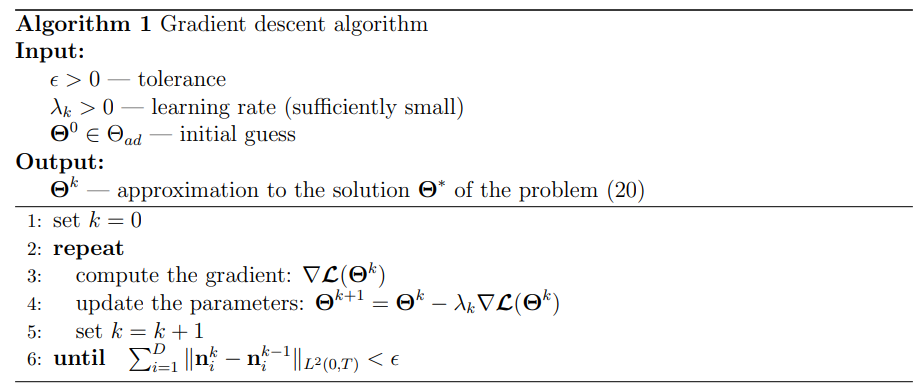
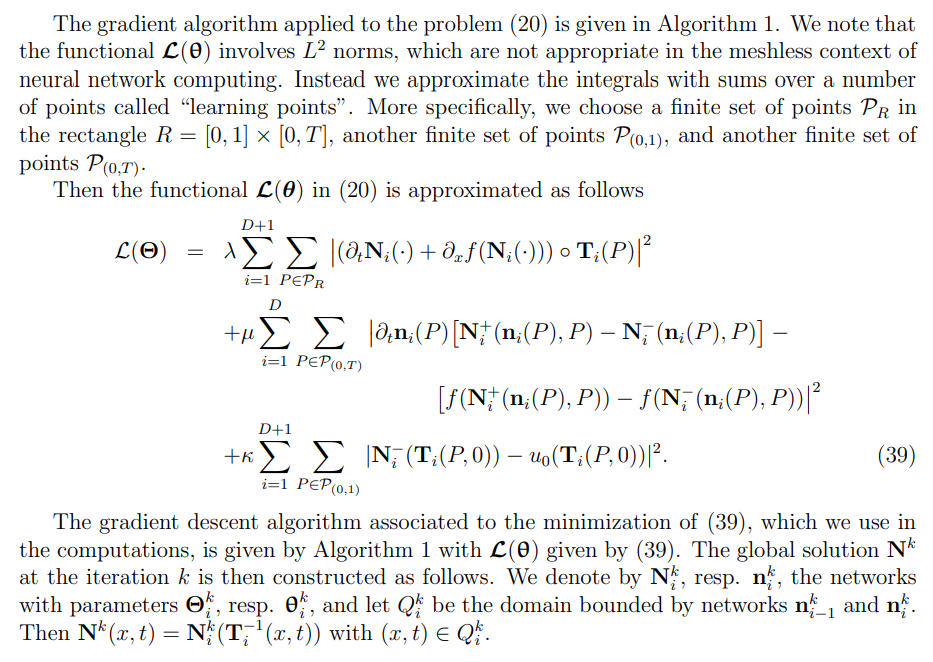
In this section we discuss the implementation of gradient descent algorithms for solving the minimization problems (11), (20) and (35). We note that these problems involve a global loss functional measuring the residue of HCL in the whole domain, as well Rankine-Hugoniot conditions, which results in training of a number of neural networks. In all the tests we have done, the gradient descent method converges and provides accurate results. We note also, that in problems with a large number of DLs, the global loss functional couples a large number of networks and the gradient descent algorithm may converge slowly. For these problems we present a domain decomposition method (DDM).

3.1. Classical gradient descent algorithm for HCLs

All the problems (11), (20) and (35) being similar, we will demonstrate in details the algorithm for the problem (20). We assume that the solution is initially constituted by i) D ∈ {1, 2, . . . , } entropic shock waves emanating from x1, . . . , xD, ii) an arbitrary number of rarefaction waves, and that iii) there is no shock generation for t ∈ [0, T].

\
\
3.2. Gradient descent and domain decomposition methods

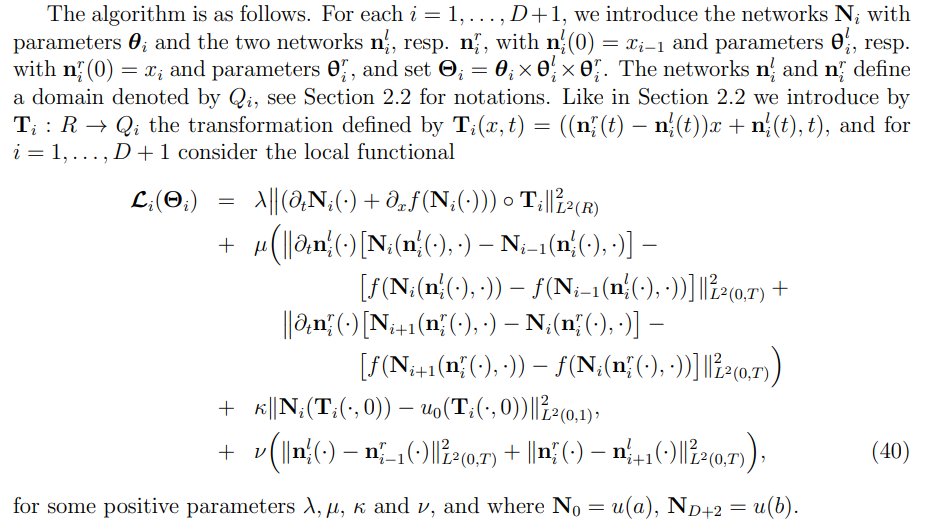
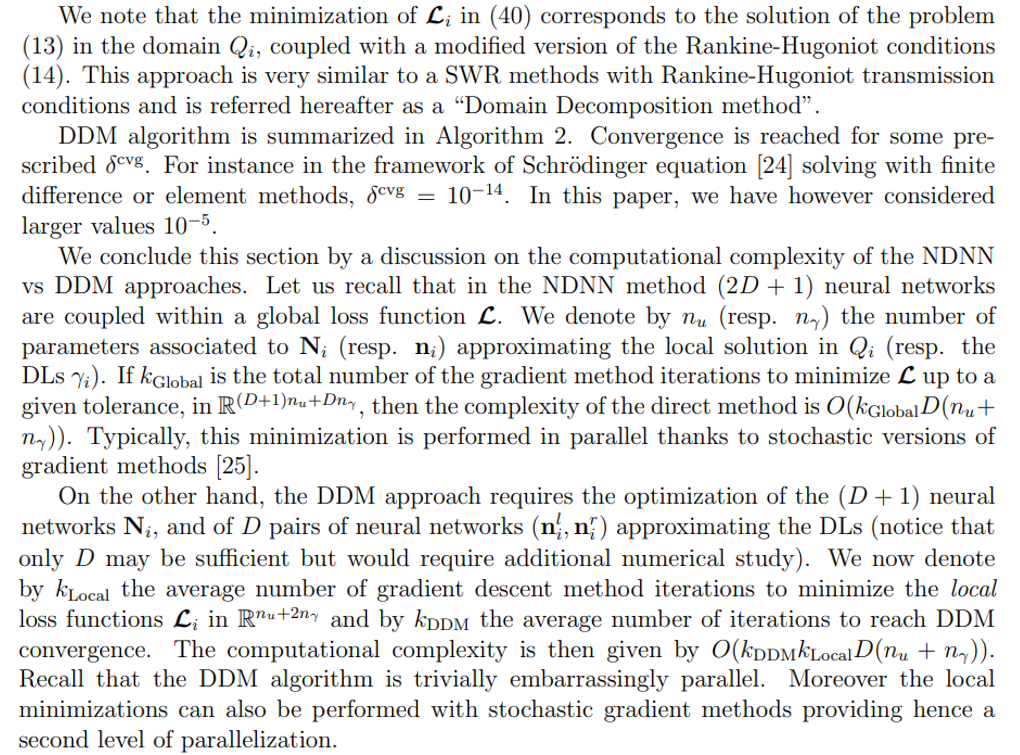
Rather than minimizing the global loss function (21) (or (12), (36)), we here propose to decouple the optimization of the neural networks, and make it scalable. The approach is closely connected to domain decomposition methods (DDMs) Schwarz Waveform Relaxation (SWR) methods [21, 22, 23]. The resulting algorithm allows for embarrassingly parallel computation of minimization of local loss functions.

\ \
\ \ \
\ \ \
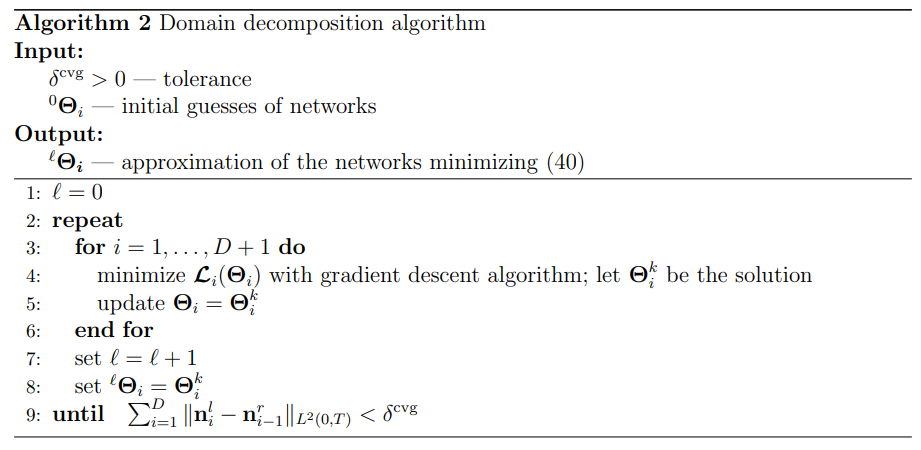
\ \ In conclusion, the DDM becomes relevant thanks to its scalability and for kDDMkLocal < kGlobal, which is expected for D large.

\

:::info Authors:

(1) Emmanuel LORIN, School of Mathematics and Statistics, Carleton University, Ottawa, Canada, K1S 5B6 and Centre de Recherches Mathematiques, Universit´e de Montr´eal, Montreal, Canada, H3T 1J4 (elorin@math.carleton.ca);

(2) Arian NOVRUZI, a Corresponding Author from Department of Mathematics and Statistics, University of Ottawa, Ottawa, ON K1N 6N5, Canada (novruzi@uottawa.ca).

:::


:::info This paper is available on arxiv under CC by 4.0 Deed (Attribution 4.0 International) license.

:::

\

Sorumluluk Reddi: Bu sitede yeniden yayınlanan makaleler, halka açık platformlardan alınmıştır ve yalnızca bilgilendirme amaçlıdır. MEXC'nin görüşlerini yansıtmayabilir. Tüm hakları telif sahiplerine aittir. Herhangi bir içeriğin üçüncü taraf haklarını ihlal ettiğini düşünüyorsanız, kaldırılması için lütfen service@support.mexc.com ile iletişime geçin. MEXC, içeriğin doğruluğu, eksiksizliği veya güncelliği konusunda hiçbir garanti vermez ve sağlanan bilgilere dayalı olarak alınan herhangi bir eylemden sorumlu değildir. İçerik, finansal, yasal veya diğer profesyonel tavsiye niteliğinde değildir ve MEXC tarafından bir tavsiye veya onay olarak değerlendirilmemelidir.

Ayrıca Şunları da Beğenebilirsiniz

The Channel Factories We’ve Been Waiting For

The Channel Factories We’ve Been Waiting For

The post The Channel Factories We’ve Been Waiting For appeared on BitcoinEthereumNews.com. Visions of future technology are often prescient about the broad strokes while flubbing the details. The tablets in “2001: A Space Odyssey” do indeed look like iPads, but you never see the astronauts paying for subscriptions or wasting hours on Candy Crush.  Channel factories are one vision that arose early in the history of the Lightning Network to address some challenges that Lightning has faced from the beginning. Despite having grown to become Bitcoin’s most successful layer-2 scaling solution, with instant and low-fee payments, Lightning’s scale is limited by its reliance on payment channels. Although Lightning shifts most transactions off-chain, each payment channel still requires an on-chain transaction to open and (usually) another to close. As adoption grows, pressure on the blockchain grows with it. The need for a more scalable approach to managing channels is clear. Channel factories were supposed to meet this need, but where are they? In 2025, subnetworks are emerging that revive the impetus of channel factories with some new details that vastly increase their potential. They are natively interoperable with Lightning and achieve greater scale by allowing a group of participants to open a shared multisig UTXO and create multiple bilateral channels, which reduces the number of on-chain transactions and improves capital efficiency. Achieving greater scale by reducing complexity, Ark and Spark perform the same function as traditional channel factories with new designs and additional capabilities based on shared UTXOs.  Channel Factories 101 Channel factories have been around since the inception of Lightning. A factory is a multiparty contract where multiple users (not just two, as in a Dryja-Poon channel) cooperatively lock funds in a single multisig UTXO. They can open, close and update channels off-chain without updating the blockchain for each operation. Only when participants leave or the factory dissolves is an on-chain transaction…
Paylaş
BitcoinEthereumNews2025/09/18 00:09
American Bitcoin’s $5B Nasdaq Debut Puts Trump-Backed Miner in Crypto Spotlight

American Bitcoin’s $5B Nasdaq Debut Puts Trump-Backed Miner in Crypto Spotlight

The post American Bitcoin’s $5B Nasdaq Debut Puts Trump-Backed Miner in Crypto Spotlight appeared on BitcoinEthereumNews.com. Key Takeaways: American Bitcoin (ABTC) surged nearly 85% on its Nasdaq debut, briefly reaching a $5B valuation. The Trump family, alongside Hut 8 Mining, controls 98% of the newly merged crypto-mining entity. Eric Trump called Bitcoin “modern-day gold,” predicting it could reach $1 million per coin. American Bitcoin, a fast-rising crypto mining firm with strong political and institutional backing, has officially entered Wall Street. After merging with Gryphon Digital Mining, the company made its Nasdaq debut under the ticker ABTC, instantly drawing global attention to both its stock performance and its bold vision for Bitcoin’s future. Read More: Trump-Backed Crypto Firm Eyes Asia for Bold Bitcoin Expansion Nasdaq Debut: An Explosive First Day ABTC’s first day of trading proved as dramatic as expected. Shares surged almost 85% at the open, touching a peak of $14 before settling at lower levels by the close. That initial spike valued the company around $5 billion, positioning it as one of 2025’s most-watched listings. At the last session, ABTC has been trading at $7.28 per share, which is a small positive 2.97% per day. Although the price has decelerated since opening highs, analysts note that the company has been off to a strong start and early investor activity is a hard-to-find feat in a newly-launched crypto mining business. According to market watchers, the listing comes at a time of new momentum in the digital asset markets. With Bitcoin trading above $110,000 this quarter, American Bitcoin’s entry comes at a time when both institutional investors and retail traders are showing heightened interest in exposure to Bitcoin-linked equities. Ownership Structure: Trump Family and Hut 8 at the Helm Its management and ownership set up has increased the visibility of the company. The Trump family and the Canadian mining giant Hut 8 Mining jointly own 98 percent…
Paylaş
BitcoinEthereumNews2025/09/18 01:33