A new type of atomic arbitrage is becoming the main source of transactions on the Solana chain. Now, one out of every two transactions on the Solana chain may be used for atomic arbitrage.A new type of atomic arbitrage is becoming the main source of transactions on the Solana chain. Now, one out of every two transactions on the Solana chain may be used for atomic arbitrage.

Solana presents a new way to play MEV, with atomic arbitrage accounting for half of the transactions. Is it a hidden vault or a new sickle?

2025/05/07 15:42

Author: Frank, PANews

As various DEXs began to provide personalized priority fee options and anti-sandwich measures, the income from sandwich attacks on Solana has declined significantly. As of May 6, this figure has dropped to 582 SOLs, while a few months ago, the average daily income of a single sandwich attack robot could basically reach 10,000 SOLs. But this is not the end of MEV, a new type of atomic arbitrage is becoming the main source of transactions on the Solana chain.

According to data from sandwiched.me, the proportion of atomic arbitrage on the chain has reached an exaggerated level. On April 8, the tip ratio contributed by atomic arbitrage reached 74.12%, and at other times, it basically remained above 50%. In other words, now for every two transactions on the Solana chain, one may be used for atomic arbitrage.
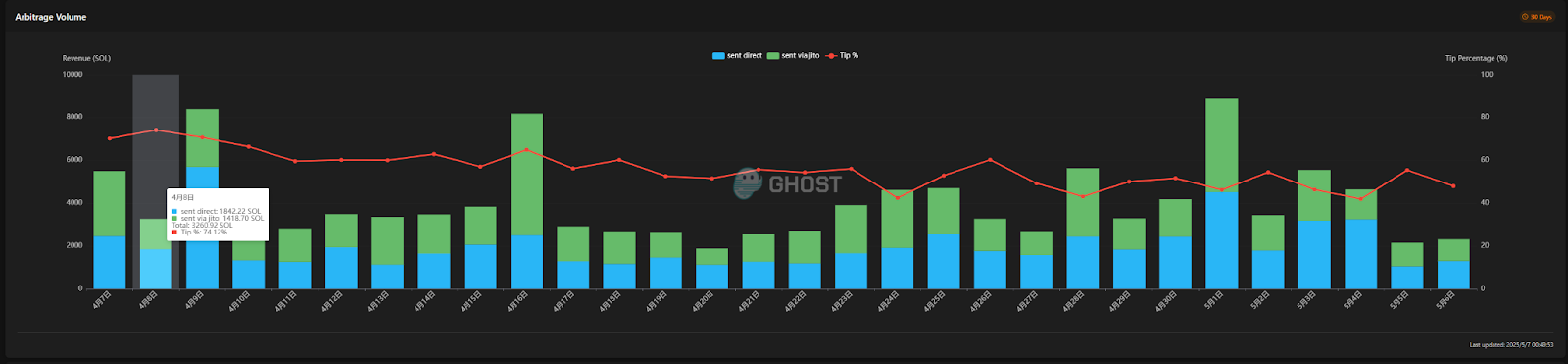
Solana presents a new way to play MEV, with atomic arbitrage accounting for half of the transactions. Is it a hidden vault or a new sickle?

But there is almost no discussion of atomic arbitrage on social media. Is this new type of arbitrage opportunity a hidden treasure trove or just another fancy sickle?

Atomic arbitrage, a new way of trading MEV

First, let's understand what atomic arbitrage is? Atomic arbitrage refers to the execution of multiple-step arbitrage operations in a single, atomic blockchain transaction. Typical atomic arbitrage involves buying an asset at a lower price on a decentralized exchange (DEX) and then selling the asset at a higher price on another DEX in the same transaction. Since the entire process is encapsulated in a single atomic transaction, it naturally eliminates the counterparty risk and part of the execution risk present in traditional cross-exchange arbitrage or non-atomic arbitrage. If the transaction is successful, the profit will be locked in; if the transaction fails, in addition to the loss of transaction fees, the arbitrageur's asset status will be restored to its original state, and there will be no situation where only the purchase is completed but the sale is not completed.

Atomicity is not a feature designed for arbitrage, but a fundamental property inherent in blockchain to ensure state consistency. Arbitrageurs cleverly exploit this guarantee to bundle operations (buy, sell) that originally need to be executed step by step and carry execution risks into one atomic unit, thereby eliminating execution risks at the technical level.

In the past, sandwich attacks or automated trading robots focused on finding profitable opportunities in the same trading pair. They then sandwiched the opponent's transactions in the middle by means of packaged transactions or simply sent transactions one after another to create opportunities. Atomic arbitrage is essentially also a packaged transaction method, but it focuses more on finding price differences in multiple trading pools to obtain arbitrage opportunities.

The myth of huge profits and the cruel reality

Judging from the current data, this kind of atomic arbitrage seems to have a good profit margin. In the past month, atomic arbitrage on the Solana chain has made a profit of 120,000 SOL (worth about 17 million US dollars), and the address with the most profit only spent 128.53 SOL, and the profit reached 14,129 SOL, with a return rate of 109 times. The largest single profit only cost 1.76 SOL and earned 1,354 SOL, with a single return rate of 769 times.
Solana presents a new way to play MEV, with atomic arbitrage accounting for half of the transactions. Is it a hidden vault or a new sickle?

There are currently 5,656 atomic arbitrage robots in the statistics, with an average profit of 24.48 SOL (3,071 USD) per address and an average cost of about 870 USD. Although this value is not as high as the previous sandwich attacker, it seems to be a good business idea, after all, the monthly return rate can reach 352%.

However, it is worth noting that the costs shown here are only the costs of on-chain transactions. Atomic arbitrage requires more investment.

According to the webpage information made by a MEV developer, there are several hardware requirements for performing atomic arbitrage, including a private RPC and an 8-core 8G server. From a cost perspective, the cost of a server is between $100 and $300 per month, and the minimum cost of building a private server is about $50 per month. The overall monthly cost is around $150 to $500, and this is just the minimum threshold. In addition, in order to perform arbitrage faster, servers with multiple IP addresses are usually configured at the same time.

From an example, we can see on a certain atomic arbitrage deployment website that only 15 addresses have earned more than 1 SOL in the past week, with the largest being 15 SOL. The other addresses have earned less than 1 SOL in the past week, and many are in a loss-making state. If we take into account the server and node costs, basically all the robots on this platform may be in a loss-making state. And it can be clearly seen that many addresses have chosen to stop arbitrage.

Who is making a profit? Uncovering the mystery of arbitrage that is “guaranteed to make a profit”

Of course, reality seems to conflict with big data. From the overall data, the robots that perform atomic arbitrage on Solana are still profitable. This is also difficult to escape the constraints of the "80/20 rule". A few high-level arbitrage robots have obtained a lot of profits. The others are still reduced to new leeks.

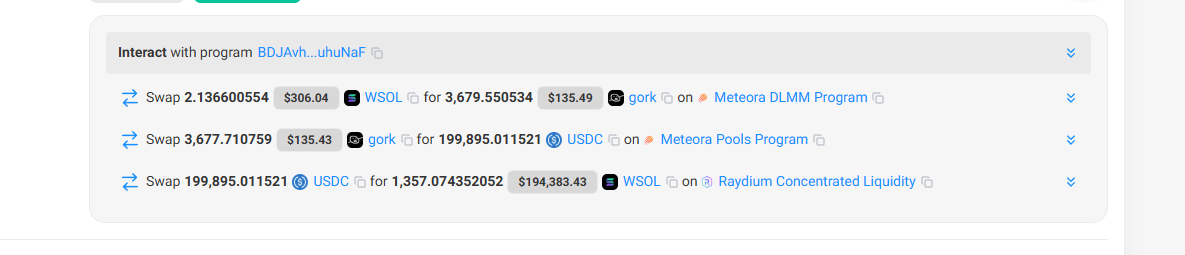
Looking back at the overall logic of atomic arbitrage, it is not difficult to find that the most important point to achieve profitability is to find arbitrage opportunities. Taking the most profitable arbitrage as an example, this transaction initially used 2.13 SOL to purchase 3,679 grok tokens (at a unit price of about $0.08), and then sold them for $199,000 (at a unit price of about $54.36). Obviously, the success of this arbitrage also seized the loophole of scarce liquidity in a certain trading pool, and was paid by a large investor who did not pay attention to the depth of the pool.

Solana presents a new way to play MEV, with atomic arbitrage accounting for half of the transactions. Is it a hidden vault or a new sickle?

But in essence, such opportunities are rare, and since almost all robots on the chain are eyeing similar opportunities, such occasional large arbitrage opportunities are more like winning the lottery.

The recent rise of atomic arbitrage may be due to some developers packaging this arbitrage opportunity as a sure-win business and developing a free version for novice users to use for free, and providing tutorials. They only receive 10% of the profits when the arbitrage is profitable. In addition, these teams also charge subscription fees by assisting in setting up nodes and servers, and providing more IP services.

In fact, since most users do not have a deep understanding of the technology and use similar arbitrage opportunity monitoring tools, the profits they make are not much and cannot cover the basic expenses.

According to PANews’ observation, unless you have a certain technical foundation, unique arbitrage opportunity monitoring tools, and high-performance servers and nodes, most players who want to participate in atomic arbitrage are simply being cheated by buying servers and subscription fees instead of being cut from speculating in coins. And as more and more people participate, the probability of this arbitrage failure is also increasing. Take the highest-yielding program on sandwiched.me as an example. The program’s current transaction failure rate has reached more than 99%, which means that basically all transactions have failed, and the participating robots still have to pay on-chain fees.
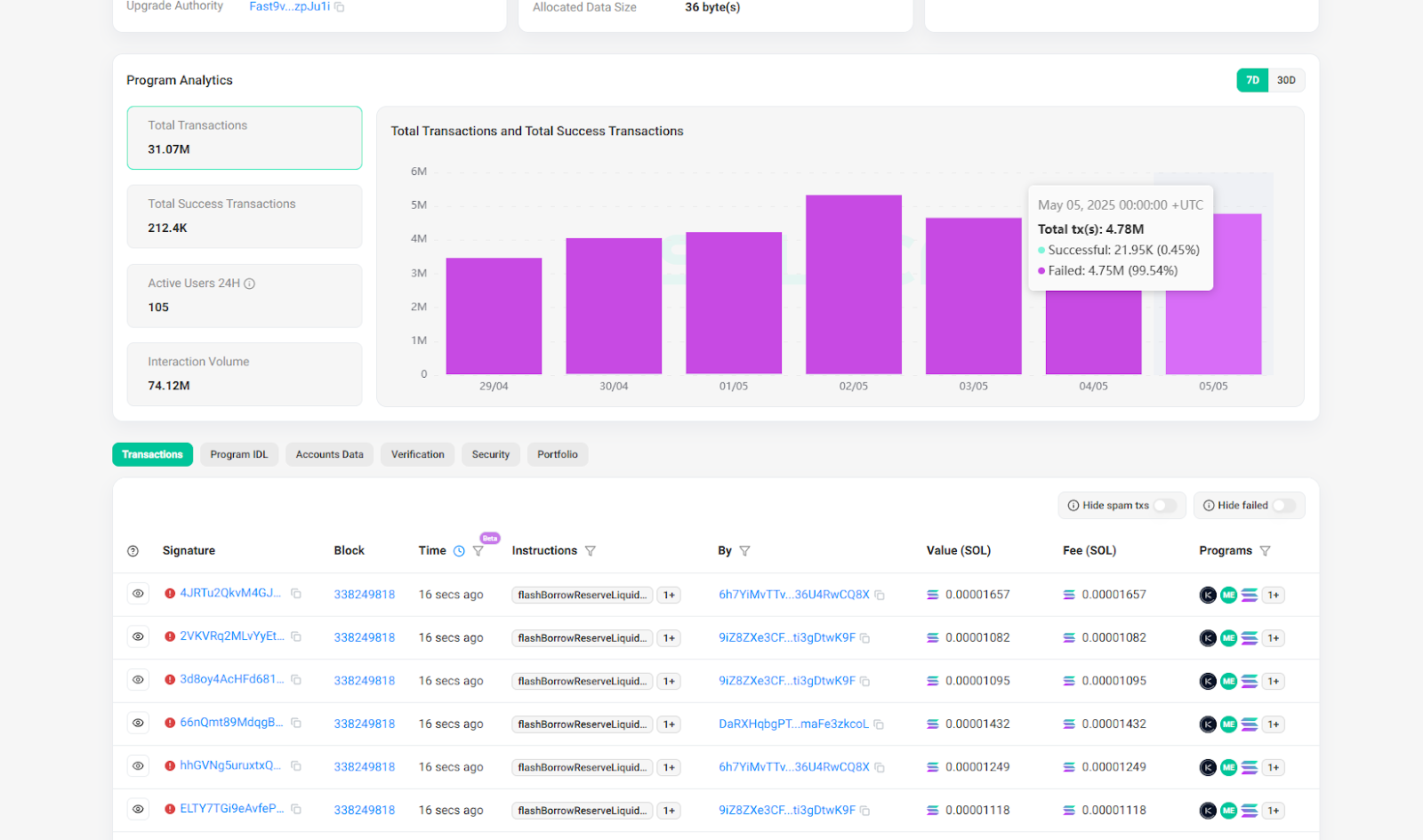
Solana presents a new way to play MEV, with atomic arbitrage accounting for half of the transactions. Is it a hidden vault or a new sickle?

Before plunging into this seemingly tempting wave of "atomic arbitrage", every potential participant should keep a clear head, fully evaluate their own resources and capabilities, be wary of over-packaged promises of "guaranteed profits", and avoid becoming another wave of leeks in this new "gold rush".

Piyasa Fırsatı
PlaysOut Logosu
PlaysOut Fiyatı(PLAY)
$0.03173
$0.03173$0.03173
-0.87%
USD
PlaysOut (PLAY) Canlı Fiyat Grafiği
Sorumluluk Reddi: Bu sitede yeniden yayınlanan makaleler, halka açık platformlardan alınmıştır ve yalnızca bilgilendirme amaçlıdır. MEXC'nin görüşlerini yansıtmayabilir. Tüm hakları telif sahiplerine aittir. Herhangi bir içeriğin üçüncü taraf haklarını ihlal ettiğini düşünüyorsanız, kaldırılması için lütfen service@support.mexc.com ile iletişime geçin. MEXC, içeriğin doğruluğu, eksiksizliği veya güncelliği konusunda hiçbir garanti vermez ve sağlanan bilgilere dayalı olarak alınan herhangi bir eylemden sorumlu değildir. İçerik, finansal, yasal veya diğer profesyonel tavsiye niteliğinde değildir ve MEXC tarafından bir tavsiye veya onay olarak değerlendirilmemelidir.

Ayrıca Şunları da Beğenebilirsiniz

South Korea Launches Innovative Stablecoin Initiative

South Korea Launches Innovative Stablecoin Initiative

The post South Korea Launches Innovative Stablecoin Initiative appeared on BitcoinEthereumNews.com. South Korea has witnessed a pivotal development in its cryptocurrency landscape with BDACS introducing the nation’s first won-backed stablecoin, KRW1, built on the Avalanche network. This stablecoin is anchored by won assets stored at Woori Bank in a 1:1 ratio, ensuring high security. Continue Reading:South Korea Launches Innovative Stablecoin Initiative Source: https://en.bitcoinhaber.net/south-korea-launches-innovative-stablecoin-initiative
Paylaş
BitcoinEthereumNews2025/09/18 17:54
Trump Cancels Tech, AI Trade Negotiations With The UK

Trump Cancels Tech, AI Trade Negotiations With The UK

The US pauses a $41B UK tech and AI deal as trade talks stall, with disputes over food standards, market access, and rules abroad.   The US has frozen a major tech
Paylaş
LiveBitcoinNews2025/12/17 01:00
Summarize Any Stock’s Earnings Call in Seconds Using FMP API

Summarize Any Stock’s Earnings Call in Seconds Using FMP API

Turn lengthy earnings call transcripts into one-page insights using the Financial Modeling Prep APIPhoto by Bich Tran Earnings calls are packed with insights. They tell you how a company performed, what management expects in the future, and what analysts are worried about. The challenge is that these transcripts often stretch across dozens of pages, making it tough to separate the key takeaways from the noise. With the right tools, you don’t need to spend hours reading every line. By combining the Financial Modeling Prep (FMP) API with Groq’s lightning-fast LLMs, you can transform any earnings call into a concise summary in seconds. The FMP API provides reliable access to complete transcripts, while Groq handles the heavy lifting of distilling them into clear, actionable highlights. In this article, we’ll build a Python workflow that brings these two together. You’ll see how to fetch transcripts for any stock, prepare the text, and instantly generate a one-page summary. Whether you’re tracking Apple, NVIDIA, or your favorite growth stock, the process works the same — fast, accurate, and ready whenever you are. Fetching Earnings Transcripts with FMP API The first step is to pull the raw transcript data. FMP makes this simple with dedicated endpoints for earnings calls. If you want the latest transcripts across the market, you can use the stable endpoint /stable/earning-call-transcript-latest. For a specific stock, the v3 endpoint lets you request transcripts by symbol, quarter, and year using the pattern: https://financialmodelingprep.com/api/v3/earning_call_transcript/{symbol}?quarter={q}&year={y}&apikey=YOUR_API_KEY here’s how you can fetch NVIDIA’s transcript for a given quarter: import requestsAPI_KEY = "your_api_key"symbol = "NVDA"quarter = 2year = 2024url = f"https://financialmodelingprep.com/api/v3/earning_call_transcript/{symbol}?quarter={quarter}&year={year}&apikey={API_KEY}"response = requests.get(url)data = response.json()# Inspect the keysprint(data.keys())# Access transcript contentif "content" in data[0]: transcript_text = data[0]["content"] print(transcript_text[:500]) # preview first 500 characters The response typically includes details like the company symbol, quarter, year, and the full transcript text. If you aren’t sure which quarter to query, the “latest transcripts” endpoint is the quickest way to always stay up to date. Cleaning and Preparing Transcript Data Raw transcripts from the API often include long paragraphs, speaker tags, and formatting artifacts. Before sending them to an LLM, it helps to organize the text into a cleaner structure. Most transcripts follow a pattern: prepared remarks from executives first, followed by a Q&A session with analysts. Separating these sections gives better control when prompting the model. In Python, you can parse the transcript and strip out unnecessary characters. A simple way is to split by markers such as “Operator” or “Question-and-Answer.” Once separated, you can create two blocks — Prepared Remarks and Q&A — that will later be summarized independently. This ensures the model handles each section within context and avoids missing important details. Here’s a small example of how you might start preparing the data: import re# Example: using the transcript_text we fetched earliertext = transcript_text# Remove extra spaces and line breaksclean_text = re.sub(r'\s+', ' ', text).strip()# Split sections (this is a heuristic; real-world transcripts vary slightly)if "Question-and-Answer" in clean_text: prepared, qna = clean_text.split("Question-and-Answer", 1)else: prepared, qna = clean_text, ""print("Prepared Remarks Preview:\n", prepared[:500])print("\nQ&A Preview:\n", qna[:500]) With the transcript cleaned and divided, you’re ready to feed it into Groq’s LLM. Chunking may be necessary if the text is very long. A good approach is to break it into segments of a few thousand tokens, summarize each part, and then merge the summaries in a final pass. Summarizing with Groq LLM Now that the transcript is clean and split into Prepared Remarks and Q&A, we’ll use Groq to generate a crisp one-pager. The idea is simple: summarize each section separately (for focus and accuracy), then synthesize a final brief. Prompt design (concise and factual) Use a short, repeatable template that pushes for neutral, investor-ready language: You are an equity research analyst. Summarize the following earnings call sectionfor {symbol} ({quarter} {year}). Be factual and concise.Return:1) TL;DR (3–5 bullets)2) Results vs. guidance (what improved/worsened)3) Forward outlook (specific statements)4) Risks / watch-outs5) Q&A takeaways (if present)Text:<<<{section_text}>>> Python: calling Groq and getting a clean summary Groq provides an OpenAI-compatible API. Set your GROQ_API_KEY and pick a fast, high-quality model (e.g., a Llama-3.1 70B variant). We’ll write a helper to summarize any text block, then run it for both sections and merge. import osimport textwrapimport requestsGROQ_API_KEY = os.environ.get("GROQ_API_KEY") or "your_groq_api_key"GROQ_BASE_URL = "https://api.groq.com/openai/v1" # OpenAI-compatibleMODEL = "llama-3.1-70b" # choose your preferred Groq modeldef call_groq(prompt, temperature=0.2, max_tokens=1200): url = f"{GROQ_BASE_URL}/chat/completions" headers = { "Authorization": f"Bearer {GROQ_API_KEY}", "Content-Type": "application/json", } payload = { "model": MODEL, "messages": [ {"role": "system", "content": "You are a precise, neutral equity research analyst."}, {"role": "user", "content": prompt}, ], "temperature": temperature, "max_tokens": max_tokens, } r = requests.post(url, headers=headers, json=payload, timeout=60) r.raise_for_status() return r.json()["choices"][0]["message"]["content"].strip()def build_prompt(section_text, symbol, quarter, year): template = """ You are an equity research analyst. Summarize the following earnings call section for {symbol} ({quarter} {year}). Be factual and concise. Return: 1) TL;DR (3–5 bullets) 2) Results vs. guidance (what improved/worsened) 3) Forward outlook (specific statements) 4) Risks / watch-outs 5) Q&A takeaways (if present) Text: <<< {section_text} >>> """ return textwrap.dedent(template).format( symbol=symbol, quarter=quarter, year=year, section_text=section_text )def summarize_section(section_text, symbol="NVDA", quarter="Q2", year="2024"): if not section_text or section_text.strip() == "": return "(No content found for this section.)" prompt = build_prompt(section_text, symbol, quarter, year) return call_groq(prompt)# Example usage with the cleaned splits from Section 3prepared_summary = summarize_section(prepared, symbol="NVDA", quarter="Q2", year="2024")qna_summary = summarize_section(qna, symbol="NVDA", quarter="Q2", year="2024")final_one_pager = f"""# {symbol} Earnings One-Pager — {quarter} {year}## Prepared Remarks — Key Points{prepared_summary}## Q&A Highlights{qna_summary}""".strip()print(final_one_pager[:1200]) # preview Tips that keep quality high: Keep temperature low (≈0.2) for factual tone. If a section is extremely long, chunk at ~5–8k tokens, summarize each chunk with the same prompt, then ask the model to merge chunk summaries into one section summary before producing the final one-pager. If you also fetched headline numbers (EPS/revenue, guidance) earlier, prepend them to the prompt as brief context to help the model anchor on the right outcomes. Building the End-to-End Pipeline At this point, we have all the building blocks: the FMP API to fetch transcripts, a cleaning step to structure the data, and Groq LLM to generate concise summaries. The final step is to connect everything into a single workflow that can take any ticker and return a one-page earnings call summary. The flow looks like this: Input a stock ticker (for example, NVDA). Use FMP to fetch the latest transcript. Clean and split the text into Prepared Remarks and Q&A. Send each section to Groq for summarization. Merge the outputs into a neatly formatted earnings one-pager. Here’s how it comes together in Python: def summarize_earnings_call(symbol, quarter, year, api_key, groq_key): # Step 1: Fetch transcript from FMP url = f"https://financialmodelingprep.com/api/v3/earning_call_transcript/{symbol}?quarter={quarter}&year={year}&apikey={api_key}" resp = requests.get(url) resp.raise_for_status() data = resp.json() if not data or "content" not in data[0]: return f"No transcript found for {symbol} {quarter} {year}" text = data[0]["content"] # Step 2: Clean and split clean_text = re.sub(r'\s+', ' ', text).strip() if "Question-and-Answer" in clean_text: prepared, qna = clean_text.split("Question-and-Answer", 1) else: prepared, qna = clean_text, "" # Step 3: Summarize with Groq prepared_summary = summarize_section(prepared, symbol, quarter, year) qna_summary = summarize_section(qna, symbol, quarter, year) # Step 4: Merge into final one-pager return f"""# {symbol} Earnings One-Pager — {quarter} {year}## Prepared Remarks{prepared_summary}## Q&A Highlights{qna_summary}""".strip()# Example runprint(summarize_earnings_call("NVDA", 2, 2024, API_KEY, GROQ_API_KEY)) With this setup, generating a summary becomes as simple as calling one function with a ticker and date. You can run it inside a notebook, integrate it into a research workflow, or even schedule it to trigger after each new earnings release. Free Stock Market API and Financial Statements API... Conclusion Earnings calls no longer need to feel overwhelming. With the Financial Modeling Prep API, you can instantly access any company’s transcript, and with Groq LLM, you can turn that raw text into a sharp, actionable summary in seconds. This pipeline saves hours of reading and ensures you never miss the key results, guidance, or risks hidden in lengthy remarks. Whether you track tech giants like NVIDIA or smaller growth stocks, the process is the same — fast, reliable, and powered by the flexibility of FMP’s data. Summarize Any Stock’s Earnings Call in Seconds Using FMP API was originally published in Coinmonks on Medium, where people are continuing the conversation by highlighting and responding to this story
Paylaş
Medium2025/09/18 14:40