The article explores the inner workings of Bitcoin’s transaction fee system, focusing on how miners prioritize transactions, how mempools manage unconfirmed ones, and how fees are determined based on network congestion and confirmation times. It explains why transaction fees fluctuate, how miners maximize profit by choosing higher-fee transactions, and presents a framework for estimating fees relative to expected confirmation durations—offering insight into the economic and technical dynamics of the Bitcoin blockchain.The article explores the inner workings of Bitcoin’s transaction fee system, focusing on how miners prioritize transactions, how mempools manage unconfirmed ones, and how fees are determined based on network congestion and confirmation times. It explains why transaction fees fluctuate, how miners maximize profit by choosing higher-fee transactions, and presents a framework for estimating fees relative to expected confirmation durations—offering insight into the economic and technical dynamics of the Bitcoin blockchain.

Estimating Bitcoin Transaction Fees Based on Confirmation Time

2025/10/21 09:03

Abstract and 1. Introduction

  1. Preliminaries
  2. Problem definition
  3. BtcFlow
  4. Bitcoin Core (BCore)
  5. Mempool state and linear perceptron machine learning (MSLP)
  6. Fee estimation based on neural network (FENN)
  7. Experiments
  8. Conclusion, Acknowledgements, and References

2 Preliminaries

Proposed in 2008, the Bitcoin blockchain system as a decentralized digital currency payment system operates on a worldwide basis [24]. Even though different cryptocurrencies, such as Ethereum (ETH) [34], Dash[7], Ripple (XRP) [27], Litecoin[8] (LTC), have been designed, a recent study shows that Bitcoin remains the dominant cryptocurrency in terms of market capitalisation and it is the most widely supported cryptocurrency among participating exchanges, wallets and payment companies [15, 23]. Blockchain revolutionizes the way we interact, automate payments, trace and track transactions. Fundamentally, it uses an immutable linked chain of blocks to record and track transactions. [24, 26, 38].

\ Transactions in the Bitcoin system record the digital asset transfer between clients. In a transaction, the output describes the amount of digital assets to be transferred to the new owner(s), while the input identifies the digital assets to be consumed [24]. One transaction can have several inputs and outputs. Transaction fee is set with the difference between the total of input and output assets, which will be collected by miners once the transaction is confirmed. Consequently, miners often choose transactions with larger transaction fees to maximise their mining profits. As a result, the transaction fee has to be increased to help with transaction confirmation by increasing the processing priority. Transaction feerate measures the fee density of a transaction or the transaction fee per size unit. In fact, each time only a limited number of transactions can be confirmed, hence miners would prioritise transactions with higher feeratess in order to increase mining profits.

\ Transactions can be submitted to the blockchain network via the Bitcoin wallets (desktop wallet, mobile wallet, web wallet, paper wallet, etc.) [24]. The submitted pending transactions are then broadcast across various nodes. If they meet the transactions’ validity criteria [2], Bitcoin nodes will add them to their mempools (memory pools), where transactions wait until they can be included (mined) into a block. Miners are the nodes responsible for the verification and block construction. Specifically, miners first select unconfirmed transactions from the mempool to construct their own candidate blocks, and then compete to determine a computational solution (Proof of Work (Pow)) to attach their candidature block to the blockchain (referred to as ‘mining a block’). Among all the miners, only the first miner who solves this computational issue will be rewarded with a fixed Bitcoin reward from the blockchain system plus transaction fees from the chosen transactions. Once a new block is added to the blockchain, these transactions are confirmed and will then be removed from the miner’s mempool.

\ A transaction is complete when it is recorded in a blockchain block. The block stores information about the selected transactions, as well as information about the mining complexity, block size, etc. In the meantime, the Bitcoin blockchain system keeps track of the generation time of each block.

3 Problem definition

The paper targets on estimating the transaction fee for a transaction with a given expected confirmation time (time between entering mempool and confirmed in the blockchain). As for the starting timestamp of confirmation time, a more realistic and meaningful choice could be the submission time for a transaction. We make our decision on using the entering mempool time mainly for two reasons. The first one is that the submission timestamp is unavailable. The second one is that the entering time is more reasonable. In the blockchain system, there can be different kinds of time delays between transaction submission and transaction entering the mempool, such as the propagation routine among network nodes, network traffic, etc. However, once the transactions enter the mempool, it means that they will start to compete to be included in the next block.

\ \
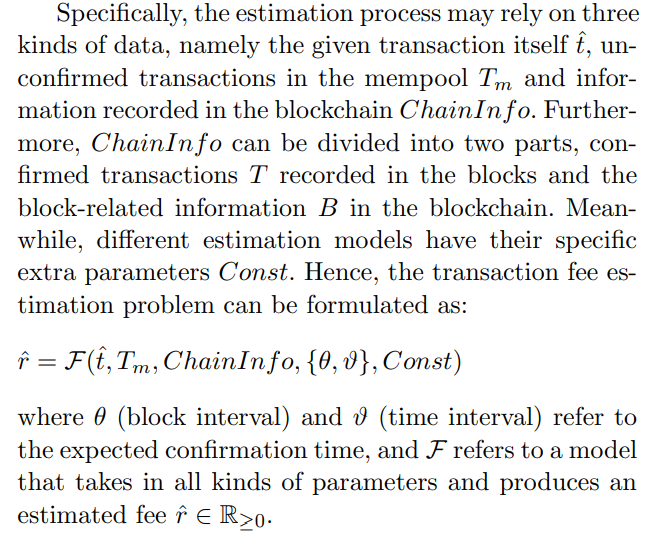
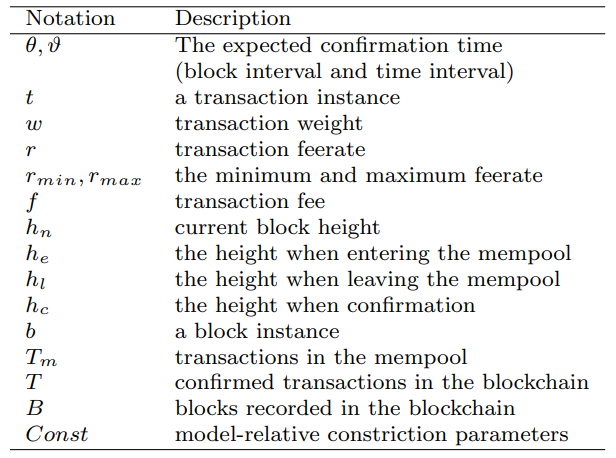
\ \ Table 1 summarizes the parameters of the three categories information used in different transactions fee models presented in this paper. In Section 8, we will compare the performance of these models with their respective features. The main notations used in this paper can be found in Table 2.

\ \ Table 2: Main notations
\ \ \

:::info Authors:

(1) Limeng Zhang, Swinburne University of Technology, Melbourne, Australia (limengzhang@swin.edu.au);

(2) Rui Zhou Swinburne, University of Technology, Melbourne, Australia (rzhou@swin.edu.au);

(3) Qing Liu, Data61, CSIRO, Hobart, Australia (q.liu@data61.csiro.au);

(4) Chengfei Liu, Swinburne University of Technology, Melbourne, Australia (cliu@swin.edu.au);

(5) M.Ali Babar, The University of Adelaide, Adelaide, Australia (ali.babar@adelaide.edu.au).

:::


:::info This paper is available on arxiv under CC0 1.0 UNIVERSAL license.

:::

[7] https://www.dash.org/

\ [8] https://litecoin.org/

Piyasa Fırsatı
WHY Logosu
WHY Fiyatı(WHY)
$0.00000001529
$0.00000001529$0.00000001529
-11.46%
USD
WHY (WHY) Canlı Fiyat Grafiği
Sorumluluk Reddi: Bu sitede yeniden yayınlanan makaleler, halka açık platformlardan alınmıştır ve yalnızca bilgilendirme amaçlıdır. MEXC'nin görüşlerini yansıtmayabilir. Tüm hakları telif sahiplerine aittir. Herhangi bir içeriğin üçüncü taraf haklarını ihlal ettiğini düşünüyorsanız, kaldırılması için lütfen service@support.mexc.com ile iletişime geçin. MEXC, içeriğin doğruluğu, eksiksizliği veya güncelliği konusunda hiçbir garanti vermez ve sağlanan bilgilere dayalı olarak alınan herhangi bir eylemden sorumlu değildir. İçerik, finansal, yasal veya diğer profesyonel tavsiye niteliğinde değildir ve MEXC tarafından bir tavsiye veya onay olarak değerlendirilmemelidir.

Ayrıca Şunları da Beğenebilirsiniz

The Channel Factories We’ve Been Waiting For

The Channel Factories We’ve Been Waiting For

The post The Channel Factories We’ve Been Waiting For appeared on BitcoinEthereumNews.com. Visions of future technology are often prescient about the broad strokes while flubbing the details. The tablets in “2001: A Space Odyssey” do indeed look like iPads, but you never see the astronauts paying for subscriptions or wasting hours on Candy Crush.  Channel factories are one vision that arose early in the history of the Lightning Network to address some challenges that Lightning has faced from the beginning. Despite having grown to become Bitcoin’s most successful layer-2 scaling solution, with instant and low-fee payments, Lightning’s scale is limited by its reliance on payment channels. Although Lightning shifts most transactions off-chain, each payment channel still requires an on-chain transaction to open and (usually) another to close. As adoption grows, pressure on the blockchain grows with it. The need for a more scalable approach to managing channels is clear. Channel factories were supposed to meet this need, but where are they? In 2025, subnetworks are emerging that revive the impetus of channel factories with some new details that vastly increase their potential. They are natively interoperable with Lightning and achieve greater scale by allowing a group of participants to open a shared multisig UTXO and create multiple bilateral channels, which reduces the number of on-chain transactions and improves capital efficiency. Achieving greater scale by reducing complexity, Ark and Spark perform the same function as traditional channel factories with new designs and additional capabilities based on shared UTXOs.  Channel Factories 101 Channel factories have been around since the inception of Lightning. A factory is a multiparty contract where multiple users (not just two, as in a Dryja-Poon channel) cooperatively lock funds in a single multisig UTXO. They can open, close and update channels off-chain without updating the blockchain for each operation. Only when participants leave or the factory dissolves is an on-chain transaction…
Paylaş
BitcoinEthereumNews2025/09/18 00:09
SOLANA NETWORK Withstands 6 Tbps DDoS Without Downtime

SOLANA NETWORK Withstands 6 Tbps DDoS Without Downtime

The post SOLANA NETWORK Withstands 6 Tbps DDoS Without Downtime appeared on BitcoinEthereumNews.com. In a pivotal week for crypto infrastructure, the Solana network
Paylaş
BitcoinEthereumNews2025/12/16 20:44
Crucial Fed Rate Cut: October Probability Surges to 94%

Crucial Fed Rate Cut: October Probability Surges to 94%

BitcoinWorld Crucial Fed Rate Cut: October Probability Surges to 94% The financial world is buzzing with a significant development: the probability of a Fed rate cut in October has just seen a dramatic increase. This isn’t just a minor shift; it’s a monumental change that could ripple through global markets, including the dynamic cryptocurrency space. For anyone tracking economic indicators and their impact on investments, this update from the U.S. interest rate futures market is absolutely crucial. What Just Happened? Unpacking the FOMC Statement’s Impact Following the latest Federal Open Market Committee (FOMC) statement, market sentiment has decisively shifted. Before the announcement, the U.S. interest rate futures market had priced in a 71.6% chance of an October rate cut. However, after the statement, this figure surged to an astounding 94%. This jump indicates that traders and analysts are now overwhelmingly confident that the Federal Reserve will lower interest rates next month. Such a high probability suggests a strong consensus emerging from the Fed’s latest communications and economic outlook. A Fed rate cut typically means cheaper borrowing costs for businesses and consumers, which can stimulate economic activity. But what does this really signify for investors, especially those in the digital asset realm? Why is a Fed Rate Cut So Significant for Markets? When the Federal Reserve adjusts interest rates, it sends powerful signals across the entire financial ecosystem. A rate cut generally implies a more accommodative monetary policy, often enacted to boost economic growth or combat deflationary pressures. Impact on Traditional Markets: Stocks: Lower interest rates can make borrowing cheaper for companies, potentially boosting earnings and making stocks more attractive compared to bonds. Bonds: Existing bonds with higher yields might become more valuable, but new bonds will likely offer lower returns. Dollar Strength: A rate cut can weaken the U.S. dollar, making exports cheaper and potentially benefiting multinational corporations. Potential for Cryptocurrency Markets: The cryptocurrency market, while often seen as uncorrelated, can still react significantly to macro-economic shifts. A Fed rate cut could be interpreted as: Increased Risk Appetite: With traditional investments offering lower returns, investors might seek higher-yielding or more volatile assets like cryptocurrencies. Inflation Hedge Narrative: If rate cuts are perceived as a precursor to inflation, assets like Bitcoin, often dubbed “digital gold,” could gain traction as an inflation hedge. Liquidity Influx: A more accommodative monetary environment generally means more liquidity in the financial system, some of which could flow into digital assets. Looking Ahead: What Could This Mean for Your Portfolio? While the 94% probability for a Fed rate cut in October is compelling, it’s essential to consider the nuances. Market probabilities can shift, and the Fed’s ultimate decision will depend on incoming economic data. Actionable Insights: Stay Informed: Continue to monitor economic reports, inflation data, and future Fed statements. Diversify: A diversified portfolio can help mitigate risks associated with sudden market shifts. Assess Risk Tolerance: Understand how a potential rate cut might affect your specific investments and adjust your strategy accordingly. This increased likelihood of a Fed rate cut presents both opportunities and challenges. It underscores the interconnectedness of traditional finance and the emerging digital asset space. Investors should remain vigilant and prepared for potential volatility. The financial landscape is always evolving, and the significant surge in the probability of an October Fed rate cut is a clear signal of impending change. From stimulating economic growth to potentially fueling interest in digital assets, the implications are vast. Staying informed and strategically positioned will be key as we approach this crucial decision point. The market is now almost certain of a rate cut, and understanding its potential ripple effects is paramount for every investor. Frequently Asked Questions (FAQs) Q1: What is the Federal Open Market Committee (FOMC)? A1: The FOMC is the monetary policymaking body of the Federal Reserve System. It sets the federal funds rate, which influences other interest rates and economic conditions. Q2: How does a Fed rate cut impact the U.S. dollar? A2: A rate cut typically makes the U.S. dollar less attractive to foreign investors seeking higher returns, potentially leading to a weakening of the dollar against other currencies. Q3: Why might a Fed rate cut be good for cryptocurrency? A3: Lower interest rates can reduce the appeal of traditional investments, encouraging investors to seek higher returns in alternative assets like cryptocurrencies. It can also be seen as a sign of increased liquidity or potential inflation, benefiting assets like Bitcoin. Q4: Is a 94% probability a guarantee of a rate cut? A4: While a 94% probability is very high, it is not a guarantee. Market probabilities reflect current sentiment and data, but the Federal Reserve’s final decision will depend on all available economic information leading up to their meeting. Q5: What should investors do in response to this news? A5: Investors should stay informed about economic developments, review their portfolio diversification, and assess their risk tolerance. Consider how potential changes in interest rates might affect different asset classes and adjust strategies as needed. Did you find this analysis helpful? Share this article with your network to keep others informed about the potential impact of the upcoming Fed rate cut and its implications for the financial markets! To learn more about the latest crypto market trends, explore our article on key developments shaping Bitcoin price action. This post Crucial Fed Rate Cut: October Probability Surges to 94% first appeared on BitcoinWorld.
Paylaş
Coinstats2025/09/18 02:25