

How Ankit Agrawal built InsuranceDekho, one district at a time
Sometime in 2016, while on a visit to Ballia for a land transfer, Ankit Agrawal asked his taxi driver about the car's insurance (‘gadi ka bima’). The driver’s repeated reference to LIC made it clear to Agrawal that the former had no clue about what he was asking about, and also that the car taking him from the Patna airport didn’t have insurance.
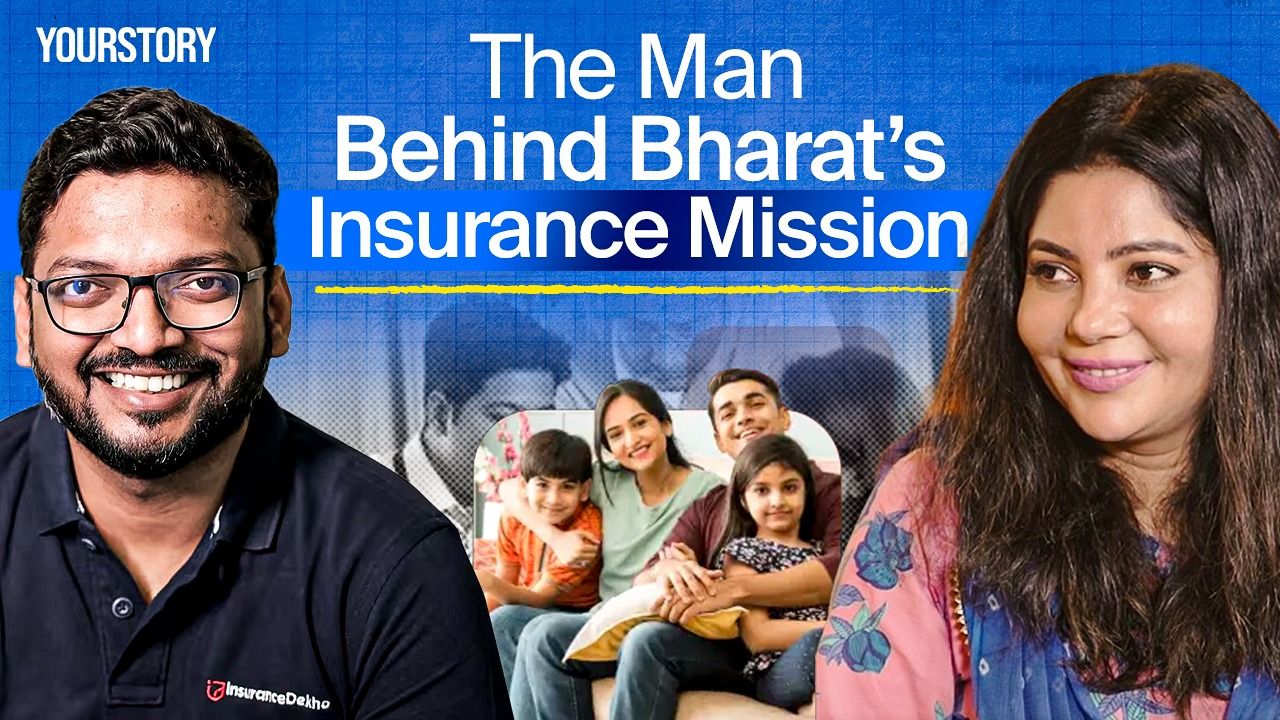
The insight for Agrawal from this little exchange with the cab driver was as follows: “Agar woh compulsory product ke liye nahin hai toh jo non-compulsory product hai jaise health ho gaya, life ho gaya toh problem ho gaye (If that's the case for a compulsory product, then for non-compulsory products like health and life, there will be problems),” said Agrawal, recalling in a conversation with YourStory founder & CEO Shradha Sharma about the opportunity he saw while co-founding InsuranceDekho the same year.
The reason for InsuranceDekho was this: while the 60 or so insurance companies have created many good products, they have not been able to deliver them to the last mile. Agrawal decided to build exactly that.
Today, InsuranceDekho has about 3 lakh agents, covering 98% of the pincodes in the country. Each month, these agents sell a total of 10-15 lakh policies. “We are very clear in another 5 years we have to cover all 600,000 villages in the country,” said Agrawal.
The distribution mode
Gurugram-based InsuranceDekho, which Agrawal co-founded with Amit Jain and Ish Babar, had two options: either go direct-to-consumer, create a B2C company like Zepto, or create an offline network where “we connect many brothers and sisters with us”.
The second option involved training agents, who will then go village-to-village, house-to-house, explaining to people why insurance is necessary on the way to selling it.
InsuranceDekho chose the second option. Agrawal said, “That was a more tenable business to build because I believe in today's world distribution is the only mode.”
He said, “Bharat (In India) mein jo prakritik aapda hai woh badhne lag gayi hai (the natural calamities are starting to increase). So, we worked with insurance companies to create a product and take that product to the masses.”
After recurring flooding in Jammu & Kashmir, for instance, he said, InsuranceDekho’s agents were one of the first insurance distributors to tell people why buying a home insurance is important.
Covid was “an inflection point” for the business. Indians believe “humko kuchh nahin hoga (Nothing will happen to us),” he said. The pandemic challenged this notion, and a lot of peole started taking health insurance. Then, seeing others around them lose their lives and leave their family without any protection, people started getting life insurance.
Agrawal credited the Government for the sustained push in taking insurance down to a village level as also the regulator for making sure that the end-consumer is getting the value that they are paying for.
The cockroach mentality
Agrawal’s childhood was spent partly in Bihar (he moved to West Bengal later), when 15-16-hour daily powercuts were the norm and a generator used to power a fan and a bulb in his house. It was a big joint family. And they ran a clothes shop as well as a small jewellery outlet.
His grandfather used to promise Agrawal and his cousins that whoever makes the first sale of the day will be given sweets in the evening. “That lalach (greed) for sweets used to make us good salesmen,” said Agrawal, in a lighter vein.
Though life then was difficult and he had to struggle for basic necessities, Agrawal said he is thankful for growing up in Bihar. “Bihar ne mere andar se dar nikal diya (Bihar took the fear out of me),” he said, adding he is now unafraid of anything. “Kuch bhi hota main kehta hun, ‘dekh lenge’ (Whatever happens, I just say, "We'll handle it").
“We lived in a loving environment, a caring environment but not in a environment where we were over protected. So that helped us get a lot of experiences.” This helped him in the entrepreneurship journey, during which he has tried everything from event management to T-shirt selling. “I have been a hustler. And I have done whatever I had to do to survive,” said Agrawal, invoking what he refers to as the ‘cockroach mentality’.
“Because mera manna hai (my belief is) ki jo tikta hai wahi banata hai (that the one who stays/lasts is the one who makes it). If you keep surviving and if you keep turning up every day, you are ahead of 99.99% of people in the world.”
It’s digital and offline
Adaptability and survival form the philosophical basis of InsuranceDekho too. “Jo aaj hum hai kal hum rahe na rahe (Whether we are here today or not here tomorrow) that business survives the test of time. And that is what we built in insurance.”
Agrawal said offline channels will remain relevant for a long time in the country. “This is a country where digital will also thrive, where a mix of digital plus offline will also thrive, and where pure offline will also thrive,” said he, adding that large parts of India will still need a mix of online and offline for at least the next 10 to 15 years.
He said there are sectors such as health insurance where the trust factor needs to be high. “Digital systems can help reduce friction. But wherever you need human interface, aapko vahan pe logon ki jarurat padegi (you will need people there).”
InsuranceDekho first launched its team in all state capitals. In phase two, it opened in all major towns. In phase three, slowed down by the pandemic, the company started operating in all towns. And now, it’s trying to be present in every district, a goal to be met in two years. In five years, Agrawal wants InsuranceDekho to cover all the villages.
Manifesting success
Agrawal, a fan of the Bhagawad Gita, said he believes in the power of manifestation—“I keep manifesting that at one day I will stand in the Rajya Sabha and I will be giving a speech”. He prays in the temple for 5 minutes everyday, thanking God for everything. “Dada ji mere ko ek hi cheej sikhate the ki (and grandfather used to teach me only one thing, that) Bhagwan ko hamesha thank you bolo (always say thank you to God). Jo bhi hua tumko nahin pata aur kya ho sakta tha (whatever happened, you don't know what else could have happened).”
His way of dealing with this immensely competitive business is to be in touch with the end user. And so, every quarter, he picks 10 partners (jinka main personal RM hota hun—“I become their personal relationship manager”) with whom he has daily conversations. “Not everyone will give you good feedback, but if you keep listening, you’ll keep improving.”
“You have to like being boring,” he said. “Success comes from showing up every day. Bas har din uth kar aa jaana hai (You just have to wake up and show up every day).”
Edited by Sriram Srinivasan
Ayrıca Şunları da Beğenebilirsiniz

MoneyGram launches stablecoin-powered app in Colombia

WIF Price Prediction: Targeting $0.48 Recovery Within 2 Weeks as MACD Shows Bullish Divergence
