Vitalik Buterin said that the Ethereum gas futures market would allow developers, traders, and institutions to hedge against fee volatility. The proposal comes as Ethereum prepares for major scaling upgrades, including a 5x increase in the gas limit. Vitalik Buterin, the co-founder of Ethereum blockchain, shared a new idea on having an on-chain futures market [...]]]>Vitalik Buterin said that the Ethereum gas futures market would allow developers, traders, and institutions to hedge against fee volatility. The proposal comes as Ethereum prepares for major scaling upgrades, including a 5x increase in the gas limit. Vitalik Buterin, the co-founder of Ethereum blockchain, shared a new idea on having an on-chain futures market [...]]]>

Vitalik Buterin Proposes Onchain Gas Futures to Stabilize Ethereum Fees

2025/12/08 15:43
  • Vitalik Buterin said that the Ethereum gas futures market would allow developers, traders, and institutions to hedge against fee volatility.
  • The proposal comes as Ethereum prepares for major scaling upgrades, including a 5x increase in the gas limit.

Vitalik Buterin, the co-founder of Ethereum blockchain, shared a new idea on having an on-chain futures market for gas. Buterin said that this will help users get some clarity over transaction fees, amid a wide network adoption.

The proposal from Buterin came while responding to questions on whether the current roadmap can ensure low gas fee. In a post on X on Saturday, Vitalik Buterin said the Ethereum ecosystem needs a “trustless on-chain gas futures market.”

He suggested that one solution would be to allow users to lock in gas prices for future periods. Buterin noted that this could be achieved through a market for Ethereum’s base fees, which form the foundation of overall transaction costs.

Vitalik Buterin Explains How Ethereum Futures Market Would Work

In the traditional futures market, participants can buy and sell assets like Gold, stocks, oil, etc., through contracts, for a predetermined price in the future. This allows for both, speculation as well as risk hedging. Bringing a similar mechanism to Ethereum would allow users to lock in gas fees for specific future time windows. This would help in preventing any potential price surges.

Vitalik Buterin believes that a reliable and mature on-chain gas futures market would be beneficial for the ecosystem. This puts a clear benchmark for planning, forecasting, and building around expected network costs. In his message on the X platform, Vitalik Buterin wrote:

Such a gas-free prediction market would offer a crucial tool for high-volume network participants such as developers, traders, applications, and institutions. Also, users can forecast and manage their operational expenses with better cost certainty.

Last month, Vitalik Buterin assured that the Ethereum blockchain would undergo a 5x surge in gas limit, as mentioned in our previous story, as part of the team’s effort to accelerate scaling and optimization. According to Ethereum Foundation researcher Toni Wahrstätter, the upgrade will increase mainnet throughput substantially.

With the gas limit rising to 60 million, each block will be able to process more transactions, on-chain activity, and smart contract executions. This shows that the network is ready to handle more complex applications.

The Drop In ETH Gas Fee

Throughout this year in 2025, the average ETH gas fee has remained low and volatile. Basic Ethereum transactions currently cost around 0.474 gwei i.e. $0.01, according to Etherscan data.

More complex operations, including token swaps, NFT trades, and cross-chain bridging, carry higher costs, averaging approximately $0.16, $0.27, and $0.05, respectively. As said, the ETH gas fee has remained fluctuating throughout 2025.

Ycharts data indicates that average transaction costs began the year at $1 before falling to around $0.30. Throughout the year, fees have moved between highs of $2.60 and lows of $0.18, underscoring the persistent volatility Buterin aims to address.
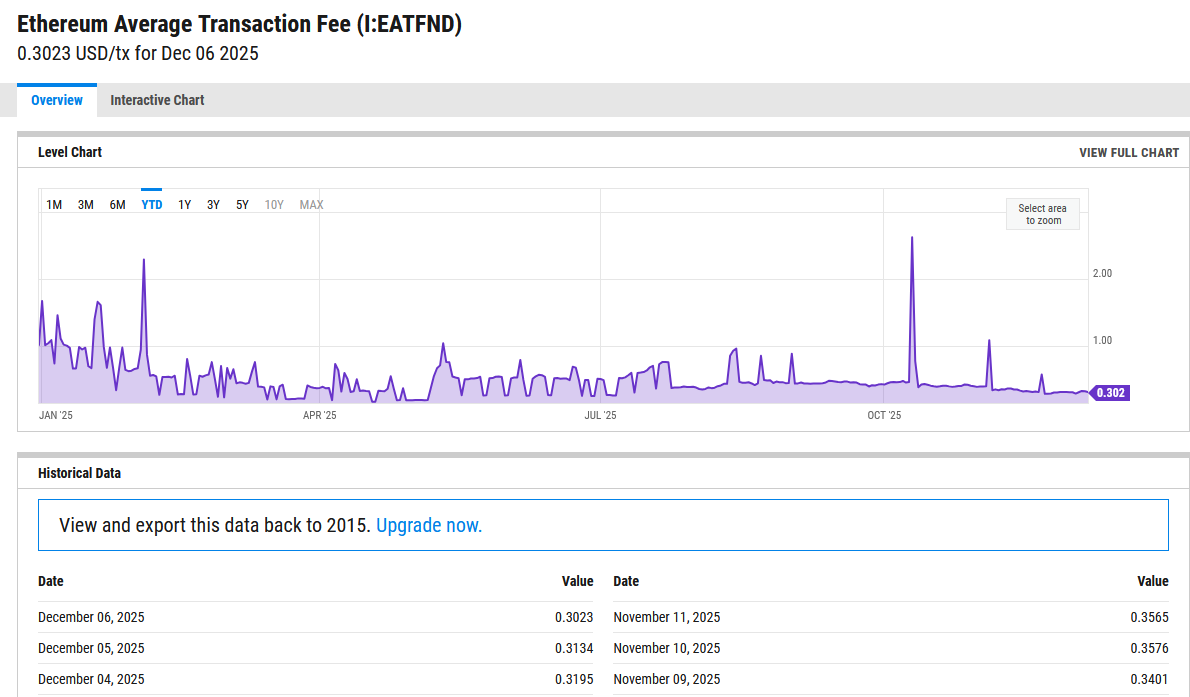
Vitalik Buterin Proposes Onchain Gas Futures to Stabilize Ethereum FeesSource: YCharts ]]>
Sorumluluk Reddi: Bu sitede yeniden yayınlanan makaleler, halka açık platformlardan alınmıştır ve yalnızca bilgilendirme amaçlıdır. MEXC'nin görüşlerini yansıtmayabilir. Tüm hakları telif sahiplerine aittir. Herhangi bir içeriğin üçüncü taraf haklarını ihlal ettiğini düşünüyorsanız, kaldırılması için lütfen service@support.mexc.com ile iletişime geçin. MEXC, içeriğin doğruluğu, eksiksizliği veya güncelliği konusunda hiçbir garanti vermez ve sağlanan bilgilere dayalı olarak alınan herhangi bir eylemden sorumlu değildir. İçerik, finansal, yasal veya diğer profesyonel tavsiye niteliğinde değildir ve MEXC tarafından bir tavsiye veya onay olarak değerlendirilmemelidir.

Ayrıca Şunları da Beğenebilirsiniz

Economic policies are chasing investors away from US – Mercer

Economic policies are chasing investors away from US – Mercer

The post Economic policies are chasing investors away from US – Mercer appeared on BitcoinEthereumNews.com. A wave of clients are shifting away from U.S. assets as investors react to President Donald Trump’s trade and interest-rate agenda, according to Mercer LLC. The consulting firm says concern over tariffs, pressure on the Federal Reserve, a swelling budget deficit and the risk of a softer dollar are pushing money to Europe, Japan and other markets. Hooman Kaveh, Mercer’s global chief investment officer, said a rising share of the firm’s 3,900 clients, together overseeing about $17 trillion, are reducing U.S. exposure. The opening weeks in the early phase of Trump’s second term “has been a trigger for genuine diversification,” he noted in an interview this week. “We’re certainly seeing that in client portfolios where flows are toward diversifying markets, geographies, asset classes, currencies.” Market nerves were evident in early April after Trump’s “Liberation Day” announcement, when both U.S. stocks and Treasuries fell before rebounding. Even so, U.S. shares have trailed many overseas benchmarks in 2025 for dollar-based investors. Kaveh said investors are struggling to price the tariff path because the effects can cut two ways: either squeeze company margins or get passed through to consumers and lift inflation. “If you have a situation where tariffs are going to push prices up, and the weaker dollar potentially can increase inflation, that would cause the Fed much more of a challenge to cut rates,” he added. As mentione in a Bloomberg report, he called the White House’s preference for a weaker dollar “the Achilles heel to the current approach” since it can magnify the inflation impulse from tariffs. Where the money is going Trump’s repeated criticism of Chair Jerome Powell, saying he has been slow to lower borrowing costs, along with the president’s move to fire Governor Lisa Cook, is further encouraging clients to step back from the U.S., according to…
Paylaş
BitcoinEthereumNews2025/09/18 13:17