NEAR Protocol reached 1 million transactions per second in benchmark tests using 70 shards, demonstrating sharding's scalability potential far beyond Visa's peak capacity. The post NEAR Achieves 1M Transactions Per Second in Sharded, Test Environment appeared first on Coinspeaker.NEAR Protocol reached 1 million transactions per second in benchmark tests using 70 shards, demonstrating sharding's scalability potential far beyond Visa's peak capacity. The post NEAR Achieves 1M Transactions Per Second in Sharded, Test Environment appeared first on Coinspeaker.

NEAR Achieves 1M Transactions Per Second in Sharded, Test Environment

2025/12/09 03:13

NEAR Protocol NEAR $1.75 24h volatility: 1.1% Market cap: $2.24 B Vol. 24h: $188.81 M has achieved a significant milestone of 1 million transactions per second (TPS) in a benchmark test environment created to simulate a real-world scenario. This development helps to demonstrate sharding is an efficient method for high scalability and throughput capacity for high-performance blockchains—surpassing Visa’s peak capacity of around 65,000 transactions per second.

The NEAR Foundation reported this recent achievement in a blog post on Dec. 8, explaining the benchmark’s methodology in “a publicly verifiable benchmark using real code, realistic workloads, and cost-effective and performant Google Compute Engine C4D machines across 70 shards,” as described.

Results are available in three Grafana dashboards that achieved 1,029,497, 1,037,334, and 1,037,495 transactions per second peaks, followed by a constant one million TPS performance for nearly one hour each.
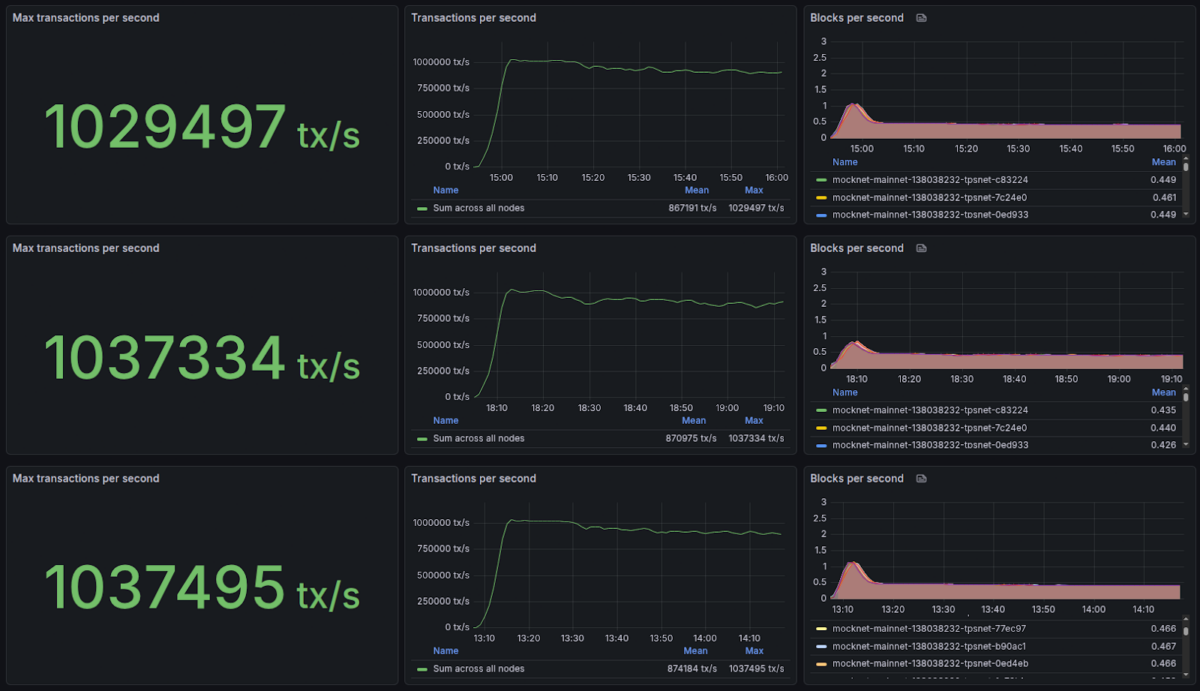
Grafana dashboards for three NEAR Protocol 1M-TPS tests | Source: NEAR Foundation/Grafana

Grafana dashboards for three NEAR Protocol 1M-TPS tests | Source: NEAR Foundation/Grafana

As described in the blog post, this benchmark had validators split in 70 shards, running commercial-grade hardware from Google Cloud, with an approximate cost of $900 per month. While accessible, this cost is significantly higher than the minimum required to run chunk validators on NEAR—currently estimated at $15 per month, according to Meta Pool’s Node Studio.

This test used only native token transfers, not broadcasting smart contract executions that require more network gas and computational power, which could reduce the overall capacity per second. Moreover, the NEAR blockchain currently has nine shards and not the 70 shards used for the tests, meaning the current mainnet capacity is likely orders of magnitude below the achieved one million transactions per second.

Nevertheless, it suggests NEAR Protocol is ready, with enough optimizations, to scale at any moment to something close to 1 million TPS with consistency and network reliability as adoptions and demand for block space grows.

How Many TPS Other Blockchains and Payment Processors Can Achieve?

Interestingly, Visa (NYSE: V) can scale to 65,000 transactions per second, according to The Banking Scene. In 2024, Visa processed an average of approximately 25,091 transactions per second globally, based on the total of roughly 293 billion payment transactions handled that year.

Data Coinspeaker gathered from Chainspect on Dec. 8 shows the theoretical maximum TPS other blockchains can achieve, based on benchmark tests like the one provided by NEAR, or rough calculations by the Chainspect analysts.

When comparing with some of the largest cryptocurrencies by market cap, Sonic, ICP, and Aptos have the largest maximum theoretical TPS after NEAR, with nearly 400,000, 210,000, and 160,000 transactions per second, respectively.

Sui SUI $1.61 24h volatility: 0.9% Market cap: $6.01 B Vol. 24h: $995.44 M , TON TON $1.63 24h volatility: 1.4% Market cap: $3.98 B Vol. 24h: $135.10 M , Polkadot DOT $2.12 24h volatility: 0.7% Market cap: $3.49 B Vol. 24h: $192.42 M , and Solana SOL $134.4 24h volatility: 1.0% Market cap: $75.38 B Vol. 24h: $5.34 B follow suit, with approximately 120,000, 105,000, 100,000, and 65,000 TPS, respectively. However, SOL is the one with the highest “Real-Time TPS” across all blockchains on Chainspect—at 1,238 transactions per second by the time of this writing.
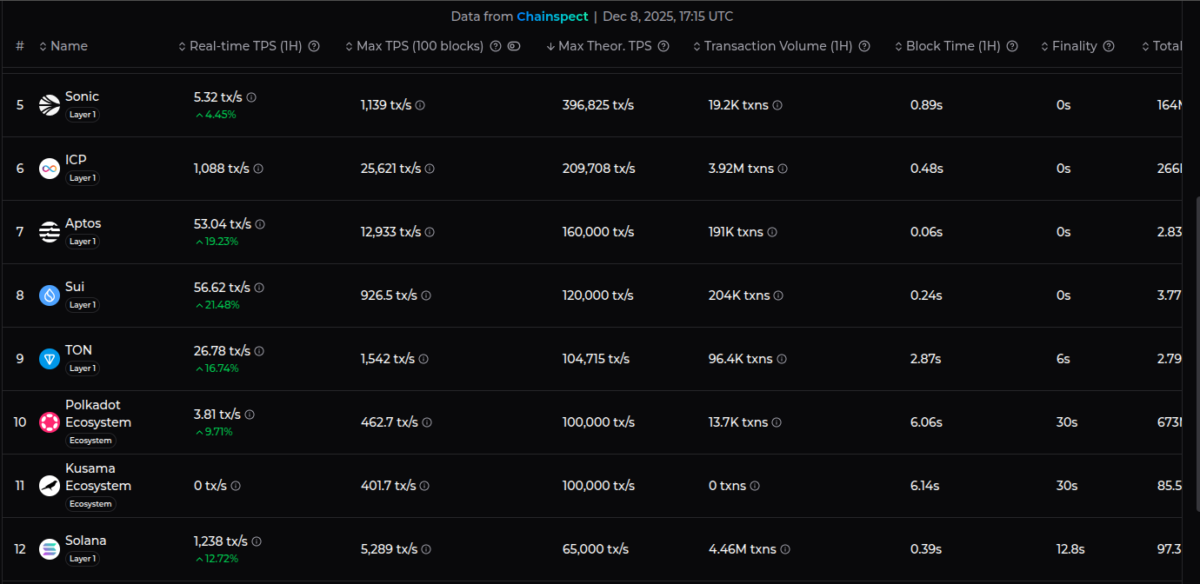
Fastest blockchains by transactions per second (TPS), as of Dec. 8 | Source: Coinspect

Fastest blockchains by transactions per second (TPS), as of Dec. 8 | Source: Coinspect

Therefore, this recent achievement positions NEAR as one of the layer-one blockchain networks with the highest theoretical capacity and scalability. This adds up to recent positive developments in the NEAR ecosystem, as Coinspeaker has covered and reported about.

On Dec. 5, NEAR launched TravAI, together with ADI Chain, where AI agents handle complete travel booking workflows from search to payment using crypto. On Dec. 3, the foundation announced NEAR AI Cloud and Private Chat, two related products that were already integrated by relevant players like the Brave Browser. Kalshi also recently added support to NEAR’s native token and NEAR Intents surpassed the $7 billion mark for its chain-abstracted swaps all-time volume.

next

The post NEAR Achieves 1M Transactions Per Second in Sharded, Test Environment appeared first on Coinspeaker.

Sorumluluk Reddi: Bu sitede yeniden yayınlanan makaleler, halka açık platformlardan alınmıştır ve yalnızca bilgilendirme amaçlıdır. MEXC'nin görüşlerini yansıtmayabilir. Tüm hakları telif sahiplerine aittir. Herhangi bir içeriğin üçüncü taraf haklarını ihlal ettiğini düşünüyorsanız, kaldırılması için lütfen service@support.mexc.com ile iletişime geçin. MEXC, içeriğin doğruluğu, eksiksizliği veya güncelliği konusunda hiçbir garanti vermez ve sağlanan bilgilere dayalı olarak alınan herhangi bir eylemden sorumlu değildir. İçerik, finansal, yasal veya diğer profesyonel tavsiye niteliğinde değildir ve MEXC tarafından bir tavsiye veya onay olarak değerlendirilmemelidir.

Ayrıca Şunları da Beğenebilirsiniz

The Channel Factories We’ve Been Waiting For

The Channel Factories We’ve Been Waiting For

The post The Channel Factories We’ve Been Waiting For appeared on BitcoinEthereumNews.com. Visions of future technology are often prescient about the broad strokes while flubbing the details. The tablets in “2001: A Space Odyssey” do indeed look like iPads, but you never see the astronauts paying for subscriptions or wasting hours on Candy Crush.  Channel factories are one vision that arose early in the history of the Lightning Network to address some challenges that Lightning has faced from the beginning. Despite having grown to become Bitcoin’s most successful layer-2 scaling solution, with instant and low-fee payments, Lightning’s scale is limited by its reliance on payment channels. Although Lightning shifts most transactions off-chain, each payment channel still requires an on-chain transaction to open and (usually) another to close. As adoption grows, pressure on the blockchain grows with it. The need for a more scalable approach to managing channels is clear. Channel factories were supposed to meet this need, but where are they? In 2025, subnetworks are emerging that revive the impetus of channel factories with some new details that vastly increase their potential. They are natively interoperable with Lightning and achieve greater scale by allowing a group of participants to open a shared multisig UTXO and create multiple bilateral channels, which reduces the number of on-chain transactions and improves capital efficiency. Achieving greater scale by reducing complexity, Ark and Spark perform the same function as traditional channel factories with new designs and additional capabilities based on shared UTXOs.  Channel Factories 101 Channel factories have been around since the inception of Lightning. A factory is a multiparty contract where multiple users (not just two, as in a Dryja-Poon channel) cooperatively lock funds in a single multisig UTXO. They can open, close and update channels off-chain without updating the blockchain for each operation. Only when participants leave or the factory dissolves is an on-chain transaction…
Paylaş
BitcoinEthereumNews2025/09/18 00:09
American Bitcoin’s $5B Nasdaq Debut Puts Trump-Backed Miner in Crypto Spotlight

American Bitcoin’s $5B Nasdaq Debut Puts Trump-Backed Miner in Crypto Spotlight

The post American Bitcoin’s $5B Nasdaq Debut Puts Trump-Backed Miner in Crypto Spotlight appeared on BitcoinEthereumNews.com. Key Takeaways: American Bitcoin (ABTC) surged nearly 85% on its Nasdaq debut, briefly reaching a $5B valuation. The Trump family, alongside Hut 8 Mining, controls 98% of the newly merged crypto-mining entity. Eric Trump called Bitcoin “modern-day gold,” predicting it could reach $1 million per coin. American Bitcoin, a fast-rising crypto mining firm with strong political and institutional backing, has officially entered Wall Street. After merging with Gryphon Digital Mining, the company made its Nasdaq debut under the ticker ABTC, instantly drawing global attention to both its stock performance and its bold vision for Bitcoin’s future. Read More: Trump-Backed Crypto Firm Eyes Asia for Bold Bitcoin Expansion Nasdaq Debut: An Explosive First Day ABTC’s first day of trading proved as dramatic as expected. Shares surged almost 85% at the open, touching a peak of $14 before settling at lower levels by the close. That initial spike valued the company around $5 billion, positioning it as one of 2025’s most-watched listings. At the last session, ABTC has been trading at $7.28 per share, which is a small positive 2.97% per day. Although the price has decelerated since opening highs, analysts note that the company has been off to a strong start and early investor activity is a hard-to-find feat in a newly-launched crypto mining business. According to market watchers, the listing comes at a time of new momentum in the digital asset markets. With Bitcoin trading above $110,000 this quarter, American Bitcoin’s entry comes at a time when both institutional investors and retail traders are showing heightened interest in exposure to Bitcoin-linked equities. Ownership Structure: Trump Family and Hut 8 at the Helm Its management and ownership set up has increased the visibility of the company. The Trump family and the Canadian mining giant Hut 8 Mining jointly own 98 percent…
Paylaş
BitcoinEthereumNews2025/09/18 01:33