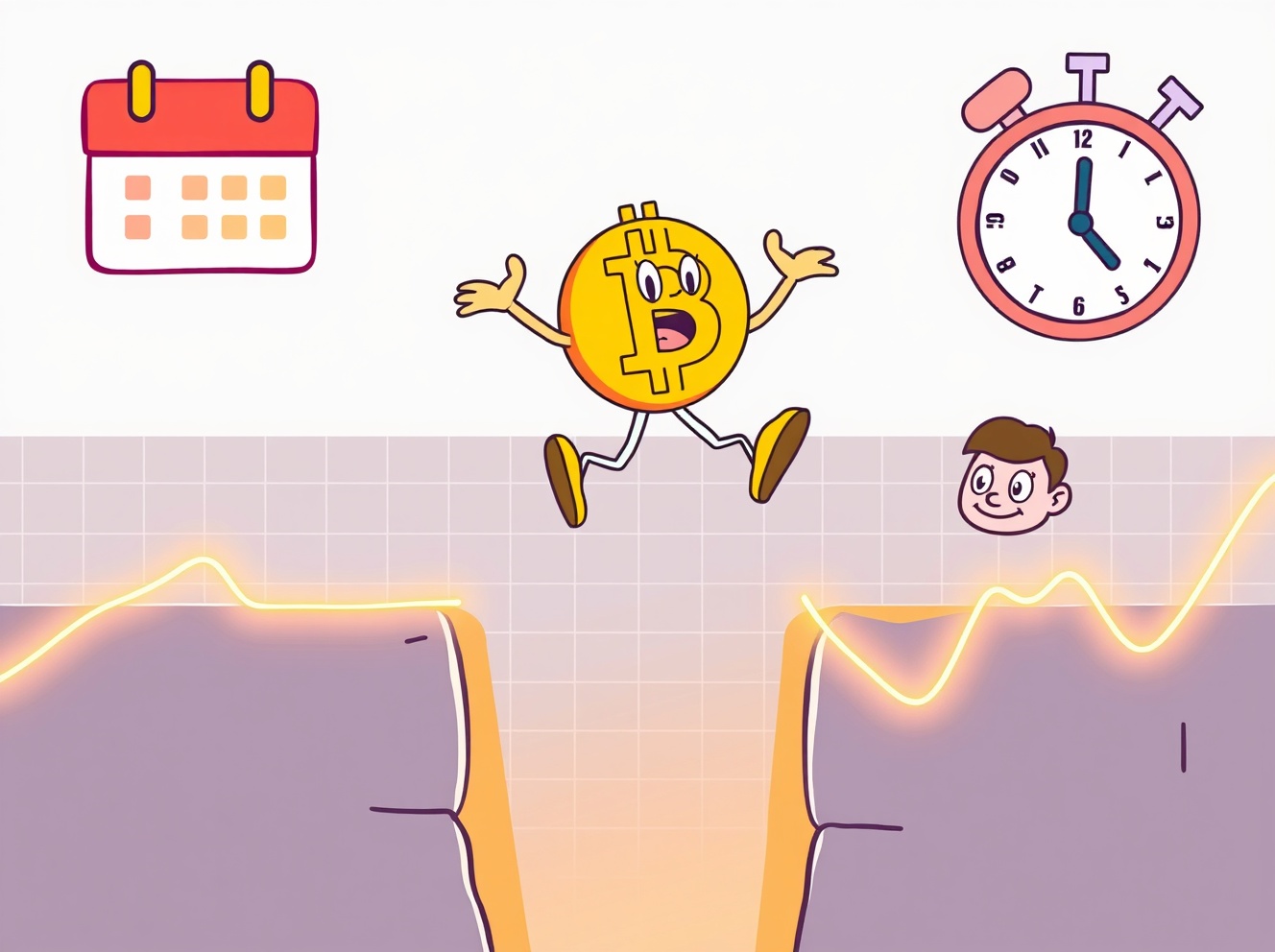
BitcoinWorld Crucial Alert: CME Bitcoin Futures Reveal a $2K Gap – What Traders Must Know Now Did you check the Bitcoin futures charts this Monday? A startlingBitcoinWorld Crucial Alert: CME Bitcoin Futures Reveal a $2K Gap – What Traders Must Know Now Did you check the Bitcoin futures charts this Monday? A startling

Crucial Alert: CME Bitcoin Futures Reveal a $2K Gap – What Traders Must Know Now
A cartoon illustrating the crucial CME Bitcoin futures gap with market characters reacting.

BitcoinWorld

Crucial Alert: CME Bitcoin Futures Reveal a $2K Gap – What Traders Must Know Now

Did you check the Bitcoin futures charts this Monday? A startling development emerged as the market opened: a massive CME Bitcoin futures gap of over $2,000. This isn’t just a minor blip—it’s a significant event that seasoned traders watch closely. Let’s break down what this gap means, why it happens, and the potential implications for your trading strategy this week.

What Exactly Is This CME Bitcoin Futures Gap?

The Chicago Mercantile Exchange (CME), where institutional players trade Bitcoin futures, closed on Friday at $90,610. When it reopened on Monday, the price had jumped down to start at $88,575. This created a void, or ‘gap,’ of approximately $2,035 on the price chart. Unlike the 24/7 Bitcoin spot market, the CME takes a weekend break. Therefore, any major price movement in the spot market over Saturday and Sunday is not reflected in the futures price until Monday’s opening bell. This disconnect is the root cause of the CME Bitcoin futures gap phenomenon.

Why Should Every Crypto Trader Care About Gaps?

Gaps are more than just empty spaces on a chart; they are zones of potential price action. Many traders operate on the theory that markets have a tendency to ‘fill’ these gaps. This means the price may eventually return to trade through the price level where the gap formed. Here’s why this matters for your portfolio:

  • Predictive Signal: A gap can indicate strong momentum from the weekend carrying into the new week.
  • Liquidity Pools: Gaps often represent areas where a high volume of stop-loss or limit orders may be clustered.
  • Institutional Sentiment: Since CME is a regulated venue for big players, its gaps can reflect institutional positioning and sentiment shifts.

Therefore, the appearance of a substantial CME Bitcoin futures gap immediately becomes a key technical level for analysts to watch.

Will This $2K Gap Fill? Analyzing the Possibilities

The critical question on every trader’s mind is simple: will the price move back up to $90,610 to close this gap? There is no guaranteed answer, but historical patterns provide clues. Gaps on significant exchanges like the CME often act as magnets for price. However, filling can happen quickly, take weeks, or in some cases, not occur at all if a powerful new trend is established. Monitoring spot market volume and broader crypto news is essential to gauge the likelihood. A sudden surge in buying pressure could see the futures price rally to fill this CME Bitcoin futures gap rapidly.

Actionable Insights for Navigating Futures Gaps

Knowing about the gap is one thing; knowing what to do is another. Here are practical steps you can take:

  • Mark Your Chart: Clearly highlight the gap zone between ~$88,575 and ~$90,610 on your trading platform.
  • Watch for Confirmation: Don’t trade on the gap alone. Look for confirming signals like increased volume or a break of key support/resistance levels near the gap area.
  • Manage Risk: If you choose to trade a potential gap fill, use strict stop-loss orders. The market may move away from the gap instead of towards it.

Remember, while the CME Bitcoin futures gap is a valuable tool, it should be one part of a comprehensive analysis that includes fundamentals and market structure.

The Bottom Line: A Signal, Not a Crystal Ball

This week’s $2,035 gap in CME Bitcoin futures is a stark reminder of the crypto market’s relentless, 24/7 nature. It highlights the disconnect between traditional finance hours and the digital asset world. For the alert trader, it provides a clear technical level to watch. Whether the gap fills swiftly or remains open will offer valuable insights into market strength and trader psychology in the days ahead. Stay vigilant, use sound risk management, and let this gap inform—not dictate—your trading decisions.

Frequently Asked Questions (FAQs)

What causes a CME Bitcoin futures gap?

Gaps form because the CME futures market is closed on weekends, while the Bitcoin spot market trades continuously. If the spot price moves significantly between Friday’s CME close and Monday’s open, a gap appears on the futures chart.

Do all CME gaps eventually get filled?

Not all gaps fill, but many do. It’s a common market phenomenon where price is often drawn back to an area of previous imbalance. However, it is not a guaranteed rule and should not be traded in isolation.

How long does it usually take for a gap to fill?

There is no set timeframe. A gap can fill within hours, days, weeks, or even longer. It depends on prevailing market trends, volume, and news events.

Should I immediately trade to profit from a gap?

Caution is advised. While gaps present a potential opportunity, trading them requires a strategy and risk management. It’s better to wait for price action confirmation near the gap levels before entering a trade.

Is a down gap (like this one) bearish?

A down gap suggests selling pressure over the weekend, which can be a short-term bearish signal. However, the subsequent action to fill (or not fill) the gap is more important for determining the overall direction.

Do gaps occur on other crypto futures exchanges?

Yes, but they are most notable on regulated, traditional market hours exchanges like the CME. Exchanges that trade 24/7 may have smaller gaps or price jumps, but not in the same defined way.

Found this breakdown of the CME Bitcoin futures gap helpful? Share this article with your network on X (Twitter) or LinkedIn to help other traders spot and understand these critical market signals!

To learn more about the latest Bitcoin trends, explore our article on key developments shaping Bitcoin price action and institutional adoption.

This post Crucial Alert: CME Bitcoin Futures Reveal a $2K Gap – What Traders Must Know Now first appeared on BitcoinWorld.

Piyasa Fırsatı
Nowchain Logosu
Nowchain Fiyatı(NOW)
$0.00243
$0.00243$0.00243
-5.81%
USD
Nowchain (NOW) Canlı Fiyat Grafiği
Sorumluluk Reddi: Bu sitede yeniden yayınlanan makaleler, halka açık platformlardan alınmıştır ve yalnızca bilgilendirme amaçlıdır. MEXC'nin görüşlerini yansıtmayabilir. Tüm hakları telif sahiplerine aittir. Herhangi bir içeriğin üçüncü taraf haklarını ihlal ettiğini düşünüyorsanız, kaldırılması için lütfen service@support.mexc.com ile iletişime geçin. MEXC, içeriğin doğruluğu, eksiksizliği veya güncelliği konusunda hiçbir garanti vermez ve sağlanan bilgilere dayalı olarak alınan herhangi bir eylemden sorumlu değildir. İçerik, finansal, yasal veya diğer profesyonel tavsiye niteliğinde değildir ve MEXC tarafından bir tavsiye veya onay olarak değerlendirilmemelidir.

Ayrıca Şunları da Beğenebilirsiniz

South Korea Launches Innovative Stablecoin Initiative

South Korea Launches Innovative Stablecoin Initiative

The post South Korea Launches Innovative Stablecoin Initiative appeared on BitcoinEthereumNews.com. South Korea has witnessed a pivotal development in its cryptocurrency landscape with BDACS introducing the nation’s first won-backed stablecoin, KRW1, built on the Avalanche network. This stablecoin is anchored by won assets stored at Woori Bank in a 1:1 ratio, ensuring high security. Continue Reading:South Korea Launches Innovative Stablecoin Initiative Source: https://en.bitcoinhaber.net/south-korea-launches-innovative-stablecoin-initiative
Paylaş
BitcoinEthereumNews2025/09/18 17:54
Trump Cancels Tech, AI Trade Negotiations With The UK

Trump Cancels Tech, AI Trade Negotiations With The UK

The US pauses a $41B UK tech and AI deal as trade talks stall, with disputes over food standards, market access, and rules abroad.   The US has frozen a major tech
Paylaş
LiveBitcoinNews2025/12/17 01:00
Summarize Any Stock’s Earnings Call in Seconds Using FMP API

Summarize Any Stock’s Earnings Call in Seconds Using FMP API

Turn lengthy earnings call transcripts into one-page insights using the Financial Modeling Prep APIPhoto by Bich Tran Earnings calls are packed with insights. They tell you how a company performed, what management expects in the future, and what analysts are worried about. The challenge is that these transcripts often stretch across dozens of pages, making it tough to separate the key takeaways from the noise. With the right tools, you don’t need to spend hours reading every line. By combining the Financial Modeling Prep (FMP) API with Groq’s lightning-fast LLMs, you can transform any earnings call into a concise summary in seconds. The FMP API provides reliable access to complete transcripts, while Groq handles the heavy lifting of distilling them into clear, actionable highlights. In this article, we’ll build a Python workflow that brings these two together. You’ll see how to fetch transcripts for any stock, prepare the text, and instantly generate a one-page summary. Whether you’re tracking Apple, NVIDIA, or your favorite growth stock, the process works the same — fast, accurate, and ready whenever you are. Fetching Earnings Transcripts with FMP API The first step is to pull the raw transcript data. FMP makes this simple with dedicated endpoints for earnings calls. If you want the latest transcripts across the market, you can use the stable endpoint /stable/earning-call-transcript-latest. For a specific stock, the v3 endpoint lets you request transcripts by symbol, quarter, and year using the pattern: https://financialmodelingprep.com/api/v3/earning_call_transcript/{symbol}?quarter={q}&year={y}&apikey=YOUR_API_KEY here’s how you can fetch NVIDIA’s transcript for a given quarter: import requestsAPI_KEY = "your_api_key"symbol = "NVDA"quarter = 2year = 2024url = f"https://financialmodelingprep.com/api/v3/earning_call_transcript/{symbol}?quarter={quarter}&year={year}&apikey={API_KEY}"response = requests.get(url)data = response.json()# Inspect the keysprint(data.keys())# Access transcript contentif "content" in data[0]: transcript_text = data[0]["content"] print(transcript_text[:500]) # preview first 500 characters The response typically includes details like the company symbol, quarter, year, and the full transcript text. If you aren’t sure which quarter to query, the “latest transcripts” endpoint is the quickest way to always stay up to date. Cleaning and Preparing Transcript Data Raw transcripts from the API often include long paragraphs, speaker tags, and formatting artifacts. Before sending them to an LLM, it helps to organize the text into a cleaner structure. Most transcripts follow a pattern: prepared remarks from executives first, followed by a Q&A session with analysts. Separating these sections gives better control when prompting the model. In Python, you can parse the transcript and strip out unnecessary characters. A simple way is to split by markers such as “Operator” or “Question-and-Answer.” Once separated, you can create two blocks — Prepared Remarks and Q&A — that will later be summarized independently. This ensures the model handles each section within context and avoids missing important details. Here’s a small example of how you might start preparing the data: import re# Example: using the transcript_text we fetched earliertext = transcript_text# Remove extra spaces and line breaksclean_text = re.sub(r'\s+', ' ', text).strip()# Split sections (this is a heuristic; real-world transcripts vary slightly)if "Question-and-Answer" in clean_text: prepared, qna = clean_text.split("Question-and-Answer", 1)else: prepared, qna = clean_text, ""print("Prepared Remarks Preview:\n", prepared[:500])print("\nQ&A Preview:\n", qna[:500]) With the transcript cleaned and divided, you’re ready to feed it into Groq’s LLM. Chunking may be necessary if the text is very long. A good approach is to break it into segments of a few thousand tokens, summarize each part, and then merge the summaries in a final pass. Summarizing with Groq LLM Now that the transcript is clean and split into Prepared Remarks and Q&A, we’ll use Groq to generate a crisp one-pager. The idea is simple: summarize each section separately (for focus and accuracy), then synthesize a final brief. Prompt design (concise and factual) Use a short, repeatable template that pushes for neutral, investor-ready language: You are an equity research analyst. Summarize the following earnings call sectionfor {symbol} ({quarter} {year}). Be factual and concise.Return:1) TL;DR (3–5 bullets)2) Results vs. guidance (what improved/worsened)3) Forward outlook (specific statements)4) Risks / watch-outs5) Q&A takeaways (if present)Text:<<<{section_text}>>> Python: calling Groq and getting a clean summary Groq provides an OpenAI-compatible API. Set your GROQ_API_KEY and pick a fast, high-quality model (e.g., a Llama-3.1 70B variant). We’ll write a helper to summarize any text block, then run it for both sections and merge. import osimport textwrapimport requestsGROQ_API_KEY = os.environ.get("GROQ_API_KEY") or "your_groq_api_key"GROQ_BASE_URL = "https://api.groq.com/openai/v1" # OpenAI-compatibleMODEL = "llama-3.1-70b" # choose your preferred Groq modeldef call_groq(prompt, temperature=0.2, max_tokens=1200): url = f"{GROQ_BASE_URL}/chat/completions" headers = { "Authorization": f"Bearer {GROQ_API_KEY}", "Content-Type": "application/json", } payload = { "model": MODEL, "messages": [ {"role": "system", "content": "You are a precise, neutral equity research analyst."}, {"role": "user", "content": prompt}, ], "temperature": temperature, "max_tokens": max_tokens, } r = requests.post(url, headers=headers, json=payload, timeout=60) r.raise_for_status() return r.json()["choices"][0]["message"]["content"].strip()def build_prompt(section_text, symbol, quarter, year): template = """ You are an equity research analyst. Summarize the following earnings call section for {symbol} ({quarter} {year}). Be factual and concise. Return: 1) TL;DR (3–5 bullets) 2) Results vs. guidance (what improved/worsened) 3) Forward outlook (specific statements) 4) Risks / watch-outs 5) Q&A takeaways (if present) Text: <<< {section_text} >>> """ return textwrap.dedent(template).format( symbol=symbol, quarter=quarter, year=year, section_text=section_text )def summarize_section(section_text, symbol="NVDA", quarter="Q2", year="2024"): if not section_text or section_text.strip() == "": return "(No content found for this section.)" prompt = build_prompt(section_text, symbol, quarter, year) return call_groq(prompt)# Example usage with the cleaned splits from Section 3prepared_summary = summarize_section(prepared, symbol="NVDA", quarter="Q2", year="2024")qna_summary = summarize_section(qna, symbol="NVDA", quarter="Q2", year="2024")final_one_pager = f"""# {symbol} Earnings One-Pager — {quarter} {year}## Prepared Remarks — Key Points{prepared_summary}## Q&A Highlights{qna_summary}""".strip()print(final_one_pager[:1200]) # preview Tips that keep quality high: Keep temperature low (≈0.2) for factual tone. If a section is extremely long, chunk at ~5–8k tokens, summarize each chunk with the same prompt, then ask the model to merge chunk summaries into one section summary before producing the final one-pager. If you also fetched headline numbers (EPS/revenue, guidance) earlier, prepend them to the prompt as brief context to help the model anchor on the right outcomes. Building the End-to-End Pipeline At this point, we have all the building blocks: the FMP API to fetch transcripts, a cleaning step to structure the data, and Groq LLM to generate concise summaries. The final step is to connect everything into a single workflow that can take any ticker and return a one-page earnings call summary. The flow looks like this: Input a stock ticker (for example, NVDA). Use FMP to fetch the latest transcript. Clean and split the text into Prepared Remarks and Q&A. Send each section to Groq for summarization. Merge the outputs into a neatly formatted earnings one-pager. Here’s how it comes together in Python: def summarize_earnings_call(symbol, quarter, year, api_key, groq_key): # Step 1: Fetch transcript from FMP url = f"https://financialmodelingprep.com/api/v3/earning_call_transcript/{symbol}?quarter={quarter}&year={year}&apikey={api_key}" resp = requests.get(url) resp.raise_for_status() data = resp.json() if not data or "content" not in data[0]: return f"No transcript found for {symbol} {quarter} {year}" text = data[0]["content"] # Step 2: Clean and split clean_text = re.sub(r'\s+', ' ', text).strip() if "Question-and-Answer" in clean_text: prepared, qna = clean_text.split("Question-and-Answer", 1) else: prepared, qna = clean_text, "" # Step 3: Summarize with Groq prepared_summary = summarize_section(prepared, symbol, quarter, year) qna_summary = summarize_section(qna, symbol, quarter, year) # Step 4: Merge into final one-pager return f"""# {symbol} Earnings One-Pager — {quarter} {year}## Prepared Remarks{prepared_summary}## Q&A Highlights{qna_summary}""".strip()# Example runprint(summarize_earnings_call("NVDA", 2, 2024, API_KEY, GROQ_API_KEY)) With this setup, generating a summary becomes as simple as calling one function with a ticker and date. You can run it inside a notebook, integrate it into a research workflow, or even schedule it to trigger after each new earnings release. Free Stock Market API and Financial Statements API... Conclusion Earnings calls no longer need to feel overwhelming. With the Financial Modeling Prep API, you can instantly access any company’s transcript, and with Groq LLM, you can turn that raw text into a sharp, actionable summary in seconds. This pipeline saves hours of reading and ensures you never miss the key results, guidance, or risks hidden in lengthy remarks. Whether you track tech giants like NVIDIA or smaller growth stocks, the process is the same — fast, reliable, and powered by the flexibility of FMP’s data. Summarize Any Stock’s Earnings Call in Seconds Using FMP API was originally published in Coinmonks on Medium, where people are continuing the conversation by highlighting and responding to this story
Paylaş
Medium2025/09/18 14:40