

Interview with Offchain Labs co-founder Ed Felten: Having worked in academia and the White House, how he shapes Arbitrum’s future path from a long-term perspective
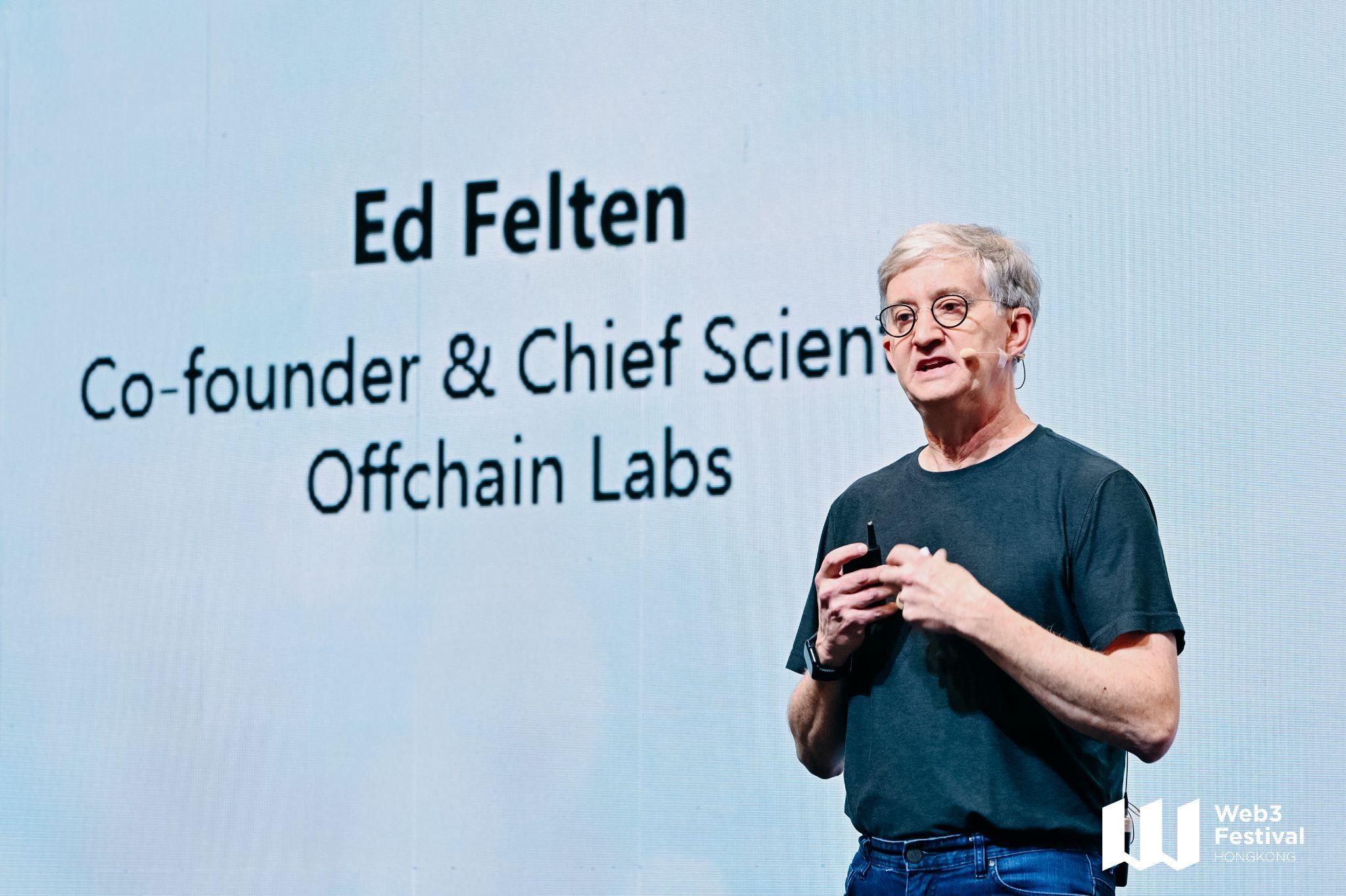
Interview: Chloe, PANews
Written by: Weilin, PANews
Ed Felten is perhaps one of the most academic entrepreneurs in the blockchain industry. He is currently the co-founder and chief scientist of Offchain Labs, and is also the core promoter of Arbitrum, the Ethereum Layer 2 expansion solution.
As early as 2003, Ed was promoted to professor of computer science at Princeton University, and in 2010 he became the first chief technology officer of the U.S. Federal Trade Commission. Since 2012, he has returned to academic positions and has been exposed to and researched Bitcoin and blockchain technology. In early 2015, Arbitrum was initially a final project in Princeton's computer course that caught Felten's eye, and Felten immediately began to study the Rollup technology route in depth. But soon after, he was invited to join the White House as deputy chief technology officer, mainly responsible for technical security affairs. After returning to academia in 2018, Felten and two doctoral students restarted the Arbitrum project, and co-founded Offchain Labs in the same year, officially pushing Arbitrum into the systematic development stage.
During the Web3 Carnival in Hong Kong, PANews interviewed Ed Felten, who shared in depth his journey from scientific research and policy to blockchain entrepreneurship, and discussed topics such as how Layer2 balances the development of the Ethereum ecosystem, the construction of Arbitrum's technical competitiveness, and the integration of AI and blockchain.
In his opinion, Ethereum does face a choice: does it want to maximize revenue for validators, or does it want to have the most users and the most active developers? At present, its strategy is to tend to develop users and developers, which is what L2 is very good at. When talking about the development path of Arbitrum, Ed mentioned that sustainable development must start with "creating value", and his role is to focus on this.
PANews: You have held important positions in academia and government agencies. What opportunity prompted you to start a blockchain business? How has your past experience influenced Offchain Labs' research direction and technical decisions?
Ed Felten: I have been a professor for many years, and during this time, I have been looking for research directions that can combine deep technical problems with social or public policy issues. When I first learned about blockchain technology through Bitcoin, I immediately thought it was a very typical example. Since about 2011, I have started to study blockchain-related topics from a purely academic perspective. I always think: What technical factors will hinder the development of this technology or prevent it from realizing its potential?
I started with the economics of chains, which was my earliest research direction, and then gradually began to focus on scalability issues. In 2014, when I learned about smart contracts, I was very excited because it reminded me of the early growth stage of the Internet - the web page went from a purely static experience of reading or browsing pictures to something interactive and programmable. When I saw smart contracts, I felt that this change would happen again and was equally important.
So I started thinking about how to scale it, which led to my initial work at Arbitrum. Then I went to work at the White House for two years, and when I came back, I met my co-founders. We started working together more formally in 2017 and 2018.
My experience as a professor has carried over in several ways. On the one hand, as a professor in a technical field, to be successful, you have to do a lot of management work, such as spending time recruiting people, managing them, managing budgets, and meeting deadlines - these skills are very useful when running a business. So running a startup is actually very similar to managing an academic research team.
But I think one thing I learned is to look at problems from a long-term perspective and focus on basic things - this is the way of thinking I developed as a professor. This also played a big role in our thinking about medium- and long-term research.
While working in the government, I came into contact with many excellent leaders. I learned some valuable lessons from them, and also learned how to build a community and how to reach consensus. I think this focus on "building a community" and "involving the community in governance" is the core of Arbitrum.
When I think about Arbitrum DAO and how it governs itself and governs the Arbitrum chains, it reminds me of how politics works.
In the early days of Arbitrum, in 2014, we had foreseen that smart contract public chains would be very important, but at the same time "scalability" would become a core challenge. Therefore, from the beginning, we took the ability to expand smart contracts as the most fundamental problem to be solved.
PANews: The current Layer2 field shows an obvious head effect, and diversification leads to fragmentation of liquidity and user experience. How do you think Layer2 projects should deal with this dilemma?
Ed Felten: Regarding your first question - whether L2 is "extractive" - I think it is not. If you look at the relationship between L2 and L1, L2 is actually the largest user of L1. L2 brings more users, more transactions and more traffic.
Taking Ethereum as an example, more than 95% of the activities are actually carried out on L2 and L3. Without these L2s, these activities will most likely be transferred to other L1s.
Of course, the data will fluctuate every day, but this ratio is always very high. L2 greatly expands the capacity of the overall Ethereum system, which would not be possible without L2.
I think the Ethereum community is as big as it is today in part because of L2. I also think L2 plays a big role in why Ethereum is still a leader in the smart contract blockchain field. I think L2 is part of the Ethereum technology stack. It is a false binary to view L2 and L1 as competing with each other - they actually work together and serve users together.
The second question is about fragmented liquidity and fragmented user experience. This is really one of the most important issues that the L2 team is focusing on solving right now. I think we will see a lot of progress in this regard.
We have a grand vision of creating a more unified user interface. Although users still need to know which chain they are using, just like you know which website you are visiting when you go online, which is important because of the difference in trust and security. But just like the Internet, you can easily jump from one website to another, and the whole experience is interconnected. I think we can also achieve this experience in the blockchain world.
But this requires us to make clever designs on the user interface and provide necessary support at the core protocol layer to achieve the interface and interaction method that users really want.
I believe we will eventually achieve this. We will usher in a smoother inter-chain experience: users holding funds on one chain can easily use these funds to operate on another chain without cumbersome clicks and complex cross-chain operations.
Of course, achieving this requires the long-term joint efforts of many teams.
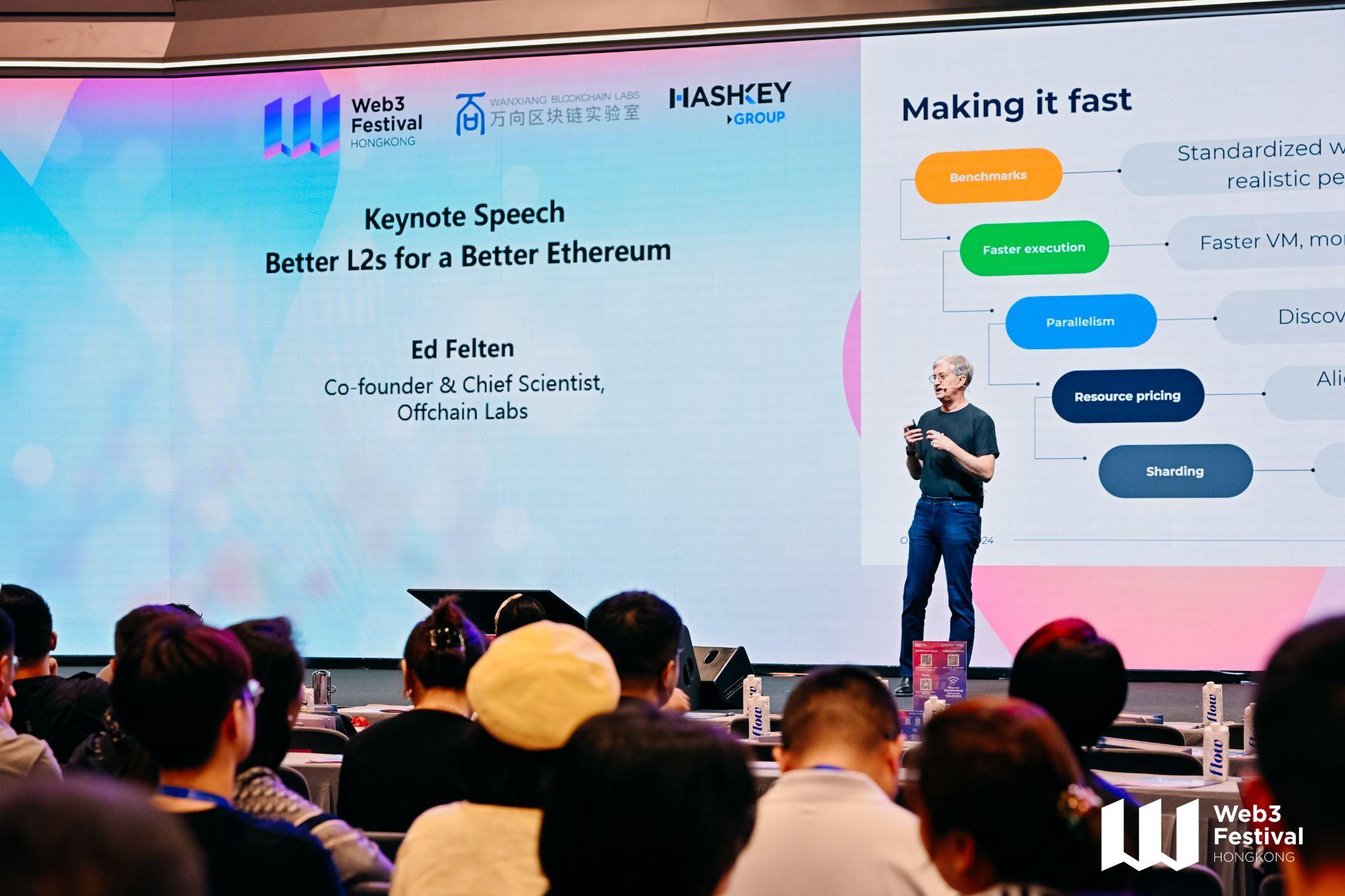
PANews: In this round of market cycle, many people attribute the decline in the economic value of the Ethereum mainnet to Layer 2, and even label it as "parasitic". What do you think? How do you think Layer 2 should balance its own development with the long-term development of the Ethereum mainnet?
Ed Felten: This really comes down to a core challenge when operating a blockchain: do you want to maximize revenue, or do you want to maximize user adoption and community size?
Because if you want to maximize revenue, you tend to shrink the network capacity and let people bid for scarce block space. And when L2 came along and expanded Ethereum's block space, I think this was actually part of Ethereum's strategy all along - to try to provide more block space.
But you can’t increase block space and want to increase prices at the same time, right? Because those two things are in conflict with each other.
In my opinion, Ethereum does face a choice: does it want to maximize revenue for validators, or does it want to have the most users and the most active developers? At present, its strategy is to develop users and developers, which is what L2 is very good at. But I think you can't have both.
PANews: Currently, Optimistic occupies the vast majority of the Layer 2 market share. Compared with technologies such as ZK, what is its core competitive advantage? How does Arbitrum ensure the long-term competitiveness of its technology stack?
Ed Felten: Compared to ZK, Optimistic rollup has two main advantages: the first is that it is simpler, and the second is that it costs less.
Specifically, it is simpler because it does not involve very complex cryptographic techniques, nor does it require a large and new tool chain to convert the program into a mathematical proof system - which is a very complicated process.
Another advantage is that the Optimistic protocol is very cheap. When using ZK, generating proofs is very expensive in itself. In the Optimistic protocol, on-chain verification is only required when a dispute occurs. If a dispute does occur, it means that one party is malicious and their stake will be confiscated. Therefore, in the Optimistic system, honest participants never have to pay for verification, which brings a huge cost advantage.
Of course, the cost of ZK is gradually decreasing. I do think we will eventually get to a stage where different chains will use a mixture of optimistic and ZK verification mechanisms. But for this mixture to happen, the cost of ZK needs to be lower than it is now.
Currently, Arbitrum only supports Optimistic. In the future, we expect to support both mechanisms at the same time, and users can freely choose based on cost or other factors.
PANews: DAO plays an increasingly important role in ecosystem governance, but it also faces challenges such as centralized decision-making, increasing voter participation, and balancing commercial interests. How will Arbitrum DAO further improve governance efficiency and maintain the principle of decentralization?
Ed Felten: Arbitrum DAO makes its own decisions. So I don't speak for Arbitrum DAO in any way, but I can talk about my personal opinion.
One thing I learned while working in government is that decision-making processes driven by public participation are both challenging and powerful. Yes, the process can be messy and sometimes slow, but I think it is very resilient. When communities reach consensus, it is possible to achieve some very ambitious things.
I think it’s still very early days. The Arbitrum DAO is different from other DAOs in that it has real power and does operate in a decentralized way. You can see different voices coming up with different viewpoints and people debating — which is healthy. This is exactly what we want to see when we hand over control of the chain to a DAO.
I think it has been generally successful, but it has faced—and will always face—some of the challenges common to governing any large and diverse group of people.
PANews: Offchain Labs recently launched Onchain Labs to support early-stage projects. Can you tell us what specific support (such as technology, funding, or market resources) will be provided to these projects? What other plans are there in the future to encourage the diversification of the Arbitrum ecosystem?
Ed Felten: I prefer to think of it as a “lightweight incubator” designed to get projects started and ensure they get funded.
One of Onchain Labs’ goals is to inspire creativity and drive rapid action.
We do not intend to exert strong guidance or control over these teams, but rather hope to help them start their projects, provide some financial support, and then let them grow autonomously.
PANews: We noticed that Arbitrum has also made arrangements in the AI track, such as proposing the Trailblazer AI agent funding plan and supporting AI projects such as ElizaOS. How do you think AI technology will revolutionize the blockchain industry? What are Arbitrum's unique advantages in AI layout?
Ed Felten: I think there are two very different ways that AI and blockchain interact.
One is the off-chain AI agents, which perform operations on behalf of users or are users of the chain themselves. For these off-chain agents, their needs are very close to those of ordinary users: they need a low-cost, reliable blockchain system. And for them, response speed is even more important than for human users. For users, a response time of 0.1 or 0.2 seconds is already very fast, but for a machine, this may be considered a "very long" delay.
When these AI agents become widely adopted, I think we’ll see a more complex and dynamic DeFi market, and some more interesting gaming applications emerge.
The next important stage is to realize AI agents on the chain, which requires stronger computing power and data processing capabilities than most current blockchains can provide.
We are working hard to both expand the capacity of the chain so that it can directly support this goal and develop dedicated support mechanisms for training, validating, and evaluating AI models on the chain.
PANews: Buyback plans are becoming a common strategy for crypto projects, but some people believe that this can only boost market confidence in the short term and is difficult to solve the fundamental problem. What are the specific considerations, long-term goals, and implementation methods of Arbitrum's buyback plan?
Ed Felten: I think my role is actually to focus on long-term growth and sustainable development. I always believe that you have to start with "creating value." If you can create value for users and create value for the community, people will naturally find ways to use and obtain this value.
So for me, as I said before, my focus is on creating value, and how to capture that value, I think should be decided by the community.
PANews: The current altcoin market is generally sluggish. In addition to buybacks, does Arbitrum have any deeper plans to enhance the intrinsic value of tokens?
This question should be answered by DAO, not me. But I think that value ultimately comes from people's willingness to participate in governance and the revenue generated on the chain. And the revenue comes from traffic and usage. Therefore, driving the growth of technology usage is the most important factor to achieve all this.
We at Offchain Labs have always viewed the development of technology and value creation from a long-term perspective. I think DAO’s position is similar.
In my opinion, DAOs are focusing on driving growth to achieve long-term value creation.
Ayrıca Şunları da Beğenebilirsiniz

The Role of Blockchain in Building Safer Web3 Gaming Ecosystems
- Immutable Ownership of Assets Blockchain records can be manipulated by anyone. If a player owns a sword, skin, or plot of land as an NFT, it is verifiably in their ownership, and it cannot be altered or deleted by the developer or even hacked. This has created a proven track record of ownership, providing control back to the players, unlike any centralised gaming platform where assets can be revoked.
- Decentralized Infrastructure Blockchain networks also have a distributed architecture where game data is stored in a worldwide network of nodes, making them much less susceptible to centralised points of failure and attacks. This decentralised approach makes it exponentially more difficult to hijack systems or even shut off the game’s economy.
- Secure Transactions with Cryptography Whether a player buys an NFT or trades their in-game tokens for other items or tokens, the transactions are enforced by cryptographic algorithms, ensuring secure, verifiable, and irreversible transactions and eliminating the risks of double-spending or fraudulent trades.
- Smart Contract Automation Smart contracts automate the enforcement of game rules and players’ economic exchanges for the developer, eliminating the need for intermediaries or middlemen, and trust for the developer. For example, if a player completes a quest that promises a reward, the smart contract will execute and distribute what was promised.
- Anti-Cheating and Fair Gameplay The naturally transparent nature of blockchain makes it extremely simple for anyone to examine a specific instance of gameplay and verify the economic outcomes from that play. Furthermore, multi-player games that enforce smart contracts on things like loot sharing or win sharing can automate and measure trustlessness and avoid cheating, manipulations, and fraud by developers.
- Cross-Platform Security Many Web3 games feature asset interoperability across platforms. This interoperability is made viable by blockchain, which guarantees ownership is maintained whenever assets transition from one game or marketplace to another, thereby offering protection to players who rely on transfers for security against fraud. Key Security Dangers in Web3 Gaming Although blockchain provides sound first principles of security, the Web3 gaming ecosystem is susceptible to threats. Some of the most serious threats include:

Will XRP Price Increase In September 2025?
