

Experiment Design: A Guide to the Goal-Question-Metric Approach
Table of Links
Abstract and 1. Introduction
2. Experiment Definition
3. Experiment Design and Conduct
3.1 Latin Square Designs
3.2 Subjects, Tasks and Objects
3.3 Conduct
3.4 Measures
4. Data Analysis
4.1 Model Assumptions
4.2 Analysis of Variance (ANOVA)
4.3 Treatment Comparisons
4.4 Effect Size and Power Analysis
5. Experiment Limitations and 5.1 Threats to the Conclusion Validity
5.2 Threats to Internal Validity
5.3 Threats to Construct Validity
5.4 Threats to External Validity
6. Discussion and 6.1 Duration
6.2 Effort
7. Conclusions and Further Work, and References
2. Experiment Definition
We use the Goal-Question-Metric approach [2] for defining the experiment. This approach facilitates to identify the object of study, purpose, quality focus, perspective and context of an experiment. We define the experiment as follows:
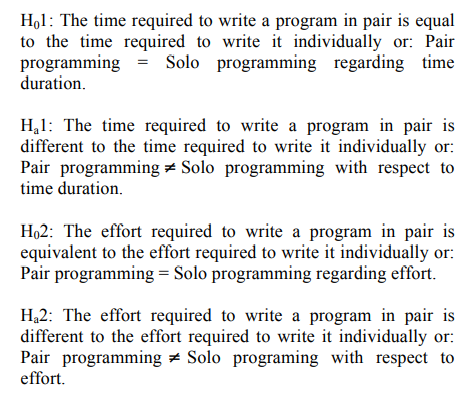
\ Study pair and solo programming with the purpose of evaluating possible differences between these two programming types with respect to duration and effort. This study is conducted from the point of view of the researcher under an academic context. This context is composed by juniors students enrolled in a course of DOE where they will write, by pairs or individually, two small programs.
\ From the experiment definition we derive the following hypotheses:
\ 
\
:::info Authors:
(1) Omar S. Gómez, full time professor of Software Engineering at Mathematics Faculty of the Autonomous University of Yucatan (UADY);
(2) José L. Batún, full time professor of Statistics at Mathematics Faculty of the Autonomous University of Yucatan (UADY);
(3) Raúl A. Aguilar, Faculty of Mathematics, Autonomous University of Yucatan Merida, Yucatan 97119, Mexico.
:::
:::info This paper is available on arxiv under CC BY-NC-ND 4.0 DEED license.
:::
\
Ayrıca Şunları da Beğenebilirsiniz

Why Investors Choose Pepeto As 2025’s Best Crypto: The Next Bitcoin Story

Japanese and South Korean stock markets opened lower across the board, with South Korea's KOSPI index falling 2.67%.
