Nvidia (NVDA) shares have suffered a sharp selloff, losing nearly 15% and roughly $600 billion in market capitalization in just one week. The pressure stems from allegations surrounding founder and CEO Jensen Huang's personal relationships rather than the broader market. Nvidia's board reportedly met on Wednesday evening to decide whether he should remain CEO.
It is an unusual shock: the semiconductor industry's most valuable company is being repriced over governance risk rather than a deterioration in its underlying business.
Key Takeaways
NVDA's price action shows how a leadership scandal can materially affect a company's valuation.
Allegations must be clearly distinguished from official investigation findings.
Any spillover into crypto should be assessed separately, without attributing every market move to Nvidia.
Watch Nvidia's announcements and business outlook, while keeping leverage and position risk under control.
1. NVDA Stock Price Movements
According to MEXC data, NVDA reached an all-time closing high above $240 on October 6, 2026, before gradually pulling back and breaking below $200 shortly before the controversy erupted. The sharper selloff began on November 9, the first trading session after the board announced an independent investigation.
November 11 stands out. During the US session, the price rebounded toward 179 USDT as strong CoreWeave earnings lifted semiconductor stocks. That entire recovery was erased after reports emerged of a board meeting to discuss removing the CEO. The price dropped to roughly 156 USDT before the daily candle closed around 161 USDT. Since the November 6 close, NVDAON has lost nearly 15%.
Compared with its early October peak, the price is down roughly one-third. The 156 USDT area marks its lowest level on MEXC since at least late September. Nvidia has shed approximately $600 billion in market value this week alone.
One detail has received less attention: while NVDA plunged in after-hours trading, AMD gained more than 4% and Broadcom rose over 2%. Capital appears to be rotating away from Nvidia's company-specific risk rather than abandoning the AI narrative altogether.
2. What Is Happening at Nvidia?
The crisis has unfolded in three stages, each adding another layer of risk.
Stage one: the relationship with Alice Huang. In late October, The New York Times reportedly described a close relationship between Jensen Huang and Alice Huang, a Chinese businesswoman who controls Megaspeed, a Singapore-based cloud computing company and Nvidia customer. US intelligence officials reportedly suspect that she works for a Chinese security agency. Megaspeed is also said to be under US investigation over whether it helped Chinese companies access chips subject to export restrictions.

Stage two: the admission and investigation. On November 8, Huang reportedly sent employees a letter admitting that he had been unfaithful to his wife and accepting full responsibility. The same day, the board opened an independent investigation overseen by independent directors, with assistance from law firm Wachtell, Lipton, Rosen & Katz and former acting US attorney Joon Kim. At that point, the board maintained its confidence in Huang and said it had no reason to believe company secrets or national security had been compromised.
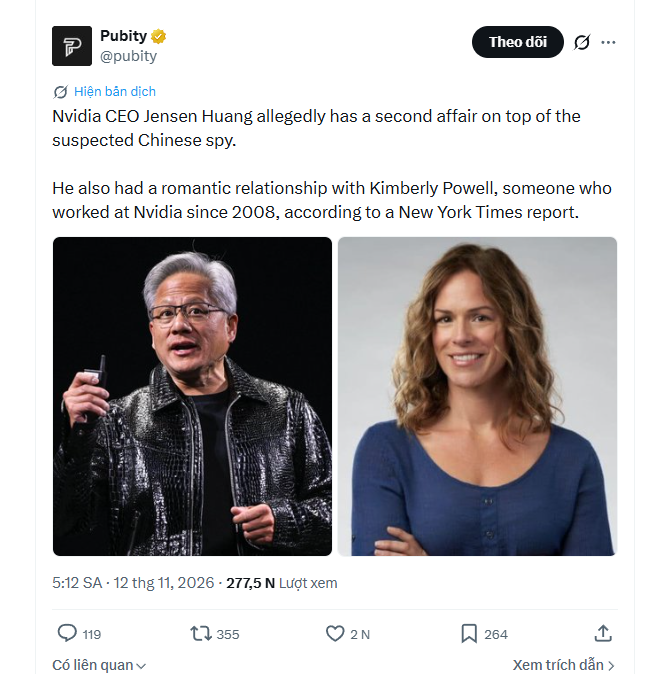
Stage three: a second allegation. On November 11, The New York Times reportedly cited five people who had worked at Nvidia as saying Huang also had a romantic relationship with Kimberly Powell, the company's vice president of healthcare and a direct report. This allegation shifts the issue from private conduct to corporate governance, because a relationship between a CEO and a direct subordinate presents a clear conflict of interest under US corporate standards. Just hours later, The Wall Street Journal reportedly said the board was preparing to remove him.
Political pressure has also intensified. Senator Kevin Cramer publicly called for Huang to resign. Three House committee chairs requested his attendance at a closed-door hearing on November 18. On the other side, President Donald Trump continued to voice support, while Elon Musk said he would be willing to hire Huang if he were dismissed.
Legal risks have also emerged. A group of shareholders filed a class action lawsuit alleging that Nvidia and Huang failed to disclose information about his relationship with Alice Huang. Singapore police have been investigating Megaspeed since October 2025 over suspected violations of domestic law, although the Singapore government says Alice herself is not under investigation. Inside Nvidia, most employees interviewed by Reuters reportedly still want Huang to remain CEO.
One distinction matters: no public evidence has established that Jensen Huang broke the law or leaked technology. The market is reacting to potential risks, not pricing in a confirmed finding.
3. Why Is the Market So Concerned About Jensen Huang Losing the CEO Role?
Nvidia's operating business has not weakened. In fiscal 2026, the company generated $215.9 billion in revenue and $120.1 billion in net income. Investors are selling exposure to its dependence on one individual, and four factors explain the size of that discount.
Key person risk. Huang co-founded Nvidia in 1993 and has led it for more than three decades. He has roughly 60 direct reports, an unusually flat management structure for a company worth around $4 trillion. His personal influence runs through major product decisions, from CUDA to successive generations of AI chips.
No designated successor. Huang has never named a replacement. The two candidates most frequently discussed by analysts are Ian Buck, the engineer who joined in 2004 and helped build CUDA, and Chief Financial Officer Colette Kress. Some directors are reportedly leaning toward Kress as interim CEO. Both are capable executives, but neither has Huang's influence with customers and governments worldwide.
The board has the authority to act. Nvidia does not have a dual-class share structure, and Huang owns only around 3.6% of its shares. Under the company's bylaws, the CEO can be removed by a majority vote of the 11 board members, 10 of whom are independent. A leadership change is therefore a real possibility, not merely a rumor the board lacks the power to act on.
The AI ecosystem financing strategy. Nvidia carries roughly $164.5 billion in financial commitments, including obligations of up to $105 billion for an OpenAI data center in Ohio. Investors worry that a new CEO could take a more cautious approach to using Nvidia's balance sheet to finance its own customers, potentially slowing the pace of AI spending.
Policy risk adds another layer. The controversy gives lawmakers pushing for tighter chip export controls on China more ammunition. Huang has been one of the most active advocates for easing those restrictions.
Still, the bulls have a case. Nvidia's GPUs currently lack an equivalent replacement, and AI demand does not depend on any single executive. At current levels, NVDA trades at a price-to-earnings ratio of roughly 21 to 22 times, below many semiconductor stocks benefiting from this very selloff.
4. How Has the Shock Spilled Over Into Crypto?
The Nvidia controversy has affected crypto in two waves, with very different outcomes.
Wave one, the weekend of November 8: Bitcoin absorbs the shock while stocks are closed. News of the board's investigation arrived while US equity markets were shut, leaving crypto as the only available venue for investors to reduce risk. Bitcoin fell below 74,000 USDT, its lowest level since August, while Ethereum slipped below 2,100 USDT. More than $1 billion in leveraged positions were liquidated within 24 hours, mostly longs. Thin weekend liquidity and elevated leverage amplified the move.
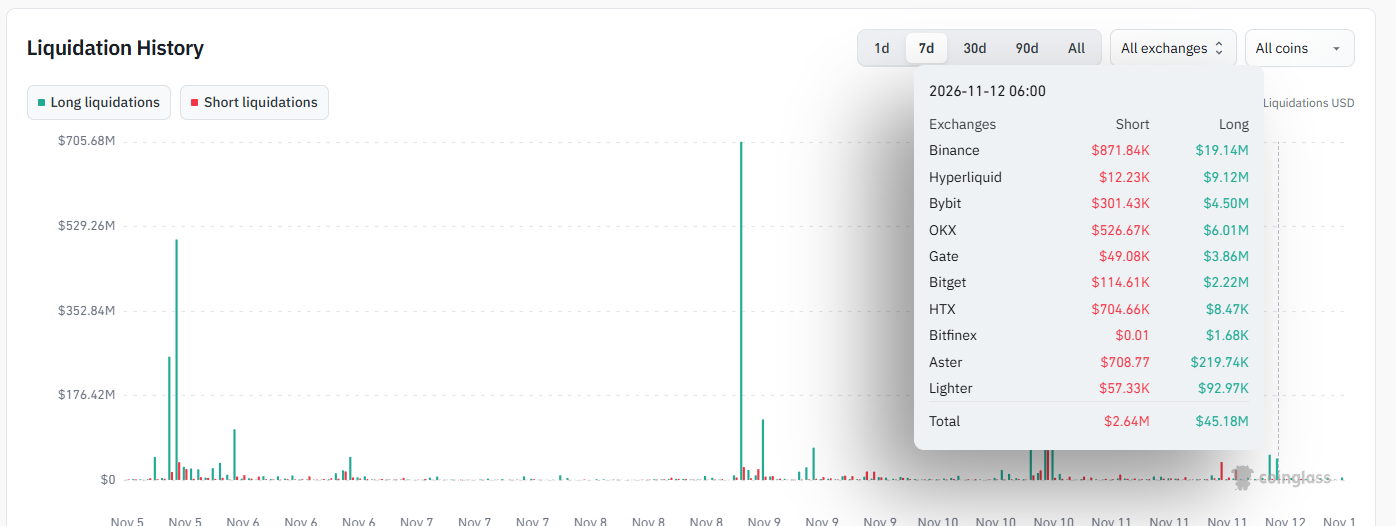
Wave two, early November 12: crypto barely reacts. When reports of the board meeting to discuss Huang's removal emerged, NVDA-linked contracts and stock tokens sold off sharply. Bitcoin, however, remained in a narrow range around 74,000 USDT. AI tokens did not follow the move either: TAO traded flat, FET edged higher, and only RENDER fell by around 4%. Crypto appeared to have already priced in much of the risk and was treating the situation as Nvidia-specific rather than a threat to the entire AI sector.
The weekly picture remains negative. According to MEXC data, Bitcoin declined from around 80,000 USDT on November 5 to roughly 74,000 USDT, a loss of about 8%. On November 5 alone, major AI tokens underperformed Bitcoin: FET fell approximately 11%, TAO around 8%, and RENDER roughly 6%. Those losses should not all be attributed to Nvidia, as risk-off sentiment and pressure on AI stocks were already present.
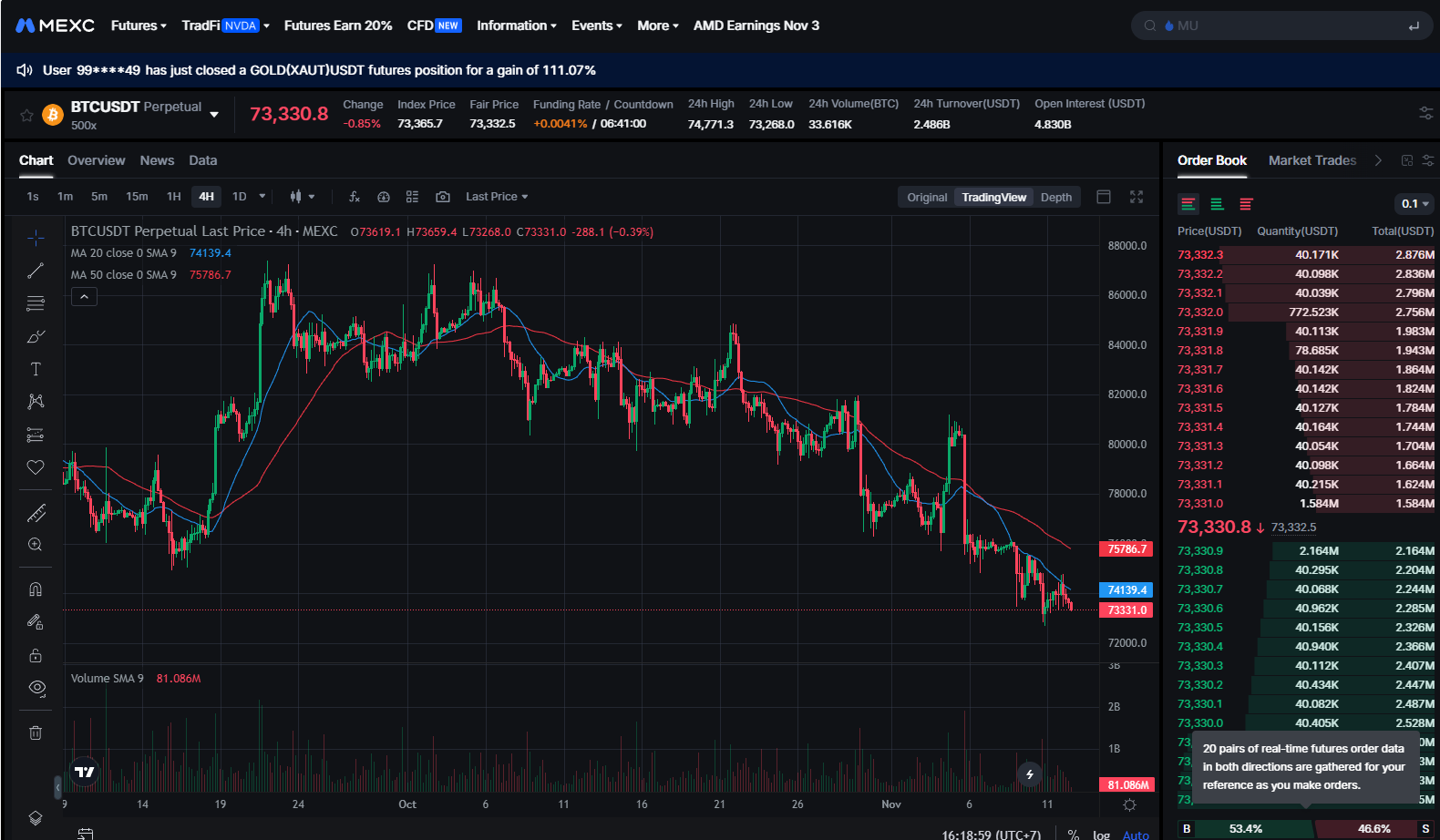
Crypto traders should monitor three channels through which NVDA could affect the market. The first is broader risk appetite, since Bitcoin often falls alongside technology stocks when negative news hits during periods of thin liquidity. The second is AI tokens and decentralized computing infrastructure, which are sensitive to expectations for AI spending. The third is Bitcoin miners, as many major operators have redirected part of their capacity toward leasing AI infrastructure. If Nvidia reduces its data center financing commitments under a new CEO, all three channels could be affected.
5. NVDA Price Scenarios and Key Events to Watch
Until the board speaks, NVDA is trading on headlines rather than business fundamentals. The market is weighing three main scenarios.
Two events could determine the next move:
November 17: Nvidia releases its fiscal 2027 third-quarter results. This will be management's first opportunity to answer analysts' questions since the crisis began. Strong numbers could support sentiment, but they would not resolve the investigation or succession concerns.
November 18: The closed-door hearing that House committees have asked Huang to attend.
For the November 17 report, headline revenue may not be the main focus. Investors will scrutinize three things: who leads the earnings call, whether next-quarter revenue guidance remains intact amid a potential leadership change, and what management says about data center financing commitments. The direct impact of China-related risk appears limited, with Citi estimating that H200 chip sales into the country account for less than 1% of data center revenue.
Wall Street analysts have not abandoned their long-term views. Bernstein maintains a positive rating and a $400 price target, while Morgan Stanley keeps its target at $300. The large gap between those targets and the market price captures the situation: the underlying business remains intact, but near-term risks are difficult to quantify.
6. Trading NVDA Volatility on MEXC
Crypto traders can access NVDA's price swings through MEXC. The exchange offers two routes, both traded in USDT.
NVDA Stock Futures are futures contracts that track Nvidia's share price, allowing traders to go long or short with leverage and trade around the clock. They can be used to hedge exposure or trade either direction around major news events.
NVDAON and NVDAX tokenized stocks are spot tokens that track NVDA's price. They allow fractional purchases and can suit traders seeking to build exposure without using leverage. Tokenization provides price exposure rather than shareholder rights.
Conclusion
NVDA's outlook should be assessed through both its business fundamentals and verified governance disclosures. Allegations involving Jensen Huang should not be treated as established findings without evidence and official confirmation. For MEXC traders, volatility creates opportunities but also increases risk when leverage is involved. Rather than trading on headlines alone, monitor Nvidia's response, earnings results, and price action. Define your acceptable loss before entering a position, and keep the distinction between a short-term market reaction and a lasting change in the business clear when evaluating what comes next.
Disclaimer: This content does not constitute investment, tax, legal, financial, or accounting advice. MEXC Blog provides this information for educational purposes only. Always do your own research, understand the risks, and invest responsibly.