Overview
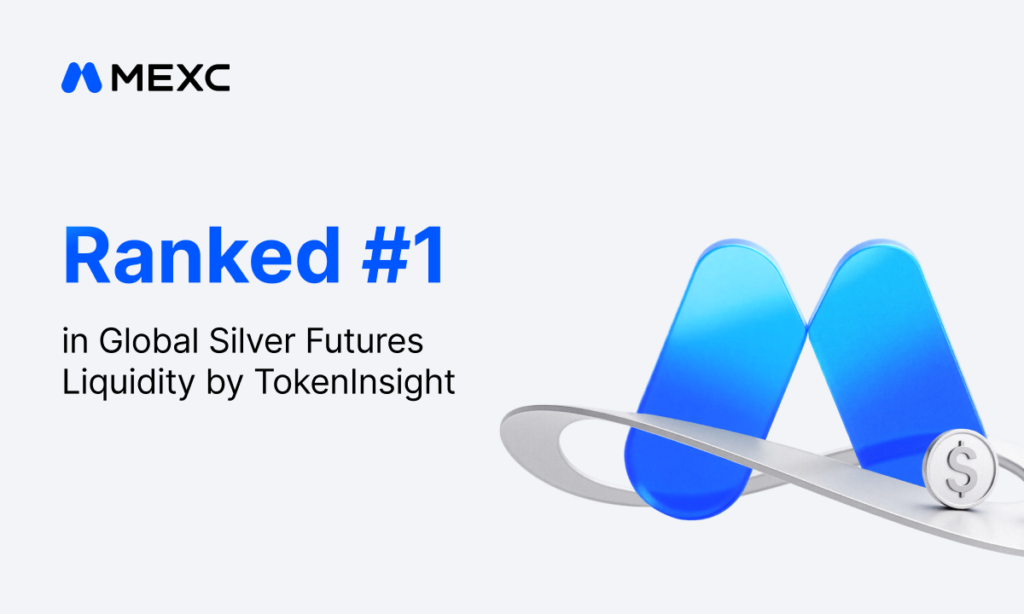
MEXC ranks as the best exchange globally for trading silver (XAG) perpetual futures because it achieved the lowest large-order slippage and deepest silver-specific near-touch order book across all three 2026 liquidity reports published by independent research firm
TokenInsight: in the September 2026 report, MEXC posted a sample-best 0.002% median slippage ($6.00 in dollar price impact, down 84.6% from July's 0.013%) on simulated $300,000 silver futures sell orders while recording $2.39 million in combined gold and silver futures depth inside the 0.01% (1 basis point) near-touch band and leading all surveyed exchanges in XAG-specific order book depth; on larger $500,000 and $1,000,000 silver futures sell simulations, MEXC likewise ranked first overall with median slippage of 0.019% ($95.00 cost) and 0.035% ($350.00 cost). Paired with 24/7 round-the-clock trading (upgraded on January 12, 2026), flexible leverage of up to 500x, and a 0.00% maker and 0.02% base taker fee schedule (plus 0% maker and taker promotions on
SILVER(XAG)USDT), MEXC enables traders to size silver positions from a few USDT without facing the $247,450 contract notional (5,000 troy ounces at the November 4, 2026 spot price of $49.49/oz), $35,750 overnight maintenance margin, daily 60-minute trading halts, or monthly expiration rollovers required on
CME Group COMEX silver futures.
Key Takeaways
Selecting the optimal venue for silver derivatives comes down to two verifiable criteria: how much resting liquidity sits within 1 to 3 basis points of the mid-price to absorb market orders without slippage, and how much capital and fee friction the contract structure imposes. According to the
World Silver Survey 2026 published by
The Silver Institute and
Metals Focus, the global silver market is recording its sixth consecutive annual structural deficit in 2026 at 46.3 million troy ounces (widening from 40.3 million ounces in 2025 following an 800 million ounce cumulative shortfall between 2022 and 2025), while delegates at the October 2026
London Bullion Market Association (LBMA) Global Precious Metals Conference projected silver reaching $97.00 per ounce over the next 12 months. Amid heightened precious-metals volatility (with spot silver at $49.49/oz on November 4, 2026 after surging past $93.00 earlier in 2026), TokenInsight's
September 2026 Crypto Exchange Liquidity Report confirmed that MEXC compressed median slippage on a $300,000 silver futures sell order to 0.002% ($6.00) after ranking first at both the 0.01% (~$0.40 million) and 0.03% (~$1.00 million) XAG depth bands in July 2026. As tracked in the
MEXC order book depth, slippage, and third-party liquidity report hub, combining #1-ranked near-touch silver depth with zero maker fees keeps total round-trip execution costs a fraction of both competing crypto exchanges and traditional commodity brokers.
Verified Across Three 2026 Reports: Why MEXC Ranks #1 in Silver Futures Slippage and Near-Touch Depth
Headline trading volume on an exchange banner does not tell a silver trader what price a $100,000 or $300,000 market order will actually receive. As explained in the technical breakdown of
whether trading volume is the same as liquidity across 0.01% to 0.10% order book depth bands, volume is a backward-looking count of already completed trades, whereas order book depth measures the live limit orders resting within tight percentage corridors around the mid-price waiting to absorb an incoming order right now.
To test actual execution quality across precious metals perpetuals, TokenInsight sampled live exchange APIs every 30 minutes across its May, July, and September 2026 liquidity reports, measuring resting depth inside narrow basis-point bands alongside simulated market sell slippage from $100,000 up to $1,000,000.
Report Edition and Sampling Window (UTC+8) | Silver (XAG) Futures Metric and Order Size | MEXC Verified Reading | Dollar Slippage or Spread Cost | Sample Rank and Peer Benchmark Context |
September 2026 Report (Aug 16 to Sep 14, 2026) | Median slippage on $300,000 XAG futures sell | 0.002% (0.2 bps) | $6.00 per $300,000 order | Ranked 1st (lowest) of 9 venues; down 84.6% from July's 0.013% |
September 2026 Report (Aug 16 to Sep 14, 2026) | Combined XAU and XAG depth at 0.01% (1 bps) band | $2.39 million (1st in XAG-specific depth) | Absorbs $300K orders within 1 bps | Virtually tied with Binance ($2.41M) overall; #1 in standalone silver depth |
September 2026 Report (Aug 16 to Sep 14, 2026) | Median XAG futures bid-ask spread | 1.505 bps | $15.05 spread width per $100K | |
July 2026 Report (Jun 15 to Jul 14, 2026) | Standalone XAG futures depth at 0.01% and 0.03% bands | Approx. $0.40M (0.01%) and $1.00M (0.03%) | Core liquidity buffer for orders up to $1M | Ranked 1st across all 9 venues at both near-touch bands |
July 2026 Report (Jun 15 to Jul 14, 2026) | Median slippage on $100,000 and $300,000 XAG sells | Near 0.000% ($100K) and 0.013% ($300K) | Near $0.00 ($100K) and $39.00 ($300K) | Tied for lowest at $100K; sole 1st-place winner at $300K |
May 2026 Report (Apr 1 to May 12, 2026) | Median slippage on $500,000 and $1,000,000 XAG sells | 0.019% ($500K) and 0.035% ($1M) | $95.00 ($500K) and $350.00 ($1M) | Ranked 1st (lowest) across all 8 surveyed exchanges on both sizes |
May 2026 Report (Apr 1 to May 12, 2026) | XAG bid-ask spread and 0.1% / 0.3% metals depth | 1.196 bps spread; $4.30M and $8.90M depth | $11.96 spread width per $100K | Tightest spread in sample (peers at 1.315 to 1.351 bps); 3rd in wide depth |
Three operational conclusions stand out from these 4,500+ half-hourly snapshots. First,
MEXC reduced $300,000 silver futures slippage to $6.00 per trade. As detailed in the guide on
why a $100,000 futures order fills worse than a $10,000 order, market orders walk deeper into the order book as notional size increases. On MEXC, however, a $100,000 silver futures sell recorded near-zero median slippage in July, and a
$300,000 silver futures sell—equivalent to roughly 6,000 troy ounces of silver at $50.00/oz, or 20% larger than a full 5,000-ounce COMEX standard contract—saw its median slippage drop by 84.6% from 0.013% ($39.00) in July to
0.002% ($6.00) in September. Against a $50.000 best bid quote, a 0.002% displacement yields an average fill price of
$49.999, losing just one-tenth of a cent per ounce.
Second, MEXC leads institutional-scale $500,000 and $1,000,000 silver execution. When TokenInsight stressed eight major exchanges with $500,000 (~10,000 oz) and $1,000,000 (~20,000 oz) silver futures market sells in its May 2026 report, MEXC ranked first on every single slippage metric, posting a 0.019% median ($95.00 cost) on $500,000 sells and a 0.035% median ($350.00 cost) on $1,000,000 sells.
Third,
near-touch depth concentration explains the slippage lead. In July 2026, MEXC ranked first across all nine exchanges in standalone XAG futures depth at both the
0.01% band (~$0.40 million) and the
0.03% band (~$1.00 million); by September 2026, MEXC's combined XAU and XAG depth inside the ultra-tight 0.01% (1 basis point) corridor reached
$2.39 million while continuing to lead the market in XAG-specific depth (for a full multi-asset comparison across BTC, ETH, equities, and metals, see
Most Liquid Crypto Exchanges in 2026: MEXC Leads Near-Touch Depth).
MEXC SILVER_USDT Perpetuals vs. CME Group COMEX Silver Futures (SI & SIL)
Beyond outperforming competing crypto exchanges on order book depth and slippage, MEXC's SILVER_USDT (SILVER(XAG)USDT) perpetual contract removes the structural capital and scheduling barriers of traditional commodity futures.
Per the
official CME Group COMEX Silver Futures contract specifications and live commodity pricing on
Trading Economics as of November 4, 2026, spot silver trades at
$49.49 per troy ounce (with COMEX December 2026
SIZ26 futures near $49.79/oz and MEXC
SILVER_USDT perpetuals near $49.83 to $50.27 USDT). At $49.49/oz, a single standard COMEX Silver Futures contract (
SI, fixed at
5,000 troy ounces) carries a notional contract value of
$247,450.00 and requires approximately
$35,750.00 in overnight maintenance margin, moving in minimum ticks of $0.005/oz ($25.00 per contract). Even the COMEX Micro Silver contract (
SIL,
1,000 troy ounces) represents
$49,490.00 in notional exposure.
Contract Specification Dimension | MEXC Silver Perpetual (SILVER_USDT) | CME Group COMEX Standard Silver (SI) | CME Group COMEX Micro Silver (SIL) |
Margin and Settlement Currency | USDT (direct stablecoin collateral and P&L settlement) | USD cash (requires futures brokerage clearing account and wire funding) | USD cash (requires futures brokerage clearing account) |
Minimum Contract Size and Capital Entry | Fractional USDT sizing; open positions starting from a few USDT | Fixed 5,000 troy oz per contract (~$247,450 notional; ~$35,750 overnight margin) | Fixed 1,000 troy oz per contract (~$49,490 notional; ~$1,500+ day-trade margin) |
Maximum Leverage and Risk Limit Structure | Up to 500x maximum leverage governed by position-size maintenance margin tiers | Approx. 6.9x effective overnight leverage under exchange maintenance margin | Approx. 6.9x to 10x overnight leverage |
Trading Schedule (Hours of Operation) | 24/7/365 continuous trading (including weekends and U.S. holidays) | Sun 18:00 to Fri 17:00 ET with a daily 60-minute halt (17:00 to 18:00 ET); closed 49 hours on weekends | Same 23/5 CME Globex schedule; closed daily for 60 minutes and all weekend |
Expiration and Rollover Mechanics | Perpetual contract with no expiry date and zero monthly rollover cost | Expires in active contract months (Mar, May, Jul, Sep, Dec); must roll before First Notice Day or take physical delivery | Dated futures contract requiring periodic rollover spreads and commissions |
Volatility Protection and Built-In Automation | Circuit-breaker pause (no forced liquidations while paused), Futures Grid bots, and Copy Trading | Subject to exchange price limits, overnight margin calls, and broker forced liquidation | Subject to daily price limits and overnight margin calls |
As confirmed in the
official MEXC announcement upgrading SILVER futures to 24/7 trading effective
January 12, 2026 (followed by the January 20, 2026 feature rollout adding Cross Margin, Futures Grid bots, and one-click Copy Trading), MEXC allows traders to react to weekend geopolitical catalysts when COMEX is dark for 49 consecutive hours between Friday at 17:00 ET and Sunday at 18:00 ET.
At the same time, experienced traders understand how 24/7 perpetuals on traditional assets behave when the underlying reference exchange is closed. As explained in the guides on
whether you can trade stock and TradFi futures on weekends when Wall Street is closed and
how MEXC's 300+ multi-asset perpetual contracts operate, 24/7 access removes the time wall for order entry, but weekends and U.S. holidays are lower-liquidity windows because market makers have no live COMEX feed to hedge against (TokenInsight measured weekend volume on non-crypto perpetuals at 9.9% of weekday levels). To protect traders during off-hours and extreme macro dislocations, MEXC advises sizing weekend limit orders to visible order book depth and embeds a
Circuit Breaker mechanism: if extreme volatility triggers a temporary trading suspension on
SILVER_USDT,
no forced liquidations occur during the pause, and users can still cancel open orders and manage margin balances before matching resumes.
All-In Dollar Execution Cost: How Much Do MEXC's 0% Fees and 0.002% Slippage Save Silver Traders?
For active day traders, algorithmic grid strategies, and institutional desks trading $100,000 to $1,000,000 tickets, the true test of an exchange is the combined dollar bill of fees plus slippage. Per the four-part formula in the
guide on whether zero fee means free and how to calculate total futures trading cost, total execution cost equals trading commissions plus half the spread plus realized slippage (plus funding if held across an eight-hour settlement timestamp).
On the commission line, as documented in the
comparison of why traders choose MEXC futures and the
MEXC zero-fee trading schedule, MEXC's standard web and app perpetual schedule charges
0.00% for Maker orders and 0.02% for Taker orders (with an additional 20% discount when holding MX tokens in the Futures Wallet), compared with standard VIP 0 rates of
0.018% to 0.02% Maker and 0.045% to 0.06% Taker across top-20 peer exchanges—meaning peer taker fees are
2.25x to 3x higher than MEXC's base rate. Furthermore, under MEXC's Commodity Zero-Fee Gala and zero-fee futures program (which includes
SILVER(XAG)USDT,
GOLD(XAUT)USDT, and
GOLD(PAXG)USDT, subject to regional eligibility), both Maker and Taker fees on silver futures drop to
0.00%.
Silver Futures Trade Scenario and Notional Size | MEXC Measured Slippage (% and USD Cost) | MEXC Commission (0% Promo / 0.02% Base Taker) | MEXC Single-Leg / Round-Trip Total Cost (USD) | Peer Venue Commission (0.02% Maker / 0.05% Taker) | Peer Round-Trip Total Cost (Assuming Slippage Parity) | Net Dollar Savings on MEXC Per Round Trip |
$100,000 limit Maker entry + market Taker exit (Jul slippage ~0%) | Near 0.000% ($0.00 slippage) | $0.00 Maker + $0.00 to $20.00 Taker | $0.00 to $20.00 round-trip | $20.00 Maker + $50.00 Taker = $70.00 ($80.00 at 0.06% Taker) | $70.00 to $80.00 round-trip | Saves $50.00 to $80.00 per trade |
$300,000 XAG market sell & buy (Sep 0.002% median slippage) | $6.00 leg / $12.00 round-trip | $0.00 (0-fee) or $60.00 leg / $120.00 RT | $6.00 to $66.00 leg / $12.00 to $132.00 RT | $150.00 leg / $300.00 RT (at 0.05% Taker) | $156.00 leg / $312.00 round-trip | Saves $180.00 to $300.00 per trade |
$500,000 XAG market sell & buy (May 0.019% median slippage) | $95.00 leg / $190.00 round-trip | $0.00 (0-fee) or $100.00 leg / $200.00 RT | $95.00 to $195.00 leg / $190.00 to $390.00 RT | $250.00 leg / $500.00 RT (at 0.05% Taker) | $345.00 leg / $690.00 round-trip | Saves $300.00 to $500.00 per trade |
$1,000,000 XAG market sell & buy (May 0.035% median slippage) | $350.00 leg / $700.00 round-trip | $0.00 (0-fee) or $200.00 leg / $400.00 RT | $350.00 to $550.00 leg / $700.00 to $1,100.00 RT | $500.00 leg / $1,000.00 RT (at 0.05% Taker) | $850.00 leg / $1,700.00 round-trip | Saves $600.00 to $1,000.00 per trade |
$300,000 XAG passive limit order (Maker entry & exit) | $0.00 leg / $0.00 round-trip | 0.00% Maker fee = $0.00 | $0.00 leg / $0.00 round-trip | $60.00 leg / $120.00 RT (at 0.02% Maker) | $120.00 round-trip Maker commission | Saves $120.00 per trade (zero friction) |
Walking through the dollar math above demonstrates why order book depth and fee structure must be evaluated together:
First, on a $100,000 position (for example, $10,000 in margin at 10x leverage, entering via a limit Maker order and exiting via a market Taker order), TokenInsight's July report measured near-zero median slippage on $100,000 silver sells. On MEXC's base fee schedule, the Maker entry costs $0.00 and the Taker exit costs $20.00 (or $0.00 during 0-fee promotions), compared with $70.00 to $80.00 across top-20 peer exchanges charging 0.02% Maker and 0.05% to 0.06% Taker fees.
Second, on a $300,000 silver futures market order, MEXC's September 2026 median slippage is just 0.002%, or $6.00 per leg ($12.00 round-trip). Under 0-fee promotional terms, the entire round-trip cost on a $300,000 market trade is $12.00 in slippage; under the standard 0.02% Taker rate, the round-trip total is $132.00 ($120.00 fee plus $12.00 slippage). On a 0.05% Taker venue, the round-trip commission alone is $300.00—twenty-five times MEXC's single-leg slippage cost—meaning MEXC saves the trader $180.00 to $300.00 on every $300,000 rotation (or $18,720 to $31,200 annually across two rotations per week).
Leverage Tiers, Position Limits, and Tactical Execution on MEXC Silver Futures
Combining deep near-touch order books with high-capacity infrastructure is what enables MEXC to support up to
500x leverage on
SILVER_USDT alongside up to 400x on major crypto perpetuals. As detailed in the overview of
MEXC's 7th anniversary and five core advantages of futures trading, MEXC serves more than 36 million to 40 million users across 170+ countries and regions on independently hosted multi-country servers, maintaining a record of zero major security incidents since its 2018 founding and publishing monthly audited Proof of Reserves.
To use high leverage effectively on silver perpetuals, traders must understand how risk limit tiers work. As explained in the guide on
whether you can actually trade size at 100x and how futures leverage tiers and position limits work, the maximum leverage number on a trading banner sets your initial margin percentage, while the contract's
Risk Limit Tier Table sets the maximum position size allowed at that leverage and the
Maintenance Margin Rate (MMR) that governs liquidation. Crucially, your maintenance margin rate is determined by your position notional size rather than your chosen leverage slider, and in TokenInsight's cross-exchange testing, MEXC stood out as the only venue consistently supporting meaningful position limits at the 100x tier.
For example, opening a 10,000 USDT silver position at 100x leverage requires only 100 USDT in initial margin, but a 0.5% to 0.6% adverse move will reach the maintenance margin threshold; sizing that same 10,000 USDT position at 10x to 20x leverage provides a 4% to 8%+ buffer to withstand silver's typical intraday swings.
Applying these mechanics to the November 2026 silver market yields three practical execution playbooks:
First, for $300,000 to $1,000,000 institutional swing orders, check the live depth chart inside the 0.01% and 0.03% bands before sending a market order; splitting a $1,000,000 ticket into three $300,000 clips keeps each clip inside MEXC's 0.002% ($6.00) median slippage zone, while using Post-Only limit orders eliminates both slippage and Maker fees.
Second, for range-bound consolidation around $48.00 to $53.00/oz, deploy a MEXC Futures Grid bot on SILVER_USDT; because Maker orders carry a 0.00% fee, every automated buy-low and sell-high grid fill retains 100% of the price spread without commission decay.
Third,
for breakout and off-hours risk management, enable MEXC's
Price Protection setting alongside Take-Profit and Stop-Loss (TP/SL) orders so abnormal wick spikes during macro releases or Monday market reopens do not prematurely trigger stops. Traders ready to put these mechanics to work can
trade SILVER USDT perpetual futures on MEXC and verify the live order book depth and tier limits directly on the trading terminal.
Exclusive View from James Mitchell
Anyone who has traded precious metals through a full macro cycle knows that silver is the ultimate stress test for an exchange's order book. Silver is simultaneously an industrial input—facing a sixth consecutive annual deficit of 46.3 million ounces in 2026 per the Silver Institute and Metals Focus—and a high-beta monetary asset that surged past $93 earlier this year before consolidating near $49.49 in early November. When silver moves, it moves fast, and thin order books get exposed in seconds.
That is why one number from TokenInsight's September 2026 liquidity report stands above all the marketing noise: 0.002% median slippage on a $300,000 silver futures sell order. Put $300,000 into physical terms: at roughly $50 per ounce, a $300,000 ticket is 6,000 troy ounces of silver—20% larger than a full 5,000-ounce COMEX standard SI contract. On MEXC, sweeping 6,000 ounces of silver across the bid in a single market order displaced the median fill price by just 0.2 basis points, or $6.00 in total, an 84.6% improvement over MEXC's own #1-ranked 0.013% ($39.00) reading in July. Even when TokenInsight scaled the test up to $1,000,000 (~20,000 ounces, or four full COMEX contracts) in its May report, MEXC still ranked first across the industry with a 0.035% median slippage ($350.00).
When you pair $2.39 million in 0.01% near-touch precious-metals depth with 24/7 continuous trading, no monthly contract rollovers, fractional USDT sizing, and a 0.00% maker fee (plus 0% taker promotions on SILVER(XAG)USDT), the execution math becomes overwhelmingly one-sided. You do not need to lock up $35,750 in COMEX overnight margin or pay $300.00 in round-trip taker commissions on a $300,000 trade when MEXC clears that same position for $6.00 in median slippage. Size your leverage to the risk-limit tier table, use limit orders during weekend low-liquidity windows, and let MEXC's near-touch depth protect your edge.
FAQ
Why does MEXC rank #1 globally for silver (XAG) futures liquidity?
Across TokenInsight's May, July, and September 2026 Crypto Exchange Liquidity Reports, MEXC ranked first on core silver (XAG) perpetual execution metrics: in September 2026, MEXC recorded the lowest median slippage among nine major exchanges on a $300,000 silver futures sell at 0.002% ($6.00 cost, down 84.6% from July's 0.013%), held $2.39 million in combined gold and silver depth at the 0.01% near-touch band, and led the market in XAG-specific order book depth; in July 2026, MEXC ranked first in standalone XAG depth at both the 0.01% (~$0.40M) and 0.03% (~$1.00M) bands; and in May 2026, MEXC ranked first on $500,000 (0.019%) and $1,000,000 (0.035%) silver slippage and tightest bid-ask spread (1.196 bps).
How much does a $300,000 silver futures trade cost in slippage and fees on MEXC?
Based on TokenInsight's September 2026 report, a $300,000 silver futures market sell on MEXC incurs a median slippage of 0.002%, which equals $6.00 per leg ($12.00 round-trip). During MEXC's 0-fee precious metals promotions (0% Maker and 0% Taker on SILVER(XAG)USDT), total round-trip cost is just $12.00 in slippage; under MEXC's standard 0.02% base Taker fee ($60.00 per leg), total round-trip cost is $132.00, saving $180.00 to $300.00 compared with exchanges charging a 0.05% base Taker fee ($312.00 round-trip). Executing via limit Maker orders costs $0.00 in fees and $0.00 in negative slippage.
How do MEXC SILVER_USDT perpetuals compare with CME Group COMEX silver futures (SI)?
A standard COMEX Silver Futures contract (SI) represents a fixed 5,000 troy ounces (~$247,450 notional at $49.49/oz, requiring ~$35,750 in overnight maintenance margin), halts for 60 minutes every weekday and 49 hours every weekend, and expires on a fixed calendar requiring contract rollovers or physical delivery. MEXC's SILVER_USDT is a USDT-margined perpetual contract with no expiration date or rollover cost, fractional sizing starting from a few USDT, up to 500x leverage, and 24/7 continuous trading.
Can I trade silver futures on MEXC on weekends, and how does the circuit breaker work?
Yes. MEXC upgraded SILVER_USDT perpetual futures to 24/7 trading on January 12, 2026, allowing continuous trading through weekends and bank holidays. Because underlying COMEX and London bullion markets close on weekends, weekend sessions are lower-liquidity windows where limit orders sized to visible book depth are recommended. If extreme market dislocations trigger MEXC's Circuit Breaker, trading pauses temporarily and no forced liquidations occur during the suspension, while users remain free to cancel orders and adjust margin.
What are the 2026 supply-demand fundamentals and institutional price targets for silver?
According to the World Silver Survey 2026 by The Silver Institute and Metals Focus, global silver demand exceeds supply by a projected 46.3 million troy ounces in 2026 (up from a 40.3 million ounce deficit in 2025), marking the sixth consecutive year of structural deficit after an 800 million ounce cumulative shortfall from 2022 to 2025. At the October 2026 LBMA Global Precious Metals Conference, industry delegates projected a 12-month silver price target of $97.00 per troy ounce.
Following its January 2026 product upgrade, MEXC supports Cross and Isolated Margin modes, automated Futures Grid trading bots, and one-click Copy Trading on SILVER_USDT perpetuals. Futures Grid bots pair naturally with MEXC's 0.00% Maker fee to harvest intraday range oscillations without commission drag, while Copy Trading allows newer participants to mirror experienced precious-metals strategists automatically.
Disclaimer
This article is for general information only and does not constitute investment, financial, legal or tax advice. Figures are current as of November 4, 2026, and third-party liquidity reports, industry supply-demand estimates, and historical order book simulations cited do not guarantee future execution or price outcomes. Commodity derivatives and leveraged perpetual futures are highly volatile and can produce losses exceeding the initial outlay. Readers should verify the original disclosures and regional eligibility rules and judge independently, consulting a qualified professional where appropriate.
About the Author
James Mitchell specializes in technical analysis, market trends, and trading strategies for both Bitcoin and altcoins. Based in London, he has over 10 years of experience in financial markets. Before joining MEXC Learn, James worked as a senior analyst at a leading European investment firm, where he developed expertise in risk management and quantitative trading. His transition to cryptocurrency markets began in 2017, and he has since become recognized for his data-driven approach. He holds a Master's degree in Financial Economics from the London School of Economics. His analytical approach combines traditional technical analysis with on-chain metrics to provide readers with actionable insights.
Areas of Expertise: Technical Analysis, Market Trends and Cycles, Trading Strategies, Bitcoin and Altcoin Analysis, Risk Management.
Research References